
Revolutionizing Construction: The Potential of Injection 3D Concrete Printing for Complex Structures
The field of additive manufacturing continues to push the boundaries of what’s possible in various industries, and construction is no exception. While conventional concrete 3D printing often relies on extrusion techniques, a new paradigm is emerging from the Technical University of Braunschweig in Germany. Researchers there are pioneering an innovative injection 3D concrete printing process that promises to unlock unprecedented capabilities for designing and fabricating highly complex concrete structures. This novel approach moves beyond the limitations of layer-by-layer deposition, offering a pathway to intricate geometries previously deemed impossible.
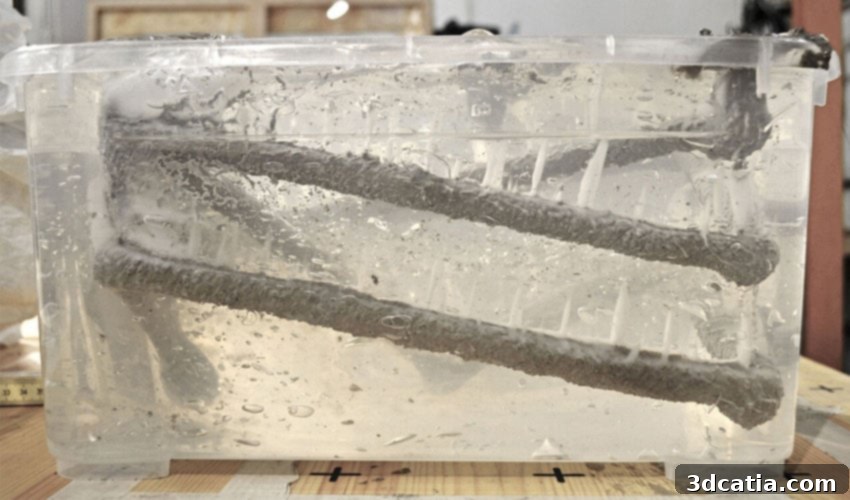
At the heart of this groundbreaking research lies the method of injecting fine-grained concrete into a non-hardening carrier liquid. More precisely, this liquid is a suspension of crushed limestone, carefully chosen for its properties. This carrier liquid serves a crucial role: it acts as a supportive matrix, delicately holding the injected concrete in place until it cures. This ingenious system allows for the creation of structures with elaborate details, internal channels, and delicate features that would simply collapse or require extensive support structures with traditional extrusion methods. It represents a significant leap forward in the quest for greater design freedom in concrete construction.
When most people think of concrete 3D printing, the image that typically comes to mind is that of a robotic arm methodically depositing successive layers of concrete, akin to a large-scale FDM (Fused Deposition Modeling) printer. This extrusion-based method has become the most widespread process to date, enabling the rapid construction of walls, small buildings, and various architectural elements. Companies worldwide have adopted this technique for its speed, efficiency, and ability to reduce labor costs on site. However, its inherent nature of building layer by layer imposes certain geometric constraints, making complex overhangs, intricate internal lattices, and highly organic shapes challenging or even impossible without extensive post-processing or temporary support structures.
Recognizing these limitations, a growing number of innovators and researchers are exploring alternative approaches, including injection 3D concrete printing. This method involves depositing a fluid material (in this case, concrete) into a second material that possesses specific, supportive properties. The genius of this technique lies in the way the primary material is maintained in a stable state within the secondary, allowing for the construction of far more elaborate and complex structures. A notable example of this alternative philosophy comes from the French start-up Soliquid, which has developed its own process for printing concrete parts within a gel matrix. Interestingly, Amaury Thomas, one of Soliquid’s co-founders, is also a co-author of the seminal study from the Technical University of Braunschweig, highlighting a collaborative spirit in advancing this exciting technology.

Injection concrete 3D printing would allow for more complex designs (photo credit: TU Braunschweig)
In their comprehensive work, the researchers from TU Braunschweig delve into the theoretical framework of Injection 3D Concrete Printing (I3DCP), categorizing it into three distinct approaches. The first involves injecting a fine-grained concrete into a non-hardening carrier liquid – precisely the method they are pursuing. The second category describes the injection of a non-hardening suspension into a fine-grained concrete, effectively building within a solidifying matrix. The third, and perhaps most advanced, scenario details the injection of a fine-grained concrete with specific properties into another concrete possessing different characteristics, opening doors for multi-material concrete structures. The team’s decision to focus on the first category, injecting concrete into a liquid medium like ground limestone suspension, underscores their commitment to exploring the immediate and most impactful applications for intricate architectural and engineering designs.
To gain a profound understanding of the complex physical mechanisms governing I3DCP, the research team conducted a series of meticulously designed experiments. As detailed in their paper, they systematically varied several critical parameters: the rheological properties of the carrier liquid (its flow and deformation characteristics), the concrete flow rate during injection, and the nozzle displacement velocity. Their primary goal was to investigate the effect of these variables on the positional stability of the injected concrete within the carrier liquid. By using a ground limestone suspension as the carrier, they explored how its viscosity and yield stress influenced the ability to maintain precise control over the concrete’s placement. This empirical data formed the foundation for developing an analytical model, a crucial tool that describes and predicts positional stability as a function of the carrier liquid’s rheological properties. Such a model is indispensable for optimizing the process and ensuring the reliability and integrity of printed structures.

Photo Credits: TU Braunschweig
The visual evidence from their experiments clearly illustrates the transformative potential of this injection 3D concrete printing method. Unlike the solid, monolithic blocks often associated with extrusion, the structures produced via I3DCP reveal intricate, interconnected concrete strands. These delicate yet robust patterns interlock in ways that defy conventional manufacturing limitations, showcasing a level of geometric freedom previously unimaginable in concrete construction. This capability to create complex, lightweight lattice structures or organic forms holds immense promise for various advanced applications. For instance, in the aerospace sector, where every gram counts, this method could facilitate the design and production of innovative, lightweight structural components optimized for maximum strength and minimal material usage, potentially enabling new possibilities for space travel and high-performance vehicles. Imagine concrete parts with internal channels for heating, cooling, or even sensing capabilities – the possibilities are vast.
Beyond aerospace, the implications for architecture and civil engineering are profound. Architects could explore biomimetic designs, drawing inspiration from nature to create aesthetically striking and structurally efficient buildings. Imagine facades with integrated shading elements printed directly into the structure, or self-supporting shell structures with optimized material distribution. This technology could also lead to more sustainable construction practices by enabling material-efficient designs that minimize waste and optimize structural performance, potentially reducing the overall carbon footprint of concrete. The ability to create customized, highly complex pre-fabricated elements off-site could also streamline construction processes, reduce on-site labor, and enhance safety.
The development of I3DCP at TU Braunschweig is a testament to the ongoing evolution of additive manufacturing in construction. It challenges the existing paradigms and opens up exciting avenues for innovation in material science, design, and structural engineering. While still in its research phase, the progress made by this team, alongside collaborators like Soliquid, demonstrates a clear path towards commercial viability and widespread adoption. The ability to produce concrete structures that are not only aesthetically unique but also functionally superior due to their optimized internal geometries marks a significant milestone. The future of concrete construction appears far more dynamic and intricate than ever before, promising a new era of possibilities for designers and engineers alike. For those keen to delve deeper into the specifics of this cutting-edge research, the complete study offers a wealth of detailed information and findings, highlighting the immense dedication and expertise of the researchers involved.
What are your thoughts on this revolutionary concrete 3D printing method? Do you foresee it transforming the construction landscape, or do you anticipate significant challenges before widespread adoption? We invite you to share your perspectives in a comment below or join the conversation on our Facebook and Twitter pages. Stay informed about the latest breakthroughs and trends in additive manufacturing by signing up for our free weekly newsletter, delivered directly to your inbox!