
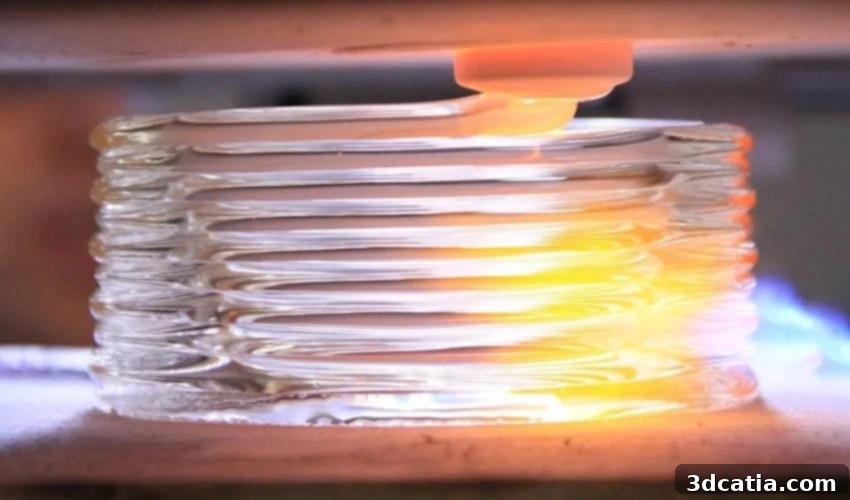
Glass 3D Printing: A Comprehensive Guide to Additive Manufacturing with Translucent Materials
Glass, a remarkable material defined by its hard, brittle, transparent, and amorphous inorganic properties, exists both naturally – such as in obsidian formed from rapidly cooled volcanic lava – and through sophisticated man-made processes. While often considered an unconventional material within the realm of additive manufacturing, its potential for creating unique and intricate glass parts, layer by precise layer, is rapidly transforming various industries. Thanks to relentless research and technological advancements, 3D glass printing is experiencing a surge in popularity, prompting numerous companies and research institutions to develop innovative solutions and push the boundaries of what’s possible.
This cutting-edge technology captivates not only scientists seeking novel research tools but also artists envisioning new forms of expression. It heralds new avenues for glass manufacturing, offering unprecedented design freedom and customization. To provide a deeper understanding of this fascinating field, we’ve compiled a comprehensive guide to glass 3D printing. This guide explores its fundamental characteristics, outlines the intricate manufacturing process, highlights its significant benefits and inherent limitations, and showcases its most notable and emerging applications across diverse sectors.
Understanding Glass 3D Printing: Key Characteristics
Before delving into the specifics of the manufacturing process, it’s crucial to appreciate the material itself. Glass, at its core, is an amorphous solid, meaning its atomic structure lacks the long-range order typical of crystalline solids. This unique characteristic contributes to its transparency and allows for its versatile shaping. While naturally occurring glass like obsidian fascinates geologists, the glass most people are familiar with is manufactured, offering a wide spectrum of colors, optical properties, and mechanical characteristics tailored for specific uses.
Indeed, the term “glass” encompasses a broad family of materials, each with distinct compositions and properties. For 3D printing, the choice of glass variant significantly impacts the process. Whether working with common soda-lime glass, specialized art glass, high-purity crystalline glass, or even recycled glass bottles, the specific manufacturing temperature, cooling rates, and post-processing requirements will vary. These variations are critical for achieving the desired aesthetic, functional, and structural integrity of the final 3D-printed glass part. Researchers and engineers continually explore new glass formulations and processing parameters to expand the capabilities of glass additive manufacturing.
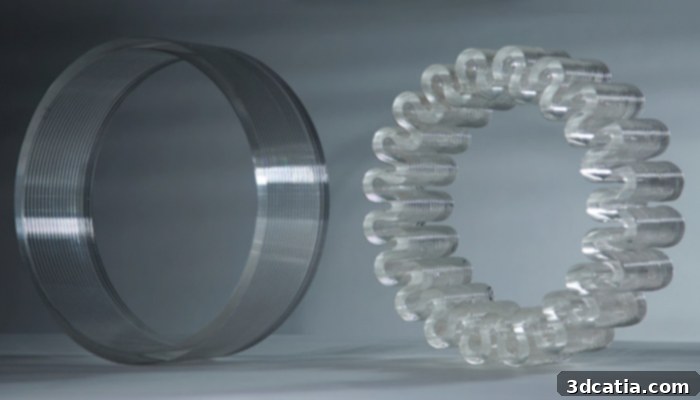
Parts created by glass 3D printing (photo credits: Chikara Inamura)
The Glass 3D Printing Process: A Step-by-Step Overview
The journey of transforming raw glass into a complex 3D-printed object involves several sophisticated steps, similar in principle to other additive manufacturing processes but with unique challenges posed by the material’s properties. The process typically begins with a digital design, where a CAD (Computer-Aided Design) model of the desired object is created. This digital model is then fed into a specialized software known as a slicer. The slicer’s role is critical: it digitally slices the 3D model into hundreds or thousands of thin layers and generates the G-Code. This G-Code is essentially a set of instructions that precisely tells the 3D printer how to move, how much material to extrude, and at what temperature, ensuring accurate layer-by-layer fabrication.
Once the G-Code is prepared, the physical printing process commences. Glass, typically in the form of rods, filaments, or granular powder, is fed into the 3D printer’s system. For extrusion-based methods, glass rods are inserted into a heating element. Unlike common plastics used in FDM, glass requires exceptionally high melting temperatures. While specific temperatures depend heavily on the type of glass, the material must often reach around 1300°C (2372°F) or even higher to become viscous enough for extrusion. This intense heat transforms the solid glass into an optimal molten state, allowing it to be precisely pushed through the printer’s nozzle.
The molten glass is then extruded and meticulously deposited onto a manufacturing tray, building the object layer by layer, much like the familiar Fused Deposition Modeling (FDM) process. However, the extreme temperatures and the unique thermal properties of glass introduce significant complexities. Maintaining a controlled environment throughout the printing process is paramount. During manufacturing, the entire part is often held within a closed, heated chamber, typically around 400°C (752°F). This elevated ambient temperature prevents premature cooling and subsequent thermal stress, which could lead to cracking or structural defects in the delicate glass layers.
Following the completion of the layer-by-layer deposition, the printed model undergoes a critical cooling phase. It is slowly and incrementally cooled down to room temperature. This controlled cooling, often referred to as annealing, is essential to relieve internal stresses that accumulate during the rapid heating and controlled cooling of the printing process. Rushing this step could result in brittle, flawed, or shattered parts. Once fully cooled, the glass parts may require minimal post-processing, such as light polishing or surface finishing, but are generally robust and nearly ready for use. Glass 3D printing is still a relatively nascent field, and as research continues to evolve rapidly, specific printer configurations, material recommendations, and process parameters are continuously being refined and improved, promising even greater versatility and efficiency in the future.
Benefits and Transformative Applications of 3D-Printed Glass
Glass additive manufacturing offers a compelling array of advantages, making it an exciting frontier in modern fabrication. One of its most significant benefits lies in its deep connection to sustainability and recycling. Glass is a uniquely recyclable material that can be reprocessed multiple times without any degradation of its intrinsic properties. This inherent characteristic makes glass 3D printing an environmentally friendly option, particularly when utilizing recycled glass waste as a raw material, thereby reducing landfill burdens and conserving natural resources.
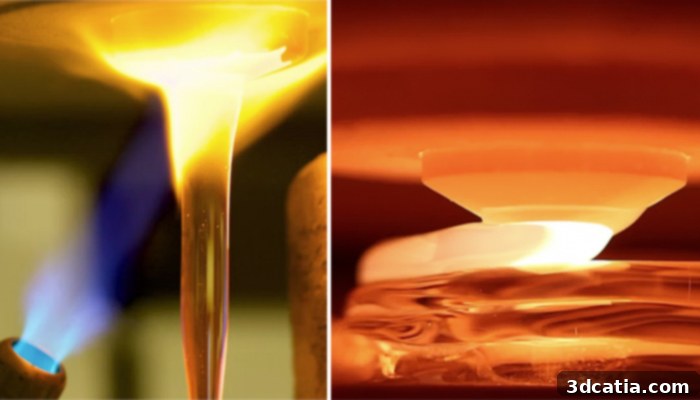
Glass 3D printing requires high manufacturing temperatures
From a design perspective, additively manufactured glass unlocks unprecedented levels of creative freedom. It enables the creation of exceptionally precise lines, complex curves, and intricate internal geometries that are often impossible to achieve with traditional glass blowing or molding techniques. Beyond structural complexity, the optical properties of 3D-printed glass are profoundly unique. The passage of light through the layered structure of 3D-printed glass can generate a mesmerizing “aurora effect,” where light is dispersed, refracted, and reflected through the internal lines and surface layers, creating dynamic and captivating visual experiences.
In terms of applications, 3D-printed glass is primarily making significant inroads in fields where aesthetic appeal, intricate design, and specialized optical properties are paramount. While its inherent fragility generally precludes its use in industries demanding high mechanical properties like extreme strength or durability, its advantages shine in other sectors. Key beneficiaries of glass 3D printing include the realms of fine art, bespoke architecture, specialized optics, and luxury jewelry, where custom, unique, and visually striking glass components are highly valued.
Beyond creative industries, scientific research stands out as another crucial application where additive glass manufacturing plays an increasingly vital role. Glass is an indispensable experimental asset in countless STEM (Science, Technology, Engineering, and Mathematics) fields due to its inertness, transparency, and thermal resistance. The ability of 3D printing to produce customized, complex geometries means scientists can now design and fabricate bespoke laboratory equipment, microfluidic devices, optical components, and specialized sensors precisely tailored to their experimental needs, accelerating discovery and innovation across a wide range of disciplines.
Leading Innovators and Manufacturers in the Glass 3D Printing Market
The emerging market for glass 3D printing is characterized by pioneering companies and academic research groups pushing the boundaries of this complex technology. One prominent player known for its innovative glass 3D printing solution is Maple Glass Printing. Their flagship machine, the Maple 3, boasts a maximum manufacturing volume of 170 x 200 x 300 mm and is designed for high-speed creation of intricate glass parts. Furthermore, Maple Glass Printing demonstrates a strong commitment to sustainability through its proprietary device, Vitri-Glass. This ingenious system transforms recycled and ground glass waste into printable bars, with diameters ranging between 3.5 and 6 mm, ready for direct use with their 3D printer, closing the loop on material consumption and promoting eco-friendly manufacturing.
Another significant name to watch in this specialized market is Nobula3D, a Swedish company actively developing advanced glass 3D printing technology. Nobula3D is currently in the process of formalizing a patent for its novel approach, which is expected to pave the way for the commercialization of its desktop 3D printer designed specifically for glass. Their efforts aim to make this sophisticated technology more accessible to a broader audience, from designers and artists to research laboratories.
Pioneering research in this field can be traced back to the Massachusetts Institute of Technology (MIT), particularly through the groundbreaking work of Neri Oxman’s research group. They were among the very first to systematically study and advance this manufacturing method, laying much of the foundational knowledge. To this day, Neri Oxman continues to make her extraordinary 3D-printed decorative glass pieces available to the public through her Evenline studio. While her group hasn’t yet commercialized a complete 3D printing solution for widespread adoption, their artistic works serve as powerful demonstrations of the technology’s aesthetic and functional potential.
Although the number of commercial entities actively developing and marketing glass 3D printing solutions is still relatively small, the landscape is poised for rapid expansion. The massive research push from academic institutions and the increasing demand for customizable, complex glass components across industries suggest that more innovative technologies and players are expected to enter the market in the coming years. This growth promises to further refine the process, diversify material options, and lower the barriers to entry for glass additive manufacturing, ultimately making it a more widespread and impactful technology.
What are your thoughts on the revolutionary potential of glass 3D printing? Share your insights and comments below, or engage with us on our LinkedIn, Facebook, and Twitter pages! Don’t miss out on the latest advancements in additive manufacturing – subscribe to our free weekly newsletter here to get the freshest 3D printing news delivered straight to your inbox! You can also explore all our insightful videos and demonstrations on our dedicated YouTube channel.
*Cover Photo Credits: MIT