
Massivit 10000: Revolutionizing Composite Mold Production with Cast In Motion 3D Printing at Formnext 2022
The global additive manufacturing industry converged at Formnext 2022, the premier international trade fair dedicated to 3D printing technologies. Held in mid-November, this significant event once again solidified its position as a crucial gathering point for innovators, manufacturers, and enthusiasts from across the globe. With an impressive roster of over 800 exhibitors and thousands of visitors, Formnext served as a vibrant showcase for the latest advancements shaping the future of industrial production. Among the distinguished exhibitors demonstrating groundbreaking large-format additive manufacturing solutions was Massivit 3D. A leading provider of large-scale 3D printers, Massivit 3D boasts strategic locations in Israel, North America, and Belgium, underscoring its international reach and commitment to serving a diverse industrial client base. At this year’s Frankfurt show, the company proudly unveiled its highly anticipated and award-winning Massivit 10000 system to the additive manufacturing market. This debut not only presented the innovative system itself but also provided compelling live demonstrations of its unique “Cast In Motion” technology, designed to redefine mold creation for composite parts.
Massivit 3D has long been recognized for its pioneering large-format solutions, built upon its proprietary Gel Dispensing Printing (GDP) technology. This advanced approach enables the creation of exceptionally large and complex parts, addressing critical needs across numerous industrial sectors. The latest edition of Formnext offered a clear testament to the versatility and impact of Massivit’s machines. Through a series of engaging live demonstrations, the company introduced visitors to its new additive manufacturing system, which promises to be a transformative solution for countless users. Its capacity for automating mold production, particularly for composites, marks a significant leap forward. The core objective behind Massivit 3D’s 10000 solution and its innovative Cast In Motion (CIM) technology is to effectively mitigate common bottlenecks prevalent in traditional composite manufacturing workflows. This is achieved by directly printing and casting industrial molds within a single, streamlined process. To fully appreciate the profound significance of this technological advancement, it is essential to delve deeper into the operational mechanics of this revolutionary production method and explore the substantial benefits it confers upon both the industrial and additive manufacturing sectors.
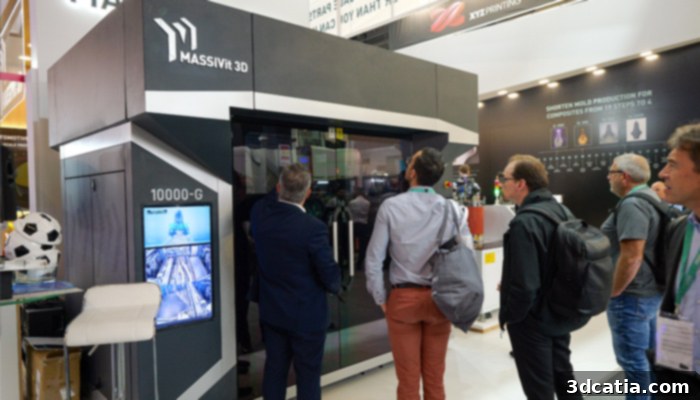
Massivit 3D’s dynamic booth at Formnext 2022, highlighting their innovative large-scale 3D printing capabilities (photo credits: Massivit 3D).
The Massivit 10000 System and Groundbreaking “Cast In Motion” Technology
As highlighted, Massivit 3D’s flagship presentation at Formnext 2022 was its transformative Massivit 10000 system. This system, powered by the ingenious Cast In Motion (CIM) technology, facilitates the automated, high-speed production of isotropic molds and tooling, significantly accelerating composite manufacturing processes. The fundamental problem CIM aims to resolve lies in the inherently complex and time-consuming nature of producing composite parts using traditional methods. Typically, the manufacturing journey for composite objects commences with extensive CNC milling to create a master pattern or tool. This is then followed by a labor-intensive manual layering of composite materials, such as carbon fiber or fiberglass, to form the mold itself. Subsequent steps involve casting and curing, often demanding specific environmental controls and lengthy cycles. Massivit 3D estimates that this conventional multi-stage process can involve up to 19 distinct steps, consuming valuable time, resources, and often contributing to significant material waste, rendering it environmentally less sustainable. The CIM method, however, introduces a paradigm shift, approaching this manufacturing challenge in an entirely novel way that sets a new benchmark in the 3D printing industry.
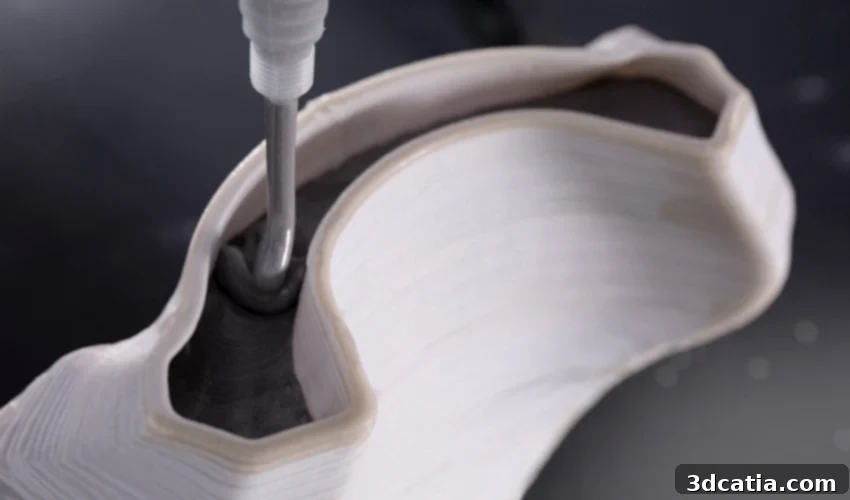
The innovative Massivit 10000 system operates through a sophisticated, integrated dual-head mechanism. One head is responsible for precisely printing an outer sacrificial shell, utilizing Massivit 3D’s unique water-breakable thermoset material. This material forms the precise shape and structure of the mold. Concurrently, a second head intermittently and strategically pours a specialized thermosetting casting material into this continuously building shell. This simultaneous process of printing the shell and casting the core material allows for a highly efficient and integrated manufacturing approach. The harmonious combination of these two processes culminates in the creation of a truly isotropic 3D printed mold, perfectly suited for the demands of composite component production. The specific casting material employed, known as CIM 500, is engineered to deliver exceptional mechanical and thermal properties. These include a remarkably low coefficient of thermal expansion (CTE), which ensures minimal dimensional changes and warping during the composite curing cycles, and a high heat deflection temperature (HDT), enabling the molds to withstand the elevated temperatures often required for curing advanced composite resins. Crucially, the Massivit 10000 system stands out for its capacity to dramatically accelerate mold production by an astonishing 80%, effectively shrinking lead times from many weeks to just a few days. This significant reduction translates directly into faster prototyping, quicker iteration cycles, and a swifter time-to-market for complex composite parts across various industries.
The excitement surrounding the Massivit 10000 at Formnext 2022 was palpable, reflecting a deep-seated industry need for such a breakthrough. Erez Zimerman, CEO of Massivit 3D, articulated this sentiment perfectly: “There’s no doubt that the composite market has eagerly awaited such a breakthrough in molding processes. The Massivit 10000 overcomes critical bottlenecks for manufacturers, cutting down their mold production time from dozens of weeks to just days. There was a palpable excitement at our Formnext booth reflecting the deep need for digital transformation in the composites arena.” His words underscore the profound impact this technology is set to have, addressing long-standing challenges in terms of speed, efficiency, and cost, thereby driving a much-needed digital transformation within the composites manufacturing landscape.
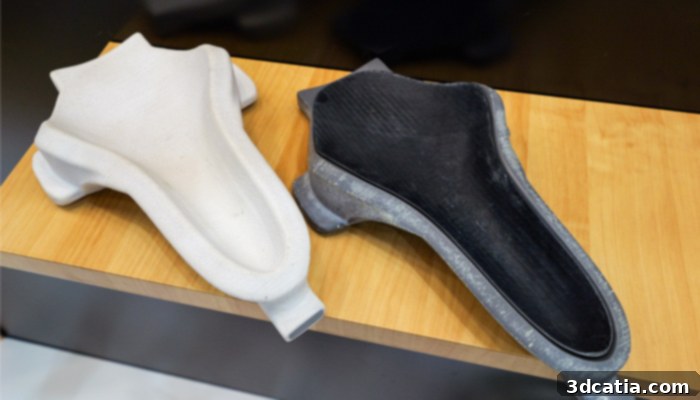
The Cast In Motion (CIM) technology excels in enabling the automated, rapid production of highly durable and isotropic molds, streamlining the composite manufacturing workflow (photo credits: Massivit 3D).
Visitors to the Massivit 3D booth at the international trade fair in Frankfurt were not just told about the new solution; they were given a unique opportunity to directly interact with and handle a diverse range of 3D printed parts produced by the Massivit 10000 system. This tangible experience allowed them to closely examine everything from intricate isotropic molds – showcasing perfect dimensional accuracy and surface finish – to innovative wash-away mandrels, precise patterns, and robust jigs and fixtures. This hands-on demonstration provided irrefutable proof of the manufacturing technology’s advanced capabilities and versatility, enabling prospective clients to immediately grasp the potential for integrating these solutions into their own production pipelines and realize significant efficiencies.
Diverse Applications of Massivit 3D’s Advanced Technology
Massivit 3D’s patented Cast In Motion technology fundamentally opens doors for seamless integration across a vast spectrum of industries, offering unprecedented flexibility and speed in tool and mold production. Evidently, a primary and highly impactful application lies in the rapid and precise creation of complex molds. This includes, but is not limited to, open and closed molds for large composite structures, bath molds for specialized applications, thermoforming tools requiring high fidelity and thermal stability, and molds for resin transfer molding (RTM) and reaction injection molding (RIM) processes, where surface quality and durability are paramount. Beyond molds, the technology is equally adept at manufacturing a variety of other essential tools. This includes the digital production of masters, which serve as foundational models for further replication; jigs, which guide and position tools relative to a workpiece; and fixtures, which hold workpieces firmly in place during manufacturing operations. All these critical tools can be produced digitally at unprecedented speeds, circumventing the laborious and time-consuming traditional methods. A particularly innovative application is the ability to create wash-away mandrels, especially beneficial for fabricating complex internal geometries found in ductwork and vents. These mandrels are printed as a solid core, around which composite materials are laid, and then easily dissolved away, leaving a hollow, intricate structure that would be incredibly challenging or impossible to produce otherwise. These diverse applications and high-speed tooling capabilities are indispensable for demanding industries such as automotive, where lightweighting and rapid iteration are crucial; sporting goods, enabling custom high-performance equipment; rail, for structural and aesthetic components; marine, for large hull sections and intricate fittings; construction, for custom architectural elements and formwork; defense, requiring specialized and often bespoke components; and aerospace, where complex ducting, lightweight structures, and high-performance tooling are critical for mission-critical parts.
As clearly demonstrated at Formnext 2022 and through their existing portfolio, Massivit 3D’s groundbreaking new system, alongside its established and highly regarded large-format 3D printing solutions, is firmly positioning the company as an undisputed major player and innovation leader in the global additive manufacturing market. Their commitment to solving real-world industrial challenges, particularly in the demanding realm of composite manufacturing, underscores their strategic importance. The ability to dramatically reduce lead times, cut costs, and simplify complex mold production processes with technologies like the Massivit 10000 and Cast In Motion is not merely an incremental improvement but a significant leap forward, driving efficiency and opening new possibilities for designers and manufacturers worldwide. For those eager to delve deeper into Massivit 3D’s revolutionary technologies and explore the full extent of their capabilities, as showcased during Formnext and beyond, further information and detailed insights are readily available by visiting their dedicated website HERE.
What are your thoughts on the transformative potential of the Massivit 10000 solution and its Cast In Motion technology for the composite industry? We invite you to share your insights and comments below, or engage with us on our vibrant social media platforms, including LinkedIn, Facebook, and Twitter! To ensure you stay abreast of all the latest and most impactful news from the world of 3D printing, remember to sign up for our complimentary weekly Newsletter here, delivered directly to your inbox. Additionally, you can access a wealth of informative and engaging videos on our YouTube channel, offering visual demonstrations and deeper dives into cutting-edge additive manufacturing innovations.
*Cover Photo: A detailed view of the Cast In Motion process in action, illustrating its innovative dual-material approach for rapid mold production (photo credits: Massivit 3D)