

Revolutionizing Industries: Latest 3D Printing News in Sports, Healthcare, Aerospace & Materials
Welcome back to 3DExpress, your definitive source for the most impactful short news stories from the dynamic world of additive manufacturing. This week, we dive into a spectrum of exciting developments that highlight the transformative power of 3D printing across diverse industries. We begin with Wilson’s groundbreaking 3D printed, airless basketball, an innovation poised to redefine sports equipment. While we initially covered its prototype last year, Wilson has officially announced that the much-anticipated Airless Gen1 Basketball will be available for a limited release starting February 16th, 2024. This marks a significant milestone for enthusiasts of both sports innovation and 3D printing technology.
Beyond the athletic court, our focus shifts to the skies and beyond, as we explore Boeing’s substantial grant to fund an additive manufacturing space lab. This visionary initiative is specifically aimed at advancing 3D printing education for the next generation of engineers and innovators. In the realm of healthcare, discover how OSF Healthcare is leveraging custom 3D printing solutions for more effective skin cancer treatment, enhancing precision and patient care. We also bring you details on Desktop Health’s innovative new dental resin, a development set to revolutionize restorative dentistry. Finally, gain crucial insights into the latest market report forecasting impressive growth in the polymer 3D printing material market. Get ready for an informative read as we uncover how additive manufacturing continues to push boundaries, driving progress and innovation across the globe.
Wilson Launches Revolutionary 3D Printed Airless Gen1 Basketball for Limited Release
The sporting goods giant Wilson captivated the world last year with the unveiling of its pioneering 3D printed, airless basketball prototype. Building on that excitement, the Airless Gen1, an advanced evolution of that first-of-its-kind innovation, is now officially available for a limited, exclusive release starting February 16th, 2024. This extraordinary basketball distinguishes itself through a meticulously engineered 3D printed polymer lattice structure. This advanced design eliminates the need for inflation entirely, yet it flawlessly replicates the authentic bounce, precise flight, and familiar feel of a traditional basketball, offering an unprecedented and consistent playing experience.
Since its initial prototype debut, Wilson has incorporated several key enhancements into the Airless Gen1 based on extensive testing and feedback. These upgrades include newly designed perforated channels, which improve grip and optimize airflow for better flight dynamics, a refined and optimized internal lattice structure for enhanced performance consistency and durability, and the introduction of different aesthetic choices. The limited release will be available in sleek jet black, a natural finish, and a classic brown, offering options that blend modern innovation with traditional appeal. This launch not only showcases the remarkable potential of additive manufacturing in consumer products but also signifies a bold step forward in merging cutting-edge technology with athletic equipment.
The Airless Gen1 stands as a testament to the fact that innovation can redefine even the most conventional items, promising a future where sports gear is more durable, sustainable, and tailored through advanced digital manufacturing processes. The development process illustrates the intricate interplay between industrial design and advanced material science. The choice of polymer materials is critical, as it must withstand the rigorous demands of basketball play while maintaining its structural integrity and performance characteristics. The lattice design, a hallmark of generative design enabled by 3D printing, allows for precise control over material distribution, optimizing for weight, strength, and elasticity – all crucial factors for a basketball’s performance. This engineering feat represents more than just a novelty; it points towards a future where customized, high-performance athletic equipment can be produced on demand, opening new avenues for both professional athletes and recreational players globally. This limited release is a strategic move, generating buzz and allowing Wilson to gather valuable user feedback before potentially scaling up production, further cementing 3D printing’s crucial role in the ongoing evolution of sports technology.
Boeing Funds New Additive Manufacturing Space Lab to Cultivate Future Engineers
The pivotal role of additive manufacturing within the aeronautics sector is undeniably significant and well-established. As one of the earliest adopters of advanced 3D technologies, leading aviation companies like Boeing continue to champion this trend, constantly seeking innovative applications that push the boundaries of design, production, and performance for both terrestrial aircraft and spacecraft. In a recent and highly impactful development, Boeing has awarded a substantial grant to the Space Foundation Discovery Center, earmarked for the creation of an expansive 826-square-foot “Additive Manufacturing Space Lab.”
The primary objective of this state-of-the-art laboratory is ambitious: to strategically address and bridge the growing global skills gap in advanced additive manufacturing techniques. By specifically targeting students – the very individuals who represent the next generation of engineers, scientists, and innovators – the initiative aims to cultivate a highly skilled workforce ready to tackle the complex challenges of modern aerospace and beyond. This significant investment from Boeing underscores the company’s enduring commitment to 3D printing as a cornerstone technology for its future operations, from rapid prototyping and creating custom tooling to producing lightweight, complex final parts for spacecraft and commercial aircraft components. It recognizes that expertise in additive manufacturing is not just beneficial, but essential for maintaining a competitive edge in the global aerospace landscape.
The Additive Manufacturing Space Lab will offer invaluable hands-on experience with cutting-edge 3D printing equipment and software, allowing students to learn about various additive manufacturing processes, delve into materials science, and master design for additive manufacturing (DfAM) principles. This practical, experiential education is crucial for developing the foundational knowledge and critical thinking skills required to innovate in fields ranging from aerospace and defense to medical devices and advanced consumer goods. Boeing’s foresight in funding such an educational hub highlights the increasing demand for professionals proficient in digital manufacturing workflows and advanced material processes. This initiative ensures that the pipeline of talent remains robust to support continued technological advancements not only in the aerospace industry but also in the broader ecosystem of advanced manufacturing. It’s a testament to the understanding that investing in education today lays the groundwork for groundbreaking innovations tomorrow, empowering future generations to reach for the stars with additive manufacturing.

The Space Foundation Discovery Center will host the new Additive Manufacturing Space Lab, fostering future innovators in 3D printing (photo credits: Space Foundation)
OSF Healthcare Innovates Skin Cancer Treatment with Patient-Specific 3D Printing
Skin cancer remains one of the most prevalent forms of cancer globally, affecting millions in the United States and around the world each year. Despite its widespread incidence, optimizing treatment, particularly for surface-level skin cancers, has presented considerable challenges. Traditional radiotherapy often requires delivering relatively large doses, as achieving precise and highly localized delivery to the affected area, while meticulously sparing surrounding healthy tissue, can be inherently difficult with conventional methods. This often leads to potential side effects for patients and can necessitate extended treatment durations. However, a significant advancement is now poised to revolutionize this aspect of oncology, offering a more targeted and patient-friendly approach.
OSF Healthcare has proudly announced the successful implementation of cutting-edge 3D printing technology to create patient-specific radiation boluses. These custom-designed medical devices are precisely tailored to the unique anatomical contours of an individual patient’s skin. This bespoke approach enables a far more effective and remarkably localized delivery of radiotherapy than previously possible. By conforming perfectly to the skin’s surface and the tumor’s exact geometry, the 3D printed bolus ensures that the radiation dose is concentrated directly on the cancerous cells, maximizing therapeutic impact while significantly minimizing exposure to adjacent healthy tissues and vital organs. This unprecedented level of precision not only enhances the efficacy of the treatment, leading to better outcomes, but also substantially contributes to a reduction in potential side effects, ultimately improving patient comfort, quality of life, and accelerating recovery.
This innovative application further exemplifies the profound and transformative benefits of integrating cutting-edge technology, such as 3D printing, with the critical field of healthcare. Personalized medicine, where treatments are meticulously adapted to each patient’s unique anatomy, physiology, and specific condition, is becoming increasingly attainable and widespread through the capabilities of additive manufacturing. The ability to rapidly produce highly complex, custom medical devices on-demand opens new doors to improved patient outcomes across a variety of medical disciplines, from prosthetics and surgical guides to bespoke therapeutic tools. OSF Healthcare’s pioneering adoption of this technology for skin cancer treatment serves as an inspiring example of how 3D printing is not just a manufacturing tool but a vital instrument in advancing personalized, compassionate, and highly effective medical care that truly puts the patient at the center.
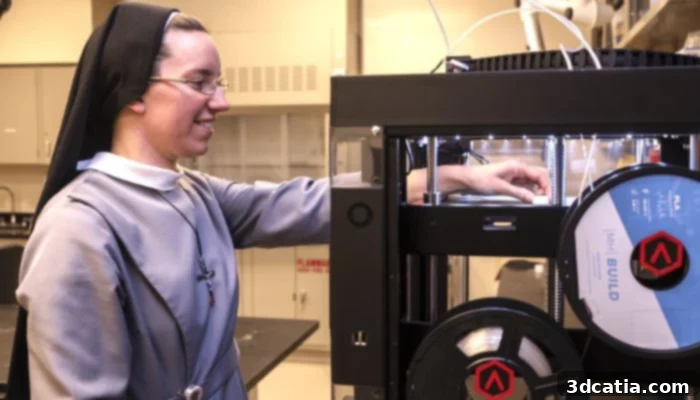
Sister Pieta from OSF Healthcare demonstrating the use of a 3D printer for medical innovations, including patient-specific radiation boluses (photo credits: OSF Healthcare)
Desktop Health Unveils Flexcera™ Base Ultra+: Advancing 3D Printed Dental Resins for Enhanced Dentures
The global denture market is currently experiencing robust and sustained growth, underscoring a significant and increasing demand for advanced restorative dental solutions worldwide. Valued at an impressive $2.8 billion in 2023, this essential market is projected to expand even further, with an anticipated compound annual growth rate of 7.5 percent from 2024 to 2030, potentially reaching a substantial nearly $4.6 billion. Within this burgeoning and evolving market, resin 3D printing has emerged as a truly transformative technology. It empowers dentists and dental laboratories to drastically reduce labor costs, significantly enhance efficiency, and deliver highly customized solutions that are both faster to produce and far more convenient for patients.
In a strategic move that further solidifies its position at the forefront of dental innovation, Desktop Health, the dedicated medical industry division of Desktop Metal, has proudly introduced its latest breakthrough: Flexcera Base Ultra+. This cutting-edge 3D-printed denture resin is a valuable and innovative addition to their acclaimed Flexcera product line, known for its superior performance and aesthetic qualities. Flexcera Base Ultra+ is a sophisticated, light-curing resin specifically engineered for the precise and efficient fabrication of the gingival component of removable full and partial dentures, providing an ideal foundation for dental restorations.
The updated Flexcera Base Ultra+ formulation is a state-of-the-art nano-ceramic composite resin, representing a significant leap forward in dental material science and engineering. This advanced composition is meticulously designed to provide an exceptionally stronger and stiffer denture base compared to previous generations, ensuring unparalleled stability and longevity. The enhanced mechanical properties not only contribute to superior durability and resistance to everyday wear and tear but also crucially enable the fabrication of significantly thinner models. These thinner dentures offer greater patient comfort, fitting more naturally within the oral cavity and reducing any perception of bulkiness, all while maintaining optimal strength and functional integrity. Desktop Health’s continuous investment in researching and developing high-performance resins like Flexcera Base Ultra+ ensures that dental professionals have access to the most advanced tools and materials to meet the evolving needs of their patients, driving innovation in restorative dentistry and ultimately improving overall quality of life for denture wearers globally.

Desktop Health’s Flexcera Base Ultra+ provides enhanced durability and comfort for 3D printed dentures, showcasing advancements in dental resins (Photo Credits: Desktop Health)
VoxelMatters Report Reveals Significant Growth in the 3D Printing Polymer Market
This week, the specialized market research firm VoxelMatters Research released a comprehensive new study detailing the burgeoning market for polymers within the additive manufacturing sector. The findings of this highly anticipated report underscore the rapid expansion and increasing importance of polymer-based 3D printing technologies across global industries. According to the study, the polymer additive manufacturing sector generated an impressive $5.6 billion in revenue during 2022, marking a substantial 19% growth over the preceding year. This significant year-over-year increase vividly highlights the accelerating adoption and diversification of polymer 3D printing applications across various industrial and consumer segments, demonstrating its growing maturity and impact on global manufacturing.
The report meticulously breaks down the revenue streams identified in the market, showing that growth is multifaceted and primarily driven by three key pillars: the sales of specialized hardware (including a wide range of polymer 3D printers), a rapidly expanding array of advanced polymer materials (such as filaments, resins, and powders), and the robust provision of professional 3D printing services. This tripartite structure indicates a healthy, mature, and interconnected ecosystem that is effectively supporting the sustained growth and innovation within polymer additive manufacturing. Looking ahead, VoxelMatters Research’s projections are even more optimistic, estimating that this global market will surge to an astounding $45 billion by 2032. This represents an extraordinary compounded annual growth rate of 23.3%, indicating a robust and sustained expansion over the next decade, far outstripping many other manufacturing sectors.
The report further identifies the four primary sectors that are acting as the key catalysts for this remarkable and rapid growth: Industrial applications, Consumer Goods, Automotive, and Dental. In industrial settings, advanced polymers are increasingly utilized for rapid prototyping, creating custom tooling and jigs, and producing lightweight, complex end-use parts due to their unparalleled versatility, cost-effectiveness, and diverse material properties. The consumer goods sector significantly benefits from the ability to achieve mass customization, personalized products, and accelerated product development cycles. Automotive manufacturers are leveraging polymers for crucial applications like lightweighting vehicle components, producing intricate interior parts, and creating functional prototypes with high fidelity. Lastly, as exemplified by developments like Desktop Health’s new resin, the dental industry is rapidly integrating polymer 3D printing for the production of custom aligners, dental models, crowns, bridges, and dentures. The inherent versatility, improving cost-effectiveness, and continuous innovation in polymer materials and processing technologies are collectively propelling this market forward, making it an increasingly critical component of the overall additive manufacturing landscape and signaling a transformative period for various industries worldwide as they embrace digital fabrication for performance and efficiency.
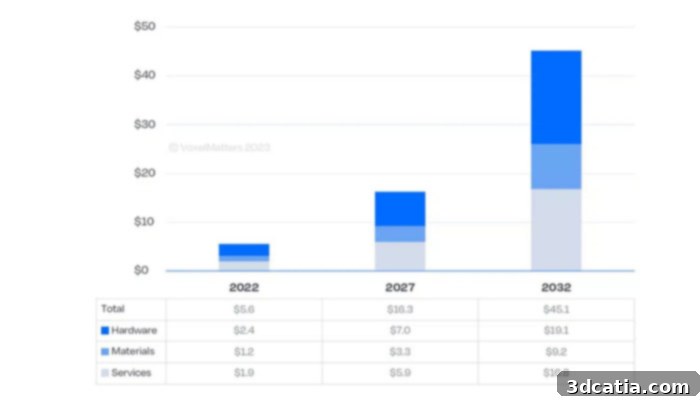
Additive manufacturing polymer market revenue forecasts by segment, illustrating significant growth projections (in billions of dollars), according to VoxelMatters Research (photo credits: VoxelMatters)
What are your thoughts on Wilson’s innovative Airless Gen1 basketball and its potential impact on sports? Which story in this week’s #3DExpress resonated with you the most, or perhaps surprised you with its implications? We invite you to share your insights and opinions in a comment below or join the vibrant conversation on our LinkedIn, Facebook, and Twitter pages! Don’t miss out on the latest advancements and cutting-edge developments in the world of additive manufacturing; sign up for our free weekly newsletter here to get all the essential 3D printing news delivered straight to your inbox. You can also explore all our compelling video content, showcasing the incredible applications of 3D printing, on our YouTube channel. Stay connected with the future of manufacturing and innovation!