
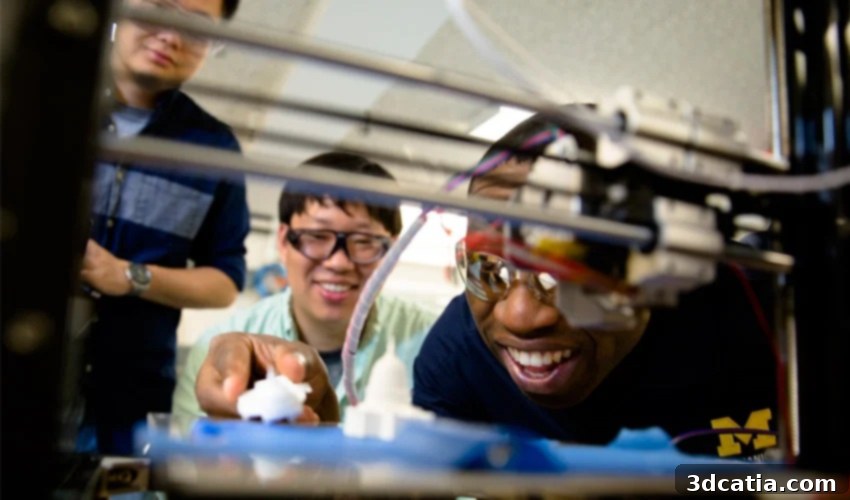
Ulendo Software Revolutionizes FDM 3D Printing: Faster Speeds, Higher Accuracy, and Vibration Control
Imagine a scenario where your Fused Deposition Modeling (FDM) 3D printer could operate at significantly higher speeds without compromising the intricate detail and structural integrity of your printed parts. This long-standing challenge in additive manufacturing has finally met its match. What began as an innovative concept at the University of Michigan has now materialized into a groundbreaking solution: the Ulendo software. This revolutionary technology, first hinted at in 2017 with the initial findings of an advanced 3D printer algorithm developed by Professor Chinedum Okwudire, has rapidly evolved. A few years later, this brilliant idea took concrete form through the company Ulendo and made its official debut at the prestigious RAPID + TCT show, held recently in Detroit, USA. At its core, Ulendo’s innovation is designed to drastically mitigate vibrations during the 3D printing process, thereby eradicating print deformations and enhancing overall part quality.
The Persistent Challenge: Balancing Speed and Quality in FDM 3D Printing
The relentless pursuit of faster production cycles has always been a critical driving force behind innovation in additive manufacturing. However, one of the most significant roadblocks to achieving this in FDM 3D printing has been the inherent mechanical challenge of controlling vibrations. As the print head of an FDM machine moves rapidly across the build plate, extruding molten thermoplastic filament layer by layer, it generates dynamic forces that lead to vibrations. These vibrations are not merely an acoustic inconvenience; they directly and detrimentally impact the final quality, dimensional accuracy, and surface finish of the printed object.
Desktop FDM 3D printers, in particular, are acutely susceptible to these issues. Their typically lighter chassis, less rigid frame structures, and more compact designs make them prone to flexing and resonating under the mechanical stresses of high-speed motion. This susceptibility manifests in various undesirable print imperfections, including visible ringing artifacts (often called “ghosting” or “moire patterns”), layer shifting, reduced geometric precision, and an overall degradation of surface quality. For users striving to produce aesthetically pleasing prototypes, functional components with tight tolerances, or intricate models, these vibration-induced flaws can be a significant source of frustration, leading to wasted material, increased post-processing, and costly failed prints.
Traditionally, the most widely adopted workaround for mitigating vibration-induced print quality issues has been to simply reduce the printing speed. While slowing down the print head can indeed lessen kinetic energy and dampen vibrations, thereby improving accuracy to some extent, this solution comes with a severe economic and operational drawback: it drastically extends print times. Given that 3D printing is often already perceived as a relatively slow manufacturing process compared to conventional methods like injection molding or CNC machining, further reducing print speed only compounds the problem. This makes FDM technology less viable for high-volume production, just-in-time manufacturing, or rapid prototyping environments where time-to-market is crucial. This fundamental trade-off between speed and quality has long represented a bottleneck, impeding the broader adoption and maximizing the efficiency of FDM technology across diverse industries.
Chinedum Okwudire, an associate professor of mechanical engineering at the University of Michigan and the visionary founder of Ulendo, eloquently summarizes this enduring dilemma: “If you want to reduce the vibration of a moving object, in most cases you can do so by slowing down the speed. But because 3D printing is already very slow, this solution poses another problem. Our solution allows you to print quickly without sacrificing quality.” This statement perfectly encapsulates the core problem Ulendo set out to solve: to fundamentally break the age-old compromise between printing speed and precision in additive manufacturing.

Visual demonstration of print failure due to excessive vibration when attempting double speed without Ulendo’s correction. (Photo Credit: Evan Dougherty/Michigan Engineering, Communications & Marketing)
Introducing the Filtered B Splines (FBS) Algorithm: A Predictive Approach
The genesis of the Ulendo software lies in a profound academic understanding of machine dynamics and a sophisticated, predictive approach to motion control. It was from the keen observation of these persistent vibration challenges in 3D printing that the Filtered B Splines (FBS) software was meticulously developed. This innovative algorithm doesn’t merely react to vibrations after they occur; instead, it proactively anticipates and actively reduces them *before* they can manifest and negatively impact the delicate process of layer deposition and overall print quality.
How FBS Works: The Science Behind Vibration Suppression
At the heart of the FBS algorithm is a complex yet elegantly simple compensation system. It operates by first constructing a precise mathematical model of a specific 3D printer’s unique behavior. This model incorporates the machine’s inherent mechanical characteristics, such as its mass distribution, stiffness, and potential resonant frequencies—points at which vibrations are naturally amplified. This detailed understanding allows the software to accurately predict how the printer’s intended motion commands will likely induce vibrations. Armed with this foresight, the FBS algorithm then intelligently adjusts the machine’s G-code or movement commands in real-time, subtly modifying the velocity and acceleration profiles.
Think of the software as a highly intelligent, proactive translator between design intent and physical execution. It bridges the gap between the idealized, vibration-free movements that a CAD model dictates for the print head and the necessary compensations the printer must make in the unpredictable real world of mechanical forces. Instead of simply instructing the printer to move in a straight line from point A to point B, the FBS algorithm calculates a slightly pre-compensated path or speed profile. When this modified command is executed by the physical machine, the inherent mechanical vibrations that would typically arise are precisely counteracted and effectively canceled out. This results in the print head following the *intended* trajectory with vastly improved accuracy and stability, even when operating at significantly elevated speeds. This predictive compensation mechanism is the true differentiator for Ulendo, transforming potentially chaotic motion into perfectly precise, controlled movement.
Expanding on this ingenious concept, Chinedum Okwudire provides an accessible analogy to clarify the FBS algorithm’s operational principle: “Let’s say you want a 3D printer to move straight, but because of the vibration, the movement is oscillating up and down. The FBS algorithm cleverly tricks the printer by telling it to go slightly downhill and then uphill. When the printer attempts to follow this pre-compensated path, the mechanical vibrations that would normally cause it to oscillate up and down are effectively canceled out, resulting in a perfectly straight and smooth movement.” This predictive intelligence is what sets Ulendo apart, turning what could be a chaotic, quality-compromising movement into precise, controlled motion, regardless of the print speed.
Unlocking New Performance Thresholds: The Impact of Ulendo
The practical implications of Ulendo’s FBS algorithm are truly transformative for the entire 3D printing industry. By effectively decoupling operational speed from vibration-induced quality degradation, the software fundamentally alters the performance envelope for FDM printers, opening up entirely new possibilities for manufacturing efficiency and product design.
Dramatic Increase in Speed and Acceleration
One of the most immediate and impactful benefits reported by early adopters and demonstrated by Ulendo is the significant increase in operational speed and acceleration. Ulendo CEO Brenda Jones, keenly aware of the industry’s excitement, highlights this revolutionary advancement: “Members of the 3D printing industry have the same jaw-dropping reaction I had when I first heard about how this technology results in a printer operating at two times the speed and 10 times the acceleration.” Doubling print speeds means halving production times for many parts, which directly translates to substantial cost savings per part and a dramatic increase in throughput for manufacturers, engineers, and designers alike. Furthermore, the ten-fold increase in acceleration allows the print head to change direction much more quickly and precisely, a critical factor for achieving finer details, sharper corners, and more complex geometries without the usual artifacts associated with rapid motion. This enhancement alone can significantly boost productivity for any FDM application.
Enhanced Print Quality and Reliability
Beyond sheer speed, Ulendo’s foundational objective remains to elevate print quality to unprecedented levels. By actively suppressing and pre-compensating for vibrations, the software ensures that each extruded filament bead is deposited exactly where it’s intended to be, layer upon meticulous layer. This precision leads to a cascade of benefits:
- Superior Surface Finish: The elimination of ringing and ghosting artifacts results in noticeably smoother, cleaner, and more aesthetically pleasing exterior surfaces, reducing the need for extensive post-processing.
- Improved Dimensional Accuracy: Parts are printed much closer to their intended CAD specifications, which is absolutely crucial for functional prototypes, assembly components, and end-use parts where precise fit and form are paramount.
- Greater Structural Integrity: Consistent and accurate layer adhesion, free from vibrational disturbances, leads to stronger, more homogeneous, and ultimately more reliable parts with enhanced mechanical properties.
- Reduced Print Failures: Fewer instances of discarded prints due to vibration-related defects translate directly into significant savings in material costs, print time, and labor, making the entire 3D printing operation more efficient and sustainable.
The overall reliability and predictability of the printing process are dramatically boosted, firmly establishing 3D printing as a more dependable and cost-effective manufacturing tool for a wider range of applications.

A stark comparison: the same Capitol replica successfully printed at double speed with the FBS algorithm enabled, showcasing the technology’s effectiveness in achieving high quality at high speed. (Photo credits: Evan Dougherty/Michigan Engineering, Communications & Marketing)
Broad Applications and Future Horizons for Ulendo
The versatility of the Ulendo software is another cornerstone of its widespread appeal and potential impact. It boasts near-universal compatibility, capable of being seamlessly applied to almost any existing 3D printer, irrespective of its brand, model, or control system. While this solution offers immense value to all types of FDM machines, its impact is particularly profound for smaller, desktop-sized printers. These machines, often favored for their affordability, accessibility, and compact footprints, typically lack the robust, heavy-duty frames and advanced motion systems of their industrial counterparts. This inherent design often makes them more susceptible to vibration-induced inaccuracies and limitations at higher print speeds. Ulendo effectively transforms these entry-level and mid-range printers into high-performance workhorses, democratizing high-speed, high-quality printing capabilities.
However, Ulendo’s utility is by no means limited to the desktop segment. Recognizing the significant and quantifiable performance gains demonstrated by the software, several leading industrial machine manufacturers have already engaged with Ulendo. They are rigorously testing and actively working to integrate the FBS algorithm into their high-end, large-format systems. Even robust, industrial-grade FDM printers, while inherently more stable, can benefit immensely from Ulendo by pushing their operational envelopes further, achieving even faster print times for massive parts or unlocking the ability to produce finer details and more intricate geometries on complex industrial components. This broad applicability, spanning from consumer-grade desktop units to advanced industrial additive manufacturing systems, underscores Ulendo’s potential to become a standard feature and a critical enabler across the entire spectrum of FDM technology.
Beyond 3D Printing: A Vision for Universal Motion Control
The innovative team at Ulendo is not content to stop at revolutionizing 3D printing. They recognize that the foundational principles of the FBS algorithm – predictive vibration compensation for high-speed, high-accuracy motion control – are inherently transferable and highly beneficial to a wide array of other automated manufacturing and robotics technologies. This forward-thinking vision includes extending their groundbreaking solution to:
- CNC Machines: By mitigating vibrations in milling, turning, and routing operations, Ulendo can enable significantly higher cutting speeds, improve surface finishes, extend tool life, and enhance the precision of machined parts.
- Laser Engravers and Cutters: The software can allow for faster, more precise engraving patterns and deeper, cleaner cuts without the distortion or blurring typically associated with high-speed laser motion.
- Robotic Arms: Enhancing the speed and accuracy of pick-and-place, assembly, welding, painting, and other complex robotic tasks, particularly those requiring fine motor control and consistent trajectory execution in dynamic industrial environments.
By targeting these adjacent industries, Ulendo aims to establish a new paradigm for motion control, revolutionizing automated production far beyond additive manufacturing. This broader application highlights the universal challenge of balancing speed, accuracy, and efficiency in dynamic systems, a challenge that Ulendo is uniquely positioned to address with its patented, predictive compensation technology. This expansion promises to set new benchmarks for efficiency and precision across the entire automated production landscape.
The Future of FDM is Faster and More Precise
The official presentation and market introduction of Ulendo’s software at prominent industry events like RAPID + TCT marks a pivotal moment for the entire 3D printing industry. It signifies a tangible and significant leap forward in overcoming one of the most persistent technical limitations of FDM technology. By empowering printers to operate at double the speed and ten times the acceleration while maintaining or even demonstrably improving print quality, Ulendo is not just offering an incremental upgrade; it is fundamentally redefining what is possible with FDM 3D printing. This innovation is poised to accelerate prototyping cycles, dramatically reduce manufacturing costs per part, and unlock new, previously unfeasible applications for this versatile and widely adopted additive process. For more in-depth information about this groundbreaking technology and its development, you can find further details HERE.
What are your thoughts on this newly developed 3D printer algorithm and its profound potential to transform FDM manufacturing and beyond? We invite you to share your valuable insights in a comment below or join the vibrant conversation on our Linkedin, Facebook, and Twitter pages! Don’t forget to sign up for our free weekly Newsletter here to receive the very latest 3D printing news and exclusive content straight to your inbox! You can also find all our engaging videos and in-depth discussions on our dedicated YouTube channel.