

Revolutionizing Drug Delivery: Triastek’s 3D-Printed T21 Drug Secures FDA IND Approval for Ulcerative Colitis Treatment
The landscape of modern medicine has undergone a remarkable transformation in recent years, largely propelled by the relentless advancements in additive manufacturing. Beyond its widely recognized contributions to producing essential items like facial masks, intricate orthoses, custom prostheses, and even sophisticated educational models, 3D printing technology has increasingly become a focal point for innovation in the pharmaceutical sector. This burgeoning field is witnessing significant investment, particularly in the realm of 3D-printed medicines, promising a new era of precision and personalization in drug development and delivery.
At the forefront of this pioneering movement is Triastek Inc., a Chinese 3D-printed drug manufacturer established in 2015. Since its inception, Triastek has dedicated itself to pushing the boundaries of digital pharmaceutical product development and smart manufacturing. Their ambitious mission encompasses not only the design of novel dosage forms but also a steadfast commitment to benefiting public health through advanced technological applications. Their persistent efforts have recently culminated in a significant milestone: Triastek has received Investigational New Drug (IND) application approval from the U.S. Food and Drug Administration (FDA) for its groundbreaking 3D-manufactured drug, T21. This innovative medication is specifically designed to treat ulcerative colitis, a chronic and debilitating inflammatory bowel disease.
Ulcerative colitis (UC) stands as one of the most prevalent chronic inflammatory bowel diseases, affecting millions worldwide. This condition is characterized by chronic inflammation of the large intestine (colon) and rectum, leading to a range of severe and often debilitating symptoms. Sufferers typically experience persistent diarrhea, abdominal pain, rectal bleeding, weight loss, and fatigue. The chronic nature of the disease, coupled with the unpredictable flare-ups and the need for long-term management, can impose immense stress and significantly diminish patients’ quality of life. Traditional treatments often involve systemic medications that can have widespread side effects, and achieving targeted delivery to the inflamed areas of the colon has long been a challenge. The FDA’s IND approval for Triastek’s T21 drug marks a crucial step forward, granting the company permission to initiate clinical trials in the United States and bringing hope for a more effective and precisely targeted treatment option for those afflicted by ulcerative colitis.
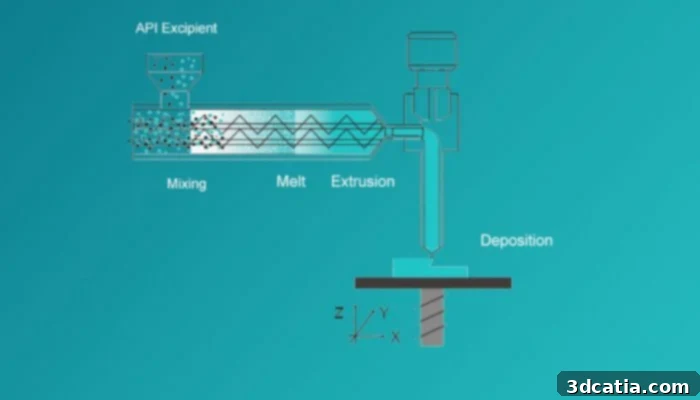
The figure illustrates the Melt-Extrusion Deposition (MED®) process (Image: Triastek)
The Science Behind the Pill: How Triastek’s T21 Drug is 3D Printed
The innovative production of the T21 drug leverages Triastek’s proprietary 3D printing technology known as Melt-Extrusion Deposition (MED®). This advanced method operates on a principle akin to conventional fused deposition modeling, but meticulously adapted for pharmaceutical applications. In the MED® process, carefully selected powdery starting materials, which contain the active pharmaceutical ingredient (API) and various excipients, are subjected to precise heating. This controlled thermal process brings these materials to a soft or molten state, transforming them into a flowable material. This molten material is then precisely extruded through a nozzle, layer after minuscule layer, building up the complex three-dimensional structure of the drug. This additive layering continues with exceptional accuracy until the final 3D-printed T21 drug is fully realized, embodying a predefined geometric structure and internal architecture.
A distinctive and particularly significant feature of employing additive manufacturing, specifically the MED® process, for drug production is its unparalleled ability to enable targeted drug delivery. In the case of T21, the drug is meticulously engineered to specifically deliver its therapeutic agents to the colon, bypassing earlier segments of the gastrointestinal (GI) tract. This site-specific delivery is profoundly advantageous for treating conditions like ulcerative colitis, where inflammation is concentrated in the large intestine. By ensuring that the active drug is released directly at the site of disease, T21 can achieve its therapeutic effect with a significantly lower overall drug dose. This targeted approach not only enhances the drug’s efficacy where it’s most needed but also substantially mitigates potential systemic side effects that are often associated with higher doses of orally administered drugs designed for broader absorption.
Furthermore, Triastek’s innovative methodology allowed for the integration of advanced assessment techniques at very early stages of T21’s development. By utilizing radioactive imaging agents embedded within the drug, researchers were able to precisely assess the site and timing of drug release within the complex environment of the gastrointestinal tract. This capability for real-time, in-vivo monitoring provides invaluable data, allowing for optimal design and validation of the drug’s release profile. This pioneering approach means that future drugs can be precisely designed and verified to target specific segments within the gastrointestinal tract, leading to greater therapeutic efficiency and significantly improved success rates in treating a myriad of GI-related conditions. This level of precision and control in drug delivery was previously challenging to achieve with traditional manufacturing methods.
The versatility of Triastek’s MED® technology extends beyond just colon-targeted therapies. The company emphasizes that this cutting-edge technology can be utilized not only for the creation of oral sustained-release tablets, which provide a consistent therapeutic effect over an extended period, but also holds immense potential for advancing research in complex areas such as peptide drugs. Peptide drugs, which are increasingly recognized for their therapeutic potential but often face challenges in oral delivery due to their susceptibility to degradation in the GI tract, could particularly benefit from the protective and precisely controlled release mechanisms offered by 3D printing. This broad applicability underscores the transformative impact that Triastek’s additive manufacturing platform is poised to have across various pharmaceutical domains, paving the way for more effective, safer, and personalized medication options.
“We are excited to receive IND clearance to begin clinical trials of this potentially transformative treatment for patients, said Dr. Senping Cheng, founder and CEO of Triastek. “Delaying drug release and delivering oral dosage forms to the colon is challenging, so T21 offers a promising new option for patients by providing site-specific drug delivery and localized drug effect, mitigating potential side effects from systemic exposure. We look forward to advancing this treatment into the clinic and appreciate the FDA’s support. “
Dr. Senping Cheng, the visionary founder and CEO of Triastek, expressed profound excitement regarding the FDA’s IND clearance. His statement underscores the significant challenges inherent in achieving delayed drug release and precisely delivering oral dosage forms to the colon. Traditional pharmaceutical methods often struggle with these intricate requirements, leading to compromises in efficacy or increased side effects. Dr. Cheng highlights how T21 directly addresses these hurdles, presenting a truly promising new option for patients suffering from ulcerative colitis. By offering unparalleled site-specific drug delivery and a localized therapeutic effect, T21 aims to significantly mitigate potential adverse effects that arise from systemic drug exposure, thereby improving both the safety and tolerability of treatment. This advancement reflects Triastek’s dedication to patient-centric innovation and their commitment to transforming chronic disease management. The appreciation extended to the FDA further acknowledges the rigorous regulatory process and the collaborative effort required to bring such cutting-edge treatments to clinical evaluation.
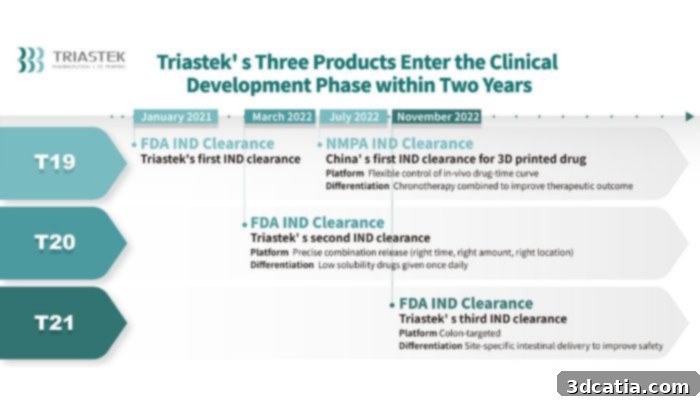
The clinical testing procedure (Image: Triastek)
Triastek’s Pioneering Journey in 3D-Printed Pharmaceuticals
Triastek’s recent success with T21 is not an isolated event but rather a continuation of their remarkable track record in the field of additive drug manufacturing. The company has previously achieved significant breakthroughs, earning IND approval for two other pioneering drugs: T19 and T20. T19 is designed for the treatment of rheumatoid arthritis, another chronic inflammatory condition that severely impacts quality of life, while T20 targets cardiovascular and coagulation disorders, addressing critical health issues related to heart function and blood clotting. These earlier approvals underscore Triastek’s consistent innovation and their ability to navigate complex regulatory pathways, demonstrating the robust potential of their 3D printing platform across a diverse range of therapeutic areas. Each of these drugs represents a tailored solution, capitalizing on the unique capabilities of 3D printing to create medicines with optimized release profiles and targeted action, paving the way for more effective and personalized patient care.
The broader implications of Triastek’s work in 3D-printed pharmaceuticals are immense and extend far beyond the specific conditions their drugs address. This technology is fundamentally shifting the paradigm of drug development, moving towards an era of personalized medicine where dosages and release characteristics can be customized for individual patient needs. Imagine a future where poly-medication, or the administration of multiple drugs, could be streamlined into a single, precisely engineered pill, improving patient adherence and reducing the burden of managing complex medication regimens. Furthermore, the ability to rapidly prototype and test new drug formulations significantly accelerates the research and development cycle, bringing potentially life-saving treatments to market faster. Triastek’s consistent success and their focus on advanced manufacturing techniques are not just about producing individual drugs; they are about establishing a new benchmark for pharmaceutical innovation, promising a future where medication is more effective, safer, and tailored to the unique biology of each patient.
The IND approval for T21 signifies a pivotal moment not just for Triastek, but for the entire pharmaceutical industry and the millions of patients worldwide suffering from ulcerative colitis. As clinical trials commence, the scientific community and patients alike will eagerly anticipate the results of this transformative 3D-printed drug. Triastek’s vision of digital pharmaceutical product development combined with smart manufacturing is clearly taking shape, demonstrating the tangible benefits of integrating cutting-edge additive manufacturing into drug production. This heralds a future where complex medical conditions can be tackled with unprecedented precision, offering a glimmer of hope for enhanced quality of life through smarter, more targeted therapies.
To delve deeper into Triastek’s groundbreaking work and their latest achievements, you can refer to their official press release available HERE. Stay informed about the future of pharmaceutical innovation as 3D printing continues to redefine possibilities in healthcare.
What are your thoughts on this exciting news and the future of 3D-printed drugs? We’d love to hear from you! Share your comments below or engage with us on our LinkedIn, Facebook, and Twitter pages! Don’t miss out on the latest advancements in additive manufacturing—be sure to sign up for our free weekly Newsletter here to get all the top 3D printing news delivered straight to your inbox. You can also explore our extensive library of videos on our YouTube channel for more insights into the world of 3D printing.