
Beyond Build Plate Limits: Revolutionizing Large-Scale 3D Printing with Expandable Foam Technology
For decades, the realm of additive manufacturing has been constrained by a fundamental limitation: the size of a 3D printed part cannot exceed the build volume of the machine that produces it. While technological advancements have led to larger and more sophisticated 3D printers, capable of printing volumes up to a cubic meter or even more in some industrial systems, these machines are often prohibitively expensive, complex to operate, and less widely available compared to their desktop counterparts. Consequently, engineers and designers frequently resort to printing smaller components and then post-processing and bonding them together to form larger structures—a labor-intensive, time-consuming, and often compromise-ridden approach. This inherent restriction has significantly hampered the widespread adoption of 3D printing for truly large-scale applications, particularly in sectors where expansive, monolithic structures are paramount. The quest for methods to overcome this build volume barrier has driven relentless innovation in material science and engineering, leading to groundbreaking discoveries that promise to redefine the capabilities of additive manufacturing.
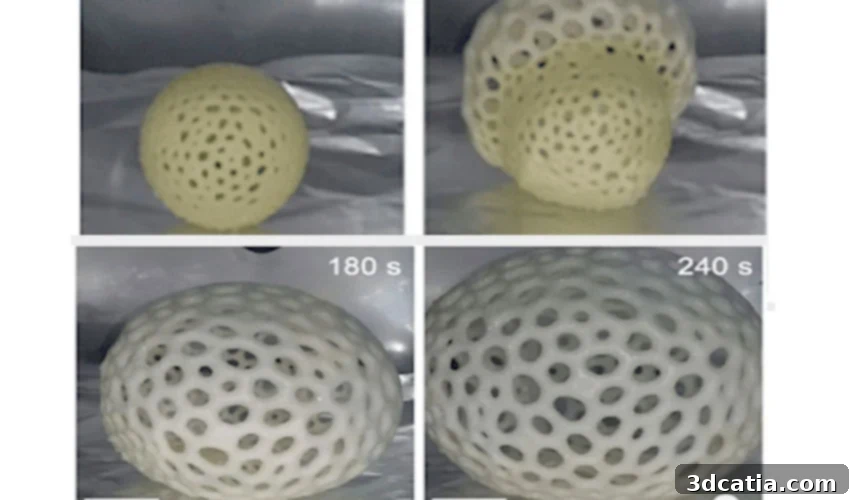
A significant breakthrough in this ongoing pursuit comes from a team of pioneering scientists at UC San Diego. Their research, meticulously detailed in a paper titled “Highly Expandable Foam for Lithographic 3D Printing” published in Applied Materials & Interfaces, introduces a revolutionary concept: a foaming prepolymer resin specifically designed for lithographic additive manufacturing. This innovative material holds the potential to fundamentally transform how large-scale objects are conceived and produced via 3D printing. The core of their invention lies in a specialized resin that, after being initially 3D printed to a manageable size, can subsequently expand to an astonishing 40 times its original volume. This dramatic expansion capability effectively liberates the final part size from the physical dimensions of the 3D printer’s build plate, opening up unprecedented possibilities for design, manufacturing, and application across numerous industries. By decoupling the printing volume from the final product volume, this technology paves the way for a new era of large-scale additive manufacturing that is more accessible, cost-effective, and versatile than ever before.
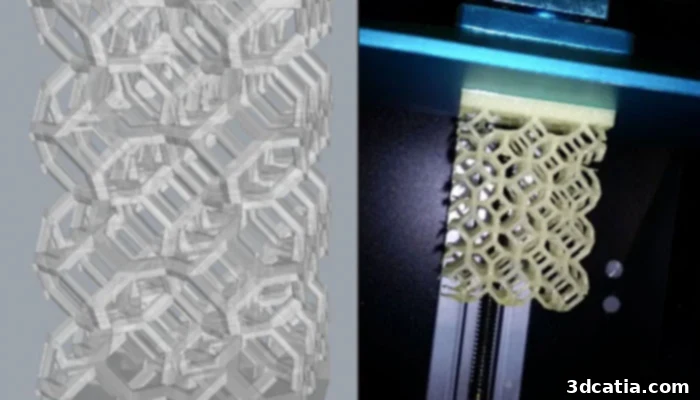
The part is modelled on CAD software and then printed on a lithography 3D printer, ready for subsequent expansion.
The lithographic additive manufacturing process, which forms the foundation for this innovative technology, is characterized by its reliance on polymerization. In this method, a light source—often UV light—selectively hardens layers of a photosensitive material, typically a liquid resin, to build an object layer by layer. The precision and resolution offered by lithography make it an ideal choice for intricate designs and fine details, but traditionally, it has been limited by the physical size of the resin vat and the projector. The UC San Diego team’s breakthrough is the development of a unique foaming prepolymer resin that combines the advantages of lithographic accuracy with the transformative power of volumetric expansion. Once the initial, smaller print is complete, a post-processing step, typically involving heat, triggers a chemical reaction within the resin. This reaction causes the material to foam and expand, dramatically increasing its volume while retaining its structural integrity and predefined geometry. This ingenious approach effectively sidesteps the traditional trade-off between print resolution and print size, allowing for the creation of intricate, large-scale objects without requiring an equally large printing apparatus.
The implications of this expandable 3D printed foam technology are far-reaching, promising to disrupt numerous technologically demanding fields. As the researchers themselves eloquently state in their abstract, “Complex geometries comprised of porous foams have implications in technologically demanding fields such as architecture, aerospace, energy, and biomedicine.” Consider the potential applications:
- Architecture: Imagine designing and printing lightweight, custom structural components or intricate façade elements on-site, expanding them to their full size, and significantly reducing transportation costs and construction time. The porous nature of the foam could also provide excellent insulation properties.
- Aerospace: The aerospace industry constantly seeks materials that offer high strength-to-weight ratios. Expandable foam could be used to produce ultra-lightweight internal structures for aircraft, drone wings, or satellite components. Printing smaller and expanding on demand could revolutionize repair and maintenance operations in remote locations.
- Energy: Large structures like wind turbine blades or components for energy storage systems could be manufactured with greater efficiency. The ability to print complex internal lattice structures within an expanding foam could lead to more efficient heat exchangers or battery casings.
- Biomedicine: While large-scale applications might seem less obvious, the technology could facilitate the creation of custom, patient-specific prosthetics or orthotics that are lightweight and comfortable. Furthermore, highly porous scaffolds for tissue engineering could be precisely printed at a smaller scale and then expanded to accommodate cellular growth.
To concretely demonstrate the efficacy and versatility of their technology and material, the research team constructed two compelling demonstrations. The first was a helical wind turbine, initially 3D printed at one-third of its intended scale. Following the printing process, this smaller model was subjected to the expansion protocol, heating it to its full, operational size. The second demonstration involved a small boat hull, also printed at a reduced scale before undergoing the same expansion procedure. For both demonstrations, the parts were heated at approximately 200°C for a duration of up to ten minutes, effectively triggering the volumetric expansion. These practical applications served as powerful proof-of-concept, illustrating how complex, functional objects, traditionally challenging to produce as single units due to size constraints, can now be fabricated with unprecedented ease and efficiency. The ability to achieve such significant expansion while maintaining geometric fidelity represents a monumental leap forward in additive manufacturing.
The successful development of this expandable foam material was a rigorous process involving meticulous material science. The team’s journey began with the careful selection of a monomer that would serve as the fundamental building block for their innovative polymer resin. They ultimately chose 2-hydroxyethyl methacrylate (HEMA), a well-known monomer often utilized in various biomedical applications and hydrogels due to its biocompatibility and ability to form robust polymer networks. The next critical phase involved identifying the optimal photoinitiator concentration—a chemical compound that initiates the polymerization process upon exposure to light—along with an appropriate blowing agent. The blowing agent is crucial for generating the gaseous phase that causes the material to foam and expand when heated. After extensive experimentation and refinement, the researchers settled on a non-traditional blowing agent, one typically associated with polystyrene-like polymers. The selection of this specific blowing agent, distinct from those commonly used with HEMA, suggests a novel chemical interaction or mechanism designed to achieve the desired controlled and significant expansion. This careful interplay between the monomer, photoinitiator, and blowing agent is what imbues the resin with its unique dual properties: precise printability in its initial state and dramatic expandability during post-processing.
One of the paramount considerations and ongoing challenges for this revolutionary 3D printing process is the maintainance of accuracy and precision. While the initial lithographic print offers high resolution, the subsequent expansion phase introduces a complex variable. Any minor deformation or inconsistency in the printed structure or material composition could potentially be exacerbated by the 40-fold volumetric increase. Achieving consistent and precise final results, particularly for intricate geometries or parts requiring strict dimensional tolerances, will undoubtedly be a key area of focus for future research and development. Factors such as the uniformity of heat application during expansion, the homogeneity of the blowing agent distribution within the printed part, and the precise control over the material’s rheology during foaming will be critical. Engineers will need to develop sophisticated simulation tools and feedback mechanisms to predict and control the expansion process, ensuring that the final expanded part faithfully reproduces the original CAD design. Despite these challenges, the potential to print complex, large objects with such a dramatically reduced initial footprint offers compelling advantages that far outweigh the hurdles, pushing the boundaries of what is possible in additive manufacturing.
This innovation heralds a new paradigm in manufacturing and supply chain logistics. Imagine the ability to print substantial components on demand, locally, without the need for massive, specialized factories. Small, highly detailed parts could be shipped efficiently and then expanded at the point of use, drastically reducing transportation costs and environmental impact. This localized, flexible production model could empower industries from automotive to construction, allowing for faster prototyping, customized product runs, and responsive manufacturing cycles. The economic implications are profound, potentially democratizing access to large-scale large format 3D printing by lowering the barrier to entry in terms of equipment size and cost. Furthermore, the inherent porosity of the expanded foam could open avenues for lightweighting solutions in various sectors, leading to improved energy efficiency in transportation and enhanced material usage in product design. The UC San Diego team’s work is not merely a scientific curiosity; it represents a tangible step towards a future where the only limit to a 3D printed object’s size is imagination, not the machine’s physical constraints.
For those interested in delving deeper into the specifics of this groundbreaking research, the full paper offers comprehensive insights. You can find more information on the paper HERE.
What are your thoughts on this revolutionary expandable 3D printed foam technology and its potential for new types of applications? Do you foresee it overcoming the existing limitations of large-scale manufacturing? We encourage you to share your perspectives and insights in the comments section below. Join the conversation on our Facebook and Twitter pages, where you can connect with a community passionate about additive manufacturing innovations. And to ensure you never miss out on the latest advancements and news in the world of 3D printing, don’t forget to sign up for our free weekly Newsletter, delivering all the essential updates straight to your inbox!