
Empowering the Visually Impaired: How See3D Uses 3D Printing for Tactile Learning and Accessibility
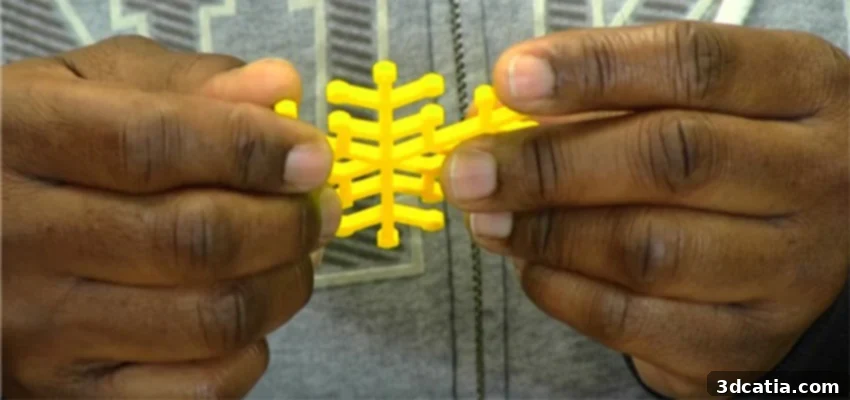
3D printing technology has profoundly transformed numerous sectors, contributing significantly to human welfare and scientific advancement. Its applications span widely, from integrating into diverse education systems to revolutionizing the medical sector through innovations like custom prosthetics and anatomical models. Amidst these varied uses, one remarkable organization, See3D, has harnessed the power of additive manufacturing to directly impact the lives of blind and visually impaired individuals. Recognizing that traditional visual learning methods are inaccessible to many, See3D employs 3D printing to create tangible models, allowing blind people to “see” and understand the world through touch. Operating on a volunteer and donation-based model, See3D’s core mission is to bridge societal gaps, fostering connection across diverse backgrounds while providing invaluable tactile experiences that illuminate concepts many sighted individuals often take for granted. We had the privilege of speaking with its young and inspiring founder, Caroline Karbowski, to delve deeper into this transformative initiative and understand the journey of See3D.
The Visionary Behind See3D: Caroline Karbowski’s Journey
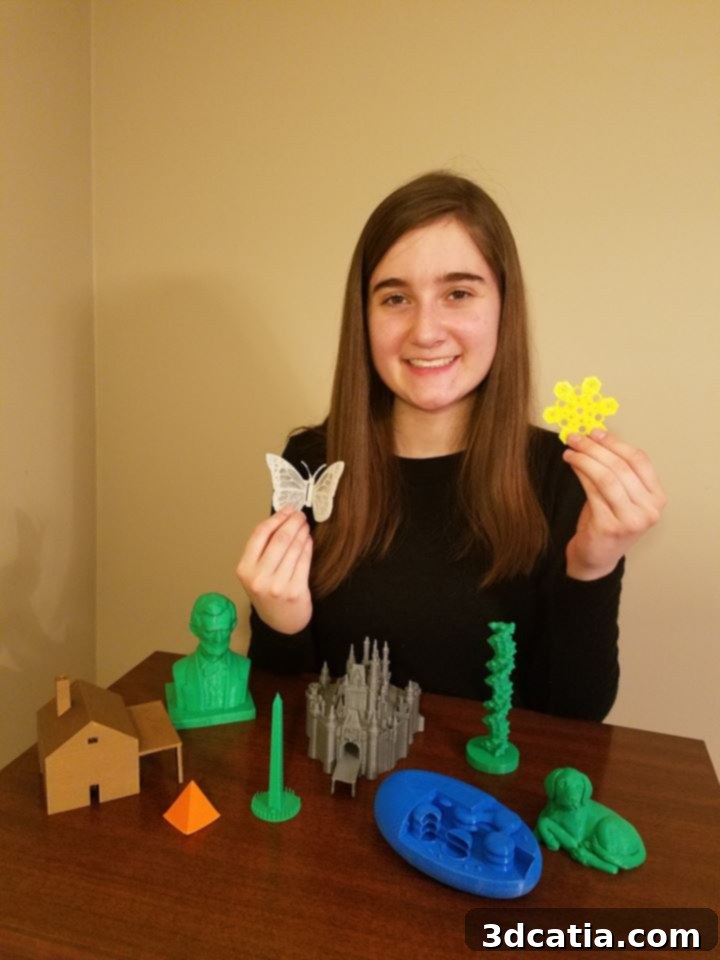
Caroline holds a snowflake (corner_case), and a butterfly (mathgrrl). On the table are models of a house (Nick S./See3D), pyramid (bbennington), Abraham Lincoln bust (TheNewHobbyist), Washington Monument (adams00), castle (gluetolf), chloroplast (xILx), DNA (mtdna), and dog (MustangDave).
Caroline Karbowski, originally from Cincinnati, Ohio, USA, is the driving force behind See3D. Currently a first-year student at The Ohio State University, Caroline’s remarkable journey into advocating for the visually impaired began unexpectedly in 6th grade. Driven by a simple desire to read books in the car without experiencing dizziness, she decided to teach herself braille. This personal endeavor soon intersected with an inspiring discovery: an article detailing how 3D printing could transform telescope and microscope images into tactile representations. This revelation ignited a passion within Caroline, realizing the immense potential for blind individuals to conduct their own scientific observations and deepen their understanding of complex concepts through touch. She envisioned a practical way to contribute by 3D printing these models and augmenting them with braille labels, making knowledge physically accessible.
From Inspiration to Implementation: The Genesis of See3D
Despite her initial enthusiasm, Caroline faced immediate challenges: she didn’t know anyone blind who needed a model, nor did she have access to a 3D printer. The turning point came during her high school years, where 3D printers were readily available. She observed that many students were fascinated by the technology and eager to print objects, yet often lacked specific projects, leading to an abundance of leftover filament. This realization sparked a pivotal idea: “What if we printed models for people who are blind?” This question became the cornerstone of a project she presented at TechOlympics, a prominent student-run technology conference for high school students in Cincinnati. This event provided the perfect platform to launch her concept and gather support.
Working alongside her friends, Caroline developed the See3D website, a crucial platform for receiving model requests. A serendipitous encounter at a college fair led her to Cassandra, a blind individual whose request for a Cinderella castle model became See3D’s very first successful print. This initial success was transformative. Cassandra, delighted with her tactile castle, shared See3D with her network of blind friends, leading to a rapid expansion of the organization’s reach. In the two years following this pivotal moment, See3D has distributed over 500 unique 3D printed models, connecting with a growing community of individuals daily and proving the profound impact of making the visual world tangible through 3D printing.
How See3D Empowers the Visually Impaired Through Tactile Models
See3D operates on a simple yet highly effective model designed to maximize accessibility and community involvement. The process begins with a request: any blind individual, or a teacher, parent, or friend supporting a blind person, can easily submit a request for a specific 3D model through the official See3D website. These requests are then meticulously processed by See3D’s dedicated network of volunteers. Once a model is printed, it is carefully packaged and mailed directly to the recipient, completely free of charge. This ensures that geographical or financial barriers do not prevent anyone from accessing these vital tactile learning tools.
Community Engagement and Advocacy for Braille Literacy
Beyond fulfilling individual requests, See3D actively encourages participation from the wider community. Individuals with prior 3D printing experience, or those simply interested in contributing to the design and printing of models, are invited to connect with the organization via email at in**@***3d.org. This volunteer network is crucial to scaling See3D’s operations and meeting the growing demand for models. Furthermore, See3D is a passionate advocate for broader issues impacting the blind community. The organization tirelessly raises awareness about the critical importance of braille literacy, emphasizes the necessity of orientation and mobility training, and actively champions high expectations for individuals who are blind. Caroline and her team firmly believe that low expectations often create unnecessary barriers between blind individuals and their personal and professional goals for success, underscoring their commitment to fostering an environment of empowerment and opportunity.
- Cassandra examines a 3D print of a yellow Cinderella castle.
- Yellow Cinderella castle designed by gluetolf.
Innovating for Impact: See3D’s Current Projects and Future Aspirations
See3D is continuously evolving to enhance its services and expand its reach. Currently, a significant focus is placed on refining its digital infrastructure, specifically by making the organization’s website and online requesting system even more accessible for visually impaired users. This involves integrating features that facilitate seamless navigation and interaction, ensuring everyone can easily request the models they need. Additionally, the team is actively developing new resources for learning braille, recognizing its foundational importance for literacy and independence. These resources will complement guides on how to effectively print and design models that are not only accurate but also engaging and informative to the touch.
Expanding Educational Outreach and Tackling Complex Design Challenges
An exciting new initiative involves collaboration with a Teacher of the Visually Impaired (TVI) who is blind. This TVI expressed interest in having his own students print models for other blind students, a concept Caroline is incredibly enthusiastic about. This program has the potential to foster a sense of purpose and practical skill development among students, creating a powerful peer-to-peer learning and support network. See3D is also actively seeking funding to purchase 3D printers directly for schools with visually impaired students. This strategic move aims to significantly reduce waiting times for models, placing the tools for tactile learning directly into educational environments. Recent requests highlight the diverse needs within the community, including models of an eye, intricate street maps, and even abstract concepts like a Yin Yang symbol, all of which the team is diligently working to print and distribute. Furthermore, Caroline is keen to recruit students at her own institution, The Ohio State University, to contribute to the various stages of the model creation process, from design and printing to cleaning and mailing.
Securing the Future: Scaling Operations and Technological Partnerships
Looking ahead, Caroline envisions a future where See3D’s outreach is vastly expanded. Recognizing that it can currently take between one to five weeks to print and distribute models, she hopes to significantly grow the volunteer network to expedite this process. A key ambition is to provide 3D printers directly to more schools serving blind students, making tactile resources immediately available. Developing a robust network of designers dedicated to creating new and complex requested objects is also a priority. Caroline plans to integrate See3D into university 3D printing design classes, allowing students to fulfill challenging requests—such as models of fire, sound waves, or a roller coaster, which have proven difficult to successfully print thus far—as part of their academic assignments. This integration would not only address complex design needs but also introduce future engineers and designers to the unique requirements of accessible design.
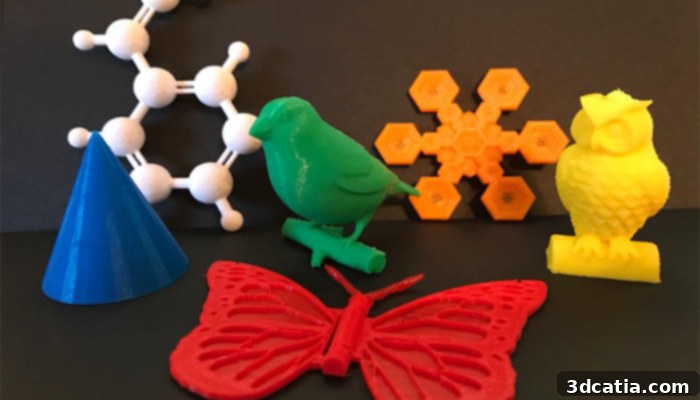
Examples of requests include a pyramid (bbennington), styrene molecule (neonorangehats), zebra finch (Fynn Große-Bley), butterfly (mathgrrl), snowflake (corner_case), and owl (BrOncO)
Currently, See3D has been able to provide all models free of charge, primarily through the generous contributions raised via its GoFundMe page. Caroline is optimistic that See3D can achieve sustained self-funding through a combination of grants and continued donations, ensuring the long-term provision of this invaluable service. Another ambitious goal is to establish a sponsorship program where businesses or individuals can fund a 3D printer for a school. See3D also aims to forge strong relationships with 3D printing companies, encouraging them to develop printers and slicing software that are fully accessible via screen readers and braille displays. This would empower blind individuals not only to receive models but also to design and print their own, fostering unparalleled independence and creativity.
A Broader Perspective: The Importance of Braille, Accuracy, and Empathy
Beyond its direct services, See3D is dedicated to raising broader societal awareness about blindness and the urgent need for accessible educational materials. Caroline highlights a sobering statistic: less than 10% of blind students are taught braille. See3D hopes that by spotlighting braille’s indispensable role in education, more blind students will gain the opportunity to learn this crucial skill, which is fundamental for literacy, employment, and full participation in society. Ultimately, See3D strives to create deeper connections between sighted and blind individuals, fostering mutual understanding and enabling everyone to gain richer, more diverse perspectives of the world.
Beyond Sight: Accurate Models for Comprehensive Education
Caroline emphasizes the critical importance of creating 3D models that accurately represent their real-world counterparts. Just as an incorrectly drawn picture can lead to misconceptions, an inaccurate 3D model can hinder effective learning in an educational setting. Precision ensures that blind individuals receive correct information and develop a true understanding of the objects they are exploring through touch. She firmly believes that blindness should never be considered a defining characteristic that limits an individual’s potential. With the right accessible materials—including braille, tactile graphics, screen readers, and, of course, 3D printed models—everyone has the capacity to reach their fullest potential, breaking down barriers and fostering independence.
Challenging Perceptions and Fostering Understanding
Caroline strongly encourages everyone to engage with a blind person and inquire about their unique interpretations of the world. She shares a fascinating anecdote: one of her blind friends described the color orange as “cold,” simply because oranges are typically stored and consumed cold from the refrigerator. This anecdote beautifully illustrates the profound and often surprising insights that can be gained when we rely on all our senses and open ourselves to different perspectives. It highlights how much sighted individuals can learn by understanding the tactile, auditory, and olfactory experiences of others. Caroline expresses immense excitement for the discoveries that await individuals as they engage with and explore the world through the power of touch, facilitated by See3D’s meticulously crafted 3D printed models.
What are your thoughts on See3D’s incredible initiative? Would you consider lending a helping hand, perhaps by volunteering your 3D printing skills or supporting their mission? Share your insights and comments below, or connect with us on our Facebook and Twitter pages! Don’t miss out on the latest advancements in additive manufacturing – subscribe to our free weekly Newsletter for all the breaking news in 3D printing delivered straight to your inbox!