
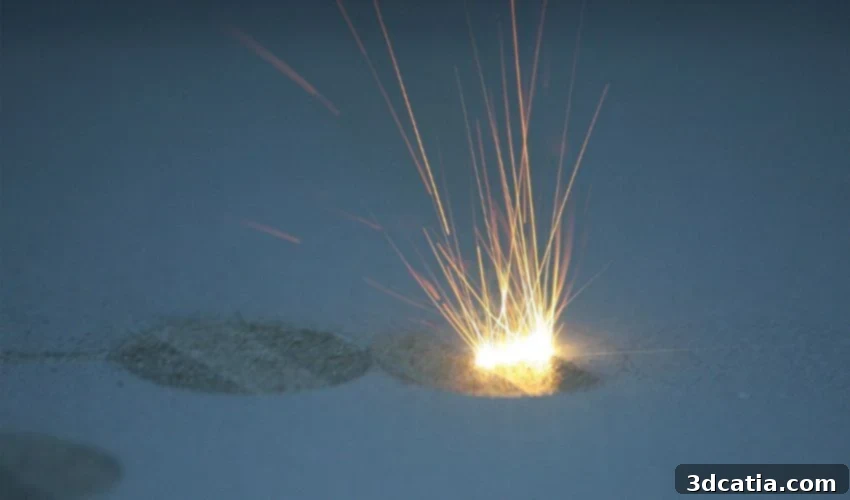
Revolutionizing Metal 3D Printing: Advanced Detection and Prevention of Keyhole Pores for Superior Part Quality
The field of additive manufacturing, particularly metal 3D printing, promises unprecedented design freedom and the ability to produce complex, high-performance parts. However, achieving consistent mechanical properties and structural integrity remains a significant challenge. One of the most critical issues faced in processes like Laser Powder Bed Fusion (LPBF) is the formation of structural defects, specifically ‘keyhole pores’. These microscopic voids can drastically compromise the strength, fatigue life, and overall reliability of additively manufactured components, hindering their widespread adoption in critical applications across industries such as aerospace, medical, and automotive.
In a groundbreaking development, a collaborative team of scientists from the University of Virginia, Carnegie Mellon University, and the University of Wisconsin-Madison has introduced an innovative method designed to both detect and prevent the formation of these detrimental keyhole pores. This research, supported by funding from the Department of Energy, focuses on addressing a fundamental barrier to the production of high-quality metal parts. By skillfully integrating advanced imaging techniques—specifically x-ray imaging and thermal imaging—with sophisticated multiphysics simulations, the team successfully identified and monitored ‘keyhole oscillation’ during the laser powder bed fusion of a widely used titanium alloy, Ti-6Al-4V. This multidisciplinary approach offers a comprehensive solution, moving beyond mere detection to a proactive prevention strategy, thereby paving the way for more robust and reliable 3D-printed metal components.
Understanding Keyhole Pores: A Critical Challenge in Metal Additive Manufacturing
To appreciate the significance of this research, it’s essential to understand what keyhole pores are and why they pose such a formidable problem. Laser Powder Bed Fusion (LPBF) operates by precisely melting and fusing layers of metal powder particles using a high-energy laser beam. This process, while enabling the creation of intricate geometries, is highly sensitive to various parameters, most notably the laser energy input. When the laser energy is excessively concentrated on a particular zone of the part, it can lead to a phenomenon known as keyhole formation.
The process begins with the intense laser beam delivering a high power density to the metal powder, causing it to rapidly melt. If the energy input surpasses a certain threshold, the metal within the melt pool not only melts but also begins to vaporize. This vaporization generates a significant recoil pressure, which acts downwards, pushing the surface of the molten metal pool away from the laser beam. This localized depression in the melt pool surface forms a deep, narrow cavity, often referred to as a “keyhole,” due to its characteristic shape resembling a keyhole in a lock. Within this keyhole, the laser beam undergoes multiple reflections and absorptions, further intensifying the localized heating and exacerbating the vaporization process. This self-reinforcing cycle makes the keyhole inherently unstable.
The instability of the keyhole is where the primary issue arises. As the keyhole oscillates and fluctuates, it can momentarily collapse. During these collapses, vapor bubbles or pockets of gas can become entrapped within the molten metal. As the material rapidly solidifies behind the moving laser, these gas bubbles get ‘frozen’ into the solidifying metal matrix, forming permanent pore defects. These keyhole pores are not merely aesthetic imperfections; they represent critical structural weaknesses within the part. They act as stress concentrators, significantly increasing the likelihood of part fatigue and serving as initiation sites for crack propagation under mechanical load. For demanding applications where components are subjected to high stresses or cyclic loading, the presence of such defects can lead to premature failure, rendering the part unfit for purpose and necessitating costly rework or scrap.
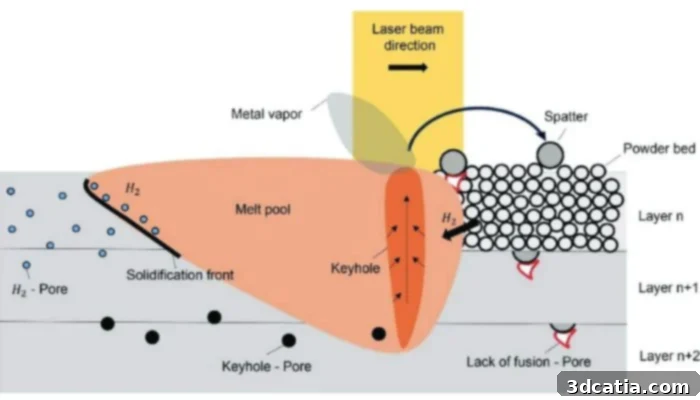
Understanding the visual manifestation of pore formation in laser powder bed fusion (Photo credits: Natan Nudelis and Peter Mayr, licensed under Creative Commons 4.0)
Advanced Detection and Prevention: A Multi-faceted Approach
The research team, spearheaded by Zhongshu Ren and Tao Sun at the University of Virginia, devised a sophisticated methodology that integrates advanced experimental techniques with computational intelligence to overcome the keyhole pore challenge. Their approach centered on developing a robust method to first detect the precursors to keyhole pores and then leverage that information for prevention.
Unveiling Keyhole Dynamics with X-ray and Thermal Imaging
A cornerstone of their method involved the synergistic use of advanced imaging technologies. High-speed x-ray imaging played a crucial role by allowing researchers to peer directly into the melt pool dynamics during the LPBF process. Unlike conventional optical imaging, x-rays can penetrate the dense metal powder and molten material, providing an unprecedented, real-time view of the subsurface keyhole behavior. This direct observation enabled the team to precisely track the tendency of keyhole oscillation—the rapid fluctuations in its depth and stability—which are direct indicators of impending pore formation. The x-ray data essentially served as the “ground truth” for understanding the complex physics occurring beneath the surface.
While x-ray imaging is invaluable for fundamental research and process understanding, its industrial application can be challenging due to cost, safety, and logistical complexities. This is where thermal imaging provided a practical alternative for real-time industrial implementation. Thermal cameras capture the surface temperature profiles of the melt pool, offering a non-invasive and readily deployable method for process monitoring. The researchers discovered that the surface temperature signatures, even if indirect, correlated strongly with the subsurface keyhole oscillations revealed by the x-ray data. This crucial correlation allowed them to develop a predictive model.
The data gathered from both x-ray and thermal imaging, combined with insights from multiphysics simulations, formed the basis for training an advanced machine learning model. Multiphysics simulations are computational models that integrate multiple physical phenomena (e.g., fluid dynamics, heat transfer, phase changes) to simulate the complex interactions within the melt pool. These simulations provided a deeper theoretical understanding, validating experimental observations and helping to identify the key parameters and features that characterize keyhole instability.
The developed machine learning model leverages thermal imaging data to detect the characteristic thermal signatures associated with unstable keyhole behavior. By analyzing these real-time temperature fluctuations, the model can accurately identify when keyhole pores are likely to form. This breakthrough shifts defect detection from a post-process inspection (which only identifies already-defective parts) to an in-situ, real-time monitoring and prediction system. This capability is paramount for additively manufactured parts, as it enables corrective actions to be taken during the build process itself, or even predictively prevent defects by adjusting laser parameters.
High Applicability to Industry and the Power of Machine Learning
The implications of this research for the laser powder bed fusion industry are substantial. The researchers firmly believe that their results are highly applicable to industrial 3D printing operations. As Sun confirmed, “Our approach provides a viable solution for high-fidelity, high-resolution detection of keyhole pore generation that can be readily applied in many Additive Manufacturing scenarios.” This statement underscores the practical nature of their innovation, suggesting it’s not merely a laboratory curiosity but a robust tool ready for industrial integration.
For manufacturers, this means a significant step towards achieving zero-defect production in metal additive manufacturing. Real-time detection allows for immediate process adjustments, reducing scrap rates, saving valuable material and energy, and ultimately lowering production costs. Furthermore, by ensuring parts are free from critical defects, it streamlines the often-arduous qualification and certification processes for AM components, especially in highly regulated sectors like aerospace and medical devices where part reliability is non-negotiable.
Beyond the immediate practical benefits, this project also highlights the transformative power of machine learning in scientific research and engineering. Zhongshu Ren commented, “This project truly changed my perception of machine learning… [it] is a great tool for scientific research and engineering applications, as long as its result can be interpreted.” This emphasis on interpretability is vital in engineering; simply getting a prediction isn’t enough. Engineers need to understand *why* a prediction is made to trust the system and make informed decisions, especially when safety-critical parts are involved. The integration of multiphysics simulations and x-ray data provides the necessary foundation for interpreting the ML model’s outputs, bridging the gap between raw data patterns and physical phenomena.
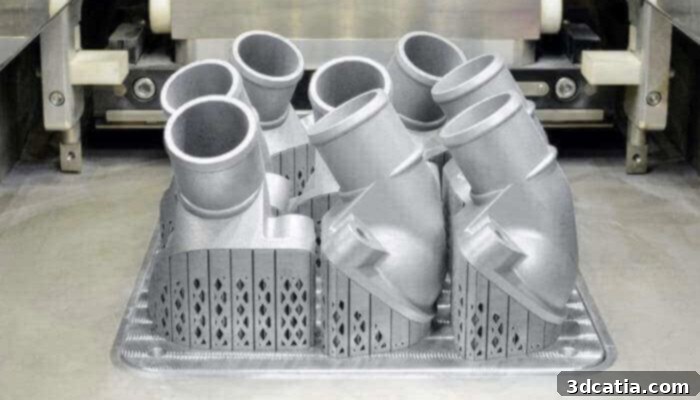
LPBF’s capability to produce high-quality metal parts is enhanced by advanced defect prevention.
A Generic and Practical Technique for Enhanced Structural Integrity
A particularly compelling aspect of this research is the generality and transferability of the developed technique. According to the team, their analysis of oscillation behaviors is ‘generic and practical’, indicating that the underlying principles and methodologies are not exclusive to specific materials or geometries. This means the insights gained from studying Ti-6Al-4V—a critical material for aerospace and biomedical implants due to its high strength-to-weight ratio and biocompatibility—can be adapted and applied to other metal alloys and different additive manufacturing scenarios. This broad applicability significantly increases the impact of their findings across the entire metal AM landscape.
Engineers and manufacturers can leverage this analytical framework to systematically prevent keyhole pores, thereby consistently producing parts with superior structural and mechanical properties. By mitigating the risk of defect formation, this method ensures a lower probability of part failure during service, leading to increased product reliability and enhanced consumer safety. The ability to monitor and control the LPBF process in real-time, coupled with predictive capabilities, marks a significant stride towards truly robust and repeatable additive manufacturing. This research not only offers a solution to a critical problem but also provides a template for future developments in smart, self-correcting 3D printing systems. For those interested in delving deeper into the scientific intricacies of this pioneering work, the full paper is available HERE.
What are your thoughts on this innovative laser powder bed fusion experiment aimed at preventing pore formation? We invite you to share your insights and comments below, or engage with us on our LinkedIn, Facebook, and Twitter pages! Don’t miss out on the latest advancements in additive manufacturing—sign up for our free weekly Newsletter here to get the freshest 3D printing news delivered straight to your inbox! You can also explore all our compelling videos and content on our YouTube channel.
*Cover photo credits: GE Additive