

LulzBot Manufacturer Aleph Objects Forges Strategic Partnership with FluidForm to Propel 3D Bioprinting for Functional Tissue Engineering
In a significant development for the additive manufacturing and biomedical fields, Aleph Objects Inc., the Colorado-based manufacturer renowned for its open-source LulzBot 3D printers, has announced an exciting new venture into bioprinting. Celebrated for their commitment to user freedom – allowing unrestricted copying, modification, and conversion of their designs – Aleph Objects is now poised to enter the rapidly expanding sector of 3D bioprinting. Their strategic announcement highlights the upcoming release of new bioprinting hardware this summer, with an ambitious long-term objective: the creation of real, functional human tissues. This move underscores a broader trend within the industry, as bioprinting technologies continue to witness tremendous growth and groundbreaking advancements. Recent months have seen incredible strides, perhaps none more captivating than the small 3D bioprinted heart developed by researchers at Tel-Aviv University, a testament to the accelerating pace of innovation. This burgeoning segment of additive manufacturing is clearly attracting substantial investment and attention from leading manufacturers, eager to contribute to and capitalize on its transformative potential.
To navigate and innovate effectively within this complex domain, Aleph Objects has chosen to collaborate with FluidForm Inc., a recognized innovator in the realm of 3D bioprinting. FluidForm is celebrated for its groundbreaking FRESH (Freeform Reversible Embedding of Suspended Hydrogels) technique, a revolutionary approach that enables the precise 3D printing of delicate bioinks and other soft materials within a support bath. This unique methodology allows for the fabrication of complex, free-standing structures that would otherwise collapse under their own weight during the printing process. Through this synergistic collaboration, both companies intend to combine their distinct areas of expertise to develop and offer advanced bioprinting solutions to a global market. The initial fruit of this partnership will be the introduction of new bioprinting hardware, anticipated for release later this summer. Adam Feinberg, CTO of FluidForm, emphasized the nascent yet promising stage of the field, stating, “We’re still at the very beginning of being able to build real functional tissues with 3D bioprinting. Collaborations like the one we are building with LulzBot will help make this a reality faster”. This sentiment highlights the critical importance of inter-corporate partnerships in accelerating research and development within this cutting-edge scientific discipline.
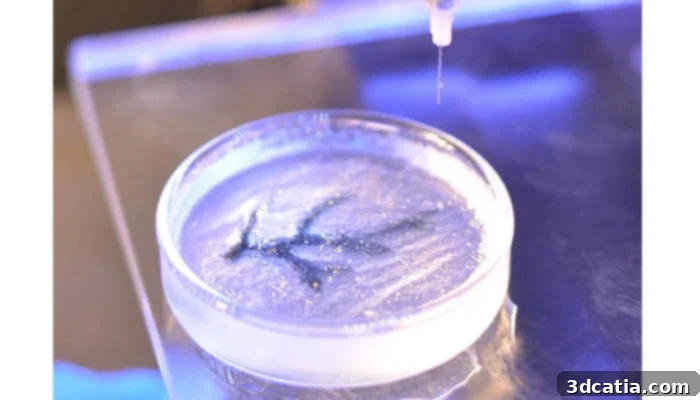
FluidForm’s FRESH bioprinting technique harnesses the power of non-Newtonian gels to allow movement through a material like it’s a liquid, while supporting deposited material like it’s a solid | Credits: FluidForm
The FRESH Technique: A Breakthrough for Soft Material Bioprinting
The FRESH technique stands as a cornerstone of FluidForm’s innovation, offering a unique solution to one of the most significant challenges in bioprinting: working with soft, pliable materials. Traditional 3D printing methods often struggle with bioinks, which are typically composed of hydrogels and living cells, as these materials lack the structural integrity to hold their shape during deposition. FRESH overcomes this by utilizing a non-Newtonian support gel. This gel behaves as a solid under low shear stress, providing a stable platform for the printed material, but fluidizes under high shear stress, allowing the printer nozzle to move through it freely. Once the printing process is complete, the support gel can be easily melted or dissolved away, leaving behind the intricate, free-standing bioprinted structure. This ability to precisely deposit and support delicate biological materials opens up unprecedented possibilities for creating complex tissue architectures, including those with intricate vascular networks essential for nutrient and oxygen transport in larger, functional tissues.
Revolutionizing Industries: Diverse Applications of 3D Bioprinting
It is unequivocally true that bioprinting technologies are catalyzing a revolution across an expansive spectrum of industries. Their transformative impact is being felt acutely in fields such as pharmaceuticals, where bioprinted tissue models are accelerating drug discovery and testing, offering more accurate and patient-specific insights than traditional methods. In regenerative medicine, bioprinting holds the promise of fabricating custom tissues and organs for transplantation, thereby addressing critical shortages and improving treatment outcomes for a multitude of conditions. Drug screening benefits immensely from the ability to create complex, multi-cellular tissue models that more closely mimic in-vivo environments, leading to more reliable and predictive test results. Beyond human health, bioprinting is making inroads into food and other animal products, particularly in the emerging field of cellular agriculture, where it could revolutionize sustainable meat production. Cell-based biosensors, designed for rapid detection of pathogens or toxins, are another promising application. Furthermore, the development of advanced bioprinted models is enhancing the testing and development of healthcare goods and medical devices, ensuring their efficacy and safety before widespread use.
Ethical Advancements: Bioprinting for Cosmetics Testing
One particularly significant and ethically impactful application of bioprinted tissues is in the realm of cosmetics testing. The growing global demand for cruelty-free products and increasingly stringent regulations against animal testing have created a pressing need for viable alternatives. Bioprinted skin models, for instance, offer a highly accurate and ethical platform for testing the safety and efficacy of cosmetic ingredients and formulations without harming animals. These models can closely replicate the structural and functional characteristics of human skin, allowing for robust toxicology and irritancy assessments. It is widely anticipated that within the next decade, major pharmaceutical and cosmetics companies will progressively replace a substantial portion of their traditional animal testing protocols with relevant 3D bioprinted human tissues, marking a monumental shift towards more humane and scientifically advanced research practices.
Market Projections and the Future of Bioprinting
The strategic importance of this collaboration and the broader bioprinting market cannot be overstated. Grant Flaharty, CEO and President of Aleph Objects, articulated this vision clearly, stating, “Combining proven expertise in professional 3D printers and hardware with 3D biofabrication technology is going to be an absolute game-changer. The market for 3D bioprinters and 3D bioprinted tissues is estimated to grow to $1.9 billion by 2028.” This robust market projection underscores the immense potential and rapid adoption expected within the next few years. The driving forces behind this growth include not only ethical considerations but also the sheer scientific advantage of working with human-specific models, leading to more accurate research, reduced development costs, and faster time-to-market for new therapies and products. The ability to create personalized tissues for individual patients, along with the potential for organ fabrication, positions bioprinting as one of the most impactful technologies of the 21st century.
The collaboration between Aleph Objects, a veteran in accessible and reliable 3D printing hardware, and FluidForm, a pioneer in advanced bioprinting materials and techniques, represents a formidable alliance. This partnership is not merely about launching a new product; it’s about laying down critical infrastructure for the future of biomedical engineering. By democratizing access to sophisticated bioprinting tools, they aim to empower researchers, scientists, and innovators worldwide to accelerate discoveries in regenerative medicine, pharmaceutical development, and beyond. This synergistic approach will undoubtedly play a pivotal role in transforming theoretical possibilities into tangible, life-changing realities, moving closer to the ambitious goal of engineering fully functional human tissues and organs.
*Cover photo credits: Aleph Objects Inc.
We’re eager to hear your thoughts on this exciting new collaboration and the future of bioprinting! Let us know what you think in a comment below, or engage with us on our Facebook and Twitter pages. Don’t forget to sign up for our free weekly Newsletter to receive all the latest news and advancements in 3D printing delivered straight to your inbox!