

The Future is Dynamic: Exploring Groundbreaking Applications and Innovations in 4D Printing
Have you ever envisioned objects that could transform, adapt, and evolve after their creation? Welcome to the world of 4D printing, an ingenious evolution of conventional 3D printing that introduces an extraordinary fourth dimension: time. Unlike static 3D-printed artifacts, 4D-printed objects possess the remarkable ability to change their shape, color, or size in response to external stimuli such as temperature, light, magnetism, or moisture. This transformative technology, first introduced in 2013, traces its origins to the pioneering work of Skylar Tibbs from MIT’s Self-Assembly Lab. Tibbs remains a prominent figure in the field, even as 4D printing continues to advance at an astonishing pace, unlocking a myriad of innovative applications across diverse sectors. In this article, we delve into some of the most successful and impactful examples of 4D printing projects, exploring the cutting-edge applications and smart materials that are defining the future of additive manufacturing.
Mizzou Engineering Pioneers Personalized Medical Implants with Smart Materials
In a significant stride for medical science, a team of researchers from Mizzou Engineering recently unveiled a groundbreaking 4D-printed medical implant. Published earlier this year, their study highlighted the implant’s capacity for full personalization, a critical factor in tailored patient care, and its ability to promote soft tissue regeneration, thanks to its unique material composition. The innovative approach leverages the dynamic capabilities of 4D printing, which seamlessly integrates advanced 3D printing technology with intelligent materials designed to adapt their functions within specific biological contexts. For this particular implant, the team utilized a bioresorbable shape memory elastomer. This choice of material allows the implant to be precisely customized to address individual patient complaints, ensuring an optimal treatment pathway. As Alireza Mahjoubnia, a PhD student in mechanical engineering, explained, “We designed an in vitro model of the patient and implanted it intravascularly inside a 3D printed heart of the patient to show a proof of concept of how the material would be used for that issue.” This innovative material exhibits remarkable shape memory behavior, programmed to navigate complex anatomical structures. Mahjoubnia added, “The material can change behavior based on physiological conditions. We program its shape to go through a catheter and after it gets inside the left atrial appendage, it can recover its shape to go back to its original shape, showing shape memory behavior.” This not only facilitates minimally invasive implantation but also ensures the device conforms perfectly to the patient’s anatomy, offering a new frontier in personalized regenerative medicine.

Photo Credits: University of Missouri
Advancing Bone Regeneration with Smart 4D Biopiezoelectric Scaffolds
Beyond soft tissue, 4D printing is also making significant inroads into orthopedic applications, particularly in bone regeneration. A team of researchers in China has explored the exciting potential of creating smart 4D biopiezoelectric scaffolds designed to facilitate bone regrowth. Piezoelectricity, the ability of certain materials to generate an electric charge in response to mechanical stress, is a fundamental property of human bones and plays a crucial role in natural bone regeneration processes. Consequently, biopiezoelectric materials have garnered considerable attention for their therapeutic potential in repairing damaged bone tissue. However, conventional manufacturing techniques often struggle to produce the intricate, customized scaffolds required for effective clinical applications, limiting their widespread adoption. Addressing this challenge, the Chinese researchers meticulously investigated how 3D and 4D printing could revolutionize the fabrication of biopiezoelectric scaffolds, enabling the creation of highly complex and precisely structured architectures. The distinct advantage of 4D scaffolds lies in their time-dependent programmable tissue response; they can adapt and change shape or properties when exposed to specific external stimuli, such as mechanical load or physiological cues. These intelligent implants represent a significant leap forward in bone tissue engineering, capable of dynamically evolving in situ. By integrating smart functionality and customizable design, these next-generation implants hold immense promise for enhancing bone healing and improving patient outcomes, offering a sophisticated alternative to current treatment modalities.

Piezoelectric materials, printing processes, and potential applications for 4D implants. (Credits: Annan Chen et al 2023 Int. J. Extrem. Manuf.)
4D Devices That Mimic Nature: Inspired by Plants
The versatility of 4D printing extends even to bio-inspired design, with researchers finding innovative ways to replicate natural phenomena. A collaborative team from the Wyss Institute and the School of Engineering and Applied Sciences at Harvard University has successfully developed 4D-printed hydrogel composites that mimic the dynamic responses of plants and flowers to environmental changes like humidity and temperature. To achieve this remarkable feat, they formulated a specialized ink composed of aligned cellulose fibrils, meticulously derived from wood. This unique ink was then configured according to a precise mathematical model tailored for 4D printing, allowing for the programming of specific expansion and stiffness properties. When these prints are immersed in water, they exhibit predefined expansion behaviors, transforming their shapes in a controlled manner. The brilliance of this approach lies in its adaptability: different hydrogel materials can be employed, and the cellulose fibrils can be substituted with other functional fillers, such as conductive particles, opening up a vast array of possibilities. The potential applications for such biomimetic materials are incredibly diverse, ranging from advanced medical devices that adopt programmed shapes upon contact with bodily fluids to smart textiles that react to their environment, soft electronics, highly sensitive sensors, and sophisticated electrical actuators. This research showcases 4D printing’s capacity to create truly adaptive and responsive functional objects by drawing inspiration from nature’s most elegant designs.
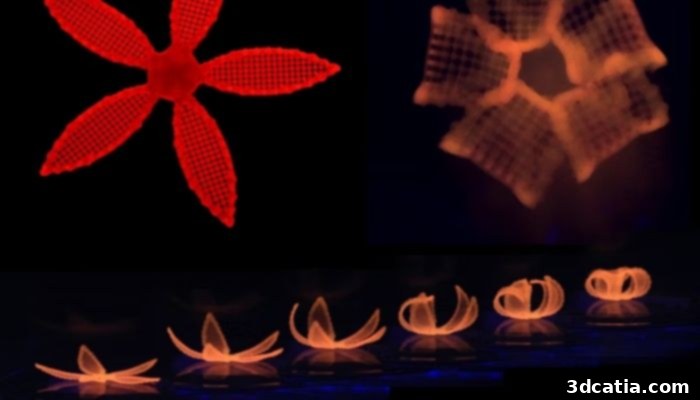
Photo Credits: Wyss Institute
Transforming Robotics with 4D Printing: Liquid Metals and Adaptive Systems
The field of robotics stands to be profoundly revolutionized by 4D printing, particularly in the development of soft, adaptable, and highly functional machines. At the University of Queensland, researchers Dr. Liwen Zhang and Dr. Ruirui Quiao have spearheaded a groundbreaking 4D printing technology capable of creating liquid metals that dynamically change shape when exposed to near-infrared light. These innovative metal polymers, which can execute mechanical tasks controlled by infrared lasers, are currently in the advanced research phase. However, their potential applications are immense and far-reaching, spanning critical sectors such as aerospace and medical technologies, where they could be used to produce next-generation artificial muscles. The printing resins are ingeniously formulated using spherical metal nanoparticles that exhibit a strong reaction to infrared light, allowing for precise control and movement. The laboratory’s novel manufacturing methods enable the creation of designs that are not only highly flexible but also remarkably strong and durable. Dr. Zhang emphasized the transformative nature of this technology: “4D printing takes traditional 3D printing and adds a new dimension – the dimension of time.” She further highlighted the versatility: “The versatility of this technology has been demonstrated by their 4D printed designs that can bend, grasp, lift, and revert to pre-programmed shapes, surpassing their weight limits.” A key advantage of this method is the elimination of traditional wiring or complex circuits, granting engineers unprecedented freedom in designing smart liquid metals that can evolve their form and function over time. This technology is poised to significantly impact soft robotics, enabling the creation of systems that can mimic natural movements and interactions with unparalleled fidelity and adaptability.

The 4D structure that is set in motion by near-infrared light (photo credits: Australian Institute of Bioengineering and Nanotechnology University of Queensland)
Enabling Future Missions: 4D Printing for Space Travel
The rigorous demands of space travel, particularly concerning weight reduction and deployable structures, present an ideal scenario for 4D printing applications. Zortrax, a renowned 3D printer manufacturer, dedicated over a year to a pioneering 4D printing project, financially supported by the European Space Agency. The objective was to develop electrical mechanisms using 3D printing that could bend, twist, and unfold on command. While initial research in 2013 explored heat-activated 4D-insertable structures, the process proved challenging to control and activated at a relatively low 40°C, limiting its practical utility. This obstacle has now been overcome through advancements in materials, software, and 3D printer technology. The project successfully incorporated shape memory polymers, characterized by a higher glass transition temperature of 75°C, ensuring greater stability and control. Additionally, the electrically conductive filament FIBERFORCE NYLFORCE Conductive was employed, acting as an integrated heater to trigger the crucial shape memory effect. This effect describes the material’s inherent ability to return to its pre-programmed original shape after being deformed. The Z-SUITE software, paired with the M300 Dual dual extrusion 3D printer – capable of simultaneously printing with two print heads using a bi-material process – provided the necessary precision and flexibility. The resulting design featured a spring-like structure, engineered to generate sufficient torque for a 3D-printed chassis to rotate smoothly without friction. This remarkable advance offers immense potential for space travel, as it could dramatically reduce the weight of critical components such as antennas or sensors. Furthermore, the underlying process can be scaled and applied to significantly larger mechanisms, promising lighter, more compact, and more easily deployable structures for future space missions. The project, while still in its research phase, highlights the transformative impact of 4D printing on aerospace engineering.

Photo Credits: Zortrax
The I-Seed Robot: A Bio-Inspired Autonomous Monitor
Inspired by the ingenious survival mechanisms of plants, researchers at the Italian Institute of Technology (IIT) have developed the soft robot known as I-Seed, utilizing the transformative capabilities of 4D printing. This innovative, plant seed-inspired robot is designed to autonomously analyze and monitor vital environmental conditions, including soil and air temperature and humidity, while also detecting the presence of pollutants. The design of I-Seed directly mimics the biomechanical operation of a South African geranium seed, a natural marvel capable of changing shape upon absorbing moisture. The IIT researchers leveraged the FDM (Fused Deposition Modeling) printing process, employing biodegradable polycaprolactone-based polymers to construct the robot. This choice of material underscores a commitment to sustainability and environmental integration. The core principle behind I-Seed’s functionality is its ability to physically transform in response to external environmental cues, specifically humidity. By meticulously emulating the biomechanical specifications of the African plant, the researchers ensured that I-Seed’s dimensions and performance would be as close as possible to that of a real seed. This biomimetic approach allows I-Seed to passively navigate and embed itself within soil, providing localized environmental data. The I-Seed robot exemplifies how 4D printing can enable the creation of autonomous, environmentally responsive devices with significant implications for ecological monitoring, agriculture, and smart sensing applications.
MIT’s Legacy: 4D Printed Self-Assembling Objects
As previously highlighted, the genesis of 4D printing is intrinsically linked to Skylar Tibbs and the groundbreaking work conducted at the MIT Self-Assembly Lab. It is therefore no surprise that this lab continues to be a pivotal force in the additive manufacturing landscape, consistently pushing the boundaries of what is possible with 4D technology. Among their many influential projects, an iconic early example from 2013 remains a cornerstone in the field: 4D printed self-assembling cubes. These remarkable structures are fabricated from hydro-reactive composite polymers, strategically combining hydrophilic (water-attracting) elements with non-active, rigid components. The genius of this design lies in its inherent responsiveness to water. When exposed to an aqueous environment, the hydrophilic elements absorb water and swell, causing a controlled internal stress that forces the entire chain to morph and fold into a predefined new shape – specifically, a perfect cube, as mesmerizingly demonstrated in their seminal video. This project not only showcased the fundamental principles of 4D printing but also ignited widespread interest in designing materials that can autonomously reconfigure. Building on this legacy, the MIT Self-Assembly Lab has continued its innovative trajectory, with more recent projects exploring the potential of dynamic textiles, such as a pioneering 4D Knit Dress that adapts its form.
Designing for Adaptability: 4D-Printed, Bistable Structures
Within specialist circles, 4D printing is often lauded as a significant “upgrade” to traditional 3D printing, primarily due to its incorporation of the critical dimension of time, allowing objects to change post-fabrication. This recognition fuels innovative research focused on developing and testing new materials specifically for 4D printing, alongside experimenting with novel designs that harness these dynamic capabilities. A compelling example comes from ETH Zurich, where PhD student Tim Chen engaged in a research project centered on the design of printed, deployable, and active systems. Chen’s initial focus was on exploring optimal designs for these 4D-printed structures, with the overarching goal of precisely controlling material behavior so that printed parts would react predictably to their environment. His work specifically concentrated on integrating bistable connections within his structures. Bistability refers to the ability of a structure to exist stably in two distinct shapes, transitioning rapidly between them upon receiving a specific stimulus. This characteristic is highly desirable for creating devices that can snap into a new configuration and hold it without continuous energy input. Such controlled and desired changes to shapes and functions hold immense potential and could prove profitable for a wide array of applications, including self-erecting architectural components, adaptable soft robotics, deployable aerospace mechanisms, and dynamic elements within the automotive industry. The ability to program discrete state changes offers a new paradigm in smart material engineering.
Precision Implantation: 4D Hydrogel Structures for Minimally Invasive Procedures
The medical field is particularly ripe for innovation with 4D printing, especially in developing minimally invasive surgical solutions. A recent study, published in the prestigious journal Nature Communications, describes a breakthrough in this area: the development of dynamic thermosetting polyurethanes for multimaterial 4D printing. The primary objective of this research was to engineer support structures that could be implanted with minimal invasiveness. The research team successfully created structures endowed with a shape memory capability, which is specifically activated by the body’s natural temperature. Furthermore, these structures are designed to deform upon contact with water, adding another layer of programmable responsiveness. The application process for these innovative supports is elegantly designed: initially, a 2D pattern is printed. This 2D pattern can then be temporarily reduced to a one-dimensional, slender shape, which significantly facilitates its insertion into the body through a narrow catheter. Once the structure is positioned inside the body, the ambient body temperature acts as a stimulus, causing the material to recover its original 2D shape. The final transformation occurs upon hydration: the material absorbs bodily fluids, expands due to a carefully engineered swelling mismatch, and ultimately transforms into the desired complex 3D structure. This remarkable combination of shape memory, programmable deformability, and precise expansion and stiffness properties renders these developed thermoset polyurethanes exceptionally promising for creating intricate filling supports for a new generation of minimally invasive medical implants, promising enhanced patient comfort and faster recovery times.
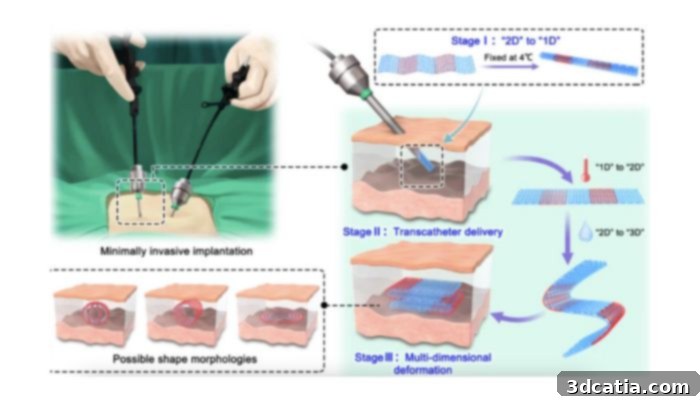
Photo Credits: Nature Communications
Unlocking Dynamic Potential: 4D Printing with Shape Memory Resins
The exploration of smart materials for 4D printing continually yields fascinating results, as demonstrated by a research project focused on advanced shape memory resins. In this endeavor, scientists have ingeniously developed a novel material formulated from a combination of photosensitive resin and liquid crystals. The inclusion of liquid crystals is critical, as they imbue the future 3D-printed part with the ability to dynamically alter its form under the influence of temperature fluctuations. The fabrication process involves meticulously mixing 5% by weight of these specialized liquid crystals into a tank containing toluene, maintained at a precise temperature of 70°C. Following this, the mixture is carefully cooled overnight, allowing the toluene to evaporate completely. The resulting shape memory material is then precisely utilized with a DLP (Digital Light Processing) 3D printer, a method known for its high resolution and intricate detail capabilities. The outcomes of this research are nothing short of impressive: when these 3D-printed parts are subjected to elevated temperatures, they predictably deform and transition into a new shape. Crucially, upon the subsequent drop in temperature, these parts reliably revert to their original, pre-programmed configuration. This reversible shape change capability opens up a wealth of possibilities for creating components that can dynamically adapt to thermal environments, offering solutions for smart sensors, responsive actuators, and intelligent structures that can self-repair or reconfigure on demand.
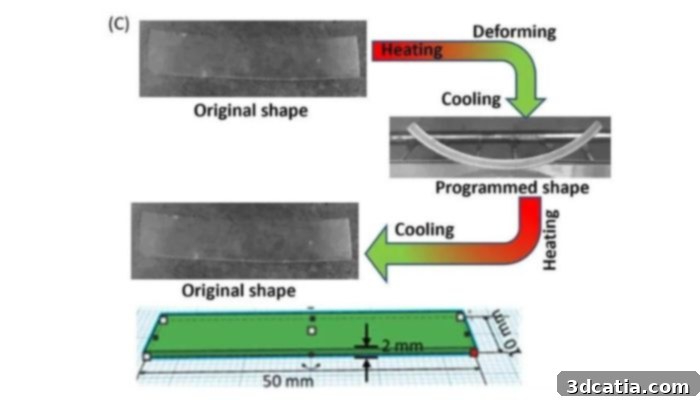
Photo Credits: Nature
Magnetoactive Polymer Actuators: Precise Control Through Magnetic Fields
Another remarkable advancement in 4D printing comes from CEA-Iramis in France, where a team of scientists has successfully developed highly controllable actuators using magnetoactive polymers. This innovative approach involves the 4D printing of smart materials that can respond dynamically to magnetic fields. The initial phase of their research included extensive experiments and simulations to understand the intricate self-assembly behavior of magnetite nanoparticles within photosensitive resins, observing how they arrange into wire-like structures. The mechanical properties of the resulting photopolymers could be finely tuned by adjusting the resin composition, while the magnetic responsiveness was modified by varying the concentration of nanoparticles within each printed layer. To achieve precise control over the magnetoactive properties, the scientists ingeniously adapted a standard DLP 3D printer. This modification allowed them to apply a magnetic field with adjustable intensity and direction during the fabrication of each successive layer. Through this sophisticated process, they were able to create a series of objects exhibiting programmed behaviors, such as actuators capable of rotating or bending precisely on command. Furthermore, by combining these magnetic wheels with non-magnetic structural elements, the team developed complex systems like linear actuators and active grippers. This technology offers a paradigm shift in creating wirelessly controllable, responsive components for soft robotics, microfluidics, and various sensing applications, where intricate and remote actuation is required.
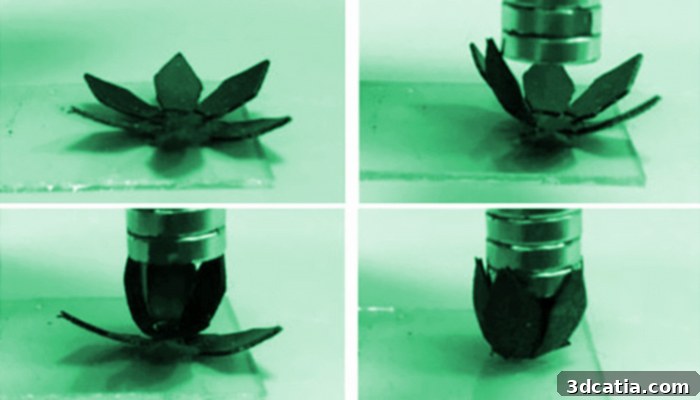
Photo Credits: CEA-Iramis
Hygromorphic Structures: Responding to Humidity with 4D Printing
The environment’s subtle shifts often hold the key to natural adaptations, and 4D printing is now harnessing this principle to create responsive materials. Harvard defines hygromorphic behavior as “responding to changes in environmental humidity by changing geometry.” Consequently, hygromorphic smart structures are increasingly sought after due to their wide-ranging and impactful applications, from innovative weather-responsive architectural skins that can adapt to climatic conditions to advanced adaptive wearables that enhance user comfort and functionality. The exciting news is that 4D printing now offers a viable pathway to fabricate these dynamic structures. In a recent research article, scientists detailed how fused filament fabrication (FFF), combined with biobased cellulose-filled filaments, can achieve humidity-responsive actuation. The key lies in utilizing filaments with varying degrees of stiffness and hygroresponsiveness, strategically combined with mesoscale structuring within the printed elements. By employing a standard dual-extruder FFF 3D printer, the researchers successfully produced parts that demonstrated a clear response to ambient relative humidity, exhibiting a remarkable ability to fold in on themselves. This process highlights a fascinating and practical approach to creating 4D-printed, humidity-responsive structures. The ability to precisely engineer objects that can change their form based on moisture levels has significant implications for fields such as sustainable architecture, smart packaging, and self-deploying environmental sensors.
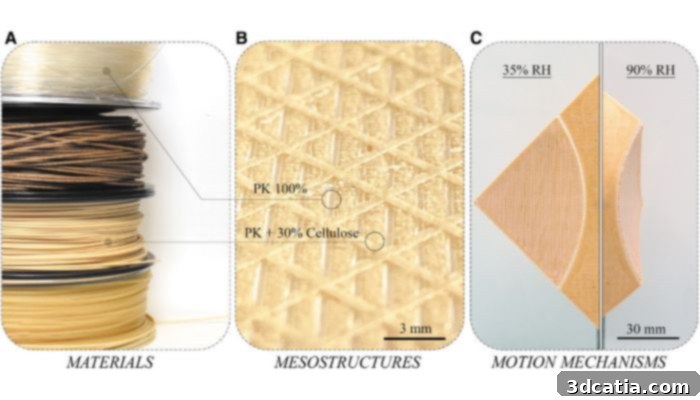
A graph showing the materials used, design of the mesostructures and the results of the hygromorphic structures (photo credits: Tahouani et al.)
The journey through these diverse projects clearly illustrates that 4D printing is far more than a mere academic curiosity; it is a rapidly evolving field poised to revolutionize numerous industries. From personalized medical implants and regenerative scaffolds to bio-inspired robots, advanced aerospace components, and self-assembling consumer products, the integration of time as a programmable dimension opens up unprecedented possibilities. The ability to create objects that can adapt, transform, and react to their environment in a predictable manner heralds a new era of smart materials and intelligent design. As research continues to uncover new responsive materials and sophisticated programming techniques, the potential applications for 4D printing are bound to expand even further, promising a future where objects are not just built, but grown to dynamically interact with the world around them. This is truly the dawn of a dynamic future, shaped one transforming layer at a time.
What do you think of these innovative 4D printing projects? We invite you to share your thoughts and insights in a comment below or connect with us on our LinkedIn, Facebook, and Twitter pages! Don’t forget to sign up for our free weekly newsletter here for the latest 3D printing news straight to your inbox! You can also find all our videos on our YouTube channel.