
UK’s Secret 3D Printed Drones: Transforming Warfare for Ukraine’s Defense
More than a year has passed since the war in Ukraine began to exert its catastrophic and devastating effects across the nation. While international allies, particularly NATO organizations, have diligently supplied aid in the form of traditional weapons and ammunition to Ukrainian citizens, the protracted nature of the conflict has increasingly highlighted a critical need for more agile, innovative, and cost-effective solutions. It is in this context that a previously undisclosed program from the UK has been brought to light: a clandestine initiative to develop advanced 3D-printed “suicide” drones for Ukraine, poised to offer a significant strategic advantage against the ongoing Russian invasion.
This burgeoning fleet of unmanned aerial systems encompasses both sophisticated surveillance and reconnaissance platforms, essential for intelligence gathering and battlefield awareness, alongside a truly groundbreaking variant: an innovative 3D-printed version of suicide drones uniquely shaped like hang gliders. These advanced solutions are designed for rapid deployment, enabling Ukrainian forces to field them quickly and at a substantially lower cost compared to the delivery of heavy, conventional weaponry. Furthermore, these drones present a more economically viable and logistically accessible alternative for the country, posing a significant aerial threat that could crucially tip the balance in favor of Ukraine’s interests in the current, dynamic conflict.
The Evolving Landscape of Modern Warfare and the Urgency of Innovation
The conflict in Ukraine has dramatically reshaped our understanding of contemporary warfare. It has underscored that while traditional military might remains foundational, sustained success often hinges on the ability to rapidly adapt, innovate, and deploy unconventional yet effective technologies. The sheer scale and duration of the war have placed immense strain on both human resources and conventional supply chains, compelling a shift towards solutions that are not only powerful but also sustainable and easy to reproduce. Traditional military aid, though vital, faces challenges of logistics, cost, and the sheer time required for manufacturing and delivery. This environment necessitates a move towards systems that can be swiftly produced, customized for specific tactical needs, and integrated into existing defense infrastructures with minimal friction.
Drones, or Unmanned Aerial Systems (UAS), have emerged as front-line tools in this evolving battlespace. Their inherent advantages—including reduced risk to human personnel, enhanced surveillance capabilities, precision strike potential, and comparatively lower operational costs—make them invaluable. The ability of drones to conduct reconnaissance deep behind enemy lines, identify targets, and even engage them with pinpoint accuracy without risking pilots’ lives, offers a strategic edge that traditional military assets often cannot match. This makes the UK’s focus on advanced drone technology a logical and timely response to the pressing demands of the Ukrainian conflict.
Additive Manufacturing: Revolutionizing Defense Production with 3D Printing
At the heart of the UK’s innovative drone program is the transformative power of 3D printing, also known as additive manufacturing. This technology is revolutionizing how defense equipment is conceived, designed, and produced, offering unparalleled benefits critical for rapid military response. Unlike traditional subtractive manufacturing, which carves objects from larger blocks of material, 3D printing builds them layer by layer, directly from digital models. This process brings several crucial advantages to the table, especially for urgent military applications:
- Accelerated Prototyping and Development: 3D printing drastically cuts down the time required to move from design concept to a functional prototype. Engineers can iterate on designs, test various configurations, and refine performance characteristics in a matter of days or weeks, a timeline impossible with conventional methods. This agility is paramount in a rapidly changing conflict environment.
- Cost-Effectiveness for Specialized Production: While 3D printing may not always be ideal for mass production of simple parts, it offers significant cost savings for low-volume, highly specialized, or customized components. It minimizes the need for expensive tooling and fixtures, reduces material waste, and can lower labor costs associated with intricate assembly. This makes advanced drone technology more financially accessible for nations like Ukraine.
- Unmatched Customization and Design Complexity: Additive manufacturing excels at creating intricate geometries and complex internal structures that are impossible to achieve with traditional techniques. This allows for highly optimized designs that improve aerodynamic performance, integrate multiple functions into a single part, or house specialized sensors and payloads. Each drone can be tailored to a specific mission profile, maximizing its effectiveness.
- Decentralized and Distributed Manufacturing Potential: The digital nature of 3D printing means that design files can be sent anywhere in the world and printed locally. This opens up possibilities for distributed manufacturing, where drones or their components could be produced closer to the operational theater. Such decentralization reduces logistical vulnerabilities, speeds up deployment, and enhances resilience in supply chains under duress.
- Reduced Material Waste: By building objects layer by layer, 3D printing typically uses only the necessary material, leading to significantly less waste compared to subtractive manufacturing processes. This efficiency is not only environmentally beneficial but also contributes to overall cost reduction and resource optimization.
These inherent advantages position 3D printing as a cornerstone for modern defense innovation, enabling the rapid and efficient production of advanced, yet affordable, unmanned systems like those being developed through the KINDRED Program.
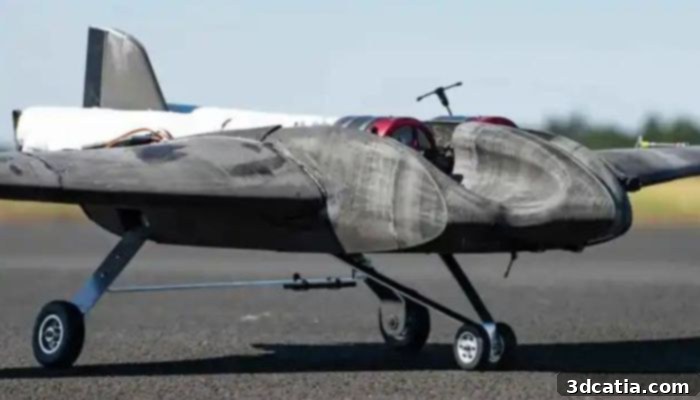
The only publicly released image of a 3D printed suicide drone developed for the conflict in Ukraine, showcasing a unique hang-glider design. (Photo credits: QinetiQ)
The KINDRED Program: UK’s Classified Initiative for Ukrainian Defense
The extensive drone program being developed for Ukraine is an integral part of an ambitious and highly classified initiative known as the KINDRED Program. This overarching project originated within the Future Capabilities Group of the British Ministry of Defence, a specialized unit entrusted with the critical mission of identifying, developing, and fielding the next generation of advanced weapons and military technologies for the UK armed forces. The core objective of the KINDRED Program extends beyond mere provision of arms; it aims to equip Ukrainian forces with innovative solutions that are not only effective but also characterized by unprecedented speed of deployment and exceptional cost-efficiency.
Within the scope of KINDRED, a variety of advanced unmanned systems are being explored and developed. These include sophisticated surveillance and reconnaissance drones, which are indispensable for gathering crucial intelligence, monitoring enemy movements, and maintaining comprehensive battlefield awareness. However, a particularly innovative element of the program is the development of 3D-printed “suicide” drones. These unique systems are engineered with a distinctive hang-glider shape, a design choice likely intended to enhance aerodynamic efficiency, extend flight duration, and potentially reduce their radar cross-section, enabling a more stealthy approach to targets. These cost-effective kamikaze drones represent a significant paradigm shift in military capabilities, offering a potent air threat that could crucially influence the tactical balance on the ground by neutralizing high-value targets with precision and at a scalable cost.
QinetiQ’s Pivotal Role and the Clandestine Revelation
A central figure in this highly secretive development program is QinetiQ, a distinguished British multinational defense technology company. QinetiQ boasts a long and reputable history as a key partner of the Royal Navy, having been involved in numerous advanced high-tech defense and space projects. Their participation in the KINDRED Program underscores the serious and sophisticated nature of the initiative, leveraging their extensive expertise in defense innovation and systems integration.
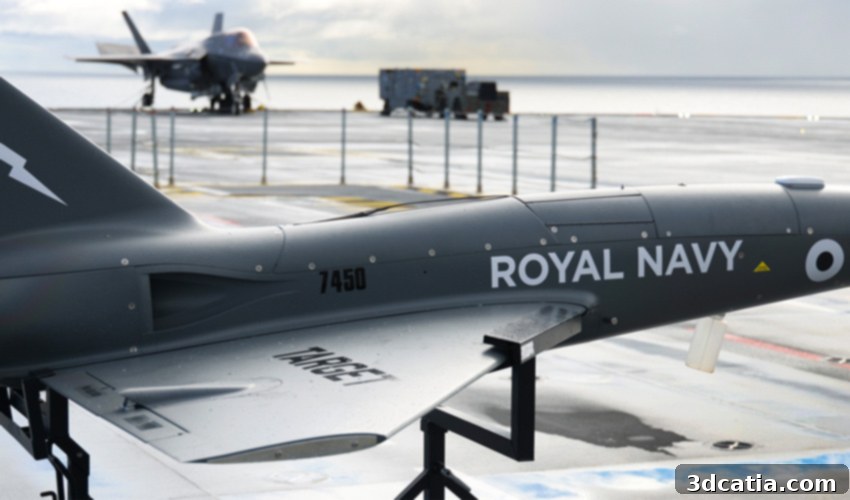
The existence of this otherwise clandestine initiative was inadvertently revealed by the company itself. QinetiQ published a statement on its website, which was subsequently removed within hours, confirming its involvement in a program designed to “provide recommendations on unmanned aircraft systems that could be easily deployed by the Ukrainian military.” This brief, yet telling, announcement offered a rare glimpse into the covert efforts. While QinetiQ’s statement refrained from disclosing specific details regarding the drone’s timeline or technical specifications, it was accompanied by a crucial photograph. This image depicted a small drone, distinctly characterized by a swept wing and a prominent tail fin, suggesting an aerodynamic design optimized for performance. Notably, the description further highlighted that the drone was “apparently powered by a pair of microturbine motors, and 3D printed.” This specific detail confirmed the application of advanced additive manufacturing techniques in its construction and pointed towards a high-performance propulsion system, indicating a sophisticated and innovative approach to drone design.
Rapid Development and Rigorous Testing at Boscombe Down
The KINDRED Program operates under an exceptionally demanding and accelerated development timeline, reflecting the urgent operational needs arising from the conflict. While the broader KINDRED initiative aimed to evaluate and field various weapon systems in less than four months, the timeline for the drone component was even more aggressive: a mere three weeks. During this compressed period, QinetiQ and four other unnamed companies converged at the Boscombe Down proving ground in southern England to showcase and rigorously test their experimental technologies.
Boscombe Down is a highly renowned and secure military aircraft testing establishment, providing the ideal environment for evaluating cutting-edge aerospace and defense systems. The test projects conducted there were comprehensive and diverse, encompassing a range of innovations critical for modern drone warfare. These included advanced command and control payloads, designed to ensure seamless communication and operational precision; sophisticated sensors, vital for enhanced intelligence gathering and target identification; and state-of-the-art VTOL (vertical takeoff and landing) drones, which offer unparalleled operational flexibility by eliminating the need for runways. Crucially, the trials also featured the 3D-printed hang glider “suicide” drone, subjecting it to stringent evaluations to confirm its capabilities and operational effectiveness under simulated real-world conditions. This rapid progression from conceptualization to rigorous field testing within such a short timeframe is a testament to the program’s commitment to leveraging additive manufacturing for swift and impactful military innovation.
The Strategic Impact and Future of Drone Warfare
The deployment of these 3D-printed drones by Ukrainian forces, facilitated by the UK’s KINDRED Program, holds the potential to significantly alter the dynamics of the ongoing conflict and could well serve as a blueprint for the future of modern warfare. The inherent cost-effectiveness of these systems makes them amenable to mass production and widespread deployment, providing Ukraine with a scalable means to project power, gather intelligence, and maintain superior situational awareness across vast and contested fronts. The “suicide” drone variant, in particular, offers a precise and relatively low-cost method for neutralizing high-value enemy assets, including command centers, logistical hubs, air defense systems, and armored vehicles, thereby disrupting critical enemy operations and capabilities.
Beyond the immediate conflict, this initiative powerfully underscores a broader, accelerating global trend: the increasing reliance on Unmanned Aerial Systems (UAS) as indispensable components of military arsenals worldwide. As geopolitical landscapes become more complex and conflicts demand increasingly adaptable and asymmetrical responses, the capability to rapidly design, manufacture, and deploy sophisticated drones will become an even more critical determinant of military effectiveness. The KINDRED Program, through its innovative blend of advanced manufacturing and strategic foresight, serves as a compelling example of how cutting-edge technology can provide disproportionate tactical advantages and redefine national security paradigms in the 21st century.
Looking Ahead: The Evolution of Defense Technology
While detailed information regarding the ongoing deployment and battlefield performance of these classified drones remains undisclosed, the KINDRED Program undeniably points towards a future where additive manufacturing will assume an increasingly central role in defense and national security. The capacity to rapidly develop, iterate, and integrate new technologies—leveraging advancements in materials science, digital design, and automated production—will empower nations to respond to emerging threats with unprecedented agility and efficiency. This secret UK-Ukraine collaboration is far more than just the development of a new fleet of drones; it stands as a potent testament to the transformative potential that arises from the convergence of cutting-edge manufacturing techniques with urgent operational demands. It sets a powerful precedent for future innovations in military technology and strategic defense, signaling a new era of rapid, adaptable, and technologically driven warfare.
For more detailed information about QinetiQ and their significant contributions to defense technology, you can visit their official website HERE.
We encourage you to share your valuable thoughts and insights on the development and strategic deployment of 3D-printed drones in contemporary warfare. Let us know your perspective in the comments section below or connect with our community on our social media channels: LinkedIn, Facebook, and Twitter. To stay informed with the very latest innovations and breaking news in the world of 3D printing, don’t forget to sign up for our free weekly Newsletter here, delivered directly to your inbox! You can also explore all our engaging video content and interviews on our dedicated YouTube channel.