
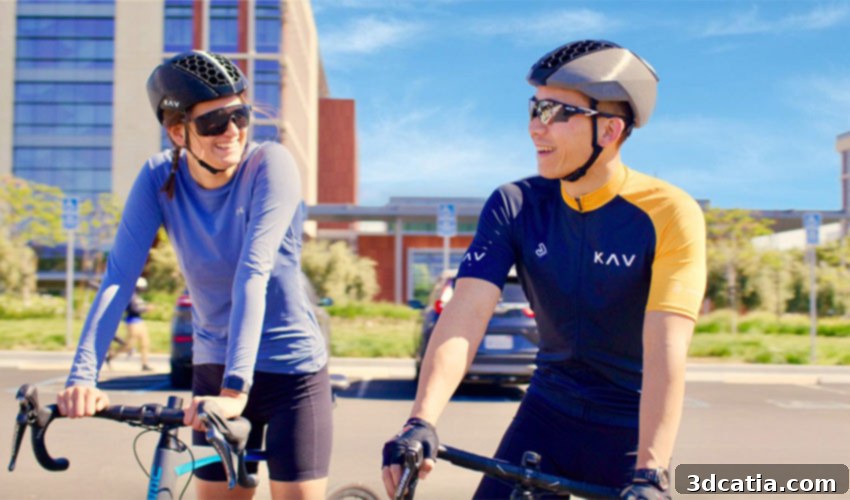
KAV Redefines Cycling Safety with Custom 3D Printed Bicycle Helmets: An Innovation in Sports Technology
For many years, the intersection of advanced manufacturing and athletic performance has been a dynamic field, with 3D printing emerging as a transformative technology in sports. Additive manufacturing, also known as 3D printing, has repeatedly demonstrated its vast potential, offering unparalleled customization, improved performance, and enhanced protection for athletes across a spectrum of disciplines. From developing specialized protective gear in high-impact sports to creating performance-optimizing components, 3D printing is rapidly changing how sports equipment is designed, manufactured, and utilized. Its applications range widely, encompassing everything from intricate parts for American football helmets to lightweight, aerodynamic components for cycling, and robust protection for ice hockey players.
The rise of 3D printed equipment is not just a passing trend; it signifies a fundamental shift towards personalized and highly efficient athletic gear. Take, for instance, the innovative work seen in bicycle helmets. In 2020, a collaborative effort by three Chinese designers resulted in a 3D printed bicycle helmet based on the intricate Voronoi diagram, showcasing how complex geometric structures can be leveraged for both aesthetic and functional advantages, such as improved ventilation and impact distribution. Following a similar trajectory of innovation, KAV, a pioneering company in the additive manufacturing space, has developed its own unique 3D printed bicycle helmet designed to set new standards in safety and performance. This groundbreaking product recently garnered significant attention through a highly successful Kickstarter campaign, illustrating strong market demand for such advanced solutions.
KAV’s Journey: Pioneering Custom 3D Printed Sports Equipment
KAV is far from being a newcomer to the realm of 3D printed sports equipment. Based in the heart of Silicon Valley, this forward-thinking company has strategically focused its expertise on two demanding sports: cycling and ice hockey. On its website, KAV already offers a specialized range of 3D printed helmets and essential accessories tailored specifically for hockey players, demonstrating a proven capability in creating high-performance, customized protective gear. Building upon this success and a deep understanding of athlete needs, KAV is now poised to expand its product line with the introduction of custom-fit helmets for cyclists, promising to revolutionize rider safety and comfort.
Whitman Kwok, CEO of KAV, articulates the company’s vision and the critical need for innovation in the cycling market: “Despite a market where every aspect of cycling, from gearing ratios to saddle position, is meticulously tuned for maximum performance, cyclists have historically had to settle for a ‘few sizes fits all’ mentality when it comes to protecting the most important part of the body – the head. The KAV Bike Helmet continues our tradition of creating a helmet that is uncompromising in both performance and protection, a feat made possible by our unique made-to-measure fabrication technology. Personally, my KAV helmet replaces and significantly outperforms both my previous aero helmet and my vented road helmet, while the additional occipital coverage offers perfect extra protection, especially for my adventurous gravel rides.” Kwok’s statement underscores KAV’s commitment to pushing the boundaries of what’s possible in protective sports gear, ensuring that cyclists no longer have to compromise on safety or comfort.
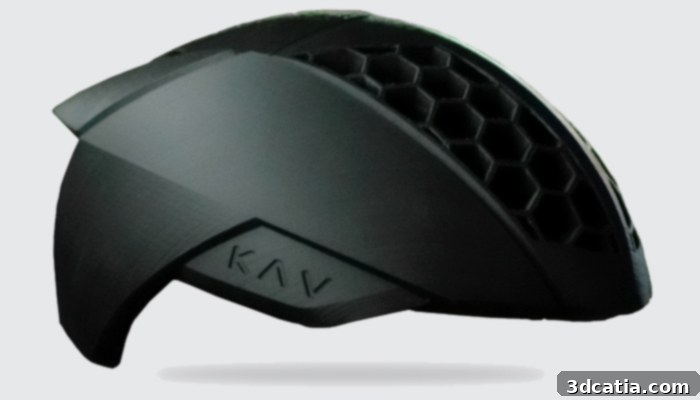
KAV’s custom 3D printed bicycle helmet, engineered for superior protection and airflow (photo credits: KAV)
The Technology Behind KAV Helmets: Unpacking Design and Materials
What makes up the KAV helmet?
At the core of the KAV helmet’s revolutionary design is a proprietary polymer specifically developed for optimal performance. This advanced material, combined with the precision of an FDM (Fused Deposition Modeling) 3D printer, allows KAV to craft helmets that excel not only in absorbing impact but also in maximizing airflow around the rider’s head. The polymer in question is an innovative blend, prominently featuring Thermoplastic Polyurethane (TPU). TPU is renowned for its exceptional elasticity, durability, and energy absorption capabilities, making it an ideal choice for protective sports equipment. Its inherent lightness is a significant advantage, as it helps to limit impact forces during a collision while keeping the overall helmet weight to a minimum.
According to KAV, a finished helmet is designed to weigh less than 300 grams (approximately 0.66 lbs), making it one of the lightest options available on the market, contributing significantly to rider comfort and reducing neck strain during long rides. The additive manufacturing process employed by KAV utilizes machines offering an impressive precision of 50 micrometers. This microscopic level of detail enables the creation of highly complex internal structures and finely tuned ventilation channels that would be impossible to achieve with traditional manufacturing methods. The ability to print with such accuracy ensures that every curve, vent, and structural element is precisely as designed, maximizing both protection and aerodynamic efficiency.
The Power of Personalization: Custom Fit for Ultimate Safety
One of KAV’s most compelling innovations lies in its commitment to custom manufacturing. Recognizing that a truly protective helmet must fit perfectly, KAV provides a unique fitting kit that allows customers to accurately take their head measurements from the comfort of their home. This data is then used to 3D print a helmet that is perfectly adapted to the individual contours and size of the customer’s head. This bespoke approach transcends the limitations of traditional mass-produced helmets, where riders often have to compromise on fit, leading to discomfort or, more critically, reduced safety in the event of an impact. A custom-fitted helmet not only enhances safety by ensuring optimal coverage and energy absorption but also significantly improves comfort, allowing cyclists to focus entirely on their ride.
Beyond the immediate benefits of enhanced safety and comfort, KAV’s focus on custom manufacturing offers substantial environmental advantages. By producing helmets only when ordered and precisely to the customer’s specifications, the American company virtually eliminates the problem of surplus inventory and manufacturing waste. This “on-demand” production model significantly reduces the environmental impact typically associated with the mass manufacture of sports equipment, aligning with growing global trends towards sustainable and responsible production practices. This approach minimizes material waste, energy consumption, and the carbon footprint related to logistics and storage, demonstrating how additive manufacturing can contribute to a greener industry.
Expanding the Horizon: 3D Printing’s Impact Beyond KAV
KAV’s innovative efforts are part of a broader movement within the cycling and sports industries, where 3D printing is catalyzing a new era of product development. The concept of personalized athletic gear, once a niche, is rapidly becoming a standard thanks to additive manufacturing. This is not an isolated innovation; it echoes the pioneering work of other companies leveraging 3D printing to redefine performance. For instance, Specialized has developed 3D-printed optimized saddles, meticulously designed to improve comfort and performance by precisely matching rider anatomy. Similarly, HEXR offers custom 3D printed helmets, further demonstrating the viability and superiority of personalized protective equipment. These examples collectively highlight a significant shift from generic, off-the-shelf products to highly individualized solutions that cater to the unique needs of each athlete. The ability to create complex lattice structures, fine-tune material properties, and integrate biometric data makes 3D printing an indispensable tool for future sports innovation, extending beyond helmets to everything from custom orthotics and prosthetics to advanced footwear and training aids.
Kickstarter Success: A Testament to Market Demand
The market’s enthusiastic reception of KAV’s vision was clearly demonstrated during its Kickstarter campaign. The campaign achieved remarkable success, greatly surpassing its initial funding goal of €8,248. With the strong backing of 88 supporters, the campaign successfully raised €23,040, validating KAV’s innovative approach and the significant demand for custom-fit, high-performance cycling helmets. This overwhelming support from the community not only provides KAV with the necessary capital to scale production but also sends a clear message to the broader sports equipment industry: personalization, advanced materials, and sustainable manufacturing practices are what modern athletes truly desire. The success of this campaign marks a pivotal moment for KAV, enabling them to bring their groundbreaking custom 3D printed helmets to a wider audience and continue their mission of enhancing athletic safety and performance. You can find more comprehensive information about the campaign and its milestones by visiting the dedicated Kickstarter page HERE.
What are your thoughts on these innovative 3D printed bike helmets and the future of additive manufacturing in sports? We encourage you to share your insights in a comment below or join the conversation on ourFacebook,Twitter andLinkedIn pages! For the very latest updates and cutting-edge developments in 3D printing technology, sign up for our free weeklyNewsletter here, delivering essential industry news straight to your inbox!
Thumbnail Photo Credits: KAV