
Brewing Innovation: 3D Printing Sustainable Objects from Recycled Coffee Grounds
As the landscape of additive manufacturing continues its exponential growth, unlocking unprecedented creative avenues, a critical focus has emerged on establishing early precedents for sustainability within the industry. Trailblazers are actively pursuing the development of environmentally friendly materials to lead this charge, seeking solutions that address the ecological footprint of this rapidly expanding technology. At the forefront of this movement is Michael Rivera, an assistant professor at the ATLAS Institute at the University of Colorado Boulder, whose pioneering work aims to revolutionize 3D printing through sustainable practices. His innovative approach centers on transforming everyday waste, specifically used coffee grounds, into a highly versatile, 3D printable material. This groundbreaking material is not only easy to produce but also inherently reusable and biodegradable, offering a compelling alternative to conventional plastics. The overarching goal of Rivera’s research group is to identify and implement sustainable production methods that can significantly reduce energy consumption, curtail the reliance on new plastics, and drastically decrease the amount of waste generated across the 3D printing sector. This initiative is particularly vital given the ever-increasing popularity and demand for 3D printing technologies globally, underscoring the urgent need for eco-conscious material solutions.
The environmental impact of current 3D printing practices presents a significant challenge. A considerable portion of plastics commonly utilized in consumer 3D printing eventually finds its way into landfills, contributing to a mounting global waste crisis. For instance, Polylactic Acid (PLA), often touted as a biodegradable material, requires specific industrial composting facilities to properly break down—conditions that are not widely accessible to the average consumer. Consequently, many PLA prints, despite their biodegradable label, still end up in general waste streams where they persist for extended periods. Acrylonitrile Butadiene Styrene (ABS), another popular printing plastic, is recyclable but completely non-biodegradable. This means that while it can theoretically be reprocessed, the infrastructure for effective recycling is often lacking, and mishandled ABS plastics become permanent fixtures in our environment. This unfortunate reality ensures that vast quantities of these plastics accumulate in landfills, alongside other persistent waste products like used coffee grounds. The decomposition timeline for plastics, unlike organic waste, is not measured in years or decades but often in centuries, or even millennia. This stark reality highlights the pressing need for truly sustainable, easily disposable, and ideally reusable materials that do not place an undue burden on our planet for generations to come. Rivera’s research directly confronts this challenge by proposing a closed-loop system where waste becomes a valuable resource.
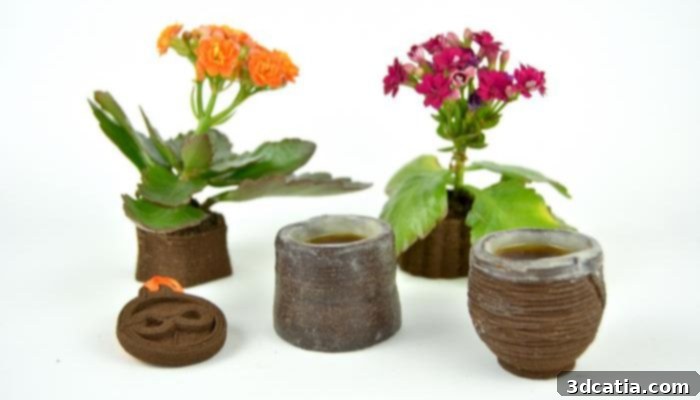
The team successfully tested a variety of objects made with 3D printed coffee grounds. Some creations, such as the planters, offer added benefits by providing more nutrients to the plants they house as they degrade.
It was during the unprecedented times of the COVID-19 pandemic that Michael Rivera experienced a pivotal moment of inspiration. With local coffee shops grappling with disruptions, the collection of donated coffee grounds for composting, a regular practice, suddenly ceased. This meant that what was once a valuable organic resource was now destined for the trash. Confronted with this abundance of discarded coffee grounds, Rivera recognized an extraordinary opportunity to address both plastic waste and the burgeoning issue of organic waste simultaneously. He pondered, “I looked at the grounds and said, ‘Maybe I can do something with them,’” – a simple thought that ignited a revolutionary idea. Coffee, being one of the world’s most popular beverages, generates an immense volume of waste grounds daily. Instead of viewing this as a disposal problem, Rivera envisioned it as a readily available, cheap, and sustainable feedstock for eco-friendly material creation. His insight led him to explore coffee grounds as a viable, alternative material that could reduce reliance on plastics, offering an ingenious, cyclical solution to waste management and material production. This vision underscores a broader paradigm shift: transforming waste streams into valuable resources, especially within rapidly evolving technological sectors like 3D printing.
Cultivating a Greener Future with 3D Printed Coffee Materials
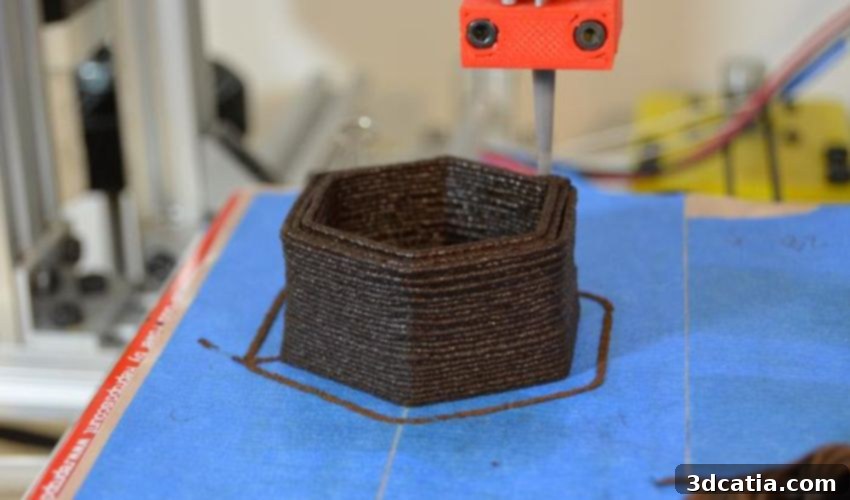
Michael Rivera and his dedicated research team at the University of Colorado Boulder embarked on an innovative journey to formulate their unique 3D printable mixture. The process involved combining the repurposed coffee grounds with a selection of readily available and plant-based ingredients. Key among these were xanthan gum and cellulose gum, both widely recognized as thickening agents and stabilizers frequently utilized in the food industry. These natural binders played a crucial role in giving the coffee ground mixture the necessary rheological properties for successful extrusion and structural integrity after printing. Once the ideal consistency was achieved, the team cleverly adapted a standard 3D printer for their purposes. Instead of conventional filament, the coffee mixture was loaded into a large syringe or a caulking tube container. From there, it was precisely extruded through plastic tubes, guiding the paste directly to the print head. This method allowed for the controlled deposition of the material, layer by layer, to form intricate objects. The culmination of their efforts resulted in solid, surprisingly durable creations, which have undergone rigorous testing and been successfully molded into an impressive array of functional and aesthetic shapes. Among these are innovative planters that, as they naturally degrade over time, subtly release beneficial nutrients back into the soil, directly contributing to plant health. The versatility of the material also extends to electrically conductive pieces, intricate jewelry concepts that challenge traditional material perceptions, and, fittingly, reusable coffee cups. These diverse applications not only showcase the material’s adaptability but also its potential to transform various industries, from sustainable agriculture to consumer goods, with an eco-conscious footprint.
One of the most compelling attributes of Rivera’s coffee-based creations lies in their remarkable reusability, embodying the very essence of a circular economy. As Rivera enthusiastically points out, “You can make a lot of things with coffee grounds and when you don’t want it anymore, you can throw it back into a coffee grinder and use the grounds to print again.” This highlights an extraordinary feature: the material isn’t merely biodegradable at the end of its life, but it can be ground down and repurposed multiple times for new prints. This revolutionary concept significantly extends the material’s lifecycle, drastically reducing waste and demonstrating a truly sustainable approach to product design and consumption. Through projects like this, Rivera and his team are driven by a profound hope to spotlight and champion zero-waste solutions that are not only effective but also readily accessible for people to implement directly from their own homes or small workshops. They envision their groundbreaking research as more than just an academic exercise; it is intended to serve as a vital launchpad, inspiring further exploration and development into an even broader spectrum of sustainable 3D printing materials. This work encourages a shift in mindset, moving away from linear production models towards regenerative systems where resources are continually cycled and reused. For those interested in delving deeper into the scientific underpinnings and comprehensive findings of this innovative research, the detailed findings are available for review HERE.
Beyond Coffee: The Future of Sustainable Additive Manufacturing
Rivera’s pioneering work with coffee grounds transcends the novelty of using an unconventional material; it represents a significant step forward in the quest for truly sustainable additive manufacturing. The implications of this research are far-reaching, demonstrating that viable, high-performance materials can be derived from waste streams, challenging the industry’s reliance on virgin plastics. This project opens doors for other researchers and innovators to explore a myriad of organic waste products – from sawdust and agricultural by-products to food scraps – as potential feedstocks for 3D printing. Such developments are crucial for scaling sustainable practices beyond academic labs and into industrial applications. Imagine construction materials made from local plant waste, or custom-designed packaging derived from agricultural refuse, all contributing to a drastically reduced carbon footprint and a more circular economy. The concept of localized, on-demand manufacturing using regionally abundant waste materials also holds immense potential for empowering communities and fostering regional self-sufficiency in material production.
While the initial success is promising, scaling these solutions presents its own set of challenges. Developing robust material standards, optimizing printing processes for diverse organic composites, and ensuring consistent mechanical properties across batches are all areas requiring further research and development. However, the fundamental proof-of-concept established by Rivera’s team provides a strong foundation. Their work highlights the critical role of interdisciplinary research, combining material science, engineering, and environmental studies, to address complex global challenges. Furthermore, fostering public awareness and education about these innovative materials will be key to their widespread adoption. Consumers and industries alike need to understand the environmental benefits, the performance characteristics, and the ease of recycling or biodegrading these new materials to embrace them fully. The transition to a truly sustainable future in 3D printing will require collaborative efforts from academia, industry, and policymakers, driven by the inspiring vision demonstrated by projects like the 3D printed coffee grounds.
What are your thoughts on utilizing organic materials like discarded coffee grounds for 3D printing new objects? Do you see this as a viable path towards a more sustainable future in additive manufacturing, or do you foresee significant challenges in widespread adoption? We invite you to share your insights and engage in the conversation by leaving a comment below, or by connecting with us on our professional LinkedIn, vibrant Facebook, and dynamic Twitter pages! To ensure you stay at the forefront of the latest advancements and news in the world of 3D printing, don’t forget to sign up for our free weekly Newsletter here, delivering essential updates straight to your inbox! Additionally, you can explore all our compelling video content and interviews on our dedicated YouTube channel, offering visual insights into the cutting-edge of additive manufacturing.
*All Photo Credits: Michael Rivera, University of Colorado Boulder