
Global CAD Trends 2018/2019: Unpacking Key Technologies, Adoption, and Future Growth
The dynamic landscape of Computer-Aided Design (CAD) is perpetually shaped by technological innovations and evolving industry demands. To provide a comprehensive understanding of these shifts, the esteemed international market research firm Business Advantage conducted an extensive survey, culminating in its insightful CAD Trends 2018/2019 report. This analysis is particularly valuable as it draws comparisons with a similar report from 2014, offering a four-year perspective on the sector’s trajectory and highlighting significant changes. The research garnered participation from a robust sample of 626 CAD users and key decision-makers, spanning a diverse range of company sizes and industries across the globe. By meticulously addressing 16 critical topics related to the perceived importance, actual current usage, and projected future adoption of various CAD technologies, the report serves as a vital resource, identifying and capturing the key trends that are defining the CAD sector today and those anticipated over the next five years. This deep dive into market dynamics is indispensable for businesses aiming to optimize their design and manufacturing workflows, make informed investment decisions, and maintain a competitive edge in a rapidly transforming digital environment.
The Evolving Landscape of CAD Technologies: Adoption Ratios and Market Maturity
The Business Advantage report meticulously categorized and examined a wide spectrum of CAD technologies, ranging from well-established industry standards to nascent, potentially transformative innovations. Standard technologies, such as the fundamental processes of 3D modeling and 2D drafting, are widely recognized and deeply integrated into daily design and engineering operations across various sectors. However, the survey also ventured into more novel and potentially disruptive technologies. These included cutting-edge areas like generative design, immersive virtual reality (VR), interactive augmented reality (AR), flexible cloud-based CAD solutions, sophisticated artificial intelligence (AI) applications, and the increasing demand for mobile access to CAD systems. These emerging technologies hold immense promise for future efficiency gains, enhanced creativity, and significant operational advancements within the sector.
To provide a quantitative measure of both market penetration and awareness, the report introduced a crucial metric: the ‘adoption ratio‘. This ratio is defined as the proportion of respondents who actively use a specific technology compared to the total number of respondents who are merely aware of its existence. This metric offers a clearer understanding of how widely a technology has been integrated into practical workflows versus how much it is simply known within the industry. For example, the report revealed that 56% of respondents were aware of Computer-Aided Manufacturing (CAM) technologies, yet only 31% actively utilized them, resulting in an adoption ratio of 55%. This disparity between awareness and actual usage is often a strong indicator of a technology’s maturity, remaining barriers to entry, or potential for future growth. When focusing on novel technologies, the adoption ratios presented a varied picture, reflecting different stages of market acceptance and integration challenges. Mobile access to CAD, for instance, exhibited a relatively healthy 46% adoption ratio, signaling a growing trend towards flexible, remote, and on-the-go design capabilities. In contrast, artificial intelligence in CAD registered a much lower adoption ratio of just 8%, indicating its very early stage of widespread industrial application.
A particularly significant and intriguing finding of the report was the inverse correlation observed between current adoption rates and projected future growth potential. Technologies that demonstrated the lowest current adoption ratios were, quite unexpectedly, identified as those with the most predicted growth over the subsequent three to five years. This compelling insight suggests that while mainstream integration for these advanced tools is still in its nascent phases, their inherent value, disruptive capabilities, and long-term potential are clearly recognized by industry professionals and decision-makers. This trend sets the stage for substantial expansion and transformation in the near future. The implication for businesses is clear: it is imperative to closely monitor and strategically evaluate these emerging technologies, as they are poised to form the next wave of innovation that could fundamentally redefine design, engineering, and manufacturing practices across industries.
Current CAD Trends and Their Adoption Ratio: A Detailed Overview

The Interplay of Importance, Usage, and Future Growth in CAD Technology Adoption
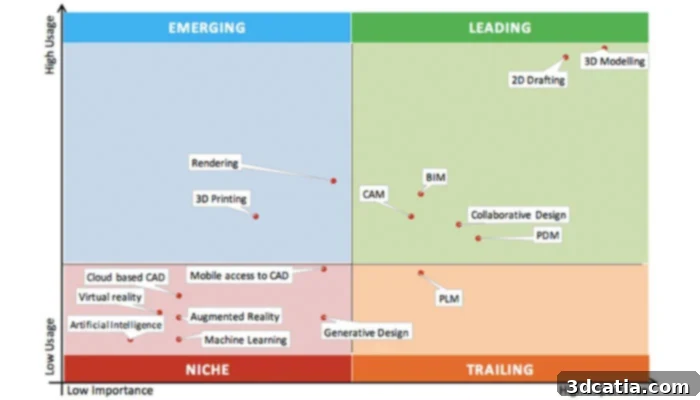
Beyond merely assessing adoption, the Business Advantage report also delved into respondents’ perceptions of each technology’s importance to their specific business operations. As expected, foundational tools such as 3D modeling and 2D drafting were almost universally rated as the most critical technologies, a perception that directly aligned with their high current usage rates. These core functionalities remain absolutely indispensable for virtually all design, engineering, and architectural tasks, serving as the fundamental backbone of the entire CAD ecosystem. Conversely, technologies with low adoption ratios, such as advanced artificial intelligence applications, were also ranked as having the least immediate importance. This strong, observable linkage between perceived importance and current adoption ratio suggests that decision-makers naturally prioritize tools that are already well-integrated, proven, and consistently delivering tangible value. Emerging technologies, despite their significant long-term potential, often face a challenge in demonstrating their immediate, measurable business impact to a broader audience, thus affecting their perceived short-term importance.
Credits: Business Advantage | CAD Trends 2018/19 report
However, the report also brought to light several technologies that are experiencing a notable surge in significance when compared to previous years’ findings. Building Information Modeling (BIM), Computer-Aided Manufacturing (CAM), and advanced collaborative design tools were all identified as growing substantially in perceived importance and actual usage. This upward trend is a clear reflection of broader industry shifts towards more integrated workflows, enhanced data exchange capabilities, and increasingly complex, team-based project execution methodologies. These shifts are particularly evident in sectors like architecture, engineering, and construction (AEC), as well as in modern, advanced manufacturing environments where precise coordination and data integrity are paramount. The increasing complexity of contemporary design and engineering projects, coupled with a relentless demand for greater efficiency and reduced time-to-market, are unequivocally driving the accelerated adoption and amplified perceived value of these sophisticated functionalities.
A core objective of the Business Advantage report was to meticulously identify which of these technologies are most likely to present the most significant opportunities for growth and innovation within the broader CAD market in the coming years. The report provided a critical distinction, clarifying that trends currently considered most important and widely used by CAD professionals, while undeniably essential for ongoing operations, are nearing a state of market saturation. This phenomenon is largely attributable to their already high current usage rates, which inherently leave limited scope for substantial further expansion or disruptive, new growth within their existing application domains. These established tools have, in essence, achieved their maximum penetration and widespread acceptance within their current areas of application.
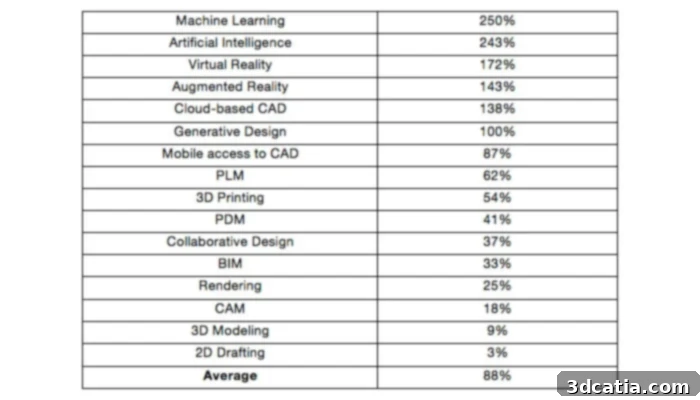
Conversely, the report unequivocally illustrated that more niche or still-nascent trends hold vastly greater future growth potential. Machine learning (ML), for example, despite exhibiting very low current usage rates and a correspondingly low perceived importance at the time the survey was conducted, emerged as the technology with the highest projected future growth across all evaluated trends. The report forecasts an astonishing 250% growth for machine learning applications in CAD over the next three to five years. This rapid acceleration is expected to be primarily fueled by significant adoption in key regions such as the Americas and APAC (Asia-Pacific), as well as by larger enterprises that possess the necessary resources, strategic foresight, and infrastructure to invest in and seamlessly integrate such advanced capabilities. Over 50% of respondents who indicated plans to implement machine learning cited ‘improved equipment effectiveness’ as their primary motivation. This key finding underscores machine learning’s profound potential to revolutionize critical aspects like predictive maintenance, automated design optimization, intelligent system diagnostics, and quality control, thereby delivering tangible operational benefits, significant cost reductions, and a robust return on investment for businesses.
Future Growth Potential of CAD Trends: Anticipating the Next Wave of Innovation
3D Printing: A Significant and Growing Player in the Modern CAD Ecosystem
Given the profound and widespread impact of additive manufacturing across various industries, the Business Advantage report dedicated specific analysis to the role of 3D printing within the CAD sector. The findings reveal that 3D printing commands a solid level of current usage, indicating its established presence and utility in numerous design and engineering workflows. While its perceived importance was somewhat lower when compared to core CAD functionalities, and its projected future growth potential stood slightly below the average for other rapidly emerging digital technologies, 3D printing nonetheless continues to exert a substantial and steadily growing influence within the industry.
At the time of the survey, 31% of the responding organizations reported actively utilizing 3D printing technology in-house. Looking forward, a significant 48% expressed their clear intention to either adopt or expand their current use of 3D printing within the subsequent three to five years. This strong forward-looking projection translates into a robust growth rate of 54% for 3D printing adoption, firmly affirming its continued relevance, expansion, and increasing integration into industrial processes. This anticipated increase in usage is particularly prominent within the manufacturing sector, among non-AEC (Architecture, Engineering, and Construction) industry sectors, and within larger corporate entities, where the myriad benefits of rapid prototyping, custom part fabrication, and on-demand production are most keenly felt and strategically leveraged. Although this 54% growth rate is comparatively below the average growth predicted for all emerging technologies covered in the report (which stood at a higher 88%), it unequivocally represents a significant and healthy expansion for a technology that has already achieved considerable market penetration and moved beyond its initial novelty phase.
The report further provided valuable insights into the specific brands of 3D printers favored among the surveyed professional audience. Among those currently using or planning to use 3D printing, 25% reported utilizing equipment from 3D Systems, a renowned pioneer and leader in the additive manufacturing space. Stratasys, another major player widely recognized for its diverse range of professional 3D printing solutions, was used by 19% of respondents. MakerBot, often associated with accessible desktop 3D printing and educational applications, accounted for 16% of users. These figures collectively highlight a competitive yet maturing market, with several established leaders effectively catering to the varied and evolving needs of CAD users across different industry segments.
Regarding the primary applications of 3D printers, the report underscored their critical role in prototyping, with a substantial 80% of users citing this as a key application. This unequivocally highlights 3D printing’s indispensable contribution to accelerating product development cycles, enabling rapid iteration, and facilitating quick validation of designs at various stages. Following prototyping, research and design (R&D) emerged as another significant application, accounting for 68% of usage, reflecting its immense value in experimental work, material science exploration, and the development of innovative new solutions. Crucially, nearly 70% of 3D printing users emphasized ‘design improvements’ as the main benefit of this technology. This encompasses a broad spectrum of advantages, including enhanced design freedom, the ability to create highly complex geometries previously unachievable with traditional methods, and the profound optimization of parts for superior performance, reduced weight, and improved functionality, all of which directly contribute to superior product outcomes and competitive advantages.
The Competitive Landscape of Most Used CAD Software Solutions
Credits: Business Advantage | CAD Trends 2018/19 report
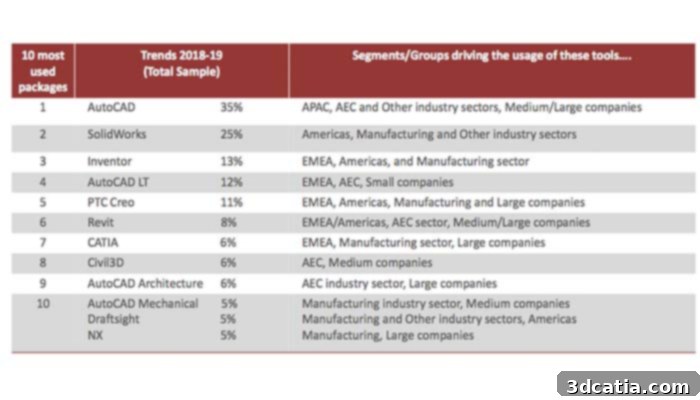
Beyond the overarching technological trends, the Business Advantage report also provides invaluable granular insights into the competitive landscape of CAD software itself. The accompanying visual representation (image above) meticulously details the most widely used CAD software solutions among the survey participants, offering a clear and concise snapshot into the prevailing market share and the dominance of various platforms at that time. This specific information is critically important for both software developers, who can better understand their competitive positioning and areas for innovation, and for end-users, who can gain insight into which tools are currently preferred by the professional community, thereby guiding strategic decisions regarding training investments, platform interoperability, and long-term software adoption strategies. Understanding the popularity and distribution of these tools is essential for navigating the complex and competitive CAD market effectively.
Conclusion: Navigating the Future of CAD with Strategic Foresight
The Business Advantage CAD Trends 2018/2019 report stands as an invaluable and insightful compass for navigating the increasingly complex and dynamic world of Computer-Aided Design. It meticulously paints a clear picture of an industry that is skillfully balancing the enduring and foundational importance of established technologies like 2D drafting and 3D modeling with the burgeoning, transformative potential of cutting-edge innovations such as generative design, artificial intelligence, and machine learning. The report’s distinctive ‘adoption ratio’ metric provides a nuanced and data-driven understanding of market penetration and maturity, while its detailed analysis of perceived importance and future growth forecasts highlights strategic areas ripe for investment, research, and development in the coming years.
Key takeaways from the report unequivocally emphasize that while widely adopted and mature technologies are nearing market saturation, more niche and novel trends, despite their current low usage rates, are strategically positioned for exponential growth. Machine learning, with its impressive forecasted 250% surge, exemplifies this potential, promising to revolutionize aspects of design, engineering, and manufacturing. Furthermore, 3D printing, though growing at a more moderate pace compared to some purely digital emerging tools, solidifies its critical and expanding role in accelerating prototyping cycles and driving significant design improvements across diverse manufacturing sectors and within large enterprises. For CAD professionals, engineering teams, and strategic decision-makers alike, staying proactively abreast of these intricate and evolving trends is not merely beneficial but absolutely essential for fostering continuous innovation, enhancing operational efficiency, mitigating risks, and securing a sustainable competitive position in an increasingly digital, interconnected, and rapidly advancing design ecosystem. The comprehensive insights provided by Business Advantage offer a robust, data-driven framework for strategic planning and informed decision-making that will undoubtedly shape the trajectory of CAD for years to come.
For those seeking a more profound understanding and a deeper dive into these comprehensive findings, the complete report and additional detailed information are readily available on Business Advantage’s official website HERE.
We highly encourage you to share your valuable thoughts, insights, and perspectives on these continually evolving CAD trends! Join the conversation and engage with our community on our official Facebook and Twitter pages. Moreover, to ensure you don’t miss out on any of the latest news and advancements in 3D printing, be sure to sign up for our free weekly Newsletter, which delivers all the essential updates directly to your inbox!