

Unlocking Industrial Power: Top Compact FDM and Metal 3D Printers for High-Performance Applications
While other additive manufacturing technologies have seen significant advancements and growth in recent years, Fused Deposition Modeling (FDM) continues to hold a dominant share of the global 3D printing market. This enduring popularity is evident not only in the proliferation of more affordable, commercial solutions but also in the increasing availability of large-format, industrial FDM systems designed for demanding high-performance applications. However, what if your operational space is limited, but your need for industrial-grade performance remains paramount? This growing demand has spurred innovation, leading many manufacturers to develop compact industrial FDM 3D printers. These sophisticated systems offer compatibility with advanced, high-temperature polymers, engineering-grade plastics, and even metals, all within a footprint small enough to integrate seamlessly into an office, lab, or small workshop environment. These compact industrial solutions bridge the gap between desktop convenience and factory-floor capabilities, making advanced additive manufacturing more accessible than ever. We’ve explored some of the most compelling compact industrial 3D printers currently on the market, presenting them in no particular order.
INTAMSYS FUNMAT PRO 310: Desktop Industrial Performance
INTAMSYS stands out as a pioneering leader in high-temperature and high-performance FDM 3D printing, offering a range of solutions from desktop to industrial-scale systems. Their FUNMAT PRO 310 exemplifies their commitment to bringing industrial capabilities to a more manageable size. Designed with a generous build volume of 305 x 260 x 260 mm, the FUNMAT PRO 310 was specifically conceived to “bring industrial performance to desktop 3D printing to respond to the growing demands of professional engineers.” This philosophy translates into a robust machine capable of handling the stringent requirements of professional applications.
The FUNMAT PRO 310 is equipped with a suite of features essential for industrial FDM 3D printing. It boasts exceptional material compatibility, supporting engineering-grade thermoplastics like PC and ABS. This is made possible by an active heating thermostatic chamber that ensures uniform temperature distribution up to 100℃, crucial for minimizing warping and ensuring optimal layer adhesion for demanding materials. Furthermore, the printer incorporates intelligent functionalities to enhance ease of use and print reliability, such as intelligent multi-point mesh automatic leveling and real-time compensation for motion accuracy. These characteristics contribute to consistently high-quality parts, reducing the need for manual intervention and post-processing. With a competitive price point starting from $8,495/€7,999, the FUNMAT PRO 310 offers an accessible entry into high-performance industrial 3D printing. You can find more details HERE.
Raise3D E2CF: A Carbon Fiber Specialist
The Raise3D E2CF emerges as a highly versatile and compact industrial 3D printer, meticulously engineered for demanding manufacturing and prototyping applications. Its standout feature is its IDEX (Independent Dual Extrusion) system, which allows the two extruders to operate entirely independently along the same axis. This advanced functionality not only doubles productivity in certain modes but also enables sophisticated printing strategies such as dual-material or soluble support printing. Utilizing FDM/FFF technology, the E2CF is specifically optimized for 3D printing carbon-fiber-reinforced filaments, opening doors to high-strength, lightweight applications across various industries.
This compact workhorse finds its place in sectors as diverse as aerospace, automotive, medical devices, and sports equipment, where robust, performance-driven parts are critical. The E2CF’s material compatibility extends beyond carbon fiber, embracing a wide array of technical thermoplastics including PLA, ABS, Nylon, PET, PPS, and fiber-reinforced PETG. With dimensions of 607 x 596 x 495 mm, it balances a respectable build volume with a manageable footprint. Key features designed for industrial reliability include a depleted filament sensor, ensuring uninterrupted production, and easily removable print heads for quick maintenance and material changes. A built-in camera provides real-time monitoring of the entire 3D printing process, offering peace of mind and remote control capabilities for professional users.
Markforged Onyx Pro: Desktop Composite FFF Powerhouse
Markforged is renowned for its innovative approach to composite 3D printing, and the Onyx Pro stands as one of their leading compact industrial composite 3D printers. This machine is engineered with a sturdy chassis and precision-machined components, built for reliability and accuracy in demanding environments. What truly sets the Onyx Pro apart is its utilization of continuous fiber reinforcement technology. This unique capability allows it to produce fiberglass-reinforced thermoplastic parts that exhibit exceptional strength, reportedly up to ten times stronger than components printed with traditional unreinforced plastics. This makes it an ideal solution for functional prototyping, tooling, and even end-use parts where structural integrity is paramount.
With a substantial build volume of 320 x 132 x 154 mm, the Onyx Pro is versatile enough to handle a variety of printing projects, from intricate small prototypes to larger, more robust functional components. Its advanced second-generation extruder and a kinematic coupling print bed work in tandem to ensure consistent and highly accurate printing results, solidifying its reputation for industrial reliability. The Onyx Pro also offers broad material compatibility, supporting various printing needs with materials such as Onyx (nylon blended with micro carbon fiber), Precise PLA, Smooth TPU 95A, and fiberglass. While a powerful solution, it’s worth noting that Markforged has recently faced some controversy, including an IP case that has drawn attention to its continuous fiber technology.
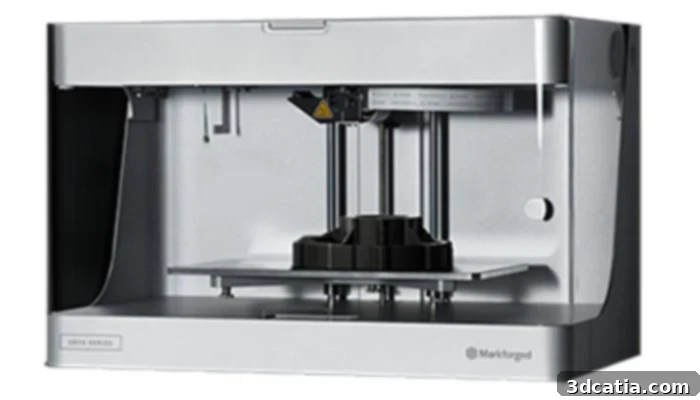
Photo Credits: Markforged
UltiMaker Method XL: Precision 3D Printing for Engineering Prototypes
The UltiMaker Method XL is engineered as an exemplary compact industrial 3D printer, particularly well-suited for the production of technical prototypes crafted from ABS. This machine excels at producing highly detailed and precise parts with tight tolerances, even when tackling larger-scale projects. Its generous build volume of 305 x 305 x 320 mm provides ample space for creating substantial prototypes, which can then undergo rigorous testing and validation processes. Crucially for engineering-grade materials, the Method XL features a flexibly heated build plate capable of reaching up to 105°C and an actively heated chamber that maintains temperatures up to 100°C. These controlled thermal environments significantly improve print layer adhesion, minimize warping, and ensure the structural integrity of printed parts, especially with materials like ABS.
Equipped with dual extrusion capabilities, the UltiMaker Method XL allows for the creation of geometrically complex parts by simultaneously extruding ABS filament alongside a water-soluble support material. This facilitates the production of intricate designs with overhangs and internal cavities that would be challenging or impossible with single extrusion. Beyond its printing performance, user-friendliness is a key consideration, addressed by a built-in HEPA filter. This filter effectively purifies the air by capturing ultrafine particles, ensuring a safer and more pleasant operating environment within an office or workshop. The Method XL thus represents a powerful, precise, and practical solution for professional engineers seeking industrial-level performance in a compact form factor.
BCN3D Epsilon W50 SC: Large Parts with Industrial-Grade Materials
The BCN3D Epsilon W50 SC represents a versatile, professional 3D printing solution that is optimally designed for producing large, robust parts using a wide array of industrial-grade materials. This system distinguishes itself with integrated features crucial for consistent and reliable industrial output. These include a passively heated chamber and its Smart Cabinet capability, which provides a humidity-controlled environment. Such environmental controls are vital for maintaining the quality and printability of hygroscopic engineering filaments, ensuring optimal conditions for every print. The Epsilon W50SC is also powered by an Independent Dual Extruder (IDEX) system, which enables it to deliver high-strength, functional parts with exceptional precision and quality by allowing simultaneous or independent extrusion of two different materials or colors.
Boasting a substantial build volume of 50 liters (420 x 300 x 400 mm), the Epsilon W50 SC offers ample space to accommodate diverse project requirements, making it suitable for a broad spectrum of industries and applications, from automotive and manufacturing to architecture and consumer goods. Its open material system is another significant advantage. Users benefit from a selection of high-quality materials developed by industry-leading chemical companies such such as BASF and Mitsubishi Chemical, while also retaining the freedom to utilize third-party materials and filament packs. This flexibility empowers users to explore an extensive range of technical applications and find the perfect material properties for their specific needs, reinforcing its position as a truly adaptable industrial solution.
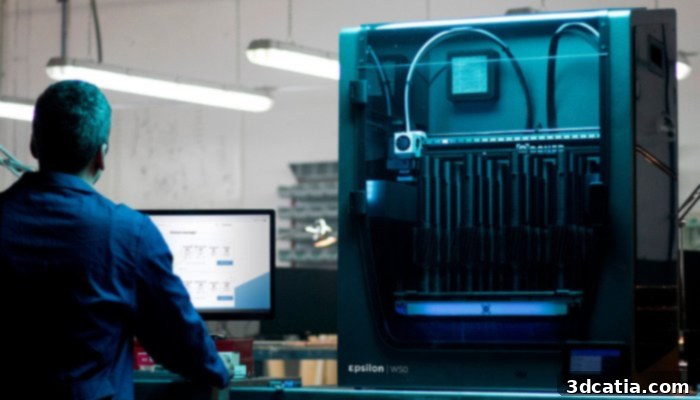
Photo Credits: Epsilon W50
Anisoprint A4: Compact, Industrial, Continuous Fiber Composite 3D Printer
Anisoprint is at the forefront of continuous fiber composite 3D printing, and their A4 3D printer represents a groundbreaking compact industrial solution in this specialized field. This machine utilizes Anisoprint’s unique co-extrusion technology, which enables the simultaneous deposition of a polymer matrix and continuous fiber reinforcement through two separate nozzles. This innovative approach allows for the creation of exceptionally strong, stiff, and lightweight parts, rivalling or exceeding the properties of traditional metals in many applications. The A4 version provides a practical build size of 297 x 210 x 140 mm, making it suitable for a wide range of engineering prototypes and functional parts. For those requiring a larger build envelope, the technology is also available in a slightly larger A3 version.
A significant advantage of the Anisoprint A4 is its open system architecture, which ensures a flexible choice of materials. This freedom allows users to select from a broad spectrum of polymers to serve as the matrix material, optimizing for specific mechanical, thermal, or chemical properties. The printer comes integrated with Anisoprint’s proprietary slicing software, AURA. AURA is designed for user convenience and efficiency, featuring a number of built-in print profiles for various filaments. These pre-configured profiles allow users to jumpstart their printing projects right away, significantly reducing the learning curve and accelerating the design-to-part workflow for complex composite structures. The Anisoprint A4 empowers engineers to produce high-performance composite parts directly on their desktop, transforming design possibilities.
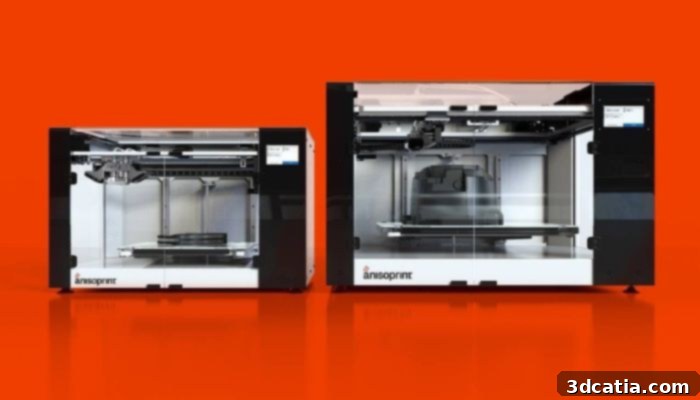
The Anisoprint A4 (left) and A3 (right) machine (photo credits: Anisoprint)
Zortrax M200 Plus: Reliable Plug & Play for Professionals
The Zortrax M200 Plus 3D printer is a testament to the Polish manufacturer’s commitment to reliable, user-friendly industrial-grade FDM solutions. As a “Plug & Play” machine, it is designed for ease of setup and operation, making advanced additive manufacturing accessible even to users with limited experience. It offers a solid print volume of 200 x 200 x 180 mm, suitable for a wide array of prototypes, tools, and functional components, and delivers prints with resolutions ranging between 90 and 390 microns. A key feature enhancing its industrial capabilities is the heated build plate, which can reach temperatures up to 105°C. This controlled environment is crucial for printing with engineering thermoplastics, ensuring excellent layer adhesion and minimizing print failures due to warping.
While compatible with a variety of thermoplastics, the M200 Plus performs optimally with Zortrax’s proprietary filaments, alongside select certified third-party materials such as ABS Ultrafuse from BASF and PC-ABS from Nanovia. This curated material ecosystem ensures consistent, high-quality results across various applications. In terms of usage, the Zortrax M200 Plus is an ideal choice for designing functional prototypes, producing medical parts, and fabricating automotive and aerospace components where precision and durability are paramount. Furthermore, the printer is equipped with an innovative Speed Mode feature that significantly accelerates the machine’s operational speed, reportedly allowing it to print up to three times faster. This enhancement makes the M200 Plus an even more efficient tool for rapid prototyping and iterative design processes in professional settings.
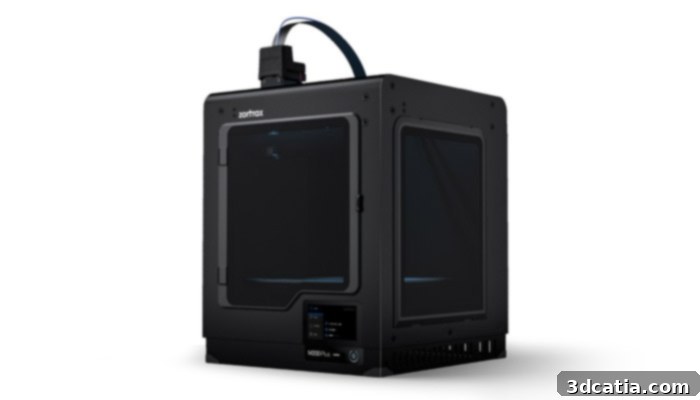
Photo Credits: Zortrax
OMNI3D Omni200 CF: Broad Material Compatibility in a Compact Form
OMNI3D, another prominent Polish manufacturer, is widely recognized for its high-performance, large-format industrial 3D printers. However, the company also offers highly capable compact 3D printing solutions, exemplified by the Omni200 CF 3D printer. This machine is explicitly designed as a “Desktop printer for customers requiring industrial standards of printing,” bringing advanced manufacturing capabilities directly to the engineer’s workspace. While featuring a more compact build volume of 200 x 200 x 200 mm, the Omni200 CF is packed with features that enable true industrial FFF 3D printing performance, allowing users to print with challenging and high-performance materials.
A standout feature is its robust thermal system, including a nozzle capable of reaching an impressive maximum operating temperature of 400°C and a build platform that heats up to 120°C. These high temperatures are critical for successfully processing a wide range of engineering filaments, including demanding high-temperature polymers and various composite materials. This broad material compatibility makes the Omni200 CF incredibly versatile for diverse industrial applications. The printer also includes convenient features such as remote management capabilities, allowing users to monitor and control prints from anywhere. It is compatible with standard 3MF, OBJ, and STL file formats for seamless integration into existing workflows. Furthermore, a removable magnetic pad offers high flexibility, simplifying the often-tricky process of removing finished prints from the build plate, thus enhancing overall user experience and workflow efficiency.
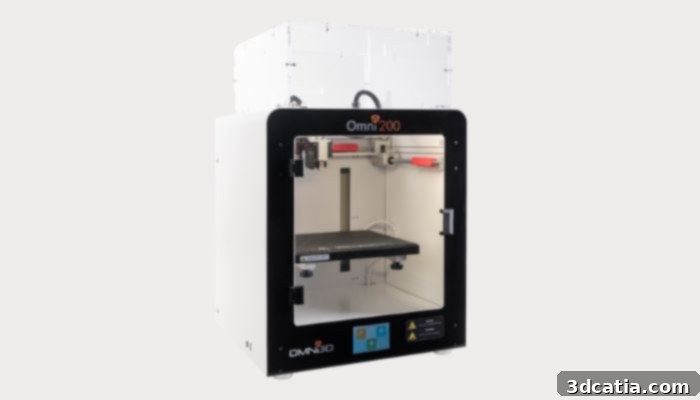
Photo Credits: OMNI3D
Desktop Metal Studio System 2: A Compact Metal 3D Printing Revolution
The Studio System 2 3D printer by Desktop Metal introduces a transformative approach to both FDM principles and metal 3D printing, moving beyond traditional laser-based systems with its proprietary Bound Metal Deposition (BMD) technology. This innovative process prioritizes safety by extruding bound metal rods, which are then debound and sintered into dense metal parts. This method not only simplifies the metal 3D printing workflow but also enables advanced design capabilities, such as fully closed-cell infill, resulting in final parts that are remarkably lightweight yet incredibly durable. This makes it an ideal solution for producing functional metal prototypes, tooling, and low-volume end-use parts.
With a strong focus on user experience, the Studio System 2 incorporates a range of features designed to enhance efficiency and ensure consistent part quality across diverse and complex geometries. These include a heated build chamber for optimal printing conditions and dual quick-release print heads for easy maintenance and material changes. Printing and subsequent sintering are made safe and straightforward with its auto-integrated Live Studio software, which automates all steps in the production process. This intelligent software streamlines material handling, print preparation, and furnace operation, making metal additive manufacturing more accessible to a wider audience. With a spacious build volume of 300 x 200 x 200 mm and compatibility with most standard file formats, the Studio System 2 stands out as a leading compact industrial 3D printer for a variety of metal applications, including stainless steel, tool steels, and copper.
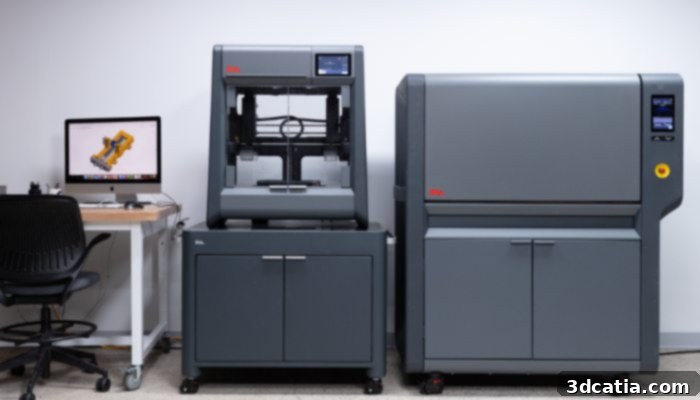
Photo Credits: Desktop Metal
CreatBot F430: Versatility for High-Performance Thermoplastics
The CreatBot F430 is a highly versatile compact industrial FDM 3D printer, meticulously engineered to excel in a multitude of applications, from intricate design validation and rapid prototyping to the production of high-performance components. With a generous build volume of 400 x 300 x 300 mm, it provides substantial space for various project sizes. Its impressive material compatibility is a major highlight, ranging from common consumer filaments (such as PLA, ABS, PETG, PVA) to robust industrial materials (like UltraPA, PA-CF, PA-GF) and advanced high-performance thermoplastics, including PEEK and PPS. This broad material support makes the F430 a truly adaptable tool for a diverse range of engineering and manufacturing needs.
The CreatBot F430 is designed to ensure precise printing down to 0.04 mm, guaranteeing stable filament extrusion without obstructions, which is critical for achieving high-quality surface finishes and dimensional accuracy. Furthermore, its advanced thermal management system, featuring a heated print bed capable of reaching up to 140°C and a heated chamber that maintains temperatures up to 70°C, significantly contributes to superior printing results. These controlled thermal environments are essential for successfully processing high-temperature and engineering polymers, as they prevent warping, improve layer adhesion, and ensure part integrity. The F430 thus empowers users to produce professional-grade parts with demanding materials, all within a compact and efficient footprint, making it a valuable asset for industrial applications requiring both versatility and precision.
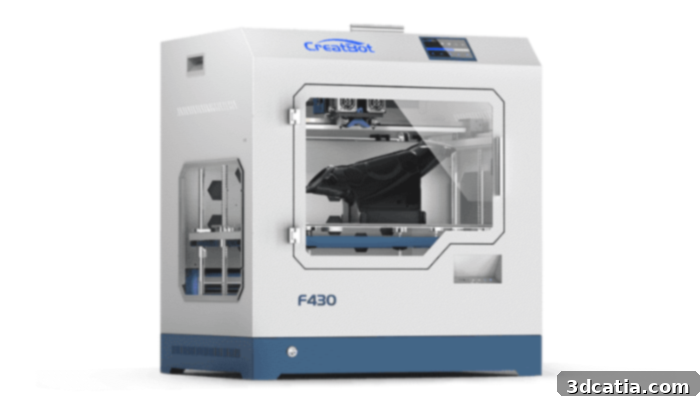
Photo Credits: CreaBot
Roboze Plus PRO: Precision for Super Polymers
The Roboze Plus PRO 3D printer exemplifies the company’s dedication to high-performance compact industrial FDM solutions, specifically engineered to process an extensive variety of advanced polymers, including super polymers. This machine supports a wide material palette, from aesthetic materials such as ULTRA-PLA and ABS, and flexible materials like FLEX-TPU, all the way to high-temperature and high-strength super polymers such as PEEK, PEKK, ToolingX CF, and Carbon PEEK. This comprehensive material compatibility positions the Roboze Plus PRO as an ideal choice for industries requiring parts with extreme mechanical, thermal, and chemical resistance.
Despite its robust industrial capabilities, the machine maintains a relatively compact design with dimensions of 790 x 690 x 1910 mm. Its printing platform offers a substantial build volume of 300 x 250 x 220 mm (xyz) and can reach impressive temperatures up to 150°C. Coupled with Roboze’s proprietary vacuum technology, this ensures exceptional stability and superior adhesion of printed components throughout the entire process, mitigating common issues like warping and delamination. In terms of precision, the Roboze Plus PRO guarantees a remarkable 3D printing accuracy of 15 microns, meeting the stringent requirements of demanding engineering applications. Finally, the machine is equipped with the innovative HT Dryer device, which pre-conditions the material before 3D printing by actively drying and heating it. This crucial step ensures optimal material quality, thereby maximizing surface finish and the mechanical performance of the produced parts, making the Roboze Plus PRO a complete solution for high-precision, high-performance polymer printing.
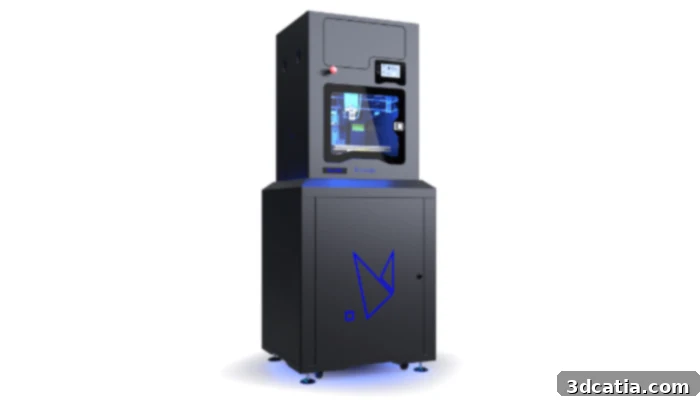
Photo Credits: Roboze
3DGence ELEMENT MP260: Compact Metal FFF for MIM Prototyping
The Polish company 3DGence has long been recognized for its large-format 3D printers, specifically tailored for processing high-temperature polymers and demanding engineering applications. However, 3DGence has also innovatively expanded its portfolio to include compact metal 3D printing solutions. Their ELEMENT series of compact industrial FFF 3D printers for metal, first unveiled at Formnext 2021, marked a significant entry into this specialized segment. While further details on the full series have been somewhat limited since the initial launch, the ELEMENT MP260 was specifically introduced in December of that same year, catering to a distinct market need.
The ELEMENT MP260 is designed as a smaller, cost-effective prototyping printer with a build volume of 260 × 260 × 200 mm. Its primary application lies in supporting Metal Injection Molding (MIM) production, offering a rapid and economical way to create prototypes and small batches of metal parts. The printer leverages 3DGence’s unique Metal Deposition Modeling (MDM) technology, which operates on principles similar to bound metal extrusion, extruding metal-infused filaments that are subsequently debound and sintered. This process enables the production of dense, functional metal components. The MP260 is currently compatible with key industrial metals, including 316L Stainless Steel, making it a valuable tool for engineers and manufacturers looking to accelerate their metal part development cycles and reduce costs associated with traditional MIM tooling.
This curated list highlights the remarkable evolution of compact industrial 3D printers, demonstrating how these machines are making high-performance additive manufacturing more accessible and versatile. From advanced engineering polymers and continuous fiber composites to robust metal parts, these compact solutions offer significant advantages in terms of space-saving design, material versatility, and industrial-grade reliability. They empower businesses of all sizes to accelerate prototyping, produce specialized tooling, and even create functional end-use parts without the need for large factory floor space or substantial capital investment. By blending desktop convenience with industrial capabilities, these printers are driving innovation across various sectors, proving that powerful manufacturing doesn’t always require a massive footprint.
What are your thoughts on this selection of compact industrial 3D printers? Have we missed any standout machines that you believe deserve recognition? We encourage you to share your insights in a comment below or join the conversation on our LinkedIn, Facebook, and Twitter pages! Don’t forget to sign up for our free weekly newsletter here to receive the latest 3D printing news directly in your inbox. You can also explore all our informative videos on our dedicated YouTube channel.