
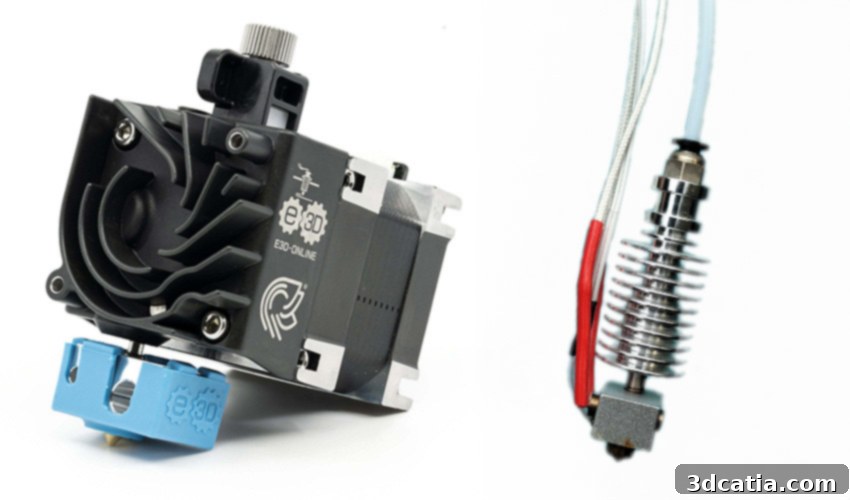
Bowden vs. Direct Drive Extruders: Choosing the Best for Your 3D Printing Success
In the dynamic world of FDM 3D printing, the choice of your extruder setup is paramount, often dictating the success and quality of your prints. It’s the critical difference between achieving flawless, high-precision models and enduring a frustrating cycle of trial and error. While FDM 3D printer extruders come in a multitude of designs and complexities, they fundamentally adhere to one of two primary configurations: the Bowden extruder or the direct drive extruder. Each type presents its own set of advantages and challenges, influencing everything from print speed and material compatibility to overall print quality. Understanding these two distinct powerhouses is essential for any 3D printing enthusiast, whether you’re a beginner or a seasoned professional, to make an informed decision tailored to your specific project needs. To help you navigate this crucial choice, we will delve into the intricacies of both Bowden and direct drive systems, examining their performance across key metrics like print quality, speed, material versatility, and retraction capabilities.
Before we dissect the differences and comparative performance, it’s vital to establish a clear understanding of what an extruder is and its foundational role in the 3D printing process. Often confused with the nozzle itself, the extruder is a pivotal component within FDM (Fused Deposition Modeling) 3D printing systems. Its primary function is to precisely feed the filament material from the spool into the printer’s hot-end. Once inside the hot-end, the filament is melted and then extruded through the nozzle, deposited layer by layer onto the print bed to construct the three-dimensional object. The extruder is meticulously engineered to maintain a consistent and regulated flow of filament, control the rate of extrusion with high accuracy, and ensure the molten material is placed precisely where needed. This intricate role makes the selection of the extruder type a critical decision, as it directly impacts a wide range of factors, including the ultimate print quality, achievable printing speeds, the variety of materials that can be successfully printed, and the overall operational capabilities of your 3D printing system.
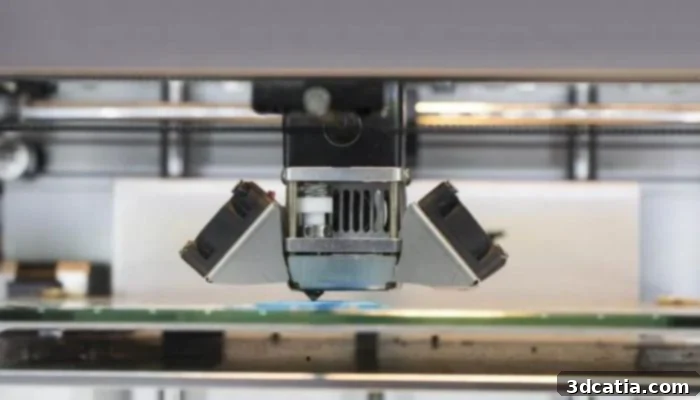
Photo credits: Sculpteo
Bowden vs. Direct Drive Extruder: A Comprehensive Look
The fundamental difference between Bowden and direct drive extruders lies in the placement of the extruder motor relative to the hot-end assembly. A **Bowden extruder** is characterized by its remote motor placement, typically mounted on the printer’s frame. A long, flexible PTFE (Polytetrafluoroethylene) tube, often referred to as a Bowden tube, connects this motor to the hot-end. This configuration significantly reduces the moving mass on the printer’s print head or carriage, as the heavy stepper motor is not carried along with the hot-end. The advantage of this reduced mass is immediately evident in the printer’s ability to achieve much faster acceleration and deceleration rates, leading to higher potential printing speeds. With less weight to move, the printer can make quicker direction changes with less inertia, minimizing vibrations and potential artifacts like ghosting or ringing on prints. This makes the Bowden setup particularly appealing for users prioritizing speed and smoother finishes, especially when printing intricate or delicate models where sudden movements could mar the surface. However, the extended distance the filament must travel through the PTFE tube introduces challenges. Flexible filaments, in particular, struggle in this setup as they tend to buckle or compress within the tube, making consistent extrusion difficult and leading to clogs or inconsistent layers. Furthermore, the inherent friction between the filament and the PTFE tube can also affect extrusion consistency and necessitate longer, more aggressive retraction settings to prevent stringing, which we will explore in detail later.
In stark contrast, a **direct drive extruder** features the extruder motor directly mounted onto the print head, in close proximity to the hot-end. This eliminates the need for a lengthy Bowden tube, creating a much shorter and more direct path for the filament to travel from the drive gears to the melt zone. This direct coupling offers unparalleled control over filament movement, as the motor’s pushing force is almost immediately transferred to the filament, with minimal lag or compression. This characteristic makes direct drive extruders the ideal choice for printing with a vast array of materials, especially challenging ones like flexible filaments (TPU, TPE) which would otherwise struggle in a Bowden setup. The precise control over filament extrusion and retraction capabilities are significantly enhanced, leading to superior print quality, reduced issues like stringing and oozing, and more consistent layering. However, this configuration comes with its own set of trade-offs. The increased mass of the motor and drive mechanism on the print carriage introduces greater inertia. This heavier moving mass can lead to increased vibrations at higher speeds, potentially causing visible artifacts like ghosting (ringing) on the print surface, and generally necessitates lower printing speeds compared to Bowden setups to maintain optimal print quality. Therefore, while direct drive offers superior material versatility and extrusion control, it often sacrifices raw printing speed.
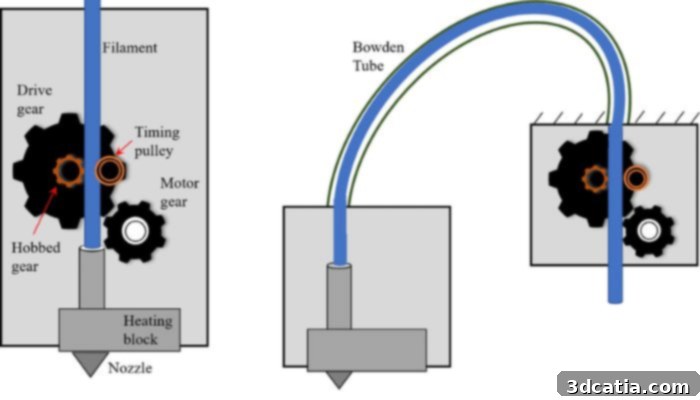
A visual comparison between the system properties of a direct drive extruder (left), versus a Bowden extruder (right) (photo credits: ResearchGate)
Optimizing Your Setup: The Critical Role of Nozzle Choice
Beyond the extruder type, the choice of nozzle significantly impacts the quality, speed, and overall efficiency of your 3D prints. This is true for both Bowden and direct drive setups, but the considerations can differ due to the unique filament paths and pressures involved. For **Bowden setups**, where the filament traverses a considerable distance through a PTFE tube before reaching the hot-end and nozzle, the selection of the right nozzle becomes particularly critical. The longer filament path in Bowden systems inevitably introduces increased friction and resistance, which can impede consistent filament flow and contribute to issues like under-extrusion or clogs. To mitigate these challenges, nozzles made from materials with high thermal conductivity, such as brass, are often preferred. These nozzles facilitate rapid and efficient heat transfer to the filament, ensuring it melts consistently as it enters the melt zone. Furthermore, utilizing high-flow nozzles, such as Bondtech CHT or E3D Volcano variants, can be highly beneficial in Bowden systems. These nozzles are engineered with optimized internal geometries or increased melt zones to allow for a greater volume of molten plastic to pass through without increasing back-pressure on the filament, helping to maintain a consistent extrusion rate despite the inherent resistance of the Bowden tube. This helps to prevent issues down the line, as reducing the pressure exerted on the filament by the nozzle makes it easier for the remotely located extruder motor to push the filament through the extended path.
In contrast, the dynamics of **direct drive extruders** bring about a somewhat different set of considerations for nozzle selection. With the extruder motor situated directly above the hot-end, the filament path is significantly shorter, resulting in minimal friction and resistance before the filament reaches the melt zone. This reduced resistance means that direct drive systems can effectively employ a wider range of nozzle sizes and types without encountering the same flow issues seen in Bowden setups. The direct control over filament movement allows for greater flexibility. Additionally, when working with specialized or abrasive filaments, the direct drive configuration offers advantages. Some filaments, such as those infused with composite materials (e.g., carbon fiber, glass fiber) or wood particles, contain small, hard additives that can rapidly wear down standard brass nozzles. While these abrasive particles would also contribute to wear within a Bowden tube, the direct drive system’s ability to handle these materials with greater consistency means that hardened steel or ruby-tipped nozzles become a more practical and essential investment to prevent premature wear and maintain print quality over time. The enhanced control of a direct drive also means that even with specialized nozzles, precision remains high.
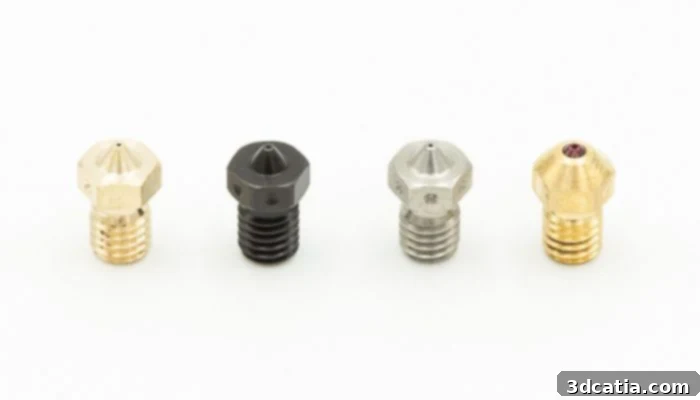
The material and diameter of a nozzle plays a vital role in determining the balance between print quality and speed (Photo credits: filament2print)
Practical Printing Considerations: Quality, Speed, and Material Versatility
When assessing the ideal extruder for specific printing outcomes, several practical considerations come into play, profoundly influencing print quality, speed, and material compatibility. If your primary goal is **exceptional print quality with intricate detailing at reasonably high speeds**, a Bowden extruder often takes the lead. Its lightweight carriage minimizes inertia, reducing the chances of sudden, jarring movements that could introduce artifacts like ghosting or ringing on the print’s surface. This makes it an outstanding choice for projects demanding high precision and smooth finishes, such as detailed architectural prototypes, intricate art pieces, or functional parts where surface aesthetics are critical. Conversely, a direct drive extruder, with its immediate and precise control over filament flow, is better suited for prints that require **diverse material usage** or models that demand exceptionally accurate retractions to prevent issues like stringing or oozing. While it can produce very high-quality prints, achieving this often necessitates slower print speeds to mitigate the effects of the heavier moving mass and associated vibrations.
If **print speed is of the essence**, particularly for larger, less intricate prints that need to be produced quickly, a Bowden extruder typically shines. The reduced mass on the print head allows for rapid acceleration and deceleration, leading to faster overall printing times without significant loss in quality for simpler geometries. This makes it a top contender for rapid prototyping or producing large batches of less detailed objects. A direct drive extruder, while generally not as fast as a Bowden system due to the increased inertia, compensates significantly with its **unparalleled material versatility**. It excels at handling a wider variety of specialized filaments, including those that are notoriously difficult to print with a Bowden setup. This direct control over the filament empowers you to experiment with flexible materials, abrasive composites, and other engineering-grade filaments with greater ease and reliability, expanding the scope of your 3D printing capabilities. Therefore, the choice often boils down to a trade-off: speed and lighter carriages with Bowden, versus material versatility and precise control with direct drive.
In addition to the aforementioned considerations, **correct retraction settings** are absolutely vital for achieving clean, high-quality prints free from imperfections like stringing and oozing. Retraction is the process where the extruder motor temporarily pulls back the filament from the nozzle during non-printing movements, preventing molten plastic from oozing out and creating unwanted strings between different parts of the print. The delicate balance of retraction distance and speed is crucial; too little retraction can lead to stringing, while too much can cause clogs or feeding issues. Factors such as filament type, printing temperature, and the ambient print environment all influence optimal retraction behavior. When comparing Bowden and direct drive systems, the required retraction settings differ significantly. A **Bowden extruder** will typically require much longer retraction distances due to the increased slack, friction, and compression effects within the extended PTFE tube. The filament needs to be pulled back further to relieve the pressure in the hot-end and overcome the system’s inherent backlash. Conversely, **direct drive extruders** require very short, often minimal, or even close to zero retraction distances. Their immediate control over the filament means that even a small retraction can quickly relieve pressure, making them exceptionally suitable for flexible filaments that are prone to buckling with longer retractions. Techniques like coasting (where the extruder stops pushing filament slightly before the end of a line) and Z-hop (where the nozzle slightly lifts during non-printing moves) can further reduce imperfections, but fine-tuning retraction remains paramount. Extensive testing and calibration are essential for finding the right settings, as it involves experimentation tailored to your specific printer, filament brand, and the intricate details of your chosen 3D model.
Ultimately, whether you are a seasoned 3D printing professional striving for specific material properties or a novice embarking on your first prints, your choice between a Bowden extruder and a direct drive extruder should be a well-informed decision based on your project’s unique requirements and priorities. Both extruder types possess distinct merits and inherent trade-offs, enabling you to tailor your 3D printing setup to the specific needs of each print. By understanding their core differences and performance implications, you can optimize your printing workflow for enhanced quality, speed, and material compatibility.
Which do you prefer for your projects: a Bowden or a direct drive extruder? Share your experiences and thoughts in a comment below or connect with us on our LinkedIn, Facebook, and Twitter pages! Don’t forget to sign up for our free weekly Newsletter here to receive the latest 3D printing news straight to your inbox! You can also find all our insightful videos on our YouTube channel.
*Cover Photo Credits: E3D (left) and 3Dnatives (right)