
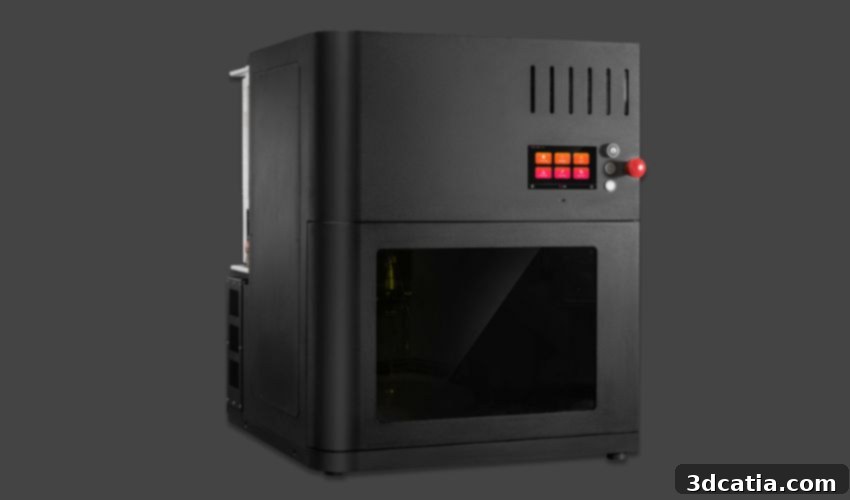
InssTek MX-Lab: Pioneering Material Research with Advanced DED 3D Printing Technology
Directed Energy Deposition (DED) stands as one of the most versatile and impactful metal additive manufacturing technologies available today. Its broad applications range from the fabrication of large-scale metal components to intricate part repairs, steadily increasing its adoption across diverse industrial sectors. A particularly dynamic area where DED 3D printing is experiencing burgeoning interest and significant growth is within material science research. This trend is perfectly exemplified by the MX-Lab 3D printer, a cutting-edge solution meticulously engineered specifically for advanced material development and experimentation.
InssTek, a prominent South Korean provider of industrial 3D printing solutions, has achieved remarkable global success with its flagship metal 3D printing machine, the MX-Lab. This innovative system has rapidly attracted the attention of leading universities and prestigious research institutions worldwide. Recent strategic sales, such as those to the esteemed Institut Jean Lamour (IJL) at the University of Lorraine in France, have further propelled the MX-Lab’s successful international expansion. Moreover, installations are actively underway at numerous other academic and research facilities, particularly those deeply engaged in the complex fields of metallurgy, advanced alloying, and the development of novel metal compositions.
The burgeoning interest in DED for material research raises several pertinent questions: How precisely can DED technology be leveraged to accelerate groundbreaking material investigations? What makes the MX-Lab an ideal choice, especially for institutions or researchers who may have limited prior experience with metal additive manufacturing? And what specific features differentiate this 3D printer, making it a preferred tool in competitive research environments? To address these crucial inquiries, we conducted an in-depth analysis of the MX-Lab 3D printer, delving into its core capabilities and unique advantages. Furthermore, those attending Formnext 2024 will have the invaluable opportunity to experience the machine firsthand at InssTek’s Booth, D98, located in Hall 12.0.
A Comprehensive Overview of the InssTek MX-Lab 3D Printer
Before exploring the myriad applications of the MX-Lab in material research, it is essential to understand the intricate design and sophisticated technology underpinning the 3D printer itself. As previously highlighted, the MX-Lab utilizes Directed Energy Deposition (DED) 3D printing, specifically integrating InssTek’s proprietary Direct Metal Tooling (DMT®) technology. This advanced process, developed by the innovative Korean manufacturer, is renowned for being one of the most precise forms of DED. It achieves unparalleled accuracy by directly melting powdered metal with a highly controlled laser. What truly sets DMT® apart is its sophisticated real-time monitoring system, which incorporates two advanced vision cameras capable of analyzing and meticulously controlling the height and stability of the melt pool in real-time. This level of precision is critical for developing new materials with consistent and predictable properties. Moreover, the MX-Lab has been thoughtfully designed as an entry-level solution for the DED process, significantly lowering the barrier to entry and making this powerful technology more accessible to a wider spectrum of research applications and institutions, irrespective of their prior metal AM experience.
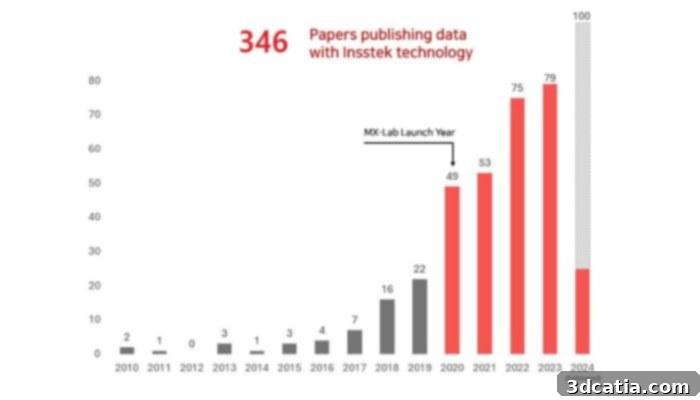
Research labs across various countries have published scientific papers utilizing the MX-Lab 3D printer for groundbreaking material studies.
The MX-Lab boasts a compact yet highly effective build volume of 150 x 150 x 150 mm, providing ample space for a wide array of experimental designs without requiring excessive lab footprint. At its core, the system employs a high-performance Ytterbium Fiber Laser, known for its stability and efficiency in metal melting. The laser’s maximum power reaches an impressive 500 watts, with an average operational wattage typically around 300 watts. This optimized power range allows researchers to achieve precise control over the material melting process, crucial for tailoring microstructure and properties. The relatively compact size of the machine is a deliberate design choice, empowering researchers with unparalleled flexibility and ease in designing and conducting intricate experiments, making it ideal for academic and industrial R&D settings where space and adaptability are often critical considerations.
Beyond its robust technical specifications, the InssTek MX-Lab solution has been engineered for effortless installation and seamless integration into existing laboratory environments. It is meticulously optimized for the rigorous demands of material research, offering a powerful combination of advanced capabilities and a remarkably user-friendly interface. This intuitive design empowers scientists and engineers to efficiently explore an extensive range of material compositions, investigate novel processing parameters, and characterize diverse material properties with unprecedented ease and speed. Consequently, the printer incorporates a host of innovative features specifically tailored to meet the evolving needs of cutting-edge research, solidifying its position as a leading tool for advanced material development.
Key Features for Advanced Material Research
Perhaps the most distinguishing and impactful feature of the MX-Lab 3D printer is its revolutionary “Hexa Powder Feeder” system. This state-of-the-art system offers unparalleled precision in controlling the ratios of up to six distinct material powders simultaneously during experimental printing. This multi-material capability is a game-changer for alloy development. The Hexa Powder Feeder guarantees exceptionally accurate powder feeding, even when dispensing micro-amounts, which is absolutely critical for highly detailed and precise research applications. For instance, it is specifically optimized for High Entropy Alloy (HEA) research, an area of rapidly growing interest in material science. The feeder’s advanced design allows for the rapid “speed-scanning” of various alloy compositions directly during the 3D printing process. This groundbreaking capability drastically accelerates material research cycles, enabling scientists to screen numerous alloy permutations and identify optimal compositions far more quickly than traditional methods would allow.
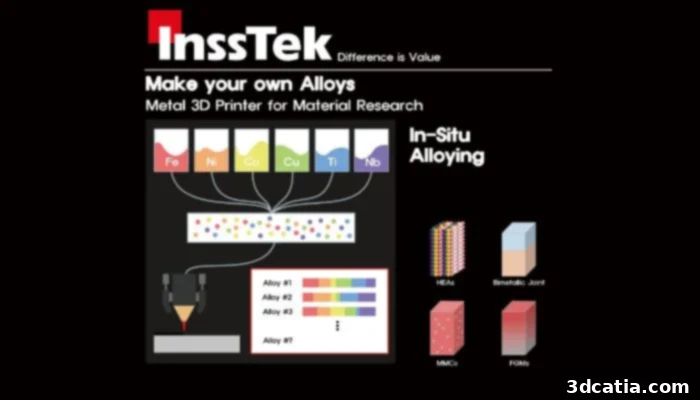
The sophisticated features of the MX-Lab 3D printer are uniquely primed for advanced alloy research, enabling complex material experimentation.
Complementing the Hexa Powder Feeder, the MX-Lab includes a suite of other intelligent features that streamline the research process. These encompass an auto powder calibration system, ensuring consistent and optimal powder flow, and an automatic adjustment mechanism for the Z-layer height, which maintains precision throughout the build. For multi-material samples, the system offers the critical ability to precisely set the appropriate laser power for each specific material at the desired location within the part. This level of localized control is indispensable for creating functionally graded materials or multi-material structures with distinct property zones. Furthermore, a comprehensive monitoring system continuously tracks vital parameters such as laser power, melt pool imaging, coordinate system data, and powder feeding performance. Crucially, this system provides robust data extraction capabilities for the user, allowing researchers to collect, analyze, and correlate process parameters with material outcomes – an enormous advantage and a fundamental requirement for rigorous scientific research and process optimization.
Leveraging DED 3D Printing for Transformative Material Research
Given its sophisticated features and purpose-built design, it is evident why the MX-Lab 3D printer has been making such significant waves and generating profound excitement within the material research sector. Its impact is global, with an impressive 40 units already sold across 15 countries worldwide, spanning major research hubs in the USA, Europe, and Asia. The diverse range of use cases unequivocally demonstrates its exceptional suitability for advanced material research, particularly in areas requiring multi-material capabilities and precise process control.
Advancements in High Entropy Alloys (HEAs)
Consider, for instance, the profound contributions of the MX-Lab to High Entropy Alloy (HEA) research. HEAs are a relatively new class of alloys characterized by their unique composition, typically formed by mixing five or more elements in equal or relatively large proportions. Unlike traditional alloys dominated by a single principal element, HEAs often exhibit extraordinary properties, including superior strength, exceptional hardness, and significantly higher corrosion resistance compared to conventional alloys and metals. These remarkable characteristics make HEAs immensely attractive for demanding applications in fields such as mold manufacturing, high-performance aerospace components, anti-radiation shielding, and more. The MX-Lab 3D printer, with its precise multi-powder feeding capabilities, is proving to be an indispensable tool for researchers exploring these complex alloys, enabling rapid compositional screening and property optimization. A prime example of this innovative research is taking place at KAIST (Korea Advanced Institute of Science and Technology) in South Korea, where the MX-Lab is actively used to push the boundaries of HEA development.
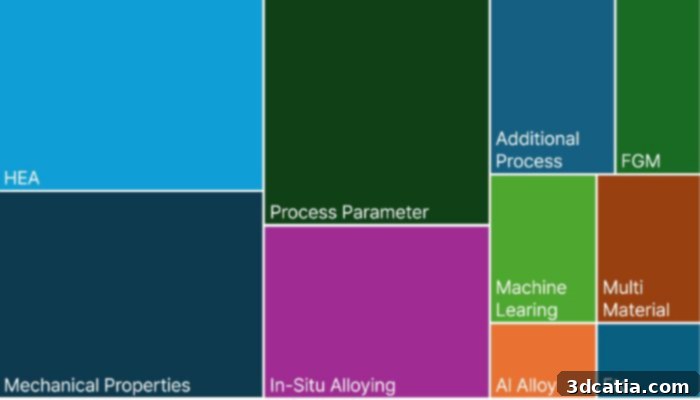
This image illustrates some of the diverse and impactful research topics that have been successfully explored and published using the InssTek MX-Lab 3D printer.
Global Research Collaborations and Diverse Applications
Further compelling applications of the MX-Lab are evident across a multitude of prestigious research institutions worldwide, underscoring its versatility and broad utility. In the United States, for example, Brown University is actively employing the MX-Lab 3D printer for pioneering research in advanced materials science and engineering, pushing the boundaries of what is possible with new metallic structures. Concurrently, at the University of Michigan, researchers are conducting in-depth studies focused on the development of novel high-performance alloys and the sophisticated optimization of 3D printing processes, leveraging the MX-Lab’s precision. Moving to the University of North Dakota, the MX-Lab is being utilized for the innovative development of complex multi-material structures and for integrating machine learning applications into the realm of 3D printing, paving the way for intelligent manufacturing processes.
Beyond the US, the MX-Lab’s influence extends to other key research hubs. At VTT in Finland, for instance, researchers are engaged in critical work aimed at discovering and developing improved alloys by systematically altering and optimizing the composition of existing metallic materials. Finally, COMTES FHT a.s. in the Czech Republic is utilizing the MX-Lab 3D printer for the intricate fabrication of Functionally Gradient Material (FGM) samples, a testament to the machine’s unique capabilities in creating spatially varying material properties.
The Power of Functionally Gradient Materials (FGMs)
Functionally Gradient Materials (FGMs) represent a remarkable class of advanced materials distinguished by their ability to exhibit continuous or stepwise variations in composition or microstructure throughout their volume. This unique characteristic allows for a gradual change in material properties across a component, enabling designers to engineer materials precisely for specific functions and demanding applications. For instance, an FGM could transition from a tough, ductile material on one surface to a hard, wear-resistant material on another, or from a high-temperature resistant layer to a thermally insulative one. Creating such intricate structures with tailored properties is an incredibly complex task, one that is largely unachievable with conventional manufacturing methods. However, DED 3D printers like the InssTek MX-Lab are uniquely equipped to fabricate FGMs due to their precise control over material deposition and multi-powder feeding capabilities. The ability to seamlessly vary material input during the build process makes the MX-Lab an indispensable tool for FGM research and development, opening new frontiers in material design. The high performance and unparalleled versatility of the MX-Lab across various research domains have been consistently highlighted and validated through numerous publications in esteemed scientific and engineering journals.
An InssTek spokesperson summarizes the company’s vision and impact: “The high interest and unwavering trust in MX-Lab’s performance and immense potential from leading research institutions globally are profoundly driving our continued success in the international market. We are deeply committed to fostering and expanding our partnerships with an even greater number of institutions, aiming to make significant contributions to innovative technology development and the advancement of material science.” For those keen to delve deeper into the capabilities and features of this groundbreaking DED system, more information about the MX-Lab 3D printer is available HERE. And for individuals interested in witnessing firsthand how this advanced machine can be powerfully utilized for pioneering material research, be sure to visit InssTek at Formnext at Booth D98, located in Hall 12.0.
What are your thoughts on the InssTek MX-Lab 3D printer and its transformative applications in advanced material research, particularly for High Entropy Alloys and Functionally Gradient Materials? Share your insights and comments below, or engage with us on our Facebook and Twitter pages! Don’t miss out on the latest advancements and news in the world of 3D printing – subscribe to our free weekly Newsletter, delivered directly to your inbox!