
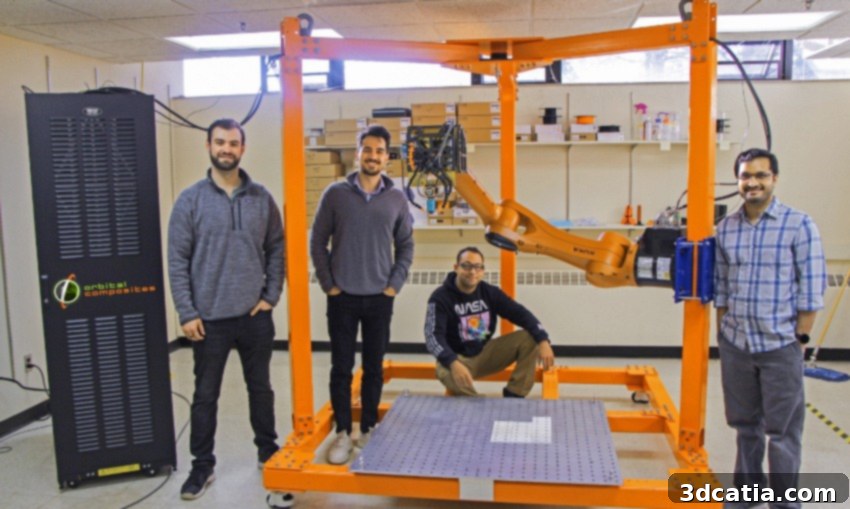
Orbital Composites Ships Advanced Robotic 3D Printer to UMD, Igniting Next-Generation Manufacturing Education and Research
Orbital Composites, a pioneering force in providing cutting-edge carbon fiber and robotic 3D printers specifically engineered for demanding space additive manufacturing applications, has proudly announced a significant milestone: the shipment of one of its state-of-the-art Robotic 3D printers to the University of Minnesota Duluth (UMD). This delivery, which includes Orbital Composites’ commercially available Orbital S Additive Manufacturing (AM) platform, is set to revolutionize UMD’s research capabilities in advanced polymer and composite additive manufacturing. This pivotal event marks a monumental achievement for both UMD and Orbital Composites. For the University of Minnesota Duluth, the acquisition of this sophisticated robotic 3D printer will serve as a cornerstone in its ambitious endeavor to dramatically expand its teaching and research capacities in large-scale, out-of-plane robotic 3D printing of thermoplastic polymers. Concurrently, it signifies Orbital Composites’ very first commercial shipment of a complete, turnkey robotic 3D printer solution, underscoring the company’s transition from R&D to market leadership in advanced manufacturing technologies.
The research at UMD, poised to explore uncharted territories in additive manufacturing, will be meticulously conducted under the expert guidance of Dr. Gireesh Menta, a distinguished professor of Mechanical Engineering. Dr. Menta’s vision for this new capability is clear and inspiring. He emphasizes that the arrival of this advanced 3D printer will “not only enable us to conduct groundbreaking research in this exciting next-generation manufacturing technology but also allows us to bring true interdisciplinary instruction to our classrooms.” This statement highlights the profound educational impact expected, fostering a collaborative learning environment that transcends traditional academic silos. Dr. Menta further articulated the profound benefits for UMD, stating, “We expect this technology to improve UMD’s competitiveness in the Additive Manufacturing field and result in job opportunities with students gaining extremely valuable skills in robotics, AI, and additive manufacturing.” This forward-looking perspective underlines the strategic investment UMD is making in preparing its students for the rapidly evolving demands of the modern industrial landscape, where expertise in robotics, artificial intelligence, and additive manufacturing is becoming increasingly indispensable.
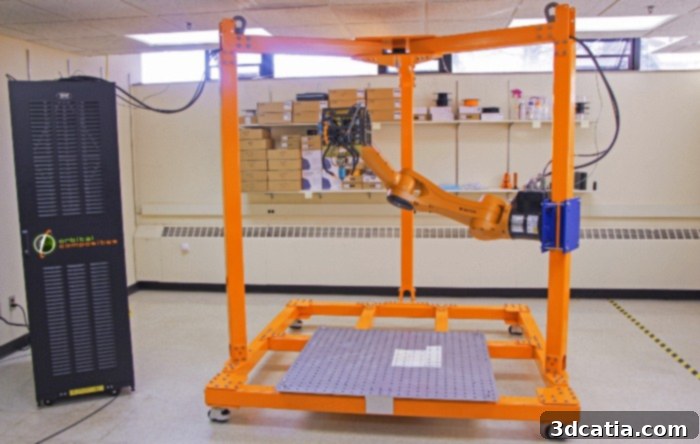
Orbital Composites’ robotic 3D printer has now been shipped to UMD, opening new frontiers in research and education.
The Orbital S platform stands out as an exceptionally versatile and multi-talented system, designed with a modular approach that seamlessly integrates robotic, additive, and even subtractive manufacturing capabilities. This inherent flexibility is paramount for an academic setting, as it empowers students to delve into a diverse array of subjects, gaining invaluable hands-on knowledge. From the intricate mechanics of robotics and the logical frameworks of software programming to the fundamental principles of material science and, critically, the nuanced processes of 3D printing for polymers and composites, students will engage with cutting-edge technologies. Furthermore, the Orbital S ensures a truly interdisciplinary learning experience. Operating this robotic 3D printer will expose students to various facets of engineering, including mechanical and electrical design, the chemical properties of materials, and advanced programming techniques, alongside numerous other critical subjects. This comprehensive exposure fosters a holistic understanding of complex manufacturing systems, preparing students not just for specialized roles, but for innovative problem-solving in a rapidly advancing technological world.
The growing emphasis on education in robotic 3D printing reflects its escalating prominence within the realm of advanced manufacturing. This educational drive is not merely a trend but a core component of Orbital Composites’ overarching mission to develop transformative technologies for future generations. The Orbital S platform exemplifies this commitment by enabling students to print objects of virtually any conceivable shape or size, transcending the limitations of traditional manufacturing methods. This unparalleled design freedom means that UMD students and researchers will be uniquely positioned to conduct pioneering research across a vast spectrum of verticals. These include, but are certainly not limited to, the high-stakes environments of aerospace, the intricate demands of biomedical applications, the sustainable innovations in renewable energy, the creative challenges of architecture, the evolving landscape of clean transportation, and the ultimate frontier of space exploration. The ability to prototype and produce large, complex parts with speed and precision opens doors to innovations previously deemed impractical or impossible.
Cole Nielsen, the visionary Founder & CTO of Orbital Composites, articulates the company’s deep-rooted philosophy, stating, “We are innately passionate about educating the next generation of engineers and advancing the research in robotic 3D printing.” This sentiment underscores Orbital Composites’ dual commitment to technological innovation and academic empowerment. Nielsen further elaborated on the strategic utility of their flagship product, concluding, “We see the Orbital S platform as a perfect multidisciplinary teaching and research tool for Robotics, 3D Printing, Advanced Materials, and Software development. As such, it is an essential tool for project-based learning for next-generation Mechanical, Civil, Electrical, Biomedical, and Software engineers alike.” This emphasis on project-based learning is crucial. It moves beyond theoretical instruction, immersing students in practical challenges that mimic real-world engineering scenarios. By working directly with the Orbital S, students will develop critical thinking, problem-solving skills, and a collaborative mindset, making them highly desirable candidates in a competitive global job market. The platform’s ability to cater to a broad range of engineering disciplines ensures that future innovators, regardless of their specialization, will possess a foundational understanding of advanced additive manufacturing and robotics.
One of the most innovative aspects of Orbital Composites’ technology, and particularly relevant for large-scale applications, is its modular system. This ingeniously designed system can be efficiently set up within standard shipping containers, allowing for both the printing and post-processing of parts directly on-site. This capability is especially critical for manufacturing components that are notoriously difficult and costly to transport, such as massive wind turbine blades, large structural elements for construction, or specialized parts for defense and infrastructure projects. By eliminating the need for long-distance transportation of finished goods, this on-site manufacturing solution drastically reduces logistical complexities, cuts down on transportation costs, and significantly minimizes environmental impact. Furthermore, it enables rapid deployment and localized production, which can be a game-changer for industries requiring agility and responsiveness. This strategic approach aligns perfectly with the future of distributed manufacturing, bringing production closer to the point of demand and unlocking new possibilities for innovation in fields reliant on large-format composites.
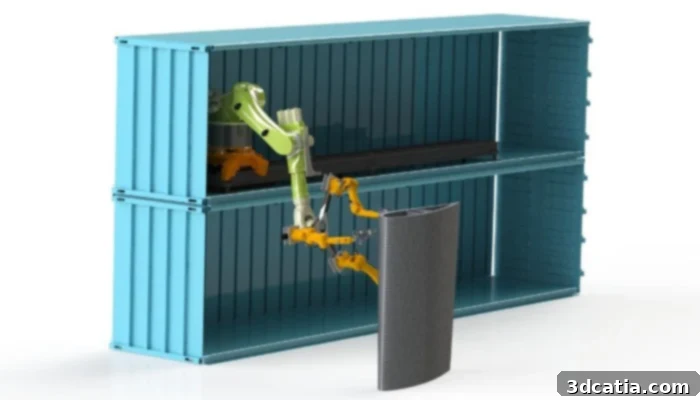
Orbital Composites’ modular system can be established in shipping containers, enabling on-site printing and post-processing of parts, a crucial advantage for oversized components like large wind blades that pose significant transportation challenges.
This collaboration between Orbital Composites and the University of Minnesota Duluth represents a significant leap forward in the integration of advanced manufacturing technologies into academic research and education. By providing students with direct access to cutting-edge robotic 3D printing, UMD is not only fostering a new generation of skilled engineers and innovators but also contributing actively to the development of next-generation manufacturing processes. The implications for industries ranging from aerospace and automotive to construction and energy are profound, promising faster prototyping, more complex designs, and more efficient production cycles for advanced composite structures. This partnership stands as a testament to the power of synergy between industry leaders and academic institutions in driving technological progress and preparing the workforce of tomorrow.
For those eager to delve deeper into the innovative work being done by Orbital Composites and its revolutionary technologies, more information is readily available on their official website, which you can access HERE. We are keen to hear your thoughts on the crucial role of encouraging education about robotic 3D printing in shaping the future of manufacturing. Please share your insights and comments below, or engage with us on our Facebook, Twitter, and LinkedIn pages! Don’t miss out on the latest advancements in additive manufacturing – sign up for our free weekly Newsletter to receive the most current 3D printing news delivered straight to your inbox!
*All photos credit of Orbital Composites