
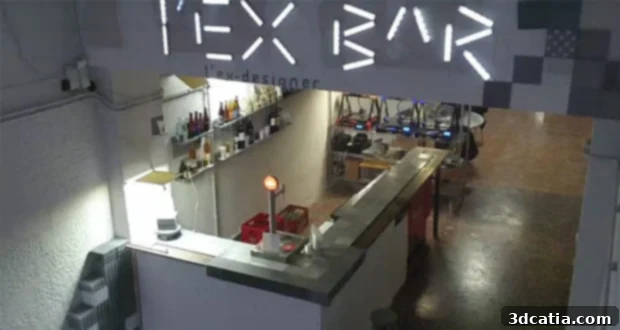
The Ex-Designer Bar: Barcelona’s Revolutionary 3D-Printed Culinary and Design Experience
In 2015, the visionary designer Martí Guixé embarked on an audacious and groundbreaking project in Barcelona: the “Ex-Designer Bar.” This innovative endeavor involved transforming a modest 90m2 space into a fully functional bar, conceptualized and realized almost entirely through the power of 3D printing. This wasn’t merely a decorative touch or a showcase for a few novelty items; every tangible element, from the delicate plates and intricate glasses to the robust bar stools and custom furniture, emerged from the nozzles of 3D printers. The sheer scope of this commitment to additive manufacturing is truly remarkable, setting a new benchmark for how design, production, and hospitality can converge. Adding another layer of intrigue, the bar itself hosts three Cartesian 3D printers that operate continuously, demonstrating real-time innovation by fabricating new improvements and evolving elements for the bar’s interior. This dynamic environment ensures that the Ex-Designer Bar is not a static installation but a living, breathing testament to the potential of digital fabrication.
The moment we grasped the revolutionary nature of this concept – a bar that not only serves food and drinks but also actively *prints* its own evolution – we knew a deeper exploration was essential. To truly understand the philosophy and mechanics behind this fascinating project, we sought out Martí Guixé himself, the creative force behind the Ex-Designer Bar, to delve into his insights and experiences.
3DN: Could you tell us about your professional background and how the idea for the Ex-Designer Bar came about?
My studio operates as a comprehensive design practice, yet my personal expertise lies predominantly in product design and interior design. The Ex-Designer Bar originated from a profound desire to critically evaluate the transformative shifts that the democratization of production, largely facilitated by technologies like 3D printing, can introduce into our society and economy. For six years prior to this project, our studio had been actively integrating 3D printers into our workflow, primarily for rapid prototyping, which gave us a deep understanding of their capabilities and limitations. This extensive experience laid the groundwork for contemplating a project of this magnitude.
The decision to create an entirely 3D-printed bar wasn’t made lightly. It was conceived as a living experiment, a public forum to showcase and test the implications of producing goods on demand, locally, and with unprecedented customization. It’s been nearly two years since we initiated the printing process for the bar’s myriad components, and even now, we estimate that we’ve only completed approximately 20% of the overall vision. This ongoing nature is intrinsic to the project’s identity – it’s a constant work in progress, mirroring the continuous evolution of 3D printing technology itself. For those keen to experience this unique blend of design and technology firsthand, the Ex-Designer Bar welcomes visitors from Monday to Friday, between 6 pm and 11 pm, offering a tangible glimpse into the future of manufacturing and design.
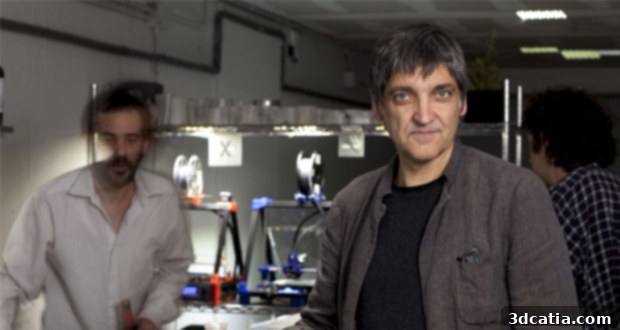
Martí Guixé, the co-founder of the bar (Photo credit: Knölke / Imagekontainer)
3DN: What unique experience does the Ex-Designer Bar offer to 3D printing enthusiasts and the general public?
The Ex-Designer Bar serves far more than just beverages and snacks; it’s designed as a dynamic hub for connection, conversation, and experiential learning. It’s an inviting venue where friends and family can gather, unwind, and engage in meaningful discussions, all while being immersed in an environment that is a living exhibit of additive manufacturing. For 3D printing enthusiasts, it’s an unparalleled opportunity to see the technology’s application beyond industrial prototypes or hobbyist projects. It vividly demonstrates how an entire interior space, down to its most minute details, can continuously “evolve” through the integrated presence of 3D printers. Visitors can literally witness the fascinating process of new components being printed in real-time, observing the creation of everyday items like drinking glasses and dinner plates right before their eyes. This transparency in production fosters a deeper appreciation for the craft and the technology.
Our commitment to pushing the boundaries of 3D printing extends even to the culinary experience. We’ve proudly collaborated with Triditive to integrate a specialized 3D food printer into our setup. This partnership allows us to expand the range of 3D-printed items beyond decor and serveware, venturing into the realm of gastronomy. The goal is to maximize the number of items guests interact with that have been produced through additive manufacturing, creating an immersive and comprehensive 3D printing experience. Imagine enjoying a uniquely designed snack, knowing it was freshly printed just moments before, tailored to innovative forms or compositions that traditional manufacturing methods couldn’t easily achieve. This makes the Ex-Designer Bar not just a place to observe 3D printing, but to truly taste and feel its potential in everyday life.
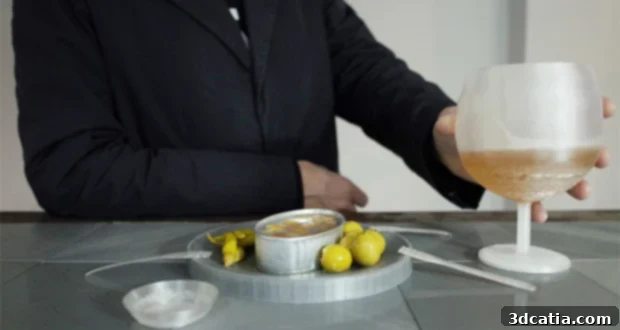
The dishes are printed in 3D (Photo credit: Knölke / Imagekontainer)
3DN: From your perspective, what do you foresee as the future of additive manufacturing in a home environment?
I firmly believe that 3D printing holds immense promise as an incredibly useful tool for fabricating a vast array of objects, offering unparalleled customization and on-demand production. Its potential to empower individuals to create, repair, and personalize items directly in their homes is revolutionary. However, it’s also clear that the technology, in its current state, still requires significant evolution to become perfectly adapted for seamless integration into the average family environment. Several factors contribute to this ongoing need for development.
Currently, common hurdles include the initial investment cost, which can still be prohibitive for many households, and the relative complexity of operating some machines, which might deter users without technical inclination. The range of consumer-friendly materials is growing but still limited compared to industrial applications, and print speeds often require considerable patience for larger or more complex objects. Furthermore, ensuring safety, particularly regarding heated components and material fumes, is crucial for domestic use. Beyond the hardware, there’s also the learning curve associated with 3D design software; while user-friendly options exist, truly bespoke creation still often demands a degree of digital literacy. Once these aspects — affordability, ease of use, material versatility, speed, and safety — are further refined, 3D printing could transform homes into micro-factories, enabling families to print replacement parts for broken appliances, create personalized toys, design unique home décor, or even contribute to a more sustainable lifestyle by producing items locally and reducing waste. The journey to widespread domestic adoption is ongoing, but the potential benefits for creativity, utility, and environmental responsibility are undeniable.
3DN: What are your immediate and long-term future projects related to 3D printing within the Ex-Designer Bar concept?
For the time being, our primary focus remains intensely on the interior of the bar itself. This might sound straightforward, but it is, in fact, an enormous and continuous undertaking. We are not just printing a few decorative pieces; we are progressively fabricating and refining every single dish, glass, and structural element within the space. This involves constant design iteration, material testing, and the production of a high volume of items that must meet both aesthetic and functional standards for a busy hospitality environment. The sheer volume of unique tableware required for a fully operational bar demands significant creative and technical effort, ensuring that each piece contributes to the bar’s unique identity and user experience.
Once this monumental task of fully furnishing and equipping the interior is substantially complete, our attention will pivot to an even more exciting frontier: the integration of 3D printing into our culinary offerings. The next major phase will involve developing and optimizing our machines so that they can effectively print the snacks we serve in the bar. This venture into 3D food printing presents its own set of fascinating challenges, from sourcing food-grade materials that can be extruded and solidify correctly, to experimenting with textures, flavors, and innovative forms that delight our customers. We envision a future where guests can enjoy freshly printed, uniquely shaped snacks, further blurring the lines between design, technology, and gastronomy. This progressive development underscores our commitment to pushing the boundaries of what’s possible with additive manufacturing and consistently surprising our visitors with new innovations.
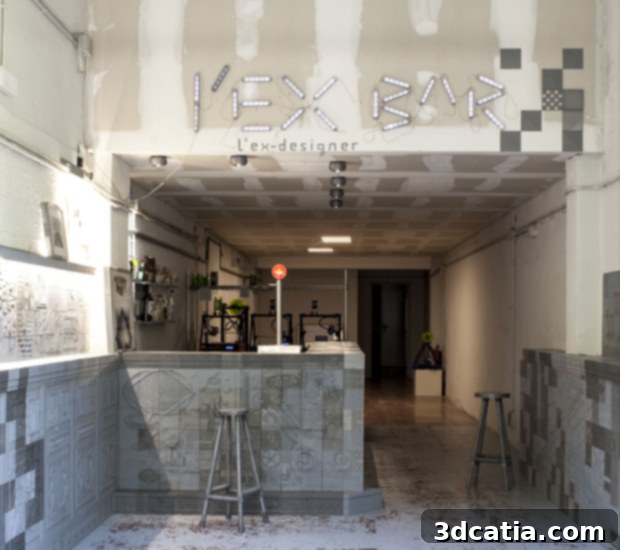
The interior of the bar (Photo credits: Knölke / Imagekontainer)
3DN: Do you have any final thoughts or a message for our readers?
Absolutely. One of the most thrilling aspects of this project, and indeed of working with 3D printing in general, is the incredible pace of evolution we’ve witnessed in such a relatively short period. We are constantly experimenting, refining, and searching for novel ways to innovate and, most importantly, to surprise our customers. For instance, we recently developed a significantly improved method for printing our glasses. Through iterative design and material adjustments, we managed to create glasses that are not only more transparent and visually appealing but also remarkably more resistant to wear and tear, all while being thinner and lighter. What’s truly astounding is that these improvements, encompassing the entire fabrication process, can be achieved in as little as 30 minutes! This level of rapid prototyping and on-demand improvement is simply unprecedented with traditional manufacturing techniques.
Furthermore, these innovative 3D-printed glasses aren’t just for display or use within the bar; it’s even possible for our customers to purchase them directly. This allows visitors to take a piece of the Ex-Designer Bar’s pioneering spirit home with them, blurring the lines between experience, product, and souvenir. Our dedication to continuous improvement and embracing the full potential of additive manufacturing ensures that every visit offers something new and exciting. We invite everyone to experience this journey of constant innovation with us.
You can find more information on the project here
What are your thoughts on the revolutionary Ex-Designer Bar and the future of 3D printing in public and private spaces? We’d love to hear your insights! Let us know in a comment below or join the conversation on our Facebook and Twitter pages. Don’t forget to sign up for our free weekly Newsletter to receive all the latest news and innovations in the world of 3D printing directly in your inbox!