
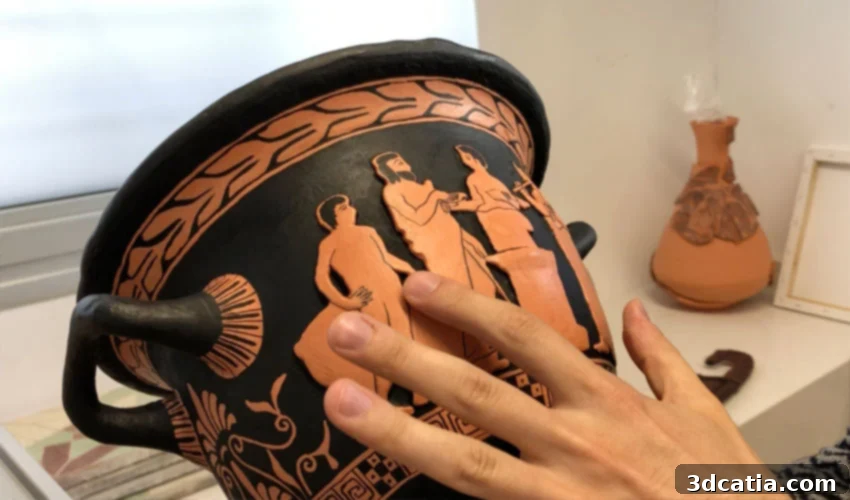
3D Printing Revolutionizes Museum Accessibility: Unlocking Cultural Heritage for All
In an era defined by technological innovation, 3D printing has emerged as a transformative force, reshaping industries and opening new frontiers for inclusion. Its applications are particularly profound in the realm of cultural heritage, where it is breaking down barriers and making historical artifacts accessible to everyone, especially people with disabilities. A remarkable project, spearheaded by researcher Néstor F. Marqués in collaboration with the Spanish technology company BQ, exemplifies this revolution. Through the power of additive manufacturing, they meticulously recreated historical pieces from the Vila Museu in Alicante, Spain. This groundbreaking initiative allows visitors to physically touch and explore ancient artifacts, offering an invaluable sensory experience for individuals with visual impairments and enriching the understanding of history for all.
The concept of leveraging 3D printing to bridge the gap between art and visually disabled communities is not entirely new, but its adoption is rapidly expanding. A few years prior, the renowned Prado Museum in Madrid pioneered a similar effort with its “Today Toca Prado” (Today You Touch the Prado) event. This initiative featured tactile reproductions of some of the museum’s most iconic masterpieces, empowering blind and low-vision visitors to experience art through touch in a way previously unimaginable. Such initiatives underscore a growing global trend towards creating more inclusive cultural spaces, where everyone can engage with and appreciate human history and artistic expression. These pioneering projects collectively highlight the immense potential of 3D printing applications for people with disabilities, extending far beyond the medical field into education, art, and heritage.
Building on these inspiring precedents, the Spanish company BQ joined forces with the Vila Museu. This collaboration brought together technological expertise and historical insight, with the invaluable contribution of researcher Néstor F. Marqués, a specialist in Virtual Heritage and Cultural Divulgation. The core objective of their ambitious project was to significantly enhance accessibility to select archaeological pieces by transforming them into tangible, 3D-printed replicas. This approach not only provides a unique tactile learning opportunity but also serves as a critical tool for cultural preservation and innovative public engagement.
Néstor Marqués eloquently articulated the profound impact of this technology on the heritage sector: “In the field of heritage, history, and archaeology, 3D printing opens a world of possibilities because it gives us the weapons to create pieces without touching the originals.” This statement underscores a dual benefit: protecting invaluable original artifacts from handling while simultaneously allowing for their widespread tactile interpretation. The ability to produce high-fidelity replicas ensures that even the most fragile or precious objects can be experienced up close, safely and repeatedly, by all museum visitors.
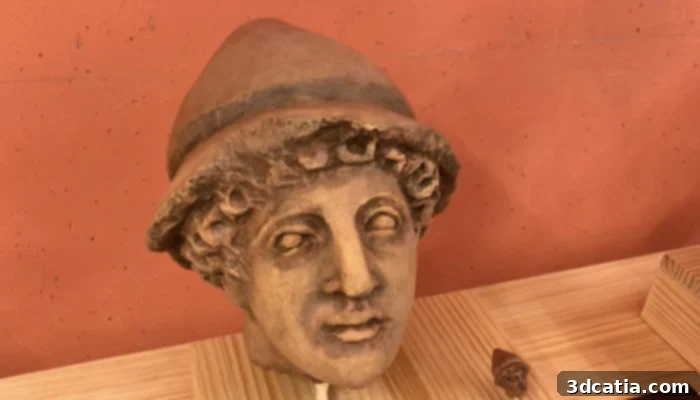
Piece printed in 3D inside the Vila Museum, demonstrating the tangible result of accessible heritage.
From Digital Scan to Tangible Replica: The Process of Recreating Cultural Works
The Vila Museu leadership recognized the immense potential in Néstor Marqués’s vision to virtualize and then 3D print selected pieces. This initiative was specifically designed to make these significant cultural artifacts accessible to blind and low-vision individuals, but also to enrich the experience for sighted visitors who could gain a deeper appreciation by physically interacting with the forms. This realization led to the development of two distinct exhibitions: a permanent display featuring key archaeological finds and a captivating temporary exhibition titled “Slaves of Beauty,” which vividly illustrated the attire and adornments of ancient civilizations such as the Greeks, Iberians, Phoenicians, and Romans. Through touch, visitors could now understand the intricate details of ancient fashion and personal identity.
For the painstaking task of producing these detailed replicas, Néstor employed the BQ Witbox 2, one of the most prominent 3D printers from the Spanish brand. The choice of printer was crucial, as it needed to deliver precision and reliability for intricate archaeological reproductions. Using this advanced FDM (Fused Deposition Modeling) machine, Néstor successfully manufactured several iconic pieces. Among them was a Greek terracotta head, meticulously enlarged ten times its original size. This significant enlargement was not arbitrary; it was a deliberate choice to allow individuals to appreciate the fine details, textures, and artistic nuances that might be imperceptible at the original scale, especially through touch.
Other significant reproductions included a bronze head of Marcus Aurelius, a historically important artifact originating from the Capitoline Museums of Rome, and the project’s crowning achievement: the head of the Lady Bidder of the Hill of Saints (Dama Oferente del Cerro de los Santos), a treasure from the National Archaeological Museum. The careful replication of these revered pieces ensures that their stories and artistic merits are no longer confined to visual interpretation. Currently, the Vila Museu’s collection boasts over twenty 3D-printed works, with ambitious plans to further expand this figure in the coming months, continuously enhancing its accessible offerings.
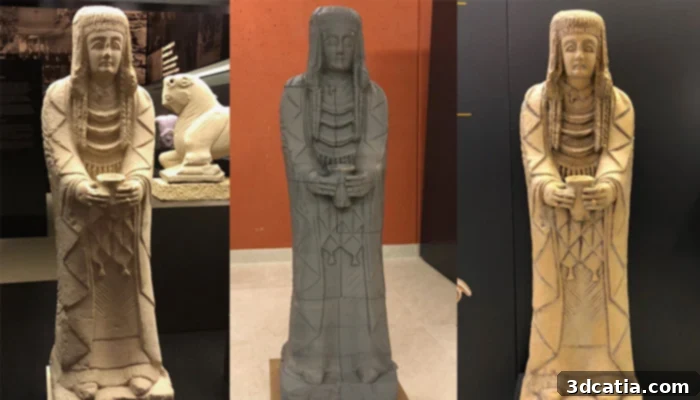
The Lady Bidder of the Cerro de los Santos. Left: original piece. Right: 3D printed replica and its final presentation, highlighting the impressive accuracy achieved.
The ‘Lady Bidder’ Project: A Testament to Dedication and Precision
The replication of the Lady Bidder of the Cerro de los Santos stands as a testament to the dedication and precision involved in this initiative. This singular, complex piece required an extraordinary effort: one month of intensive work, over 400 hours of continuous 3D printing, and the production of 21 individual segments that were then painstakingly assembled to form the complete replica. This monumental undertaking was a collaborative effort between Néstor Marqués and Javier Sanz, showcasing the synergy between archaeological expertise and technical mastery. The process began with advanced 3D scanning techniques, such as photogrammetry or laser scanning, to capture every minute detail of the original artifact. These digital models were then optimized, scaled, and sliced into printable layers. The use of BQ’s 3D printer, coupled with the exceptional craftsmanship and attention to detail from the museum’s team, resulted in a replica that achieved a truly surprising degree of realism and tactile fidelity. The texture, contours, and even subtle imperfections of the original were faithfully reproduced, allowing for an authentic sensory exploration.
The culmination of this extensive effort arrived on May 31st, when the 3D printed pieces were officially unveiled and integrated into the Vila Museu’s collections. The impact was immediate and profound. Within the first few days of the exhibition’s opening, specialists from ONCE (Organización Nacional de Ciegos Españoles – the National Organization of the Spanish Blind) visited the new displays. Néstor Marqués proudly recounted their reactions: “For them it has been something wonderful: the power to have those pieces in their hands, to feel something that they could never imagine.” This emotional response perfectly encapsulates the essence of the project’s success – transforming the intangible wonder of history into a tangible, deeply personal experience for those previously excluded from such direct engagement.
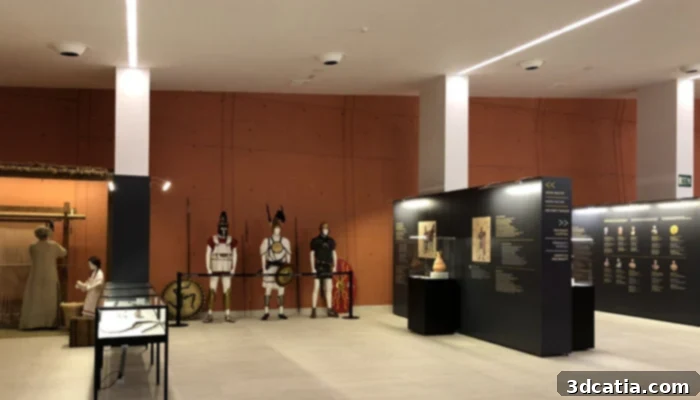
Visitors exploring the long-term temporary exhibition, “Slaves of Beauty,” engaging tactilely with ancient fashion replicas.
The Ripple Effect: Broader Adoption and the Future of Inclusive Museums
The success of the Vila Museu project has not gone unnoticed and has created a significant ripple effect across other cultural institutions in Spain. Following this pioneering development, the Museum of History of Manacor in Palma de Mallorca has adopted a similar approach, now exhibiting its own collection of 3D printed pieces, including prehistoric pots and Roman lamps. This museum has taken an innovative step further by actively encouraging all visitors, regardless of their visual ability, to cover their eyes while exploring the figures. This practice promotes a multi-sensory discovery, allowing everyone to truly appreciate the intricate forms and textures from an entirely different perspective, fostering empathy and a deeper understanding of the tactile experience.
The integration of art with 3D printing technology is increasingly being embraced by various art centers and museums worldwide. This growing trend is not merely about replicating objects; it’s about fundamentally transforming how we interact with, interpret, and preserve our shared history. It opens up unparalleled opportunities for everyone, regardless of physical limitations, to explore and connect with our past. As 3D printing technologies continue to evolve and become more cost-effective, it is widely anticipated that all museums will be able to implement these solutions, leading to a new era of unprecedented inclusivity for visually impaired individuals and enhancing the learning experience for all visitors. This democratizing effect of 3D printing promises to make cultural heritage truly universal.
Beyond direct visitor interaction, the benefits extend to preservation, research, and education. Replicas allow researchers to handle and study delicate artifacts without risk to the originals. They provide invaluable educational tools for classrooms, allowing students to physically interact with history. Moreover, 3D digital models contribute to the long-term digital preservation of cultural heritage, safeguarding it against natural disasters, degradation, or conflict.
Néstor Marqués summarized the broader vision for the future of cultural heritage and technology: “If we can take advantage of this type of technology for our field and benefit, we will do it because we will gain a lot, both at the documentation level, to study the pieces and to reach the public.” This forward-thinking perspective highlights the multi-faceted advantages of embracing additive manufacturing – from rigorous academic study and meticulous documentation to dynamic public engagement and enhanced accessibility. The collaboration between technology providers, museums, and dedicated researchers like Néstor Marqués is paving the way for a more inclusive, interactive, and resilient future for our global cultural treasures.
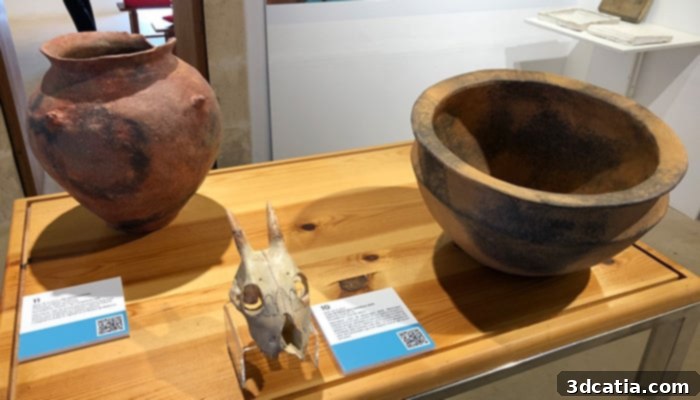
Detail of 3D printed Roman pots, showcasing the fine textures and forms that tactile exhibits can convey.
What are your thoughts on the collaboration between BQ and 3D printing to create accessible cultural heritage exhibits? How do you envision 3D printing further enhancing museum experiences? Let us know in a comment below or on our Facebook and Twitter pages! And remember to sign up for our free weekly Newsletter to get all the latest news on progress, research, and more entrepreneurs in 3D printing sent straight to your inbox!