

Revolutionizing Space Exploration: Made In Space and Braskem Pioneer In-Orbit Plastic Recycling for Sustainable Missions
In a monumental leap towards enhancing the autonomy and sustainability of long-duration space missions, Made In Space, a trailblazer in zero-gravity manufacturing, is preparing to deploy the first commercially-developed plastic recycling facility to the International Space Station (ISS). This groundbreaking endeavor is slated for November, embarking on Northrop Grumman’s commercial cargo resupply flight. Dubbed the Braskem Recycler, this innovative system is the fruit of a strategic partnership with Braskem, a global leader in biopolymer and thermoplastic resin production. The collaboration between Made In Space and Braskem has a rich history, rooted in their shared vision exemplified by the ‘Printing the Future’ project, an initiative focused on developing solutions for manufacturing in the challenging environment of space. This upcoming mission represents a critical milestone in establishing a truly self-sufficient human presence beyond Earth, marking a significant step away from the continuous and costly reliance on supplies ferried from our home planet.
The Braskem Recycler is designed to address one of the most pressing logistical challenges of space exploration: resource management and waste reduction. By enabling the reuse of materials directly in orbit, it promises to drastically cut down on the mass of supplies that need to be launched from Earth, thereby optimizing mission costs and increasing the operational flexibility for astronauts. As humanity sets its sights on more ambitious journeys to the Moon, Mars, and beyond, the ability to “live off the land” – or in this case, “live off the waste” – becomes not just an advantage, but a necessity. Made In Space, recognized for its expertise in developing 3D printers for zero-gravity environments and its long-standing relationship as a supplier to NASA, is at the forefront of this manufacturing revolution. The Braskem Recycler will integrate seamlessly with Made In Space’s existing Additive Manufacturing Facility (AMF) already operational on the ISS, creating a more robust and sustainable in-space production ecosystem.
The Braskem Recycler: Closing the Loop in Space
The fundamental objective of the Braskem Recycler is to transform plastic waste, including discarded objects and packaging materials generated by the ISS crew, into reusable feedstock for 3D printing. This capability is pivotal for improving the manufacturing sustainability and operational autonomy of future missions that venture beyond our planetary confines. On the ISS, this facility will play a crucial role in complementing and enhancing Made In Space’s existing Additive Manufacturing Facility (AMF), which has been enabling astronauts to print tools, spare parts, and scientific equipment on demand since its deployment. The integration of a recycling unit signifies a paradigm shift from a linear supply chain – where everything must be launched from Earth – to a more circular economy model, where resources are reused and repurposed in situ. This not only reduces the overall mass required for launch but also mitigates the accumulation of waste within the confines of the space station, contributing to a cleaner and more efficient living and working environment for astronauts.
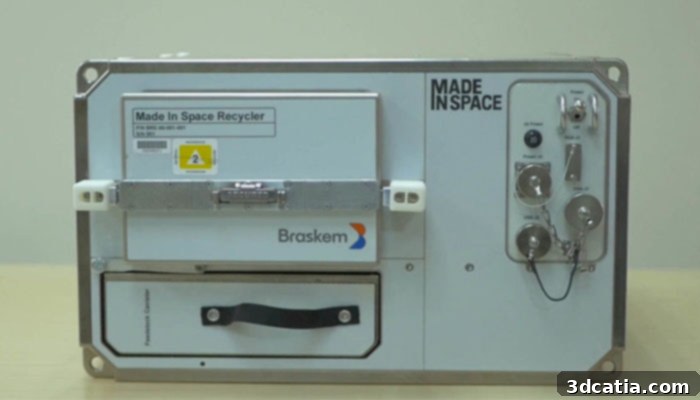
The first commercially-developed plastic recycling facility | Image via Made In Space
The operational mechanics of the Braskem Recycler are ingeniously straightforward, designed for efficiency and minimal crew intervention. It functions by converting various plastic waste materials and even previously 3D-printed objects that are no longer needed, into smaller, manageable pieces. These shredded plastic fragments are then subjected to a heating process, extruded, and precisely spooled into fresh feedstock filament. This newly produced filament is perfectly compatible with the Additive Manufacturing Facility (AMF), ready to be processed and transformed into new tools or components as required by the mission. A key advantage of the Braskem Recycler is its high degree of automation, ensuring that its operation requires minimal input from the busy ISS crew. This automation is vital for maximizing crew time, allowing them to focus on scientific research and mission-critical tasks. Furthermore, the ability to generate feedstock on-site is expected to significantly reduce the reliance on continuous resupply missions from Earth, which are both infrequent and incredibly expensive. This closed-loop system embodies the principles of a circular economy, a concept Braskem has championed in its terrestrial operations and is now extending to the frontier of space exploration.
Sustainability Beyond Our Planet: The Vision for Future Exploration
“Local manufacturing resources are a crucial capability for space exploration,” emphasized Michael Snyder, Chief Engineer at Made In Space, in a recent statement. His words underscore the profound importance of this technology. “Demonstrating and validating recycling capabilities on the ISS is an important step towards developing sustainable manufacturing systems that will enable us to venture deeper into the solar system.” This statement encapsulates the long-term vision behind projects like the Braskem Recycler. For humanity to establish a sustained presence on the Moon, Mars, or even beyond, we cannot perpetually depend on Earth for every single item. The costs, risks, and time involved in launching materials across vast distances are simply prohibitive for long-term self-sufficiency. In-space recycling and manufacturing represent the cornerstone of a future where astronauts can truly be independent, fabricating what they need, when they need it, from resources already at hand or from waste they generate.
Made In Space has consistently been at the forefront of pioneering manufacturing capabilities in space. Their journey began with the deployment of their first-generation 3D printer in 2014, followed by a second-generation system, effectively establishing on-orbit additive manufacturing as a viable and essential technology. These initial successes paved the way for the Additive Manufacturing Facility (AMF), which has been instrumental in providing astronauts with on-demand tools and experimental hardware. The introduction of the Braskem Recycler into this existing suite of manufacturing capabilities on the ISS represents a monumental leap forward. It aims to create a near-closed-loop manufacturing system, a truly revolutionary concept for space operations. This system dramatically reduces the reliance on feedstock continuously resupplied from Earth, transforming waste into valuable resources. Imagine a lunar outpost or a Mars habitat where astronauts can print spare parts for their habitat, tools for geological surveys, or even components for life support systems, all from materials that would otherwise be discarded. This level of self-sufficiency is what will truly unlock humanity’s potential for deep space exploration and eventual colonization.
The economic and environmental implications of such a system are vast. Each kilogram of payload launched to the ISS costs tens of thousands of dollars. By recycling plastic waste in orbit, missions can significantly reduce the amount of mass that needs to be carried from Earth, directly translating into substantial cost savings. Moreover, it addresses the burgeoning issue of space debris and waste management in a confined environment like the ISS. As space agencies and private companies plan for more ambitious missions, including the establishment of permanent lunar bases and human missions to Mars, the need for sustainable resource utilization becomes paramount. Technologies like the Braskem Recycler are not just about printing objects; they are about printing a sustainable future for human spaceflight, ensuring that our presence beyond Earth is both enduring and responsible. Made In Space continues to push the boundaries of what is possible in extraterrestrial manufacturing, offering a glimpse into a future where space exploration is truly self-sustaining. More detailed information about their pioneering work can be found on their official website, accessible HERE.
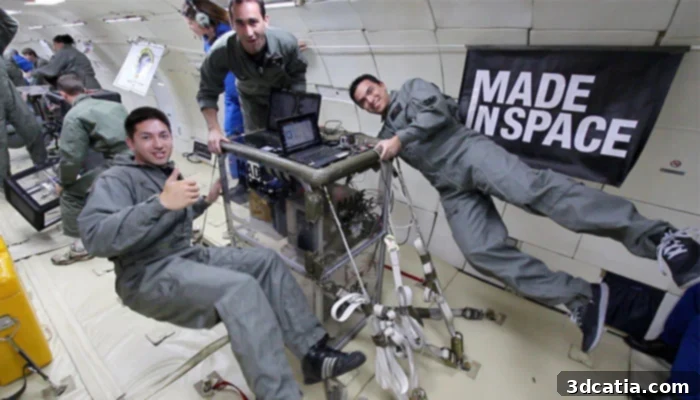
The Made In Space team
The collaborative spirit between Made In Space and Braskem further highlights the multi-disciplinary effort required to advance space technology. Braskem’s profound expertise in polymer science and its commitment to the circular economy on Earth provide the essential material knowledge for developing robust and reliable recycling processes for space. Their ‘Printing the Future’ project, an early collaboration, laid the groundwork for understanding how to adapt polymer-based manufacturing to the unique challenges of microgravity. This partnership exemplifies how terrestrial innovations in sustainability can find critical applications in the realm of space, paving the way for advanced material science to support humanity’s off-world aspirations. The successful deployment and operation of the Braskem Recycler will not only validate the feasibility of in-space recycling but will also provide invaluable data and experience that can be applied to future systems, potentially leading to the recycling of other types of materials and the development of even more sophisticated closed-loop manufacturing facilities.
What are your thoughts on this revolutionary new mission and its potential impact on the future of space exploration? Do you believe in-space recycling is the key to unlocking long-duration human missions? We invite you to share your perspectives and comments in the section below or engage with us on our vibrant social media platforms, including Facebook and Twitter pages! For those eager to stay abreast of the latest developments and innovations in the rapidly evolving world of 3D printing and its applications, consider signing up for our free weekly Newsletter, delivering all the essential news straight to your inbox.