
BMW Group’s Circular Economy Revolution: Transforming 3D Printing Waste into Sustainable Materials
The BMW Group is forging a path towards a truly circular economy, demonstrating a profound commitment to sustainable manufacturing. At its state-of-the-art Additive Manufacturing Campus in Oberschleißheim, southern Germany, the automotive giant has initiated a groundbreaking program to recycle waste powder and end-of-life components, transforming them into new, high-quality 3D printing materials. This innovative process marks a significant step forward in the sustainable use of plastics, enabling advanced recycling on an industrial scale that redefines manufacturing waste management.
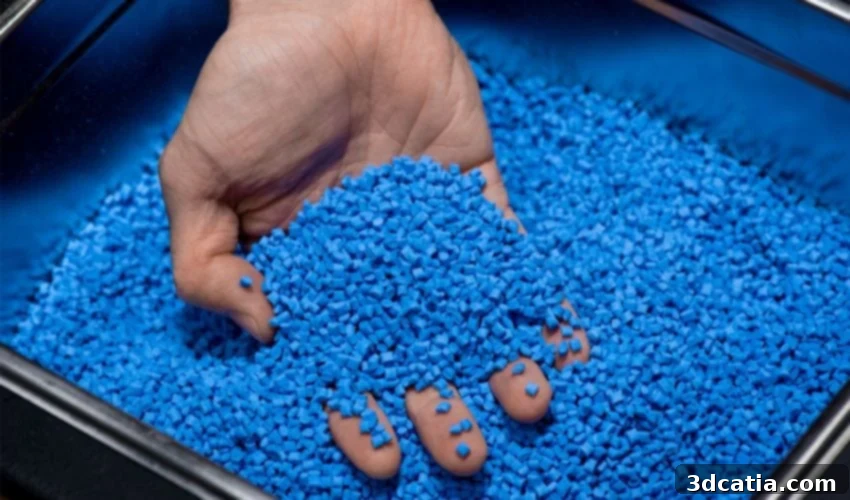
Traditionally, residual powder from additive manufacturing processes, along with components that have reached the end of their lifecycle, were often discarded, contributing to industrial waste streams. However, BMW’s pioneering approach has fundamentally altered this paradigm. Through meticulous processing, these once-disregarded materials are now being converted into new filaments specifically designed for Fused Deposition Modeling (FDM) 3D printers. These recycled filaments are meticulously wound onto spools, ready for immediate use in production lines, proving the viability of closing the material loop. Beyond FDM, the campus also excels in producing recycled granulate, a crucial material for Fused Granulate Fabrication (FGF) technology. FGF enables the efficient manufacture of large-volume components, expanding the scope of recycled materials into broader and more demanding applications within BMW’s extensive manufacturing ecosystem. This dual approach maximizes the utility of waste, ensuring a comprehensive recycling solution across different additive manufacturing technologies.
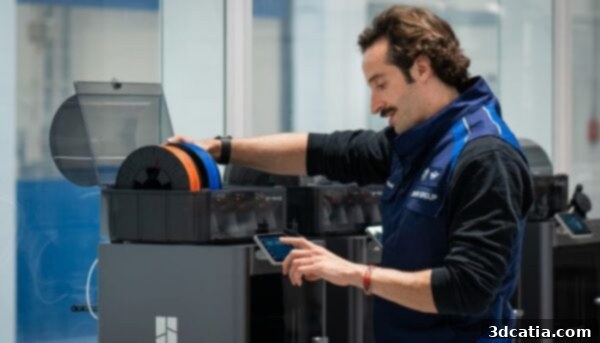
The recycled materials can be re-used directly in FDM printers.
From Pilot Project to Industrial Scale: BMW’s Journey in Additive Recycling
The journey from an ambitious concept to a fully operational industrial recycling program has been spearheaded by Paul Victor Osswald, who has managed the project since 2018. This initiative didn’t spring up overnight; it evolved systematically from a pilot phase, demonstrating BMW’s methodical approach to innovation. A notable predecessor was the “bottleUP” project, which focused on recycling PET bottles and successfully produced prototypes using recycled materials as early as 2021. This early success proved the fundamental feasibility of incorporating recycled content into high-performance applications, laying the groundwork for the more complex task of recycling proprietary 3D printing waste.
Today, the program operates on an impressive industrial scale, recycling up to 12 tons of waste powder annually. This significant volume directly translates into a multitude of tangible benefits across BMW’s operations. Economically, it leads to substantial cost reductions by minimizing the need for new, virgin raw materials and decreasing waste disposal expenses. From a quality perspective, the controlled recycling process ensures consistent material properties, maintaining the high standards expected of BMW components. Furthermore, the initiative significantly improves ergonomics in the plant by streamlining material handling and reducing the physical burden associated with managing and disposing of waste powder. Paul Victor Osswald encapsulates the spirit of this endeavor, emphasizing, “It’s an exciting task to be able to constantly develop and try out new processes. The use of waste powder and disused 3D-printed components is an important building block for a functioning and efficient circular economy.” This statement underscores BMW’s dedication to continuous improvement and its vision for a sustainable future.
The Additive Manufacturing Campus in Oberschleißheim serves as more than just a recycling facility; it acts as a central hub for know-how and technology transfer within the BMW Group. Its role extends far beyond merely supplying recycled material. The campus is instrumental in developing sophisticated printing parameters, crucial for optimizing the performance of recycled plastics. It also provides comprehensive training programs and extensive support to production sites worldwide, ensuring seamless integration of these new sustainable materials. This close cooperation with other manufacturing plants involves rigorous validation of suitable 3D printers and the development of tailored printing profiles. The goal is to provide manufacturing facilities with a complete package – encompassing validated materials, optimized processes, and expert support – enabling the fast and safe introduction of recycled materials directly on-site. This holistic approach accelerates the adoption of circular economy principles across BMW’s global production network, fostering a culture of innovation and sustainability.
Moreover, the environmental impact of this recycling initiative extends beyond mere waste reduction. By diverting significant quantities of waste powder and end-of-life components from landfills, BMW is substantially reducing its carbon footprint associated with virgin material production. The energy required to process and recycle existing plastics is often considerably less than that needed to synthesize new polymers from fossil fuels. This contributes directly to lower greenhouse gas emissions and a decreased reliance on finite resources, aligning perfectly with global climate goals and responsible resource management. BMW’s strategy not only enhances its internal operational efficiency but also sets a powerful precedent for the entire automotive and manufacturing industries to adopt more sustainable practices, highlighting that environmental stewardship can go hand-in-hand with technological advancement and economic viability.
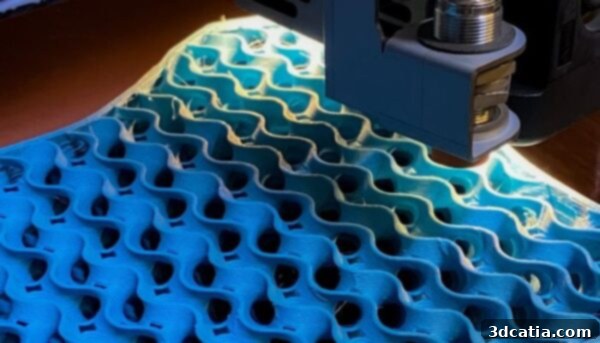
The company plans to release more prototypes created from the recycled materials.
Real-World Impact: Versatile Applications Driving Innovation and Sustainability
The efficacy and versatility of BMW’s recycled 3D printing materials are not confined to laboratory tests; they are proving themselves in practical, critical applications across various manufacturing plants. At the BMW plant in Munich, for instance, a 3D-printed component made from recycled material is already in active use for precise steering rod fixation. This application demands exceptional dimensional accuracy and structural integrity, where even minor discrepancies can impact vehicle performance. Using recycled materials for such a critical part underscores the confidence BMW places in the quality and reliability of its reclaimed resources, demonstrating that sustainability does not compromise precision or safety.
Further showcasing the broad utility of these materials, the BMW plant in Berlin utilizes special 3D-printed support aids for the intricate decorative finishing of motorcycles. These custom-designed aids provide exact support and positioning for delicate parts during complex finishing processes, preventing damage and ensuring a flawless aesthetic. Such specialized tooling, traditionally expensive and time-consuming to produce through conventional methods, can now be rapidly iterated and manufactured on-demand using recycled materials. This flexibility drastically shortens lead times for new tools and allows for quick adjustments to production processes, enhancing overall manufacturing agility and efficiency.
In Dingolfing, a key BMW production site in southern Bavaria, recycled 3D-printed magnetic screw holders play a crucial role on the assembly line. These ingenious holders prevent small parts, such as screws, from getting lost or misplaced during assembly, a common issue that can lead to costly delays and rework. By securely holding these tiny components, the magnetic holders improve assembly line efficiency, reduce material waste from lost parts, and enhance worker ergonomics by simplifying handling. Each of these diverse applications highlights how BMW is leveraging its advanced additive manufacturing capabilities and recycled materials to address specific operational challenges, improving both ecological performance and economic outcomes.
This holistic approach yields a dual benefit, ensuring not only significant ecological advantages but also fostering innovation directly at the production site. From an environmental standpoint, the initiative drastically lowers material requirements by reducing the demand for virgin plastics and substantially decreases waste volumes. This contributes to a smaller environmental footprint across the product lifecycle. Economically, the initiative drives efficiency gains through cost savings on raw materials and waste disposal, alongside improved operational effectiveness and reduced downtime. Moreover, integrating 3D printing with recycled materials directly into production lines fosters an environment of rapid iteration cycles, allowing for flexible adjustments and quick, localized solutions. This agility is vital in modern manufacturing, enabling rapid responses to design changes or unforeseen challenges and providing robust protection against potential failures on the assembly line, thus enhancing overall operational resilience.
By successfully transitioning from merely discarding waste powder to systematically transforming it into high-performance recycled printing material, BMW is unequivocally proving its technological leadership in sustainable manufacturing. More importantly, it is actively shaping the future of the circular economy within the automotive industry and beyond. The success of this ambitious program is rooted in a systematic and disciplined progression: starting from an initial start-up idea, moving through a rigorous pilot material phase, and finally establishing a standardized, scalable solution for global implementation. The Additive Manufacturing Campus, with its comprehensive approach to research, development, and application, is consistently proving itself to be a pivotal innovation hub – driving ecological efficiency, ensuring economic variability, and enabling global implementation of sustainable additive manufacturing practices. BMW’s commitment underscores that environmental responsibility and cutting-edge technology are not mutually exclusive but rather synergistic forces driving the next era of industrial production.
What do you think of BMW’s groundbreaking recycling initiative in 3D printing? We invite you to share your thoughts in a comment below or engage with us on our LinkedIn or Facebook pages! Furthermore, don’t miss out on the latest advancements in additive manufacturing by signing up for our free weekly Newsletter, delivered directly to your inbox. You can also explore our extensive library of videos on our YouTube channel for visual insights into the world of 3D printing. For more specialized 3D printing news within the dynamic automotive and transport sectors, please visit our dedicated page HERE.
*Photo Credit: BMW Group