
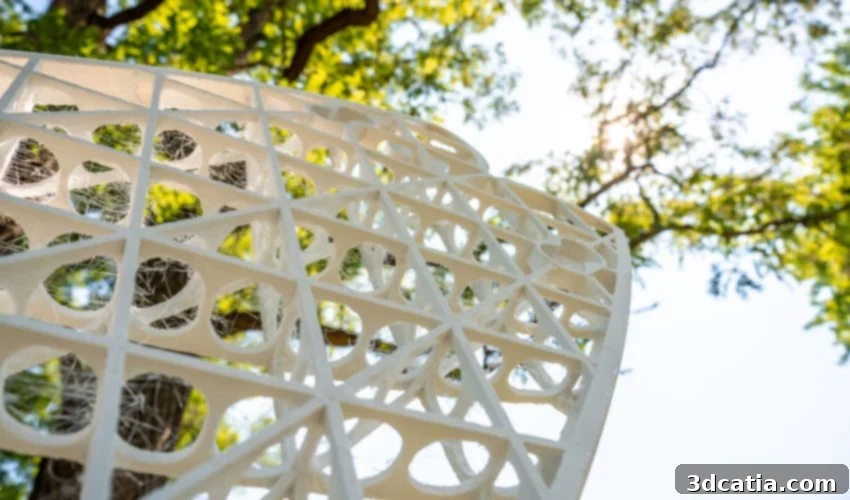
Riding the Green Wave: How 3D Printing and Blueprint Surf are Revolutionizing Sustainable Surfboard Manufacturing
The allure of surfing often conjures images of endless blue waves, sun-kissed beaches, and the exhilarating sense of freedom. Yet, beneath this idyllic facade lies a less glamorous truth: the significant environmental footprint of traditional surfboard manufacturing. Far from being eco-friendly, a typical surfboard, crafted from conventional materials, is responsible for emitting at least 600 pounds of CO2 throughout its relatively short lifespan. Furthermore, the sport’s demanding nature often necessitates frequent replacements, with surfers needing new boards two to three times annually. This stark reality casts a shadow over a pastime that intimately connects with the ocean, yet inadvertently contributes to its degradation. The contradiction is profound: how can a sport so reliant on the health of marine ecosystems be a part of their destruction?
Fortunately, a new wave of innovation is emerging, driven by companies committed to creating greener, more sustainable surfboards. Among these pioneers, additive manufacturing, commonly known as 3D printing, is proving to be a game-changer. Leading this charge is Blueprint Surf, a visionary startup based in Portland, Maine. Blueprint Surf is harnessing the power of 3D printing to craft high-performance surfboards that are not only environmentally conscious but also exceptionally durable and aesthetically pleasing. They describe their creations as being “as beautiful as the Acadia coast, as durable as a Downeast lobster boat, and fun enough to be the board you choose when your favorite break is pumping.” This commitment to sustainability is woven into every aspect of their process, from the innovative use of 3D printing technology to their strategic incorporation of recycled materials. To delve deeper into their groundbreaking approach, we recently sat down with one of Blueprint Surf’s co-founders.
3DN: Could you introduce yourself and tell us about the journey of Blueprint Surf?
My name is Luke Diehl, and my involvement with 3D printing spans over a decade. My initial fascination with additive manufacturing ignited when I discovered its potential to produce titanium orthopedic implants through laser sintering. This led me to co-found one of the pioneering companies in 3D printed implants for spinal surgery, an experience that has kept me deeply engaged with 3D printers ever since. This background provided me with a robust understanding of additive manufacturing’s precision, efficiency, and material capabilities, which proved invaluable when embarking on a new venture.
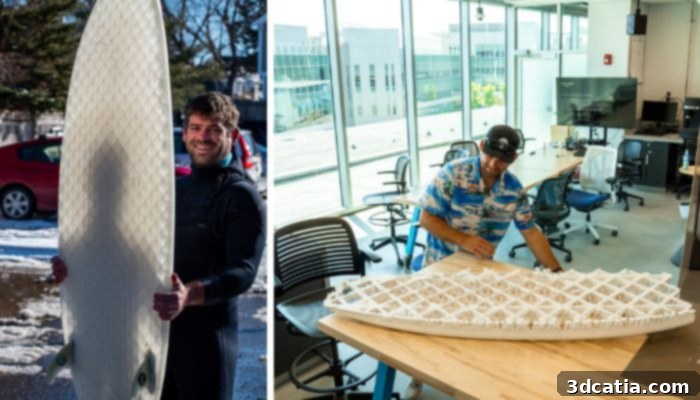
(Left) Luke Diehl with a finished 3D printed surfboard from Blueprint Surf; (right) the 3D printed core
Blueprint Surf’s story began a couple of years ago, born from a shared passion for surfing and a growing concern for the environment. Mike Ballin and I were frequently out on the chilly waters of the North Atlantic, riding traditional foam boards. While we loved the experience, we couldn’t ignore the glaring environmental shortcomings and other inherent flaws of these conventional surfboards. It became clear that there was a critical need for a more sustainable alternative. This realization crystallized into Blueprint Surf’s core mission: to design and build stunning, high-performance surfboards that not only excel in the water but also significantly reduce the environmental harm associated with their production, moving far beyond the negative impact of traditional foam surfboards. We sought to blend performance, durability, and ecological responsibility into a single, compelling product.
3DN: Can you walk us through the innovative process of crafting your 3D printed surfboards, including the specific materials and technologies you employ?
Our process begins with highly customized design, a distinct advantage offered by 3D printing. For each individual surfer, we meticulously design a unique internal “frame” structure. This allows us to tailor the board’s characteristics to match the surfer’s style, weight, and preferred performance. For instance, more powerful surfers who demand stiffer boards will receive a frame designed for enhanced rigidity, while lighter surfers who prefer a more agile and flexible ride will get a design optimized for that. This level of personalized engineering is incredibly difficult, if not impossible, to achieve with traditional foam shaping methods.
Once the custom design is finalized, we proceed to print the internal frame. Initially, we utilized recycled PETG filament, which is known for its strength and versatility, using our reliable Modix Big 180X printer. This choice of recycled PETG underscored our commitment to sustainability from the outset, repurposing plastic waste into a functional, high-performance component. After the printing phase, the frame undergoes a thorough cleaning and preparation process. Following this, we apply a smooth composite skin around the printed core, utilizing a proprietary blend of materials and techniques that we’ve developed. This composite skin is crucial for providing the desired hydrodynamics, impact resistance, and overall structural integrity of the surfboard.
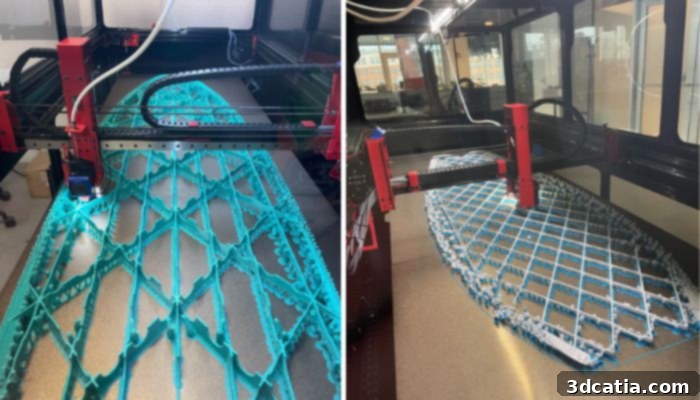
3D printing takes place on Blueprint Surf’s beloved Modix 3D printer
From this stage, the subsequent steps align more closely with conventional surfboard finishing processes, though with a sustainable twist. We add an external layer of woven fiberglass, which is then saturated with bio-epoxy resin. This bio-epoxy is a crucial element in reducing the board’s environmental impact, as it’s derived from plant-based sources, minimizing reliance on petrochemicals. Finally, a glossy topcoat of bio-epoxy is applied, creating a clean, durable, and aesthetically pleasing finish. Looking ahead, we are actively transitioning our primary production material from recycled PETG to a fiberglass-reinforced Polypropylene filament, which boasts an even more compelling environmental story: it is sourced from retired fishing nets. This innovative shift promises a stronger, lighter, and even more durable material for our boards. We believe that using recycled fishing nets not only enhances the physical properties of our products but also forges a deeper, more resonant connection between our boards and the very ocean they’re designed to be ridden upon, actively removing marine plastic waste from our seas.
3DN: Beyond material innovation, what are the primary reasons Blueprint Surf has chosen 3D printing for surfboard production, especially considering its impact on sustainability and logistics?
Our decision to fully embrace 3D printing for surfboard manufacturing stems from several pivotal advantages, especially concerning environmental impact and logistical efficiency. Firstly, the reduction of waste is monumental. Traditional surfboard shaping, which involves carving a board from a large block of foam, inherently generates a significant amount of material waste. In contrast, 3D printing is an additive process; it builds up material layer by layer, only using what is necessary. This drastically minimizes material waste. Moreover, the small amount of waste we do generate – such as scrap fiberglass trimmings or broken print supports – is largely repurposable and can often be recycled back into our production stream, closing the loop on material usage.
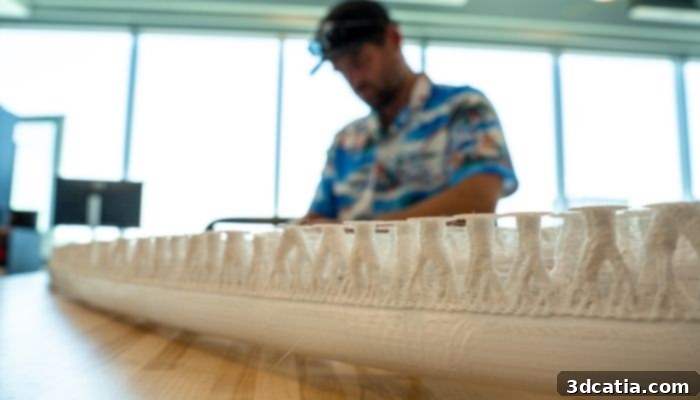
A close up of the 3D printed frame
Secondly, the logistical benefits are substantial. A major issue with conventional surfboard foam is its origin; most of it comes from Southeast Asia. Shipping these bulky foam blanks across vast oceans is incredibly inefficient and contributes significantly to the sport’s carbon footprint. Our long-term vision leverages 3D printing’s decentralized potential: we aim to establish a 3D printer in each major surf area around the world. This localized manufacturing model means that every Blueprint Surf customer could have their board made regionally, drastically reducing shipping distances, emissions, and associated costs. This approach not only enhances sustainability but also improves supply chain resilience and delivery times, offering a truly local product with global design consistency.
Furthermore, 3D printing allows for an unprecedented level of customization and performance optimization. The ability to design and print an internal frame tailored to a surfer’s exact specifications—including weight, height, skill level, and preferred wave types—means we can fine-tune the flex, stiffness, and overall responsiveness of the board in ways that are simply not feasible with traditional hand-shaping. This leads to a more personalized and ultimately superior surfing experience.
We hold immense admiration and respect for the skilled craftspeople who shape surfboards by hand. There’s a rich legacy and a profound level of technique and artistry involved in that process. We understand that when surfers hear “3D printed plastic,” some might mistakenly assume our boards are mass-produced by anonymous robots, devoid of craftsmanship. However, while our methods are modern, there is still a significant amount of technique, skill, and careful craftsmanship involved in designing, printing, post-processing, and finishing our boards. We are diligently working to engage with the surf community and demonstrate that our approach honors the spirit and legacy of “hand shapers” by evolving the craft. We aim to show that modern technology, particularly additive manufacturing, can be integrated to produce higher-performance boards using better, more sustainable materials, without sacrificing the artistry or performance expected by discerning surfers. It’s about leveraging technology to push the boundaries of what’s possible, while respecting the heritage of the sport.
3DN: Do you have any final thoughts or a message you’d like to share with our readers, especially those interested in the convergence of 3D printing and sustainability?
Absolutely! We want to express our sincere gratitude for the incredible support and wealth of information we’ve been able to access through platforms like 3Dnatives, various user forums, and the wider community of 3D printing enthusiasts. The collaborative spirit and shared knowledge within the additive manufacturing community are truly what make ambitious projects like Blueprint Surf possible. It’s a testament to how collective innovation can drive meaningful change, and for that, we are incredibly thankful! For those eager to dive deeper into our mission and explore our range of sustainable surfboards, you can find more detailed information and updates on our official website right HERE.
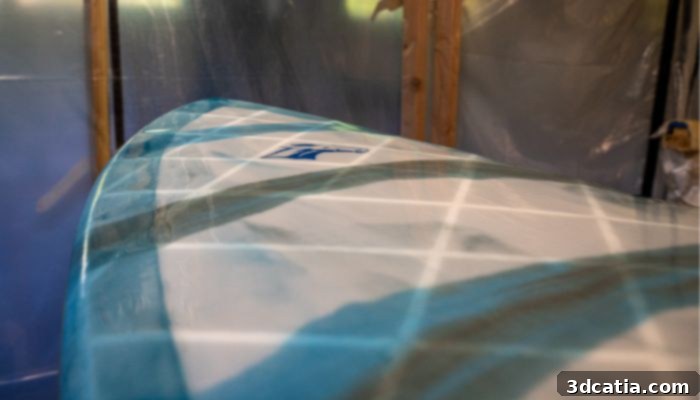
A 3D printed board after finishing printing and moving to post-processing
The work of Blueprint Surf represents a crucial step forward for sustainable sports equipment and highlights the transformative potential of 3D printing in industries that might not immediately come to mind. It’s an inspiring example of how embracing technological advancements can lead to products that are superior in performance while being significantly kinder to our planet. As surfers, we have a unique responsibility to protect the environments we cherish, and innovations like these pave the way for a truly green future for the sport.
What are your thoughts on Blueprint Surf’s pioneering efforts in sustainable surfboard manufacturing? Would you be excited to ride a 3D printed surfboard, knowing its reduced environmental impact and custom-engineered performance? We’d love to hear your perspective on the balance between traditional craftsmanship and technological innovation. Share your insights in a comment below or join the conversation on our LinkedIn, Facebook, and Twitter pages! And to stay at the forefront of additive manufacturing news, don’t forget to sign up for our free weekly newsletter here, delivering the latest 3D printing updates directly to your inbox. You can also explore all our informative videos on our dedicated YouTube channel.
*All Photo Credits: Blueprint Surf