

Driving Additive Manufacturing Excellence: The UK’s DfAM Network Ignites Innovation and Collaboration
The landscape of manufacturing is continually evolving, with Additive Manufacturing (AM), commonly known as 3D printing, at the forefront of this transformation. Realizing the immense potential and the need for a unified approach, the Engineering and Physical Science Research Council (EPSRC) recently launched its dedicated Design for Additive Manufacturing (DfAM) Network in the UK. This pivotal initiative marks a significant step towards unlocking the full capabilities of AM by fostering a robust ecosystem of academic researchers, industry professionals, and other key stakeholders. The core mission of this network is to enhance communication, stimulate collaboration, and cultivate groundbreaking research opportunities that will propel the UK to the forefront of DfAM innovation.
While Design for Additive Manufacturing as a concept isn’t entirely new—with notable techniques such as topology optimization having been around for some time—its widespread application and full potential within the AM sector remain largely untapped. Despite recent impressive examples, including pioneering work by RMIT in strengthening concrete through innovative design, and the advent of five-axis additive manufacturing, there’s a recognized need to bridge the gap between theoretical potential and practical implementation. This newly established network is poised to address this challenge head-on, uniting experts and enthusiasts to collectively discuss, promote, and advance DfAM principles and practices across the United Kingdom. Its very existence signifies a commitment to leveraging design as a strategic tool to revolutionize how products are conceived, engineered, and manufactured using AM technologies.
Understanding Design for Additive Manufacturing (DfAM)
Design for Additive Manufacturing (DfAM) is far more than just designing a part to be 3D printed; it’s a paradigm shift in engineering thinking. Building upon the established principles of Design for Manufacturability (DFM) found in traditional manufacturing, DfAM specifically tailors product design to exploit the unique advantages offered by additive manufacturing processes. This includes the ability to create highly complex geometries, internal structures, and customized parts that would be impossible or prohibitively expensive to produce with conventional methods. The ultimate goal is to optimize a product for AM production, leading to benefits such as reduced costs, faster production cycles, improved performance, enhanced functionality, and increased material efficiency.
Key DfAM Techniques and Examples
At its heart, DfAM leverages a suite of advanced design methodologies to unlock AM’s capabilities. One of the most prominent examples is **Topology Optimization**, a powerful numerical design technique. This process uses mathematical formulas and computational algorithms to determine the optimal distribution of material within a given design space, subjected to specific mechanical constraints and desired performance criteria. By essentially ‘removing’ material from areas that contribute minimally to structural integrity, topology optimization results in lightweight yet robust components, ideal for applications where weight saving is critical, such as in aerospace or automotive industries. These designs often feature organic, biomimetic forms that are inherently suited to AM.
Beyond topology optimization, other DfAM concepts include the integration of **lattice structures** – intricate, repeating patterns within a part that can dramatically reduce weight while maintaining or even improving mechanical properties like stiffness and energy absorption. **Generative design**, often powered by artificial intelligence, further complements DfAM by automatically exploring thousands of design permutations based on engineering requirements, allowing designers to discover optimal solutions that might not have been conceived through traditional methods. These techniques collectively enable the creation of highly efficient, functionally integrated parts.
Recent years have showcased compelling real-world applications of DfAM, demonstrating its transformative power. A notable example comes from RMIT, where researchers experimented with innovative designs to develop patterns for stronger 3D printed concrete. By strategically designing the internal and external geometries, they were able to enhance the material’s structural integrity and load-bearing capacity, opening new avenues for construction and infrastructure development where material efficiency and structural performance are paramount. This illustrates how DfAM can extend beyond traditional industrial parts to foundational materials.
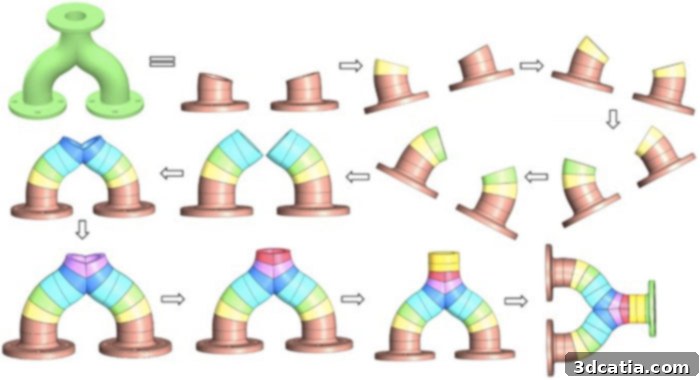
Another significant advancement highlighted in the Journal of Additive Manufacturing is the research into **five-axis additive manufacturing**. This innovative concept transcends the traditional three-axis printing limitation by enabling the print head to move along multiple axes, allowing for more complex deposition paths. A key advantage of this technology is its ability to build parts without the need for extensive support structures, or in some cases, entirely eliminating them. Traditional 3D printing often requires support materials to prevent overhangs from collapsing during the printing process, which adds material waste, increases post-processing time, and can limit design freedom. Five-axis AM significantly mitigates these issues, offering greater geometric freedom, reducing material usage, and streamlining the manufacturing workflow. The example shared, credited to Xinyi Xiao and Penn State, perfectly illustrates how this approach can lead to more efficient and cleaner prints.
An example of a 3D printing process without supports (photo credits: Xinyi Xiao, Penn State)
Why DfAM is Still Underutilized
Despite these remarkable advancements and its clear importance to the field, DfAM remains significantly underutilized across the additive manufacturing sector. This paradox can be attributed to several factors. Firstly, there’s a considerable **knowledge gap**; many engineers and designers are still trained in traditional DFM principles and lack the specialized skills and understanding required to effectively design for AM’s unique constraints and capabilities. Integrating DfAM necessitates a fundamental shift in design thinking, moving away from conventional manufacturing mindsets that prioritize simple geometries and ease of assembly.
Secondly, **software and toolchain limitations** can hinder adoption. While DfAM software is advancing rapidly, it can still be complex, costly, and require specialized training. The seamless integration of design, simulation, and manufacturing software remains a challenge for many enterprises. Furthermore, a general **resistance to change** from established, proven methodologies often delays the adoption of new, albeit more efficient, processes. The perceived complexity, initial investment in new tools and training, and the lack of standardized best practices contribute to this hesitation.
The creation of the EPSRC DfAM Network is a crucial step towards remedying this underutilization. By establishing the first dedicated network in the United Kingdom focused on the promotion and practical application of DfAM, it aims to demystify the concept, provide necessary resources, foster expertise, and build a collaborative environment where DfAM can finally reach its full potential, driving the cheap and efficient production of imaginative and highly functional parts.
The Vision and Structure of the DfAM Network
The EPSRC Design for AM Network is strategically designed to be a catalyst for innovation and growth within the UK’s additive manufacturing ecosystem. Its overarching purpose is to forge vital connections between the extensive UK Design for AM academic research community and the seasoned practitioners in industry who possess invaluable hands-on experience with additive manufacturing technologies. These symbiotic connections are intended to facilitate a dynamic exchange of knowledge, enable the identification and development of cutting-edge research themes, and encourage collaborative efforts. Ultimately, this ensures that Design for AM is provided with the most robust and fertile platform possible for its continued evolution and widespread adoption.
Bridging Academia and Industry for Collaborative Advancement
The network’s strength lies in its ability to bridge the traditional gap between theoretical research and industrial application. By connecting brilliant minds in universities with experienced engineers and decision-makers in manufacturing companies, the DfAM Network will accelerate the transition of innovative DfAM concepts from the lab to real-world production lines. This synergy promises to make academic research more industrially relevant and equip practitioners with the latest insights and tools. Already, the network boasts an impressive roster of partners, including prestigious institutions like the University of Cambridge and the University of Leeds, among others, signaling a strong foundation for future collaborations and shared expertise.

The DfAM Network’s partners (photo credits: the DfAM Network)
Core Objectives of the Network
According to its official website, the network has clearly articulated objectives that underscore its ambitious vision:
- **Facilitate and promote cooperation, collaboration, and coordination between DfAM researchers:** This involves creating platforms for knowledge sharing, joint projects, and inter-institutional partnerships.
- **Facilitate new research:** Identifying emerging trends, unmet needs, and critical gaps in DfAM knowledge to inspire novel research initiatives and secure funding.
- **Promote collaboration between DfAM researchers and industry and other academic disciplines:** Encouraging multidisciplinary approaches, bringing together not just engineers, but also materials scientists, computer scientists, and business strategists to solve complex challenges.
- **Scale up DfAM research in the UK:** Positioning the UK as a global leader in DfAM by increasing the volume, quality, and impact of research output.
- **Provide a forum for the DfAM community:** Offering a space for discussions on crucial topics such as funding opportunities, regulatory frameworks, standardization efforts, and best practices.
- **Promote the wider importance of DfAM:** Raising awareness among policymakers, educators, and the broader public about the strategic value and transformative potential of DfAM for the economy and society.
- **Deliver a sustainable research network that will become self-sufficient:** Ensuring the network’s long-term viability and impact beyond initial funding cycles through continuous engagement and value creation for its members.
Leadership Perspectives on Future Opportunities
The leadership of the DfAM Network shares a clear vision for its impact. As Prof. Allan Rennie (Lancaster University), the Co-investigator of the project, eloquently stated, “We have a real opportunity to drive forward coordinated efforts in the development of Design for AM tools, methods and applications.” His remarks highlight the network’s potential to harmonize diverse efforts, leading to more robust and widely applicable solutions in the DfAM space.
Concurring with this sentiment, Dr. Patrick Pradel (Loughborough University), the Principal Investigator, added, “The EPSRC Design for AM Network is a wonderful opportunity to step up Design for AM research and development. We hope different interest disciplines and stakeholders will join us to discuss the future direction of Design for AM and how it can benefit further the society and the economy.” Both leaders emphasize the collaborative spirit and the significant societal and economic benefits that a thriving DfAM sector can bring to the UK, from enhancing industrial competitiveness to fostering sustainable manufacturing practices.
Impact and Future Outlook for UK Additive Manufacturing
The establishment of the EPSRC DfAM Network is not merely an academic exercise; it represents a strategic investment in the future of UK manufacturing. By systematically addressing the challenges and unlocking the potential of DfAM, the network is poised to generate profound impacts across various industries and facets of society.
Transforming Industries through DfAM
The influence of DfAM, amplified by the network’s collaborative efforts, promises to be transformative across numerous sectors. In **aerospace**, DfAM can lead to significantly lighter components with optimized internal structures, resulting in improved fuel efficiency and reduced emissions. For the **medical field**, it enables the creation of highly customized implants, prosthetics, and surgical tools tailored precisely to individual patient anatomies, enhancing efficacy and patient outcomes. The **automotive industry** can benefit from performance-optimized parts, rapid prototyping for new designs, and the potential for mass customization. Even in **consumer goods**, DfAM facilitates personalized products and more efficient material usage, driving both innovation and sustainability. The ability to consolidate multiple parts into a single, complex 3D printed component reduces assembly time, simplifies supply chains, and minimizes potential failure points.
Economic and Societal Benefits for the UK
Beyond specific industrial applications, the DfAM Network is expected to yield substantial economic and societal benefits for the United Kingdom. Economically, it will foster innovation-driven growth, stimulate job creation in high-tech manufacturing and R&D, and enhance the UK’s competitive standing in the global additive manufacturing market. By promoting advanced design capabilities, the UK can attract more investment and secure its position as a hub for cutting-edge AM development. Socially, the emphasis on material efficiency, waste reduction, and the production of more durable, high-performance products contributes to environmental sustainability and resource conservation. Furthermore, the network’s efforts to educate and train a new generation of DfAM specialists will build a highly skilled workforce, capable of navigating the complexities of modern manufacturing.
Addressing Challenges and Seizing Opportunities
While the opportunities are vast, the DfAM Network will also be instrumental in addressing ongoing challenges in the AM sector. These include the need for greater standardization in materials and processes, the integration of advanced material science with design principles, and continuous skill development across the entire value chain. By providing a forum for discussion and collaboration, the network can lead the charge in developing solutions to these issues, transforming current challenges into future opportunities for innovation and growth. Its long-term vision for self-sufficiency underscores a commitment to creating an enduring legacy that will shape the future of manufacturing for decades to come.
Join the Revolution: Engage with the DfAM Network
The EPSRC Design for Additive Manufacturing Network represents a pivotal moment for the UK’s AM sector. It is a catalyst designed to foster an environment where groundbreaking research meets practical application, driving innovation and collaboration across academia and industry. By uniting the brightest minds and most experienced practitioners, the network is set to unlock the immense, yet often underutilized, potential of DfAM, paving the way for a more efficient, sustainable, and innovative manufacturing future.
We invite you to learn more about the DfAM Network and consider joining its growing community of innovators and collaborators. You can find more information and sign up as a member on their official website HERE.
What are your thoughts on the DfAM Network’s mission? Do you see yourself or your organization benefiting from or contributing to such an initiative? We’d love to hear your perspective! Let us know in a comment below or connect with us on our Facebook and Twitter pages! For the latest 3D printing news delivered straight to your inbox, don’t forget to sign up for our free weekly Newsletter here.