
Revolutionizing Green Energy Infrastructure: 3D Printed Concrete Foundations Pave the Way for Sustainability
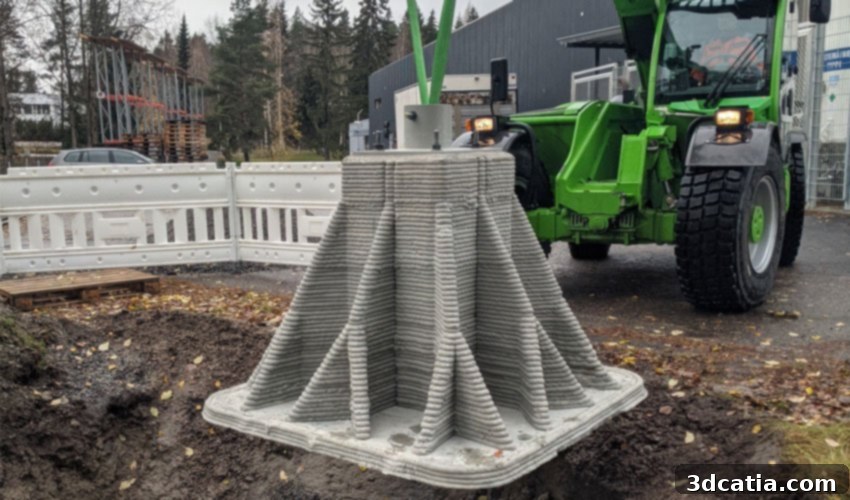
In a landmark collaboration poised to redefine the future of sustainable infrastructure, Spanish energy giant Iberdrola has joined forces with innovative manufacturer Hyperion Robotics and construction solutions provider Peikko. Their ambitious project involves leveraging cutting-edge 3D printing technology to create the foundations for Iberdrola’s expansive green energy transmission networks. Specifically, the initiative focused on developing concrete pad foundations – crucial shallow structures designed to safely distribute significant point loads – for new substation projects. This pioneering approach is not only projected to drastically reduce material consumption by an impressive 75% but also promises to significantly enhance the overall production methodology for these vital structural components, marking a pivotal step towards more environmentally conscious construction practices within the energy sector.
The global construction industry faces an urgent challenge: the environmental impact of traditional materials. Concrete, in particular, stands out as one of the most widely consumed materials on Earth, with its production accounting for approximately 8% of global carbon emissions. This figure is alarming, especially considering the rapid growth in concrete demand, which threatens to exacerbate environmental consequences on an unprecedented scale. The manufacturing process of cement, a key ingredient in concrete, is highly energy-intensive and releases vast amounts of CO2 through calcination. Furthermore, the extraction of raw materials like sand and aggregates contributes to habitat destruction and resource depletion. Faced with this critical ecological dilemma, a growing number of industry players are actively exploring and investing in concrete 3D printing as a viable and less harmful alternative. The inherent advantage of additive manufacturing lies in its precision; it utilizes only the exact amount of material needed for a structure, thereby drastically minimizing waste generation compared to conventional formwork-based construction. Hyperion Robotics stands at the forefront of this transformative movement, employing sophisticated robotic arms to precisely extrude concrete, layer by layer, shaping complex geometries with unparalleled efficiency and reduced environmental footprint.

Photo Credits: Hyperion Robotics
Pioneering Sustainable Energy Transmission Networks with 3D Printing
Iberdrola, a global leader in renewable energy, is deeply committed to expanding its infrastructure to distribute clean power efficiently. The company builds thousands of miles of power lines, crucial for transmitting renewable energy from generation sites to consumers. As Iberdrola continues to grow and scale its operations, the need for more grids capable of reliably carrying green energy becomes paramount. Recognizing the immense potential of innovative construction methods, Iberdrola turned to concrete 3D printing. Their objective was clear: to design and implement more efficient and environmentally friendly transmission means, significantly reducing the ecological impact associated with traditional construction processes. This strategic shift reflects Iberdrola’s dedication not only to producing clean energy but also to ensuring that its foundational infrastructure aligns with its sustainability ethos.
The innovative approach championed by Hyperion Robotics has resulted in the development of optimized 3D printed foundations for these critical energy infrastructure blocks. These advanced foundations boast an astounding reduction of 75% in structural concrete usage compared to conventional construction methods. Traditional foundation construction is typically characterized by its labor-intensive nature and often relies heavily on skilled manual labor, a resource that is increasingly scarce in the current market. This shortage can lead to project delays, increased costs, and challenges in scaling infrastructure development. By adopting additive manufacturing, Iberdrola can mitigate these constraints, moving towards a more automated, efficient, and reliable production process. Furthermore, this method inherently offers a significantly more environmentally friendly alternative, aligning with both companies’ sustainability objectives by reducing waste, emissions, and reliance on virgin materials. The ability to customize designs and optimize material distribution through 3D printing also contributes to enhanced structural performance with less material.
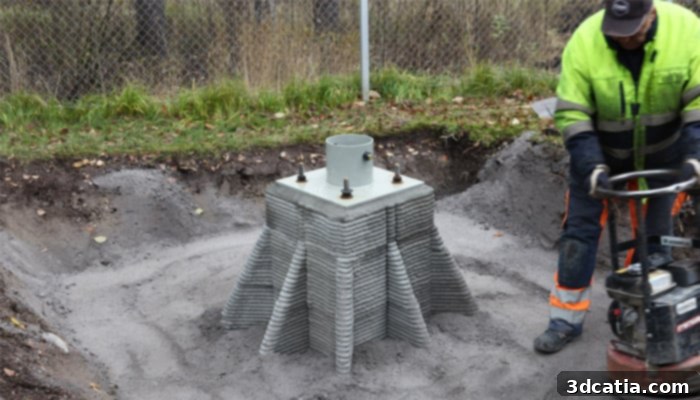
The installed foundation will be used for green energy transmission networks (photo credits: Hyperion Robotics)
Achieving Unprecedented Material Efficiency and Performance
Henry Unterreiner, co-founder of Hyperion Robotics, underscored the groundbreaking nature of this achievement, stating, “This [3D printed] foundation is very special. Being the first in the world – it is saving 75% of material compared to traditional pad foundation typically found in energy infrastructures.” This significant material reduction represents a paradigm shift in how energy infrastructure can be built, offering immense benefits in terms of resource conservation and environmental protection. It highlights the power of combining innovative design with advanced manufacturing techniques to solve complex industrial challenges. The implications extend beyond just cost savings, encompassing a reduced carbon footprint throughout the entire lifecycle of the infrastructure.
The journey to this remarkable 75% material saving was underpinned by rigorous scientific testing and validation. Teams conducted extensive tests simulating various load conditions, including horizontal and vertical traction, to ascertain the structural integrity and performance of the 3D printed foundations. The conclusive results revealed that only 25% of the concrete volume, compared to conventional processes, was required to achieve equivalent strength and load-bearing capacity. This finding is particularly impactful because Hyperion Robotics’ solution incorporates reinforced concrete specifically engineered with a low carbon content. This means the environmental benefits are twofold: less material is used, and the material itself is produced with a significantly lower ecological footprint. The manufacturer actively integrates sustainable raw materials, such as industrial ashes, mining residues, and demolition waste, into their concrete mixture. This innovative recycling strategy not only dramatically reduces CO2 emissions associated with cement production by up to 90% but also significantly lowers production costs, creating a truly circular economy approach within the construction sector.
A New Era for Construction and Green Energy Infrastructure
The successful installation of this pioneering 3D printed foundation in Finland marks a significant milestone and signals the beginning of what promises to be a transformative collaboration within the construction industry. This project not only demonstrates the practical viability of concrete 3D printing for large-scale infrastructure but also sets a new benchmark for sustainability in energy transmission networks. It exemplifies how embracing advanced manufacturing technologies can lead to tangible environmental benefits, operational efficiencies, and a stronger, more resilient infrastructure. This project serves as a compelling case study, showcasing that innovation is key to addressing the pressing environmental concerns while simultaneously meeting the growing demands for modern, robust energy grids.
This monumental project, spearheaded by Iberdrola, Hyperion Robotics, and Peikko, underscores the immense potential of additive manufacturing to revolutionize traditional construction methods. By drastically reducing material consumption, lowering carbon emissions, and improving production efficiency, 3D printed concrete foundations offer a sustainable path forward for developing critical energy infrastructure. This collaborative success in Finland is a testament to the power of inter-industry partnerships in driving innovation and achieving ambitious sustainability goals. Such advancements are crucial as the world transitions to cleaner energy sources and strives for a more sustainable future. For more detailed information on this groundbreaking project, you can visit the Hyperion Robotics project page HERE. What are your thoughts on this innovative green energy project? We invite you to share your insights in a comment below or join the conversation on our Linkedin, Facebook, and Twitter pages! Don’t forget to sign up for our free weekly Newsletter here to receive the latest 3D printing news straight to your inbox! You can also find all our compelling videos and interviews on our dedicated YouTube channel.