
Sinterit’s Pioneering Role in Industry 4.0: Driving Additive Manufacturing with Compact SLS 3D Printers
The manufacturing landscape has undergone a profound transformation in recent years, ushering in what is widely known as Industry 4.0, or the Fourth Industrial Revolution. This paradigm shift signifies the deep integration, advanced automation, and pervasive digitalization of all industrial production and manufacturing processes. At its core, Industry 4.0 harnesses a suite of interconnected technological tools designed to create “smart factories.” These include powerful innovations such as advanced simulation capabilities, immersive augmented reality, robust cybersecurity protocols, extensive big data analytics, and crucially, additive manufacturing. Within this transformative environment, 3D printing plays an indispensable role, offering advanced capabilities that are reshaping diverse industrial applications. Among the various polymer additive manufacturing processes, Selective Laser Sintering (SLS) stands out for its versatility and precision.
Emerging as a key player in this evolving market, Sinterit was one of the pioneering companies dedicated to making compact, accessible SLS 3D printers available to a broader audience. Since its inception, Sinterit has specialized in powder technology, consistently strengthening its position in the industry with its innovative range of printers, including the Lisa, Lisa X, and Lisa Pro. These machines represent a significant leap forward, democratizing a technology once reserved for large industrial giants. The critical questions now facing the industry are: how are these advanced SLS solutions and their technological enhancements fundamentally altering the additive manufacturing sector? And what specific role is Sinterit playing in accelerating this ongoing digital transformation within manufacturing?
Established in Krakow, Poland, in 2014, Sinterit emerged during a pivotal period when a new wave of companies began offering more compact, accessible, and affordable SLS 3D printers. The company quickly distinguished itself by providing professional-grade SLS technology in a more approachable format. From the launch of its inaugural machine, the Lisa, Sinterit has meticulously cultivated its presence, growing into a recognized leader in compact SLS 3D printing. While additive manufacturing is undeniably a cornerstone of Industry 4.0, the journey towards fully realized smart manufacturing still presents numerous opportunities for improvement and innovation. To explore this further, we will delve into how an Application Programming Interface (API) specifically tailored for Sinterit SLS printers can significantly optimize production workflows. Moreover, we will examine the compelling reasons why any forward-thinking company should seriously consider integrating Industry 4.0 principles into their additive manufacturing projects. Finally, we will highlight inspiring success stories from users who have already integrated Sinterit machines into their production processes, demonstrating their tangible steps towards this digital transformation.
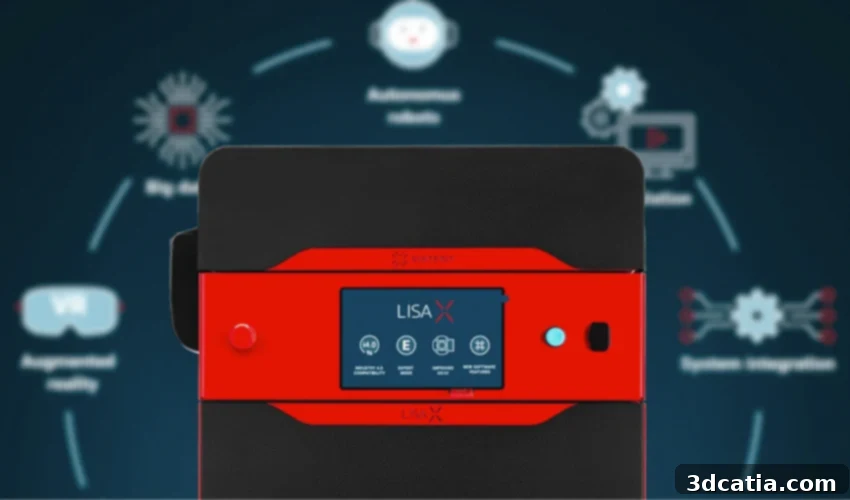
The Lisa X is one of the SLS 3D printers that are ready for Industry 4.0.
Sinterit and the Pillars of Industry 4.0 Integration
The symbiotic relationship between the Fourth Industrial Revolution and additive manufacturing is increasingly evident. While 3D printing is undeniably a critical enabler of this digital transformation, the advanced tools and philosophies inherent in Industry 4.0 concurrently provide significant advantages for companies engaged in additive manufacturing projects. The core principles of Industry 4.0—such as the Internet of Things (IoT), cloud computing, big data analytics, artificial intelligence, and autonomous systems—create an environment where 3D printing can thrive and reach its full potential. So, how can these two powerful elements be utilized in a complementary fashion, and what are the specific benefits each brings to the table?
Additive manufacturing, particularly SLS technology, empowers businesses to create complex, highly optimized final parts with reduced material waste, lower costs for specialized components, and significantly shorter lead times. It facilitates rapid prototyping, custom part production, and even distributed manufacturing models. Industry 4.0, on the other hand, is characterized by its vision of a smart, interconnected manufacturing ecosystem that focuses on real-time data exchange, predictive analytics, and proactive problem identification. The compelling reasons for organizations to embrace Industry 4.0 are manifold: it dramatically improves overall productivity, optimizes the utilization of energy resources, enhances workers’ safety through automated and monitored processes, and critically, boosts production efficiency across the entire value chain. By integrating these two forces, companies can achieve levels of agility, innovation, and responsiveness previously unattainable.
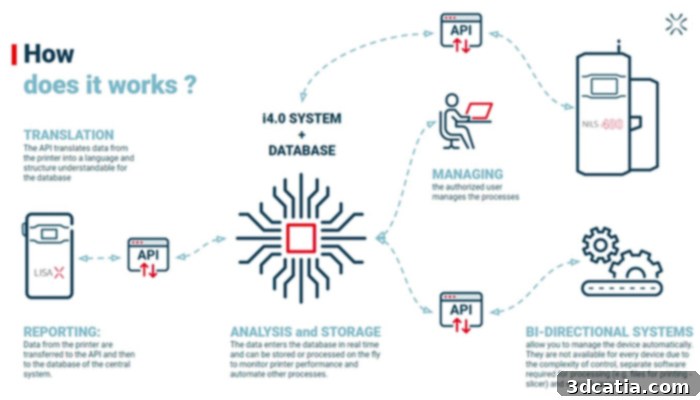
With a clear understanding of both additive manufacturing and Industry 4.0 principles, let’s explore how companies can seamlessly combine them to maximize their production processes. Sinterit has spearheaded this integration by developing a sophisticated API (Application Programming Interface) specifically for its Lisa X. The Sinterit Lisa X is renowned as the fastest and largest compact SLS 3D printer within Sinterit’s impressive product portfolio, making it an ideal candidate for advanced industrial applications. This API facilitates robust integration into Industry 4.0 environments by enabling bidirectional communication, allowing the printer to share critical operational data with the broader production system and receive commands in return. This seamless data flow is a cornerstone of smart manufacturing.
Beyond data exchange, the API significantly enhances operational efficiency. It allows for more print jobs to be efficiently queued, ensuring a smoother transition from one manufacturing process to the next. While, for safety reasons, the final print start often requires a manual confirmation, the preceding stages are highly automated. Furthermore, the API provides capabilities for live monitoring of over 20 crucial operational and security parameters in real-time. This includes vital information such as temperature, build chamber conditions, material levels, and system diagnostics. In essence, these advanced features fully equip the Lisa X 3D printer for rigorous Industry 4.0 deployment. Companies leveraging the Lisa X can achieve superior resource utilization, leading to significantly higher throughput, optimized material consumption, and a substantial reduction in quality issues for final parts. The resultant program optimization translates directly into faster, more reliable production cycles, positioning this solution as an ideal choice for a diverse array of industrial applications requiring high-performance additive manufacturing.
Elaborating on the strategic implementation of the Fourth Industrial Revolution within additive manufacturing processes, the Sinterit team emphasizes the transformative impact: “This will allow you to fully integrate 3D printing into the very fabric of your company’s structure and gain a much deeper understanding of the entire manufacturing process. This integration goes hand-in-hand with achieving total transparency across your operations. With Industry 4.0 principles effectively implemented in your additive manufacturing projects, you will possess the ability to accurately predict maintenance needs for your equipment and proceed with these essential interventions smoothly and proactively, minimizing downtime.” This proactive approach, driven by data and connectivity, also leads to a significant reduction in associated operational costs, primarily through better utilization of equipment and meticulous optimization of production batches. It’s also noteworthy that for businesses operating in EU countries, specific Industry 4.0 grants are often available. This governmental initiative further incentivizes and supports the adoption of these cutting-edge technologies by companies, accelerating their digital transformation journeys and enhancing their global competitiveness.
Transformative Uses of SLS Technology in Industry 4.0: Real-World Successes
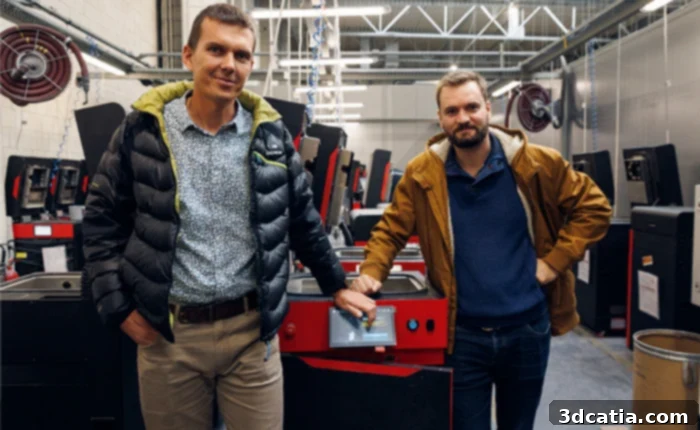
To concretely demonstrate the powerful capabilities and practical benefits of SLS 3D printing within this industrial revolution, Sinterit has proudly showcased compelling success stories from companies leveraging its technology. A prime example is the innovative Jetson One aircraft, an ambitious project designed to bridge the experiential gap between driving a car and piloting an aircraft. For the creation of both initial prototypes and critical final components, Jetson turned to additive manufacturing, specifically seeking a system capable of producing high-quality, precise, and robust parts with geometric complexity. According to the founders, access to advanced SLS technology was significantly streamlined and made much more accessible thanks to Sinterit’s compact Lisa X 3D printer.
Alec Bialek, R&D Director at Jetson, underscored the paramount importance of rapid iteration in their accelerated development process. He also highly valued having a responsive 3D printing partner like Sinterit, who could support their agile design cycles. The Lisa X machine proved to be an invaluable tool for Jetson, enabling them to quickly create and refine functional final parts for their aircraft. These included essential components such as lightweight brackets for structural support, aesthetic bezel trims for interior finishing, and precise jigs for assembly processes. This ability to rapidly produce and test functional parts not only significantly improved efficiency throughout their design and manufacturing pipeline but also drastically reduced potential errors in the intricate assembly process of their advanced aerial vehicle. The precision, material properties, and design freedom offered by Sinterit’s SLS solution were critical to Jetson’s success in bringing their innovative aircraft to life.
Another resounding success story comes from Somfy, a global leader in the automatic operation of doors, windows, and solar protection systems. Somfy has strategically adopted additive manufacturing not only for rapid prototyping but also as a core method for continuously improving its product designs and manufacturing processes. Headquartered in Cluses, France, the company demonstrated its commitment to embracing new technologies by establishing its own in-house 3D printing laboratory. While initially equipped solely with FFF (Fused Filament Fabrication) solutions, Somfy quickly recognized the need for more advanced capabilities and decided to make the decisive leap to SLS manufacturing. This transition was driven by SLS’s superior productivity, unparalleled design freedom, and ability to produce highly functional, isotropic parts.
For Somfy, Sinterit’s Lisa Pro and Lisa X SLS 3D printers became integral to their prototyping and eventual small-batch manufacturing processes, delivering substantial cost savings and significantly increased accuracy compared to traditional methods. These machines allowed Somfy to create highly complex parts and durable components without incurring the prohibitive expenses and lengthy lead times typically associated with conventional manufacturing techniques. Jonathan Caillat, Additive Manufacturing and Machine Shop Manager at Somfy, enthusiastically explains, “It’s a good way to start with a compact 3D printer. It gives room for improvement, and also a good compromise in terms of cost and capabilities.” This sentiment highlights Sinterit’s role in making professional-grade additive manufacturing accessible and scalable, enabling companies like Somfy to innovate faster and more cost-effectively within their Industry 4.0 journey.
Sinterit’s dedication to making advanced SLS technology accessible and integrated into Industry 4.0 workflows positions them as a vital enabler of modern, smart manufacturing. By offering compact, powerful, and connected 3D printers like the Lisa X and Lisa Pro, Sinterit empowers businesses of all sizes to embrace digital transformation, optimize their production, and unlock new levels of innovation. Their commitment to developing robust APIs and fostering seamless integration ensures that their machines are not just standalone tools but intelligent components within a larger, interconnected industrial ecosystem.
If you are eager to learn more about Sinterit and their groundbreaking 3D printing solutions, we encourage you to visit them during the upcoming edition of Formnext (Hall 11.1, Stand C29). You can also explore their innovative offerings and delve deeper into their technology by visiting their official website, accessible HERE.
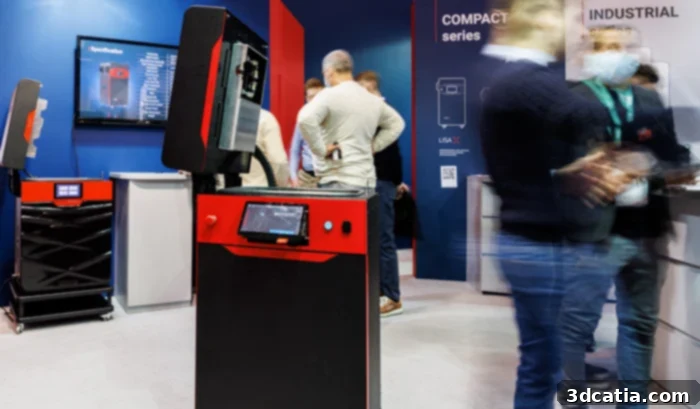
Sinterit has developed an API which makes Lisa X ready for industry 4.0 integration.
What are your thoughts on Sinterit’s pivotal role in advancing Industry 4.0 through additive manufacturing? Let us know in a comment below or join the conversation on ourLinkedIn,Facebook, andTwitter pages! Don’t forget to sign up for our free weeklyNewsletter here, to receive the latest 3D printing news straight to your inbox! You can also find all our engaging videos on ourYouTube channel.
*All Photo Credits: Sinterit