
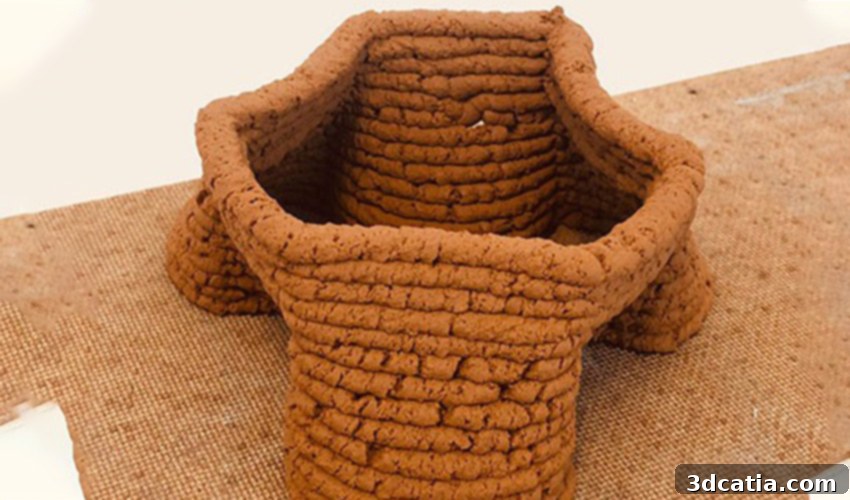
3D Printing with Local Soil: Paving the Way for Sustainable and Eco-Friendly Construction
The global construction industry stands at a critical juncture, grappling with twin monumental challenges: the urgent demand for robust and sustainable infrastructure to support growing populations, and the pressing need to repair and upgrade vast networks of deteriorating buildings, bridges, and roads. For decades, concrete has reigned supreme as the material of choice for countless construction projects due to its strength, versatility, and cost-effectiveness. However, its widespread use comes at a significant environmental cost. Concrete production is notoriously resource-intensive, contributing heavily to a large carbon footprint, generating substantial waste, and demanding immense energy expenditure. In a groundbreaking stride towards mitigating these impacts, researchers from the American Chemical Society (ACS) have reported remarkable progress in developing a truly sustainable building material derived from local soil. Their innovative approach combines this natural, abundant resource with advanced 3D printing technology to create load-bearing structures, signalling a transformative shift in how we might build in the future and offering a viable alternative to traditional, high-impact methods.
Over the past several years, the construction industry has witnessed an accelerating adoption of additive manufacturing technologies. These advancements inherently offer a myriad of benefits over conventional building methods, including unparalleled geometric freedom – allowing for complex and organic architectural designs, although this advantage is often more explored in artistic or conceptual constructions rather than everyday infrastructure. Crucially, 3D printing also presents the capacity to produce construction components locally, often directly from raw materials available on-site, thereby reducing logistical complexities and environmental burdens. Despite these promising capabilities, a significant paradox persists: most additive manufacturing construction companies continue to rely heavily on concrete. This perpetuates the very sustainability issues that additive manufacturing theoretically aims to solve. Concrete manufacturing, as highlighted by the International Energy Agency, is responsible for approximately 7% of global carbon dioxide emissions – a staggering contribution to climate change. Furthermore, once concrete reaches the end of its lifecycle, it cannot be easily recycled or repurposed, leading to immense landfill burdens, the continuous extraction of new raw materials, and a perpetual cycle of environmental degradation.
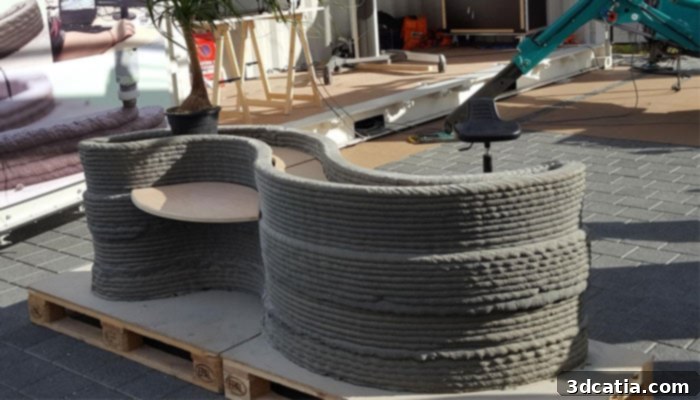
While 3D printing offers many benefits, most additive manufacturing constructions currently still rely on concrete.
The urgency of this situation is profoundly articulated by Sarbajit Banerjee, the principal investigator of the groundbreaking project at the American Chemical Society. He emphasizes, “The environmental impact of the construction industry is an issue of growing concern. Some researchers have turned to additive manufacturing, or building structures layer by layer, which is often done with a 3D printer. That advance has begun to transform this sector in terms of reducing waste, but the materials used in the process need to be sustainable as well.” Banerjee’s statement pinpoints the critical next step in sustainable construction: moving beyond just efficient processes to embrace truly eco-friendly materials. While 3D printing intrinsically reduces material waste during construction by precisely depositing only what is needed, the overall environmental benefits are significantly curtailed if the input material itself carries a substantial ecological footprint. The overarching vision, therefore, is to seamlessly couple the efficiency and precision of additive manufacturing with materials that are inherently renewable, locally abundant, and possess a minimal environmental impact throughout their entire lifecycle, from sourcing to disposal. This holistic approach promises to unlock the full potential of green construction.
While the ACS project represents a significant leap forward in scientific innovation, the fundamental concept of utilizing local soil for constructing durable structures is not entirely new. History is replete with examples of earth architecture, from ancient adobe dwellings to rammed earth constructions. In modern times, several pioneering initiatives have pushed the boundaries of what’s possible with additive manufacturing and natural materials. A notable contemporary example is the TECLA house, an innovative circular housing model collaboratively produced by WASP in Italy. This remarkable structure was created entirely from reusable and recyclable materials sourced directly from the local terrain, embodying a true circular economy approach to housing where resources are kept in use for as long as possible. The fundamental advantage of employing local soil in construction is manifold: it drastically reduces the need for energy-intensive material manufacturing processes, and it virtually eliminates the costly and carbon-intensive transportation of materials to the building site. This dual benefit translates into significant cost savings for developers and a substantial reduction in environmental damage. Beyond terrestrial applications, Banerjee also envisions a future where additive manufacturing with soil could extend its utility far beyond Earth, enabling the creation of self-sufficient settlements on celestial bodies like the Moon or even Mars. This ambitious vision echoes projects like the MARSHA habitat, initiated by AI SpaceFactory in 2018, which explored 3D printing structures for extraterrestrial living using simulated Martian regolith, showcasing the immense versatility of this approach.
To effectively transform raw soil into a printable building material suitable for advanced manufacturing, a deep and nuanced understanding of its composition and inherent properties is absolutely essential. Soil is typically characterized by distinct layers of materials, starting with the organic-rich topsoil where plant life flourishes, and extending downwards through various mineral layers to the hard bedrock forming the Earth’s crust. Beneath the initial organic layer often lies clay, a crucial geological component that imparts soil with its characteristic plastic and moldable qualities when wet, and robust structural integrity when dry. It is precisely these inherent properties of clay that the researchers skillfully capitalized on in their groundbreaking project, using it as a natural binder and structural element. Recognizing that natural soil compositions can vary dramatically from one geographical location to another – with differences in clay content, mineral makeup, and particle size – their primary objective was to develop a versatile “chemistry toolkit.” This innovative toolkit is meticulously designed to be adaptable, enabling the transformation of virtually any type of local soil into a robust, extrudable, and printable construction material through the addition of specific, environmentally friendly binders or stabilizers. This adaptability is key to widespread adoption, ensuring that the technology is not limited to specific regions with ideal soil characteristics but can be applied globally, making sustainable construction accessible everywhere, regardless of local geological variances.
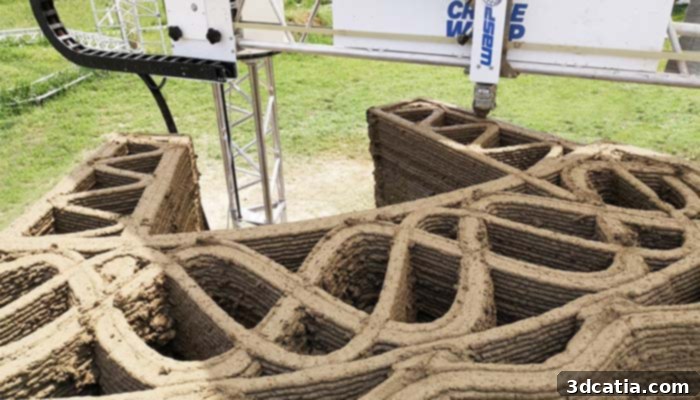
The innovative TECLA house demonstrated the immense potential of 3D printing with locally sourced earth materials.
The research methodology employed by the ACS team involved a systematic and iterative approach, beginning with the meticulous construction of small-scale test structures. These cubes, precisely measuring two inches on each side, were painstakingly built to thoroughly evaluate the material’s performance when extruded into stacked layers using a custom-designed 3D printer. A critical next phase of the investigation was to ascertain the mixture’s load-bearing capabilities. This means ensuring that the material can not only adequately support the weight of subsequent layers during the intricate printing process but also effectively withstand the substantial structural loads imposed by other essential construction components, such as rebar for reinforcement and various insulation materials required for building integrity and energy efficiency. The team’s immediate future plans involve continuously refining and significantly enhancing the soil’s load-bearing capacity. This improvement is paramount for scaling up their test structures dramatically, bringing them closer to developing a viable, comprehensive, and widely applicable replacement for conventional concrete in diverse construction applications. Concurrently, they are rigorously gathering comprehensive data to objectively assess the environmental friendliness of these 3D printed soil structures, with particular emphasis on their overall carbon footprint, long-term durability, and recycling potential. This data-driven evaluation will provide a clear and evidence-based picture of their real-world ecological benefits and economic viability. Once they achieve a more complete and holistic understanding of the chemistry, functionality, and economic feasibility of building with local soils, the researchers intend to further broaden their scope, exploring how this transformative technology can be leveraged for ambitious projects beyond our own planet, potentially enabling sustainable human expansion into space and the establishment of extraterrestrial habitats. More detailed information on the American Chemical Society’s pioneering initiatives can be found HERE.
This pioneering research by the American Chemical Society marks a pivotal moment in the global quest for truly sustainable and resilient construction solutions. By ingeniously harnessing the abundant and readily available resources of local soil and seamlessly integrating them with the precision, efficiency, and flexibility of advanced 3D printing technology, they are not only directly addressing critical environmental concerns but also opening vast new doors to innovative building practices. These practices hold the potential to redefine our urban landscapes, rural communities, and even our presence beyond Earth. Imagine a future where homes, schools, and essential infrastructure are built with materials extracted directly from their immediate surroundings, dramatically cutting down on energy consumption, reducing waste to a minimum, and contributing significantly to a healthier and more sustainable planet. This is the profound promise of soil-based 3D printing – a vision of a future where construction is in harmonious alignment with nature, fostering ecological balance and resource efficiency. We are eager to hear your thoughts on this groundbreaking project and its far-reaching implications for the future of building. Share your valuable opinions and insights in a comment below, or connect with us on our Facebook and Twitter pages! Don’t miss out on the latest advancements and cutting-edge innovations in additive manufacturing; sign up for our free weekly Newsletter to receive all the breaking news in 3D printing directly in your inbox!