
EPFL’s Revolutionary Volumetric 3D Printing: A New Era for Soft Objects, Bioprinting, and High-Precision Fabrication
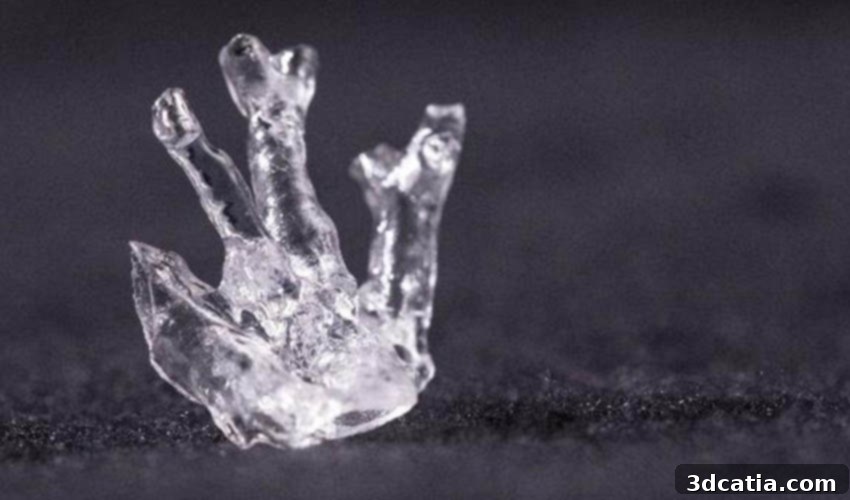
Researchers at EPFL (École Polytechnique Fédérale de Lausanne) in Switzerland have unveiled a groundbreaking, high-precision method for 3D printing small and remarkably soft objects. This innovative technology promises to revolutionize a wide array of fields, particularly bioprinting and the creation of delicate, intricate structures. Unlike conventional additive manufacturing techniques, this new approach offers unparalleled control over material properties and geometric complexity, opening doors to previously unattainable applications in medicine, engineering, and beyond. The team highlighted a significant advantage: its unique capability to print objects with varying textures and material properties within a single, continuous process. This is a critical feature for developing complex biological tissues, customized medical devices like hearing aids and mouthguards, and advanced soft robotics components. To ensure this pioneering system reaches its full market potential, a dedicated spin-off company, Readily3D, has been established to further develop and commercialize the technology.
Traditional additive manufacturing often involves building objects layer by layer, a method that can introduce weaknesses, limit material variations, and struggle with extremely delicate or soft geometries. The process pioneered by the EPFL researchers, while still a form of additive manufacturing, completely eschews this conventional layer-by-layer paradigm. Instead, it employs a sophisticated volumetric printing technique where solid structures are formed directly and instantaneously within a translucent liquid polymer. This method represents a paradigm shift, enabling the creation of intricate 3D objects in a single, fluid step. The core principle involves placing the liquid polymer into a rotating platform, which is then precisely targeted by a laser. Paul Delrot, CTO of Readily3D, elaborates on this ingenious process: “The laser hardens the liquid through a process of polymerization. Depending on what we’re building, we use algorithms to calculate exactly where we need to aim the beams, from what angles, and at what dose.” This algorithmic control is crucial, allowing for exquisite precision and the ability to define highly specific material characteristics at different points within the printed object.
The innovative volumetric approach stands in stark contrast to most existing 3D printing technologies. While FDM printers extrude molten plastic layer by layer and SLA/DLP printers cure liquid resin with UV light one layer at a time, EPFL’s method solidifies the entire object simultaneously within the resin vat. By projecting laser beams from multiple angles onto the rotating liquid polymer, the system precisely calculates the intersecting points where light intensity is sufficient to trigger polymerization. This means the object literally grows out of the liquid in a continuous, seamless fashion, free from the stair-stepping effects or anisotropic properties often associated with layer-by-layer printing. This inherent continuity is what allows for the creation of incredibly smooth surfaces and the integration of varying textures and material densities within the same structure, a feat that is exceptionally challenging, if not impossible, with conventional methods. This fundamental difference in how the object is formed is a major contributor to its speed and precision, offering distinct advantages for applications requiring highly isotropic and uniform material properties.
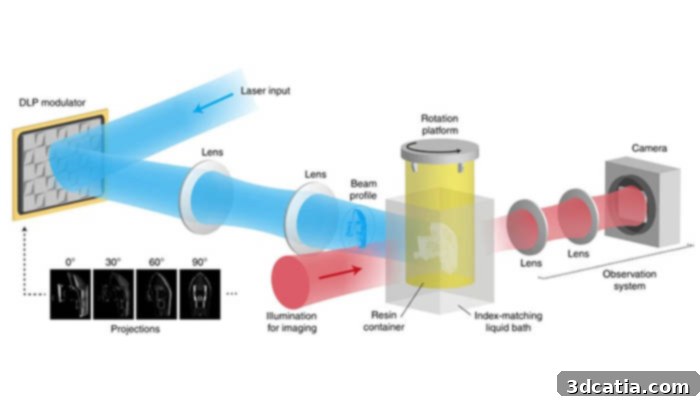
Diagram of EPFL’s technology | Credits: EPFL / LAPD / Nature Communications
Unlocking New Frontiers in Medical and Bioprinting Applications
The implications of this high-precision laser 3D printing technology for medical and bioprinting applications are truly transformative. Beyond its capacity to fabricate soft objects with intricate and varying textures, the system excels at creating extremely small and precise parts in an astonishingly short amount of time. Currently, the system can produce structures up to 20 mm in size with an impressive precision of 80 micrometers (µm), which is roughly equivalent to the diameter of a single human hair. This level of microscopic accuracy is paramount for biomedical applications, where cellular structures and delicate tissue components demand exquisite detail. The research team is actively working to enhance the technology further, aiming to build significantly larger objects, potentially up to 150 mm, while maintaining this exceptional level of precision. Scaling up without compromising detail is a crucial step towards printing larger, more complex biological constructs and medical implants.
Early tests of the technology have yielded remarkably promising results, particularly in the realm of bioprinting. In one notable instance, the process was successfully utilized to create cell-laden scaffolds – intricate 3D frameworks designed to support cell growth and development. The critical advantage here is that cells can develop within these scaffolds in a pressure-free 3D environment. This is a significant improvement over traditional 2D cell cultures or even some layer-by-layer bioprinting methods that can subject cells to mechanical stress, potentially affecting their viability and differentiation. The ability to create a truly isotropic, supportive environment is vital for mimicking the natural conditions within the human body, paving the way for more accurate in-vitro models and potentially functional tissue implants.
Further demonstrating its medical potential, the researchers collaborated with a surgeon to test 3D printed arteries produced using this innovative technique. The results were not just positive, but as Damien Loterie, CEO of Readily3D, commented, “results were extremely encouraging.” This successful printing of functional vascular structures is a monumental step towards regenerative medicine, offering hope for creating replacement blood vessels or even more complex organ components. The technology’s ability to precisely control the material properties, including elasticity and porosity, is critical for mimicking the complex mechanical behavior of natural arteries. Such breakthroughs could dramatically impact cardiovascular research, drug testing, and ultimately, patient treatments.
Beyond the immediate biomedical applications, the versatility of this technology extends into other precision manufacturing sectors. Christophe Moser, who heads the Laboratory of Applied Photonics Devices (LAPD) where the research originated, noted: “The process could also be used to quickly build small silicone or acrylic parts that don’t need finishing after printing.” This capability is invaluable for industries requiring high-fidelity components with minimal post-processing, such as microfluidics, soft robotics, customized electronics housings, and high-performance prototyping. The elimination of post-processing steps not only accelerates production but also reduces manufacturing costs and material waste, making it an attractive option for a wide range of industrial applications demanding precision, speed, and material versatility.
The Road Ahead: From Lab to Market with Readily3D
The journey from a groundbreaking scientific discovery to a commercially viable product is often long and arduous, but with the establishment of Readily3D, the EPFL team is well-positioned to bridge this gap. This spin-off company is dedicated to refining the volumetric 3D printing technology, making it more robust, user-friendly, and scalable for industrial and medical adoption. Their efforts will focus on optimizing the printer hardware, developing more advanced algorithms for even finer control over material properties, and expanding the range of compatible photopolymer resins. The potential applications are vast and varied, ranging from the mass customization of medical devices and dental prosthetics to the rapid prototyping of complex components for aerospace and automotive industries. We will undoubtedly have to keep our eyes open to the myriad of innovative applications that are poised to emerge from such a profoundly impactful technology in the coming years. The detailed research paper outlining this method was published in Nature Communications and can be accessed HERE for those interested in the scientific specifics.
Engage with the Future of Additive Manufacturing
What are your thoughts on this exciting new 3D printing technique and its potential to transform various industries, particularly bioprinting and soft robotics? We invite you to share your insights and comments below, or engage with our community on our Facebook and Twitter pages! Stay informed about all the latest advancements in the world of additive manufacturing by signing up for our free weekly Newsletter, delivering the most crucial news straight to your inbox every week.
Furthermore, for those keen on adopting additive manufacturing for their own projects, don’t miss our upcoming webinar on the 26th of February. This insightful session will focus on practical strategies and essential considerations for integrating additive manufacturing into your workflows. You can secure your spot and sign up for free as of today by clicking HERE. This is an excellent opportunity to learn from industry experts and take the first steps towards leveraging the power of 3D printing for innovation.