
TISSIUM’s Biomorphic Programmable Polymers: Revolutionizing Tissue Repair and Medical Adhesives with FDA Approval
Since the dawn of surgical procedures, one of the most persistent and critical challenges has been the effective and lasting reconstruction of damaged tissue. Traditional methods often fall short, struggling to perfectly mimic the complex biomechanical properties of natural tissues, leading to complications or suboptimal patient outcomes. In 2013, TISSIUM emerged with a visionary mission to directly address this fundamental medical hurdle. This innovative medtech company has since pioneered a groundbreaking proprietary technology known as biomorphic programmable polymers, a transformative solution designed to fundamentally alter how tissues are repaired, ultimately facilitating the restoration of their natural function and integrity.
The foundational research and development for this cutting-edge technology originated in highly esteemed institutions, including the Massachusetts Institute of Technology (MIT), Brigham and Women’s Hospital, and Harvard Medical School, underscoring its robust scientific underpinnings. TISSIUM’s journey recently marked a pivotal milestone with the U.S. Food and Drug Administration (FDA) granting approval for its Investigational Device Exemption (IDE) application specifically for its novel **vascular sealant**. This regulatory clearance not only validates the potential of TISSIUM’s technology but also paves the way for advanced clinical investigations, bringing this innovative solution closer to widespread patient benefit and marking a significant step forward in the field of advanced tissue repair and regenerative medicine.
At the heart of TISSIUM’s innovation lies its remarkable biomorphic programmable polymer technology, which offers unprecedented versatility in tissue engineering and repair. While it shares some conceptual similarities with other bioprinting technologies by enabling the precise, layer-by-layer construction of intricate 3D structures, its unique strength also extends to the direct and effective repair of damaged tissue within the body. This dual capability positions TISSIUM’s platform as a frontrunner in advanced medical interventions.
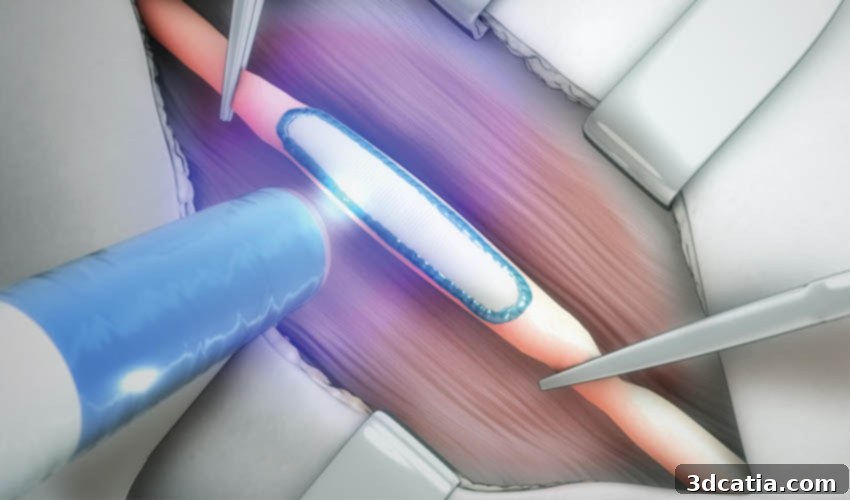
The composition of TISSIUM’s pre-polymer mixture is deliberately formulated using naturally occurring, biocompatible compounds such as glycerol and sebacic acid. This choice ensures inherent safety and compatibility with biological systems, minimizing adverse reactions. A key characteristic of this pre-polymer is its high viscosity, a critical feature that allows for its exceptionally precise application to target tissues. This high viscosity ensures minimal displacement by other bodily fluids, guaranteeing that the material remains exactly where it is needed, forming a stable and controlled interface with the tissue. Once applied, the pre-polymer is activated using a controlled blue-light exposure. This activation process initiates a chemical reaction that transforms the liquid pre-polymer into a solid, creating a bond that is both highly adhesive and remarkably elastic. This unique combination allows the resulting polymer to conform intimately with the dynamic movements and underlying tissue mechanics, mimicking natural tissue behavior while maintaining a strong, durable adhesion. Essentially, the polymer functions not just as an external patch, but as an integrated part of the tissue itself, facilitating seamless repair and optimal functional recovery. Beyond direct tissue application, TISSIUM’s versatile pre-polymer can also be utilized as a specialized resin for constructing high-resolution 3D printed medical devices or can be loaded with therapeutic drugs for targeted delivery within the body, further expanding its potential applications across various medical fields.

The pre-polymer is not displaced by other bodily fluids when applied to tissue | Image via TISSIUM
The recent FDA approval specifically pertains to TISSIUM’s vascular sealant, a product meticulously engineered to address the critical issue of achieving rapid and reliable hemostasis – the process of stopping blood flow – following peripheral vascular surgeries. These surgeries, which often involve delicate blood vessels, present a significant challenge in preventing post-operative bleeding, a complication that can lead to increased patient morbidity and extended recovery times. TISSIUM’s vascular sealant is designed to overcome these challenges by providing an immediate and effective sealing solution, enhancing patient safety and improving surgical outcomes. The sealant is not only highly efficacious but also offers superior biocompatibility, ensuring it integrates seamlessly with the body without triggering adverse immunological responses. Furthermore, surgeons benefit from its remarkably simple preparation and application process, which reduces operative time and complexity. In this particular application, the unique configuration of TISSIUM’s biomorphic polymer acts as a powerful complement to traditional sutures. By working in conjunction with sutures, the sealant provides an additional layer of security, creating a hermetic seal that ensures a fully effective surgical closure, significantly reducing the risk of bleeding and promoting faster healing in delicate vascular tissues.
Commenting on this significant achievement, Christophe Bancel, CEO of TISSIUM, expressed his profound satisfaction, stating, “We are pleased to receive this approval from the FDA as it represents a key milestone that accelerates the development of our vascular indication and triggers the further expansion of our broad platform.” His statement underscores the strategic importance of this FDA clearance, not merely as an endorsement for a single product, but as a catalyst for TISSIUM’s broader portfolio and long-term vision. Bancel further articulated the company’s forward-looking strategy: “We will continue to execute on our strategy to build devices using our core polymer technology and offer applications across multiple therapeutic areas, such as peripheral nerve and hernia repair where we have recently started development.” This vision highlights TISSIUM’s commitment to leveraging its foundational polymer technology to create a diverse range of medical devices. The expansion into areas like peripheral nerve repair and hernia repair signifies the vast potential of biomorphic programmable polymers to address unmet needs in complex surgical fields, promising innovative solutions for intricate physiological challenges and demonstrating the scalability and adaptability of their platform.
The different applications of TISSIUM’s technology | Image via TISSIUM
Indeed, as elucidated by these developments, TISSIUM’s innovative pre-polymer technology boasts an extraordinary range of applications within the medical sector. Its versatility allows it to be deployed in numerous ways both inside and outside the human body. Internally, it can function as highly effective sealants, robust adhesives, protective barriers, and versatile plugs, offering solutions for a multitude of surgical and reparative needs. Beyond structural support, the polymer also serves as an advanced vehicle for targeted drug delivery, enabling precise administration of therapeutic agents directly to affected areas, thus enhancing treatment efficacy and minimizing systemic side effects. Externally, the pre-polymer acts as a sophisticated resin, enabling the creation of intricate, high-resolution implantable devices using advanced 3D printing technology. This capability opens doors for patient-specific implants that can perfectly match anatomical structures and functional requirements, ushering in a new era of personalized medicine. The ability to tailor devices with unprecedented precision positions TISSIUM at the forefront of medical device innovation, promising improved patient outcomes across various specialties from orthopedics to reconstructive surgery.
The profound impact of TISSIUM’s biomorphic programmable polymers on tissue repair cannot be overstated. Unlike conventional medical glues or sutures that often provide rigid adhesion or mechanical closure, TISSIUM’s material is engineered to mimic the inherent elasticity and dynamic properties of natural biological tissues. This “biomorphic” quality means the polymer moves and flexes with the body, reducing stress on surrounding tissues and fostering a more natural healing environment. The “programmable” aspect further enhances its utility, allowing for customization of its properties for specific applications, whether it’s optimizing adhesion strength for vascular repair or tailoring elasticity for delicate nerve regeneration. This combination of biomimicry and adaptability represents a paradigm shift in medical intervention, offering solutions that are not only effective but also integrate seamlessly with the body’s own healing mechanisms. The potential for this technology to extend into areas such as advanced wound care, internal organ repair, and even specialized prosthetic integration is immense, promising a future where damaged tissues can be restored with unprecedented fidelity and long-term functional success. For those interested in exploring the full spectrum of TISSIUM’s groundbreaking work and its implications for future medical advancements, more comprehensive information is available on their official website. You can find out more about their innovative solutions and ongoing research efforts by visiting them HERE.
We are keen to hear your thoughts on this latest groundbreaking application within the medical sector and the transformative potential of TISSIUM’s biomorphic programmable polymers. How do you foresee such advanced technologies reshaping surgical practices and patient recovery in the coming years? Please share your insights and opinions in a comment below, or engage with us on our Facebook and Twitter pages! For those who wish to stay at the forefront of additive manufacturing innovations, don’t forget to sign up for our free weekly Newsletter. It delivers all the latest news, analyses, and developments in 3D printing directly to your inbox, ensuring you never miss an important update in this rapidly evolving field!