

Revolutionizing Space Communication: How MXene and 3D Printing are Shaping Next-Gen Antennas for Satellites and Aerospace
The landscape of advanced manufacturing is rapidly evolving, with additive manufacturing, commonly known as 3D printing, emerging as a transformative force across various sectors. Its impact is particularly profound in high-stakes industries such as aerospace and defense, where innovation in material science and production techniques can yield significant strategic advantages. For instance, 3D printing has already been instrumental in producing critical components for Boeing’s advanced combat helicopters and sophisticated satellite antennas deployed in space. This growing reliance on additive manufacturing underscores its capacity to deliver parts that are not only high-performance but also optimized for specific, demanding environments, pushing the boundaries of what was previously achievable with traditional manufacturing methods.
Amidst this backdrop of continuous innovation, new research projects are constantly pushing the boundaries of what’s possible with 3D printing and advanced materials. A recent breakthrough exemplifies this progress: researchers at the University of British Columbia Okanagan (UBCO), in a vital collaboration with Drexel University in Philadelphia, Pennsylvania, have successfully developed a novel compound – MXene – that holds immense promise for the space and satellite industry. This pioneering material is poised to revolutionize the fabrication of antennas and other critical communication components, offering unprecedented improvements in weight, cost, and design complexity, which are crucial factors for space-bound technologies where every gram and dollar count.
The groundbreaking research project represents a powerful synergy between leading scientific institutions, leveraging specialized expertise from both sides. It was a collaborative endeavor spearheaded by scientists from the A.J. Drexel Nanomaterials Institute at Drexel University, renowned for its work in cutting-edge materials science, and UBCO’s School of Engineering, known for its applied research in microelectronics. Such a significant undertaking naturally attracted substantial support, with vital funding provided by the Department of National Defense, the Natural Sciences and Engineering Research Council, and the United States National Science Foundation. This robust backing highlights the strategic importance and potential impact of the research on national security, global communication infrastructure, and the broader technological advancement of space exploration.
At the heart of this innovation is Mohammad Zarifi, a distinguished researcher in UBCO’s Microelectronics and Gigahertz Applications Laboratory (OMEGA) and an associate professor in the School of Engineering. Dr. Zarifi and his dedicated team embarked on a mission to develop advanced communication components that could surmount the inherent limitations of traditional designs. Their objective was clear: create components that are not only superior in their electromagnetic performance but also significantly lighter, more cost-effective, and simpler in design compared to conventional metal counterparts. The success of their efforts promises components that are an astonishing 10 to 20 times lighter, dramatically cheaper to produce, and streamlined in design, all while ensuring absolutely no compromise on critical performance metrics. This breakthrough is particularly vital for the aerospace sector, where every gram saved contributes directly to reduced launch costs, increased payload capacity, and enhanced operational efficiency for satellites and spacecraft.
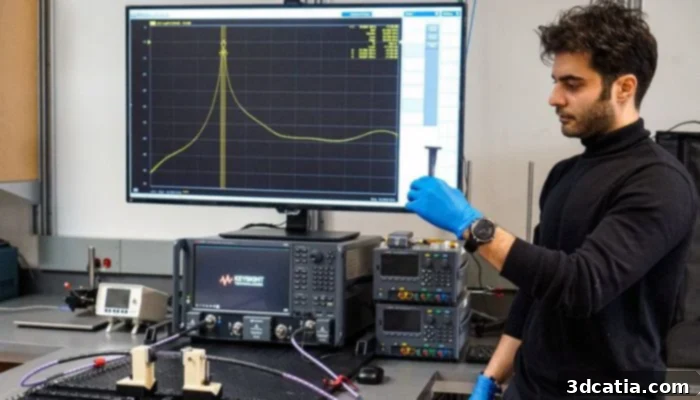
A prototype of a 3D printed, MXene-coated component, demonstrating the integration of advanced materials with additive manufacturing for next-generation telecommunications in aerospace.
The 3D-printed objects conceptualized and developed by these visionary scientists achieve their remarkable properties through the fusion of the novel MXene compound with a polymer base. This innovative combination has the profound potential to dramatically advance the manufacturing processes for telecommunications antennas and other essential connecting elements used in modern communication systems. By integrating MXene, these components are set to usher in a new era of communication technology. This includes not only highly efficient antennas but also crucial waveguides—devices meticulously engineered to efficiently conduct sound and optical waves in various communication systems—and filters, which are vital for precise signal processing, ensuring clarity and minimizing interference. Traditionally, these high-performance components have relied heavily on metals such as silver, brass, and copper. While effective, these metals come with inherent drawbacks, particularly concerning their significant weight, susceptibility to corrosion, and the complexity and cost of their manufacturing processes. MXene, however, demonstrates significant promise as a viable, and often superior, alternative, offering a pathway to lighter, more efficient, and easier-to-produce solutions that can withstand the harsh conditions of space.
MXene and 3D Printing Combination Could Create Better Satellites and Advanced Space Systems
The MXene material developed by the UBCO and Drexel researchers belongs to an exciting family of two-dimensional materials, known for their unique properties and extensive applications. Among its notable members is titanium carbide, a specific MXene compound renowned for its exceptional electrical conductivity and structural integrity. Dr. Yury Gogotsi, the distinguished Director of the A.J. Drexel Nanomaterials Institute at Drexel University in Philadelphia, provides an insightful analogy to truly grasp MXene’s unique characteristics. He vividly describes MXene as nanometer-thin conductive flakes, so incredibly fine and adaptable that they can be easily dispersed in water, behaving much like common clay. This remarkable characteristic is pivotal to its ground-breaking application method: the material can be effortlessly applied to almost any surface directly from its pure water dispersion, critically requiring no additional additives or binders. Upon simple air-drying at ambient temperatures, these MXene flakes transform polymer surfaces into highly electrically conductive ones. This innovative process is akin to achieving metallization at room temperature, entirely eliminating the need for energy-intensive high temperatures, complex vacuum environments, or the laborious melting and vaporizing of metals—a significant simplification and cost reduction compared to conventional metallization techniques, making it ideal for scalable manufacturing.
The sheer potential of devices crafted using this MXene-enhanced 3D printing technique is truly immense, promising a paradigm shift across various technological domains, especially in the demanding aerospace sector. Researchers are particularly enthusiastic about the capability of these lightweight, additively manufactured devices to profoundly impact the fundamental design and fabrication of electronic communication systems within the rapidly expanding space and satellite industries. In an environment where every kilogram counts for launch economics and mission performance, the ability to produce components that are significantly lighter without sacrificing critical electromagnetic performance is an absolute game-changer. These lightweight MXene-coated polymer structures even have the potential to completely supersede traditional manufacturing methods, such as complex and time-consuming metal machining, particularly for producing intricate channel structures vital for advanced communication devices. This represents a monumental leap forward, offering not just substantial cost savings and drastically reduced weight, but also significantly greater design freedom, faster iteration cycles, and unprecedented flexibility for crucial aerospace components.
The implications for satellite technology and deep-space missions are particularly profound. Lighter satellites require considerably less fuel to launch, leading to substantial cost reductions in launch operations and enabling either more frequent launches or the capacity to carry larger, more sophisticated payloads. Once in orbit, reduced weight contributes to greater maneuverability, extended operational lifespan by conserving fuel, and potentially higher performance capabilities due to less structural strain. The superior electrical conductivity of MXene, combined with the unparalleled precision and design flexibility afforded by 3D printing, means that antennas, waveguides, and other critical communication elements can be designed with unprecedented efficiency and in highly customized, compact form factors. This opens doors for the development of more compact, powerful, and reliable communication systems crucial for everything from global internet provision to advanced meteorological monitoring, Earth observation, and ambitious deep-space exploration missions. The ability to customize and iterate these components on demand, through advanced additive manufacturing, also offers unparalleled flexibility in adapting to evolving mission requirements and rapidly integrating new technological advancements.
Dr. Zarifi, reflecting on the journey and future prospects of this innovative material and its integration with 3D printing, concludes with palpable enthusiasm: “While there is still additional research to be done, we’re excited about the potential of this innovative material. We aim to explore and develop the possibilities of 3D printed antennas and communication devices in space. By reducing payloads of shuttle transporters, it gives engineers more options.” This statement encapsulates the forward-thinking vision driving the research. The ongoing work will focus on further optimizing MXene’s specific properties, refining the 3D printing processes for larger scale and greater complexity, and scaling up production to meet the rigorous and demanding requirements of the space industry. The long-term goal is to transition this remarkable laboratory breakthrough into practical, deployable technologies that will not only define but also fundamentally enhance the next generation of space communication infrastructure. This reduction in payload weight translates directly into more efficient rocket launches, allowing for either smaller, more economical rockets or the invaluable ability to carry more scientific instruments, essential supplies, and mission-critical equipment into orbit. Ultimately, this research paves the way for a more accessible, sustainable, and advanced future in space exploration and utilization, opening up new frontiers for scientific discovery and technological advancement.
For those interested in delving deeper into the specifics of this remarkable discovery and the underlying scientific principles, additional information can be found by clicking HERE for the original UBCO article, which provides comprehensive insights into the detailed research methodology and preliminary findings directly from the source.
What are your thoughts on the transformative potential of MXene and 3D printing for creating superior satellite components and advancing space communication? We invite you to share your valuable insights and opinions in a comment below or join the vibrant conversation on our LinkedIn, Facebook, and Twitter pages! Don’t miss out on the latest advancements and breaking news in additive manufacturing; be sure to sign up for our free weekly newsletter here to get the newest 3D printing news delivered straight to your inbox! You can also find all our engaging videos, exclusive interviews, and in-depth content on our YouTube channel, exploring the diverse world of 3D printing applications.
*Cover Photo Credits: UBC Okanagan