
Revolutionizing Sustainable Manufacturing: Chalmers University Pioneers 3D Printing with Wood-Based Nanocellulose Ink
In a significant stride towards a more sustainable future, a dedicated team of researchers at Chalmers University of Technology in Sweden has successfully achieved a groundbreaking feat: 3D printing intricate parts using an innovative wood-based ink. What makes this accomplishment particularly remarkable is their ability to precisely mimic the complex ultrastructure of natural wood, unlocking a new era for environmentally friendly manufacturing. This development is a beacon of hope for industries worldwide that are actively seeking greener alternatives and are investing heavily in hybrid additive manufacturing materials. By transforming wood pulp into a printable material, this research paves the way for producing a vast array of products directly derived from trees, drastically reducing our reliance on less sustainable resources like plastics and metals.
The concept of integrating 3D printing with plant-derived materials, especially wood, is not entirely new to the scientific community. Previous research has explored this promising intersection, highlighting the inherent advantages of such natural resources. For instance, Canadian scientists previously made headlines by 3D printing electronic circuits from nanocellulose, a versatile material meticulously extracted from wood pulp. Nanocellulose is particularly appealing due to its exceptional properties, including high porosity, impressive strength-to-weight ratio, and remarkable torsional resistance. However, a persistent challenge in working with wood and its derivatives has always been its transformation. Unlike plastics, which can be easily melted and reshaped, wood typically requires mechanical processes like sawing or planing. These traditional methods, while effective for bulk shaping, often lead to the irreversible destruction of wood’s delicate ultrastructure, consequently diminishing its unique and beneficial properties. The elegance of the Swedish researchers’ approach lies precisely in overcoming this hurdle; through additive manufacturing, they appear to have discovered an ingenious solution to preserve, and even replicate, these invaluable inherent characteristics. This preservation is key to harnessing the full potential of wood as a high-performance engineering material.
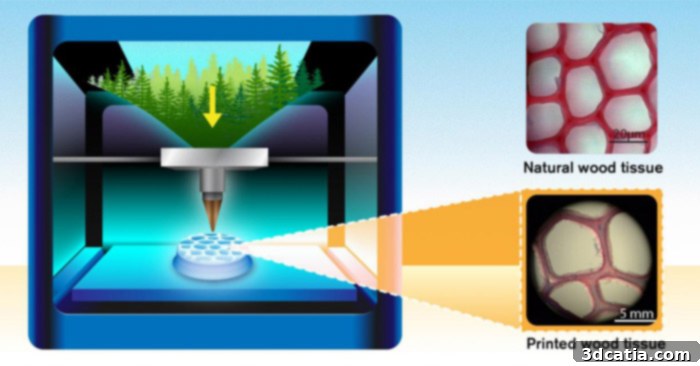
Researchers meticulously imitate the natural cellular architecture of wood | Photo Credits: Yen Strandqvist/Chalmers University of Technology
Unlocking Wood’s Potential: Mimicking Ultrastructure to Preserve and Enhance Properties
The core of this innovation involved an intricate process of transforming raw wood pulp into a specialized printable gel. This gel consists primarily of nanocellulose, augmented with hemicellulose, which serves as a crucial sticking agent. Nanocellulose provides the structural integrity and natural properties, while hemicellulose facilitates smooth extrusion and binding, ensuring the material maintains its form during and after the printing process. However, the true ingenuity of this project extends beyond mere material development. The breakthrough lies in the profound interpretation and digitization of wood’s inherent genetic code and structural blueprint. By understanding the natural orientation, shape, and distribution of cellulose nanofibres within wood, researchers can precisely guide the 3D printer. This sophisticated control allows them to manage the deposition of the ink at a microscopic level, accurately reproducing the wood’s complex ultrastructure with unprecedented precision. This capability is pivotal because it enables them to engineer parts that not only look like wood but also possess the same, if not enhanced, functional characteristics as the natural plant material, such as specific strength, stiffness, and even thermal or acoustic properties. This level of biomimicry ensures that the advantages of natural wood are fully leveraged in manufactured products.
Professor Paul Gatenholm, the Director of Research overseeing this pioneering work, articulates the profound impact of their findings: “This is a breakthrough in manufacturing technology. It allows us to move beyond the limits of nature, to create new sustainable, green products. It means that those products which today are already forest-based can now be 3D printed, in a much shorter time. And the metals and plastics currently used in 3D printing can be replaced with a renewable, sustainable alternative.” This statement underscores not only the technological leap but also the significant environmental implications. By precisely controlling the internal architecture, researchers can potentially design structures that are stronger, lighter, or more functional than their natural counterparts, effectively “moving beyond the limits of nature” through intelligent engineering. The ability to 3D print forest-based products rapidly means accelerated product development cycles, reduced lead times, and increased efficiency, particularly for customized or complex geometries that would be cumbersome or impossible with traditional methods. Furthermore, the substitution of non-renewable resources like metals and plastics with a renewable, biodegradable alternative marks a crucial step towards a circular economy and significantly reduces the carbon footprint associated with manufacturing.
This revolutionary manufacturing method is poised to have a transformative impact on conventional production processes across a multitude of industries. Wood-based products are ubiquitous, ranging from furniture and construction materials to specialized components in various sectors. The integration of additive manufacturing means these products can now be custom-designed with unparalleled flexibility and produced with drastically reduced manufacturing times. Imagine the possibilities: bespoke architectural elements, lightweight automotive interiors, advanced packaging solutions, eco-friendly consumer electronics casings, or even biomedical scaffolds, all precisely engineered from sustainable wood derivatives. The inherent design freedom of 3D printing, combined with the natural benefits of wood, opens up an expansive landscape of applications. This approach not only allows for intricate geometries and functional customization but also minimizes material waste inherent in subtractive manufacturing, contributing further to environmental sustainability.

This innovative manufacturing technique holds the potential to create greener, more effective packaging solutions
To demonstrate the immediate practical utility of their research, the Chalmers team has already developed a prototype for an innovative packaging concept. They successfully 3D printed sophisticated honeycomb structures, characterized by intricate chambers nestled between the printed walls. What’s more, they managed to encapsulate solid cellulose particles precisely within these internal chambers. This design leverages the well-known oxygen barrier properties of cellulose, making it an exceptionally promising method for creating truly airtight packaging. Such packaging could revolutionize the preservation of sensitive goods like food products, extending shelf life and reducing spoilage, or providing robust protection for pharmaceutical supplies. Unlike traditional plastic packaging, which often contributes to environmental pollution and microplastic concerns, this wood-derived alternative offers a biodegradable and renewable solution, aligning perfectly with global demands for eco-conscious consumer goods. The structural integrity provided by the honeycomb design further enhances its protective capabilities while minimizing material usage, showcasing the synergistic benefits of biomimicry and additive manufacturing.
Professor Gatenholm further elaborates on the broader implications, stating: “Manufacturing products in this way could lead to huge savings in terms of resources and harmful emissions. Imagine, for example, if we could start printing packaging locally. It would mean an alternative to today’s industries, with heavy reliance on plastics and C02-generating transport. Packaging could be designed and manufactured to order without any waste.” This vision of localized manufacturing represents a paradigm shift. By enabling on-demand, local production of goods, particularly packaging, we can drastically reduce the complex global supply chains that currently contribute significantly to carbon emissions through extensive transportation. The ability to design and manufacture to order eliminates the need for mass production and subsequent waste, fostering a lean and efficient production model. This approach moves us closer to a true circular economy, where resources are utilized efficiently, waste is minimized, and environmental impact is dramatically reduced. This innovation is not merely a scientific curiosity; it is a vital step towards a more sustainable and responsible industrial future that promises to reshape how we design, produce, and consume everyday products. We eagerly anticipate following the continued advancements of this pivotal project. In the interim, you can discover more detailed information about this groundbreaking research HERE.
What are your thoughts on this exciting new research into wood-based 3D printing? We invite you to share your perspectives in the comments section below or engage with us on our Facebook and Twitter pages! Don’t forget to subscribe to our free weekly Newsletter, ensuring you receive all the latest news and innovations in the world of 3D printing directly in your inbox!