
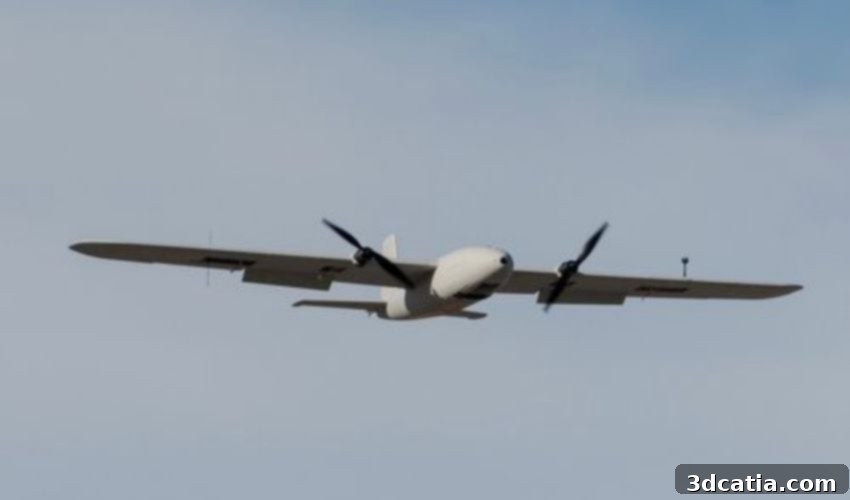
3D Printed Titan Falcon Drones: A Game-Changer in Ukraine’s Defense Strategy
As the war in Ukraine approaches its second year, the conflict continues with unwavering intensity, despite shifts in media attention. The Ukrainian armed forces, demonstrating remarkable resilience, persist in their resistance against prolonged and fierce clashes with Russian forces. However, a significant challenge facing the Ukrainian military is the critical shortage of essential supplies, particularly weapons and ammunition. In this ongoing struggle, innovative solutions are proving indispensable. One such solution that has emerged as a cost-effective and highly efficient method for supplementing resources is the deployment of 3D printing technologies. These advanced manufacturing capabilities allow for the rapid production of large quantities of vital equipment at a significantly reduced cost, fundamentally altering the dynamics of supply chain management in a conflict zone. The latest iteration of this transformative approach is exemplified by the introduction of the 3D printed Titan Falcon drones, poised to provide crucial support to Ukrainian troops.
The Pivotal Role of Additive Manufacturing in Modern Defense
For years, 3D printing, also known as additive manufacturing, has been hailed as a revolutionary force capable of profoundly impacting the defense industry. This conflict in Ukraine has dramatically accelerated the adoption and validation of this technology, showcasing numerous advances directly on the battlefield. From rapidly prototyping spare parts to producing specialized tools and even certain types of munitions, 3D printing offers unparalleled agility and responsiveness. Its ability to create complex geometries, customize designs on the fly, and produce parts closer to the point of need significantly shortens supply lines and reduces logistical burdens. This inherent flexibility is particularly vital for a military facing conventional supply challenges and seeking to maintain operational readiness against a larger adversary. The speed and cost-efficiency of additive manufacturing enable forces to iterate designs, implement improvements, and deploy new equipment far quicker than traditional procurement cycles allow, effectively democratizing access to advanced military hardware.
The collaboration behind the Titan Falcon drones underscores this global commitment to innovation. An American-Ukrainian NGO partnered with the German company Donaustahl GmbH, which is responsible for 3D printing the drones designed by Titan Dynamics Inc. This international effort has facilitated the provision of these critical unmanned aerial vehicles (UAVs) to Ukraine, with the explicit aim of helping to shift the tide of the conflict. To date, three Titan Falcon drones have already been successfully delivered to the Ukrainian Armed Forces. Initial reports indicate that these advanced drones have been swiftly integrated into missions, undergoing rigorous testing to ascertain their full capabilities and operational effectiveness in real-world scenarios. The early deployment highlights the urgency and the perceived value of these innovative assets.
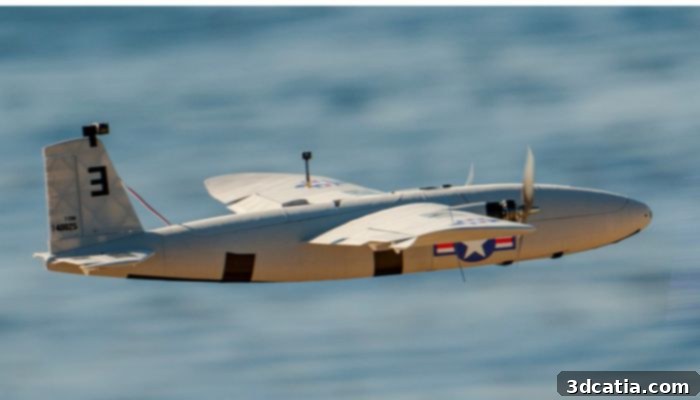
The 3D printed Titan Falcon drone flying over Ukraine
Unveiling the Titan Falcon: Advanced Features for Battlefield Superiority
The 3D printed Titan Falcon drones stand out due to their impressive array of capabilities. One of their most remarkable features is their exceptional autonomy, allowing the Titan Falcon to remain airborne for up to six continuous hours. This extended flight duration is crucial for sustained surveillance missions, providing commanders with prolonged real-time intelligence without the frequent need for drone recovery and redeployment. Complementing this endurance is an expansive handling range of up to 400 kilometers. When these two features are combined – a six-hour flight time and a 400-kilometer operational radius – the Titan Falcon gains an unparalleled ability to cover vast distances, conduct deep reconnaissance, and monitor strategic areas far behind enemy lines. This greatly enhances situational awareness and allows for more effective targeting and tactical planning.
Beyond its flight performance, the Titan Falcon is equipped with a high-definition surveillance camera that delivers a live, first-person view directly to operators. This real-time visual feed is invaluable for identifying enemy positions, tracking movements, assessing battle damage, and guiding friendly forces. Furthermore, the camera system can be customized with different payloads and targets, allowing for adaptability to various mission requirements and improving its overall effectiveness and range of applications. Whether it’s for general area surveillance, target acquisition, or perimeter security, the Titan Falcon’s modular camera system ensures versatility. These combined attributes — extended endurance, impressive range, and advanced real-time surveillance capabilities — make the Titan Falcon an ideal aircraft for critical battlefield observation and reconnaissance, significantly bolstering the Ukrainian army’s intelligence-gathering efforts.
The Power of Undisclosed Technologies: Redefining Manufacturing Agility
While the exact 3D printing technologies employed in the manufacturing of the Titan Falcon drones largely remain a proprietary mystery, their impact is unequivocally clear. The very essence of additive manufacturing — its capacity to produce intricate designs rapidly and at a compellingly low cost — is fundamentally reshaping the landscape of defense manufacturing. This paradigm shift offers unprecedented possibilities for accelerating innovation cycles and deploying cutting-edge equipment with remarkable speed. Whether it involves fused deposition modeling (FDM) for robust structural components, stereolithography (SLA) for fine details, or selective laser sintering (SLS) for durable, functional parts, the underlying principles of 3D printing enable localized, on-demand production. This bypasses the traditional constraints of complex global supply chains, reduces lead times, and allows for rapid iteration based on field feedback. The ability to quickly design, print, test, and deploy new drone iterations gives the Ukrainian forces a significant tactical advantage, adapting to evolving battlefield requirements with agility that conventional manufacturing simply cannot match. The secrecy surrounding the specific technologies likely serves both national security interests and competitive advantage, highlighting the strategic importance of these manufacturing processes.
Titan Dynamics Inc.: Pushing the Boundaries of Unmanned Aerial Systems
Leading this transformative initiative with their Titan Falcon drones is Titan Dynamics Inc., a company renowned for its specialization in the development and manufacture of VTOL (Vertical Take-Off and Landing) class aircraft. Their expertise particularly focuses on fixed-wing aircraft, a design choice that offers superior endurance and speed compared to traditional multi-rotor drones, making them ideal for long-range surveillance and reconnaissance. Titan Dynamics Inc. is driven by a clear mission: to continuously enhance the capabilities of UAVs (unmanned aerial vehicles). Their current research and development efforts are concentrated on several critical areas, including improving the overall efficiency of their platforms, increasing their utility through advanced payload integration, and significantly extending their operational range. Crucially, all these advancements are pursued with a keen eye on simultaneously reducing manufacturing costs, making sophisticated drone technology more accessible and deployable. This commitment to innovation ensures that their UAVs remain at the forefront of military and civilian applications. By focusing on these core principles, Titan Dynamics Inc. is not just producing drones; they are actively shaping the future of aerial intelligence and operational support, delivering solutions that are both technologically advanced and economically viable for demanding environments.
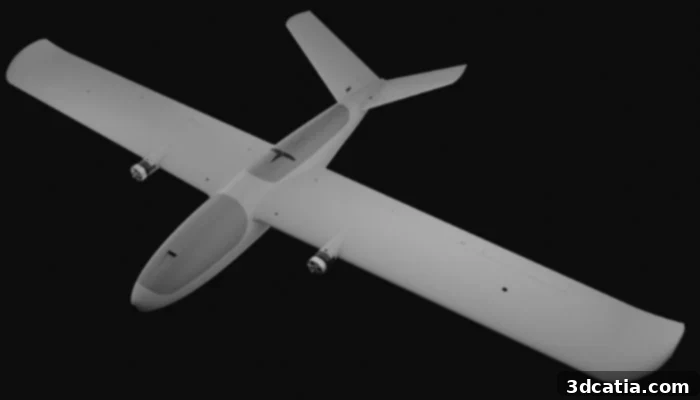
Downloadable Titan Falcon plans are available for 3D printing this drone, fostering distributed manufacturing.
Strategic Impact and Future Outlook: A New Paradigm for Defense
The introduction of 3D printed drones like the Titan Falcon into active service marks a significant turning point in modern military logistics and operational strategy. Beyond providing immediate relief for equipment shortages, this approach cultivates a more agile and resilient defense ecosystem. The ability to produce critical assets locally, on-demand, and with tailored specifications directly addresses vulnerabilities in traditional supply chains, which are often slow, costly, and susceptible to disruption. This localized manufacturing capability can drastically reduce the time from design to deployment, allowing military forces to respond to evolving threats and tactical needs with unprecedented speed. Furthermore, the cost-effectiveness of 3D printing enables the production of a greater volume of drones, increasing the availability of these crucial intelligence assets across the battlefield. This paradigm shift empowers smaller forces to access advanced technology that was once the exclusive domain of large industrial complexes. The success of projects like the Titan Falcon in Ukraine is likely to inspire broader adoption of additive manufacturing across global defense sectors, fostering a future where military innovation is faster, more adaptable, and more widely distributed, ultimately enhancing national security capabilities worldwide.
What are your thoughts on the revolutionary impact of the Titan Falcon 3D printed drones in the context of ongoing conflicts and the future of defense? We invite you to share your insights in a comment below or join the conversation on our LinkedIn, Facebook, and Twitter pages! For those eager to stay abreast of the latest developments in additive manufacturing, don’t forget to sign up for our free weekly Newsletter here, delivering the most current 3D printing news directly to your inbox! Additionally, you can explore all our engaging video content on our YouTube channel.
*All Image Credits: Titan Dynamics