
Exploring the Cutting Edge: Top 5 3D Printing Innovations Redefining Our World This Week
Welcome to our weekly dive into the dynamic and rapidly evolving world of 3D printing and additive manufacturing. Every week, we scour the globe for the most impactful and inspiring developments that highlight how this transformative technology is not just changing industries, but actively shaping our society and the future. From revolutionizing logistics with autonomous robots to pushing the boundaries of art, design, and education, these five videos showcase the incredible versatility and potential of 3D printing. We’ve curated a selection that demonstrates both groundbreaking technological advancements and their real-world applications across diverse fields. If you find these insights fascinating, we encourage you to explore an even broader collection of 3D printing videos on our YouTube channel. We hope you enjoy this curated glimpse into the future of manufacturing and innovation, and have a fantastic day!
Top 1: A 3D Printed Robot to Automate Deliveries and Logistics
The future of logistics and supply chain management is rapidly moving towards automation, and 3D printing is playing a crucial role in accelerating this transition. Bastian Solutions, a leader in material handling and robotics, has introduced a groundbreaking robotic arm designed to autonomously pick up and deliver orders. This innovation promises to significantly streamline and speed up the entire delivery process, addressing the growing demands for efficiency and precision in modern warehousing and distribution centers. The project is a remarkable testament to collaborative innovation, with Bastian Solutions partnering with the 3D Fast Radius printing service. This collaboration saw an impressive 45% of the robot’s components being manufactured using additive technologies. This high percentage of 3D printed parts highlights the technology’s capability to produce complex, customized, and functional components rapidly. Leveraging HP’s Multi Jet Fusion (MJF) technology, Fast Radius was able to produce these intricate parts with exceptional speed, while simultaneously maintaining high complexity in design and ensuring superior mechanical strength and durability. This not only expedited the prototyping and production phases but also allowed for design optimizations that would be challenging, if not impossible, with traditional manufacturing methods. The integration of 3D printed components into this autonomous delivery robot underscores the pivotal role additive manufacturing plays in bringing advanced automation solutions to fruition, paving the way for more efficient and resilient logistical networks worldwide.
Top 2: Impressive 3D Printed Art Structure, Conifera, by Arthur Mamou-Mani and COS
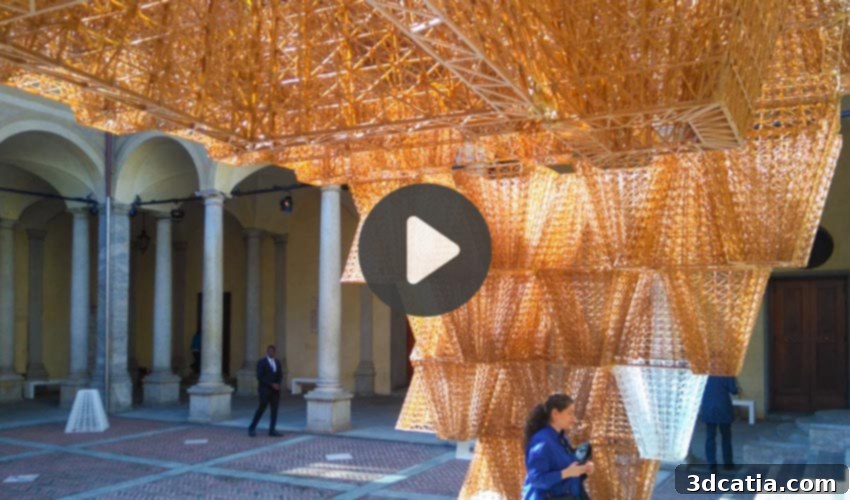
The intersection of art, architecture, and advanced manufacturing was brilliantly showcased at the prestigious Milan Furniture Fair, where French architect Arthur Mamou-Mani, in collaboration with COS studio, unveiled an awe-inspiring 3D printed structure named “Conifera.” This monumental installation captivated audiences with its organic form and innovative material composition, embodying a profound connection to nature and sustainable design. Conifera is meticulously crafted from various modular blocks, each distinguished by three distinct colors and material properties. The translucent sections are fabricated from pure PLA (Polylactic Acid), a biodegradable thermoplastic derived from renewable resources, allowing light to filter through and create a ethereal glow. The white parts incorporate a pigment, adding visual contrast and structural emphasis. Most notably, the brown sections are ingeniously made from wood pulp, blending the natural aesthetics and tactile qualities of wood with the precision of 3D printing. This diverse material palette not only enhances the visual complexity of the structure but also underscores a commitment to environmentally conscious practices. According to the artist, the primary inspiration for Conifera comes directly from the intricate geometries and natural growth patterns of trees and conifers, celebrating the beauty and complexity of natural forms through digital fabrication. The use of parametric design and computational tools allowed Mamou-Mani to generate the complex, interlocking forms that evoke a forest canopy, demonstrating how 3D printing can bring such ambitious and intricate architectural visions to life, while also exploring the potential of sustainable materials in large-scale installations.
Top 3: Unsmashable Guitar Engineered by Sandvik
In a testament to advanced material science and manufacturing prowess, industrial engineering giant Sandvik recently captured global attention with the creation of an “unbreakable” guitar. This incredible feat, which we featured just a few days ago, pushed the boundaries of what’s possible in product design and durability. Sandvik, renowned for its expertise in materials technology and industrial processes, set out to engineer an instrument that could withstand even the most vigorous performances, including the infamous guitar smash, without suffering damage. The secret behind this unparalleled resilience lies in a sophisticated blend of traditional subtractive manufacturing processes and cutting-edge 3D printing technologies. By synergistically combining these methods, the company forged a guitar with an incredibly robust and intricate internal structure that is virtually impossible to break, regardless of the force applied by the artist. This hybrid approach allowed Sandvik to utilize the strengths of both manufacturing paradigms: the precision and material integrity of subtractive methods for certain components, and the design freedom and complexity offered by additive manufacturing for others. The resulting instrument is not only extraordinarily durable but also boasts a striking, innovative design that challenges conventional guitar aesthetics. The project highlights how additive manufacturing enables the creation of complex geometries and internal lattice structures that optimize strength-to-weight ratios, making materials stronger and lighter than ever before. Discover the full story behind this remarkable engineering project and witness its incredible capabilities in the video below, a true demonstration of material innovation meeting artistic expression.
Top 4: Artist Silvia Weidenbach is the First V&A Gilbert Collection Resident
The art of jewellery making is experiencing a renaissance, driven by visionary artists who seamlessly merge traditional craftsmanship with digital innovation. Silvia Weidenbach stands at the forefront of this movement, creating truly exuberant and attention-demanding jewellery pieces that challenge conventional perceptions. Her unique approach involves a masterful fusion of advanced digital design tools, state-of-the-art 3D printing technology, and time-honored silversmithing techniques. This innovative blend allows her to craft intricate, sculptural forms that would be impossible to achieve through purely traditional methods, while still retaining the exquisite finish and tactile quality of handcrafted precious metals. Weidenbach’s pioneering work has earned her significant recognition, including the prestigious honor of being named the first V&A Gilbert Collection artist in residence. This residency at the renowned Victoria and Albert Museum in London highlights the growing importance of digital fabrication within the contemporary art and design landscape. During her time at the V&A, she has further explored the symbiotic relationship between technology and artistry, pushing the boundaries of what is considered contemporary jewellery. Her pieces are not merely ornaments; they are complex artistic expressions that tell a story of material exploration, digital precision, and human touch. The use of 3D technologies enables rapid prototyping, allowing for iterative design and experimentation with complex geometries, ultimately leading to unique, bespoke creations. Dive deeper into Silvia Weidenbach’s fascinating process and discover how she leverages 3D printing to conceive and create her original, awe-inspiring jewellery pieces that bridge centuries of craft with the innovations of tomorrow.
Top 5: Developing 3D Printing Curriculum in K-12 Education
As 3D printing continues its rapid ascent across industries, the demand for a skilled workforce proficient in additive manufacturing technologies is escalating. Recognizing this critical need, educational institutions are increasingly integrating 3D printing into their curricula, preparing the next generation for the jobs of the future. Mara from MatterHackers, a leading provider of 3D printing products and educational resources, introduces us to Rebecca Buckhoff, a dedicated Technology Professional Development Specialist for the Moreno Valley Unified School District. Rebecca is at the forefront of this educational revolution, meticulously designing comprehensive 3D printing curricula tailored for K-12 students. Her work is crucial in equipping students with the essential theoretical knowledge and practical skills they will need to thrive in a world increasingly shaped by advanced manufacturing. The curriculum goes beyond simply operating a 3D printer; it encompasses fundamental design principles, CAD (Computer-Aided Design) software proficiency, understanding various printing technologies and materials, problem-solving, and iterative design thinking. By introducing these concepts at an early age, students develop critical thinking, creativity, and spatial reasoning skills. They learn to transform abstract ideas into tangible objects, fostering an innovative mindset. This proactive approach ensures that students graduating from the Moreno Valley Unified School District are not only familiar with 3D printing but possess tangible skills that can open doors to careers in engineering, product design, architecture, healthcare, and many other fields where additive manufacturing is making a significant impact. This initiative by Rebecca Buckhoff and the Moreno Valley Unified School District, supported by industry partners like MatterHackers, exemplifies a forward-thinking educational model preparing students for the challenges and opportunities of the 21st century.
What are your thoughts on this week’s inspiring TOP 5 3D printing videos? From automating logistics and creating monumental art installations to engineering unsmashable guitars and revolutionizing education, these examples truly underscore the immense and diverse potential of additive manufacturing. This technology is not merely a tool; it’s a catalyst for innovation across every sector imaginable. We’d love to hear your insights, comments, and predictions for where 3D printing is headed next. Drop a comment below or join the conversation on our Facebook and Twitter pages! Don’t miss out on any future developments – and don’t forget to sign up for our free weekly Newsletter to keep updated on all the latest news, breakthrough innovations, and exclusive insights from the 3D industry, delivered straight to your inbox every week!