
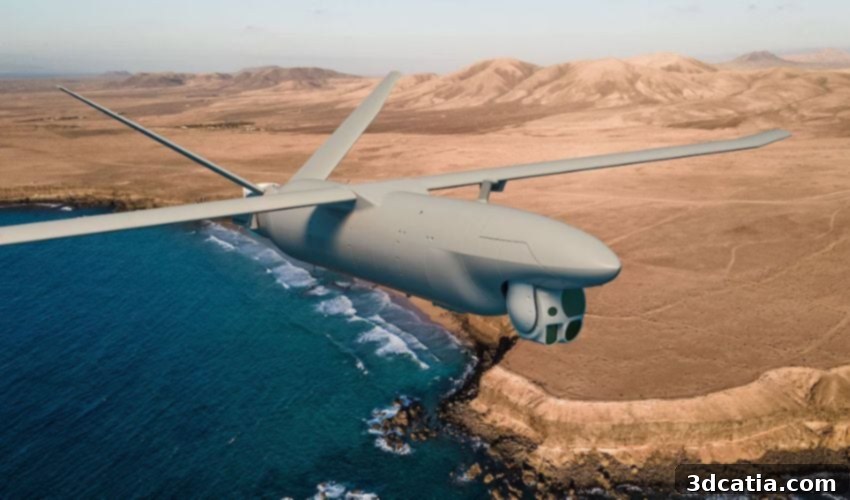
Taiwan’s Innovative Defense: How 3D Printing is Powering a New Drone Army to Counter China
In an era where geopolitical landscapes are constantly shifting, additive manufacturing, often known as 3D printing, is rapidly emerging as a disruptive force in military innovation. This advanced technology is fundamentally changing how nations approach defense, offering unprecedented flexibility, speed, and cost-effectiveness in producing critical components and even entire systems. We’ve already witnessed the tangible impact of 3D printing on modern warfare in conflicts such as that in Ukraine, where it has proven invaluable for creating essential medical supplies like tourniquets for battlefield injuries, as well as enabling the rapid prototyping and production of weapons and drone components. Now, this transformative potential is being harnessed by Taiwan, which, in collaboration with the United States, is embarking on an ambitious project: developing a 3D-printed ‘drone army’ to bolster its defenses and effectively counter potential threats in the region, particularly from China.
The narrative of a smaller entity bravely challenging a more formidable adversary is a timeless one, echoing through history from the biblical tale of David and Goliath to classic rivalries like Ford versus Ferrari, or more recent geopolitical struggles such as Ukraine’s resistance against Russia. These stories often captivate us because they represent the triumph of ingenuity and resilience over sheer power. However, it’s also true that such outcomes are rare; overcoming an overwhelmingly more powerful adversary typically requires a revolutionary shift in strategy and capabilities. Taiwan, closely observing Ukraine’s remarkable success in its ongoing struggle, appears to be drawing a vital lesson: additive manufacturing and its application in drone technology could be the key to leveling the playing field and forging a credible deterrent.
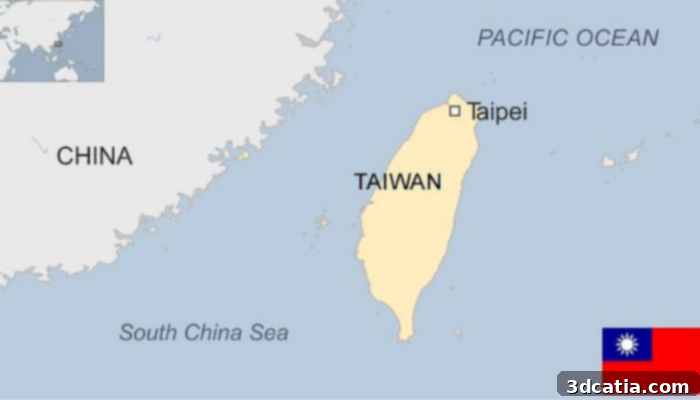
Located near to China, Taiwan and the other country have not always had the most peaceful relationship (photo credits: BBC)
To fully grasp the strategic imperative behind Taiwan’s development of a 3D-printed drone army, it’s crucial to understand the intricate and often tense history between Taiwan and mainland China. The roots of this complex relationship trace back to 1949, when the Republic of China (ROC) government, having lost the Chinese Civil War to the Chinese Communist Party, relocated to the island of Taiwan, which had previously been occupied by Japan. Since that time, relations between Beijing and Taipei have remained deeply contentious. Both sides maintain claims over the entirety of China, with the People’s Republic of China (PRC) steadfastly denying Taiwan’s legitimacy as an independent nation and regarding it as a breakaway province that must eventually be reunified with the mainland, by force if necessary. In recent years, these tensions have escalated significantly, marked by increasingly frequent and assertive Chinese military drills conducted around Taiwan, accompanied by growing diplomatic and economic pressure. This constant threat of potential invasion or blockade serves as the core motivation for Taiwan to urgently develop innovative and cost-effective defense strategies, with the 3D-printed ‘drone army’ emerging as a central pillar of this proactive approach.
Drones, or Unmanned Aerial Vehicles (UAVs) as they are more formally known, have become indispensable assets in modern military strategy due to their extraordinary versatility and adaptability. These pilotless aircraft can be deployed for a vast array of critical applications, including persistent surveillance and reconnaissance missions to gather vital intelligence, rapid delivery of urgent medical supplies to inaccessible or dangerous zones, and even precise weapon deployment for targeted strikes. Their transformative impact on battlefields has been starkly demonstrated in recent conflicts, highlighting their ability to provide real-time situational awareness, conduct effective strikes with minimal risk to human pilots, and even overwhelm sophisticated air defense systems through sheer numbers. Recognizing this profound strategic value, the Taiwanese Ministry of National Defense has proposed a substantial investment of $175 million to acquire an impressive fleet of 3,200 drones. This ambitious procurement plan directly reflects Taiwan’s intent to emulate the tactical successes observed in Ukraine, where drones have played a pivotal role in defense against a larger adversary. However, such a large-scale acquisition necessitates incredibly cost-efficient methods of development and production, a challenge that additive manufacturing is uniquely positioned to address.
To achieve its ambitious goal of a formidable drone army, Taiwan is leveraging key strategic partnerships. One of the country’s largest and most reputable drone manufacturers, Thunder Tiger Group, has forged a critical alliance with the American aerospace firm RapidFlight. This collaboration, initially reported by TheDefensePost, brings together Taiwan’s urgent defense needs and significant manufacturing capabilities with American cutting-edge aerospace and additive manufacturing expertise. RapidFlight has already established itself as a pioneer in utilizing 3D printing for the efficient and rapid creation of sophisticated drones. By combining their respective strengths, Thunder Tiger Group and RapidFlight aim to revolutionize drone production, moving beyond traditional manufacturing constraints to create a vast, resilient, and technologically advanced fleet of UAVs that can be deployed quickly and cost-effectively, thus significantly enhancing Taiwan’s defense posture.
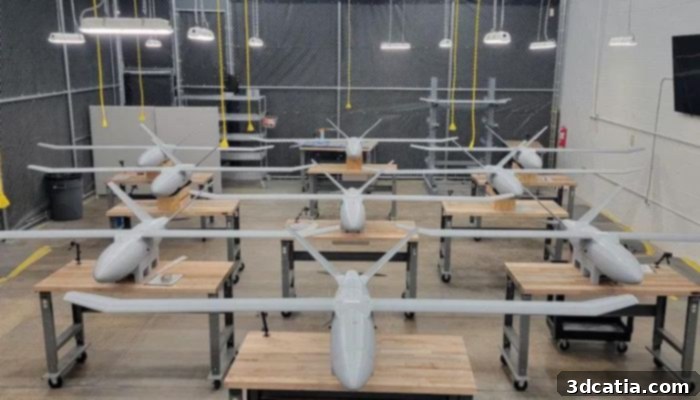
E2 drones made by RapidFlight with 3D printing (photo credits: RapidFlight)
While specific technical details regarding the exact additive manufacturing processes being employed or the final design aesthetics of the UAVs remain largely under wraps, the strategic rationale behind choosing 3D printing is exceptionally clear and compelling. RapidFlight has consistently highlighted the profound benefits of additive manufacturing for drone production. Firstly, it dramatically lowers production costs by minimizing material waste, reducing the need for expensive tooling and molds, and enabling more localized, on-demand manufacturing. This cost efficiency is paramount for a nation like Taiwan seeking to build a large-scale drone fleet as a deterrent without overwhelming its defense budget. Secondly, additive manufacturing significantly enhances the speed of design iteration and production. Prototypes can be developed, tested, and refined in a fraction of the time required by traditional methods, allowing for rapid adaptation to evolving threats and technological advancements. This agility is critical in a fast-paced military environment.
Furthermore, 3D printing offers unparalleled design freedom, allowing engineers to create complex, lightweight geometries and integrate multiple functionalities into single components, optimizing drone performance in terms of aerodynamics, payload capacity, and flight duration. Crucially, additive manufacturing also drastically reduces the logistical burden and storage footprint of UAVs, a factor RapidFlight claims can be reduced by as much as a factor of 10. This is achieved by enabling on-demand production of critical components. Instead of storing vast inventories of fully assembled drones or spare parts, components can be printed as needed, reducing warehouse space, transportation costs, and vulnerability to attack. This resilience in the supply chain is a significant advantage, particularly in a potential conflict scenario where traditional supply lines could be disrupted. The ability to quickly manufacture replacement parts or even entire drones locally ensures sustained operational capability, making additive manufacturing a cornerstone of a robust and adaptive defense strategy for Taiwan.
The implementation of a 3D-printed drone army represents a sophisticated embrace of ‘asymmetric warfare,’ a strategic doctrine where a weaker force employs unconventional tactics and technologies to exploit the vulnerabilities of a stronger adversary. In this context, Taiwan aims to negate China’s conventional military superiority by fielding a large number of relatively inexpensive, rapidly producible, and potentially expendable drones. The idea is to create a ‘drone swarm’ that could overwhelm an aggressor’s advanced and costly air defense systems through sheer volume and distributed attack. Each individual drone might be less sophisticated than a high-end manned aircraft, but their collective impact, coupled with their low cost and rapid replacement rate, drastically alters the cost-benefit analysis for any potential invasion. By making an invasion prohibitively expensive and logistically complex for China, Taiwan hopes to establish a credible deterrent, ensuring its national security through technological innovation rather than attempting to match its adversary’s conventional might.
Whether this innovative approach will ultimately prove successful in deterring aggression and strengthening Taiwan’s defense capabilities remains to be seen. However, it undeniably highlights a growing trend: 3D-printed drones are rapidly gaining traction among militaries worldwide as a powerful tool, particularly for nations seeking to engage effectively in asymmetric warfare. The collaboration between Taiwan and the United States, leveraging the transformative power of additive manufacturing, sets a significant precedent for future defense strategies globally. We will be closely monitoring the evolution of this situation in the coming months and years, as it has profound implications not only for regional security but also for the broader adoption of additive manufacturing in defense applications.
What are your thoughts on Taiwan’s strategy to develop a 3D-printed drone army? Do you believe this is an effective approach for deterring potential adversaries? We invite you to share your insights in the comments section below or engage with us on our social media platforms: LinkedIn, Facebook, and Twitter! Don’t forget to subscribe to our free weekly newsletter for all the latest 3D printing news delivered directly to your inbox. You can also explore our extensive video content on our dedicated YouTube channel.
*Cover Image: A drone made by RapidFlight, illustrating advanced drone technology, though not necessarily the exact model destined for Taiwan’s drone army (photo credits: RapidFlight)