
Beyond the Screen: How 3D Printing Revolutionized Black Panther’s Iconic Wakandan Costumes
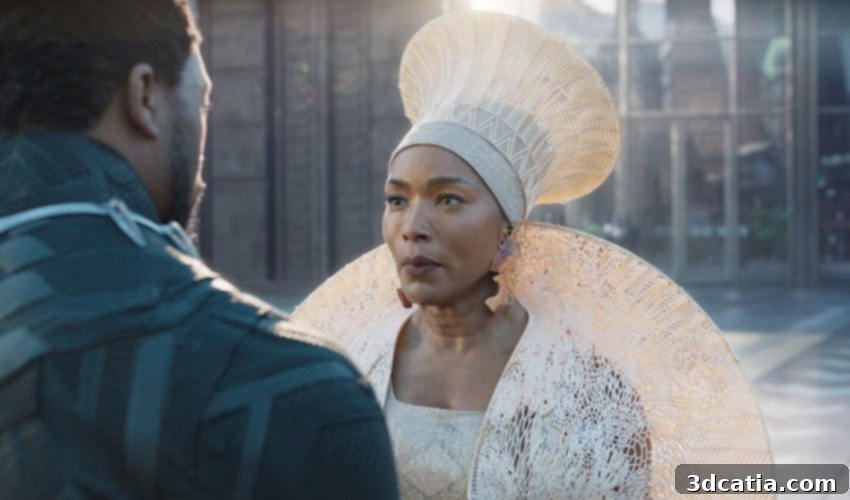
Marvel’s groundbreaking film, “Black Panther,” captivated audiences worldwide, not only by crossing the monumental billion-dollar mark at the global box office but also by offering a rich tapestry of cultural depth, futuristic vision, and unparalleled inspiration. The movie’s phenomenal success resonated deeply, celebrating a vibrant, technologically advanced African civilization. Among the many elements that contributed to its visual splendor and critical acclaim, the stunning costumes worn by the cast, particularly by Queen Ramonda, stood out. What many might not realize is that a significant portion of these intricate and breathtaking garments leveraged cutting-edge 3D printing technology, pushing the boundaries of costume design in cinema.
The creation of these iconic costumes was a masterclass in blending disparate worlds: the rich, traditional aesthetics of African design with the sleek, hyper-modern elements characteristic of the fictional Wakandan civilization. This ambitious task required innovative approaches, and 3D printing emerged as the perfect solution. Costume designer Ruth E. Carter, an Oscar-winning visionary, collaborated with Julia Koerner, an architect and renowned 3D printing fashion specialist, to seamlessly integrate additive manufacturing into the elaborate ensembles, especially those destined for the regal Queen Ramonda.
The adoption of 3D printing in filmmaking, particularly for character costumes, props, and accessories, has seen a significant surge in popularity in recent years. This innovative technology offers a plethora of advantages over traditional manufacturing methods. It allows for the rapid creation of highly personalized and bespoke objects with unprecedented efficiency and, crucially, at a more controlled cost. Furthermore, 3D printing excels at producing designs ranging from the simplest geometries to the most complex and intricate patterns, all within the same production cycle. This versatility was evident in other popular productions, such as Netflix’s hit show “Stranger Things,” which famously utilized 3D printing to craft the terrifying Demogorgon. For “Black Panther,” the challenge was even more profound: to encapsulate traditional African influences within a hypermodern context where nature and technology were not just intertwined but inseparable. Achieving this delicate balance to create costumes that authentically represented the fantasy world of Wakanda was a formidable, yet ultimately successful, endeavor thanks to additive manufacturing.
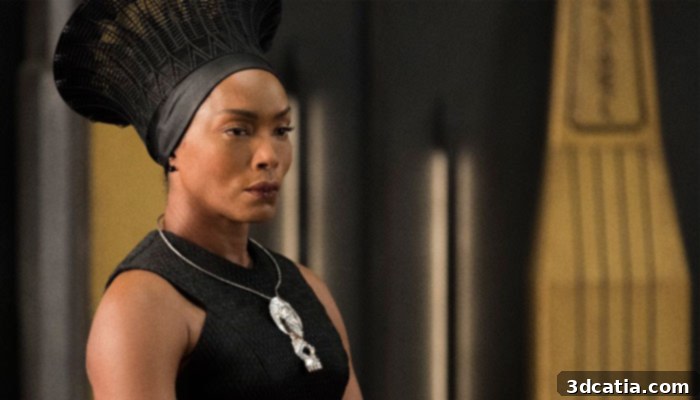
Several exquisite pieces of Queen Ramonda’s costume were brought to life using advanced 3D printing techniques.
Crafting Wakanda: 3D Printed Costumes Rooted in African Culture
To truly appreciate the innovative application of 3D printing in “Black Panther,” one must understand the core concept behind the film’s setting. The kingdom of Wakanda is a magnificent, fictitious African civilization, unparalleled in its technological advancement. Yet, due to its deliberate isolation from the rest of the world, Wakanda has meticulously preserved its deep roots in African culture, heritage, and traditions. This unique dichotomy presented a fascinating challenge for the costume department: the garments needed to be incredibly futuristic and avant-garde, while simultaneously remaining undeniably authentic to their African origins. For the majestic Queen Ramonda, the solution lay squarely in 3D printing. This technology, with its inherent capability to produce highly complex, intricate designs and robust structures, proved to be the perfect medium for stylists to forge this compelling association between the ancient and the ultra-modern, giving tangible form to Wakanda’s unique identity.
One of the most striking examples of this fusion was the crown worn by Queen Ramonda. Ruth E. Carter envisioned a piece that would echo the traditional crowns historically worn by married Zulu women, yet she aspired to infuse it with a distinct futuristic touch, ensuring it felt like an advanced Wakandan creation rather than a handcrafted artifact of the past. To achieve this intricate balance, Carter enlisted the expertise of Julia Koerner. Koerner, leveraging her profound understanding of parametric design and additive manufacturing, meticulously crafted the model pieces, seamlessly blending both traditional and futuristic concepts into a singular, breathtaking design realized through 3D printing. The result was a crown that was both reverent to its cultural inspiration and boldly innovative.
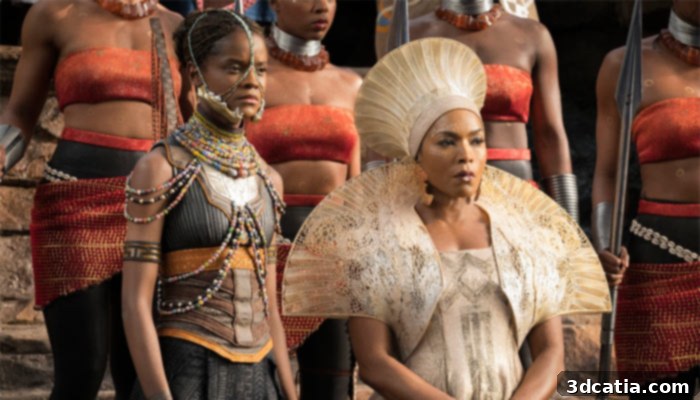
The intricate headpiece and the regal shoulder mantle adorning Queen Ramonda were produced using state-of-the-art laser sintering technology. The material of choice for these critical components was Polyamide 12 powder, selected for its exceptional properties. This advanced polymer offers a remarkable combination of high accuracy, superior robustness, and essential flexibility to the final product. These characteristics are paramount for costumes that must withstand the rigors of filming while maintaining their structural integrity and comfort for the wearer. Furthermore, Polyamide 12 is well-suited for direct skin contact, making it an ideal material for elaborate costume and high-fashion designs where comfort and safety are key. The fabrication process took place at a specialized professional-grade 3D printing facility in Belgium, ensuring the highest standards of precision and quality were met for these crucial film props.
Demonstrating her commitment to authenticity, Ruth E. Carter made a deliberate artistic choice to preserve the genuine aesthetic of the 3D printed components. She opted not to paint the pieces, leaving them in their original, additively manufactured glory. This decision not only highlighted the inherent beauty and intricate detail achievable with 3D printing but also subtly underscored Wakanda’s advanced technological integration, where form and function merge seamlessly. The technology’s precision also allowed Carter to meticulously incorporate the nuanced patterns of African lace styles, while simultaneously showcasing the sophisticated technology wielded by the Wakandan people within the film’s narrative. It was a testament to how modern manufacturing could enhance traditional artistry.
Reflecting on her creative process and the role of additive manufacturing, Julia Koerner passionately explains: “I am inspired by nature and its patterns and structures. The organic growth and synthetic manufacturing processes have an incredible contrasting engagement which I find enticing. Additive manufacturing is definitely the only technique to output the 3D designs I develop on the computer within their organic form, the intricate patterns and geometries often challenge both the computational capacity of my tools as well the production companies I work with. I always push and see what has not yet been done and I am eager to create something new.” Her words encapsulate the spirit of innovation that drove the costume design for “Black Panther,” demonstrating how 3D printing provides an unparalleled avenue for realizing complex, organic forms that bridge the gap between digital design and physical manifestation.

Image: Marvel’s BLACK PANTHER / Costume Design by Ruth Carter
For a deeper dive into the visionary concepts and groundbreaking ideas that underpinned the creation of the costumes in “Black Panther,” watch the insightful video below featuring the esteemed Ruth Carter, brought to you by IMAX:
The extraordinary artistry and innovative techniques employed in “Black Panther’s” costume design certainly made a strong case for recognition. Could this film have been nominated in the coveted “Best Costume Design” category for the 2019 Oscars? The industry buzz and critical acclaim certainly suggested its merit. For those interested in the technical aspects and the Belgian additive manufacturing specialists who provided crucial support in designing and producing these remarkable 3D printed models for the movie, further information can be found on the website of Materialise, a leading expert in the field.
The impact of 3D printing on cinematic costume design is undeniable, offering unprecedented freedom for creativity and technical execution. What are your thoughts on the revolutionary costumes featured in “Black Panther”? Did the use of advanced technology enhance your appreciation for Wakanda’s aesthetic? Share your insights in a comment below, or engage with us on our Facebook and Twitter pages! Don’t miss out on the latest advancements and news in the world of 3D printing – sign up for our free weekly Newsletter, delivering all the essential updates straight to your inbox!