
Transforming Tomorrow: Key Advancements in 3D Printing Across Pharmaceuticals, Industrial Manufacturing, and Biomedical Innovation
The landscape of manufacturing and innovation is continuously reshaped by advancements in 3D printing, a technology that promises not only efficiency but also unprecedented precision and customization. From the development of life-saving pharmaceutical drugs to robust industrial components and revolutionary biomedical implants, additive manufacturing is proving to be a cornerstone of modern progress. This week, major headlines underscore this global shift, featuring pharmaceutical giant Triastek’s monumental achievement with the world’s largest 3D printed pharmaceuticals center, Russia’s state nuclear corporation Rosatom’s expansion into additive manufacturing in Belarus, 3D Systems’ strategic realignment in its software portfolio, and groundbreaking research into 3D printed glass as a bone substitute. These developments collectively highlight the diverse and profound impact of 3D printing across critical sectors, pushing the boundaries of what’s possible and paving the way for a more advanced future.
Triastek Unveils World’s Largest 3D Printed Pharmaceuticals Facility in China
Triastek, a pioneering pharmaceutical company established in 2015, has once again captured global attention with the inauguration of its state-of-the-art 3D printing pharmaceutical facility in Nanjing, Jiangsu province, China. This facility isn’t just another production plant; it proudly holds the title of the world’s largest center dedicated to 3D printed pharmaceuticals, marking a pivotal moment in the industry’s journey towards large-scale commercialization. According to reports from the China Daily, this ambitious production center is engineered to produce an astounding 300 million tablets annually, leveraging a fleet of fully automated and autonomous 3D printers. This immense capacity signifies a significant leap from research and development into mass production, positioning Triastek as a formidable player in the global pharmaceutical market.
The traditional process of manufacturing tablets is notoriously complex and labor-intensive, typically involving multiple distinct stages such as granulation, mixing, tableting, coating, and blister packaging. In stark contrast, Triastek’s innovative 3D printing approach dramatically streamlines this workflow. Utilizing advanced additive manufacturing techniques, the process is simplified to primarily three essential steps: blending and melting of raw materials, the precise printing of the tablets, and subsequent packaging. This reduction in process steps not only enhances efficiency but also minimizes potential points of failure, leading to improved consistency and quality control.
3D printing tablets offers a myriad of benefits that extend beyond mere production efficiency. One of its most significant advantages lies in the ability to create tablets with highly complex internal structures. This design flexibility allows for sophisticated drug release profiles, such as multi-layer tablets for sequential drug delivery or porous structures for rapid dissolution. Such customization can lead to enhanced therapeutic effects, reduced side effects, and improved patient adherence. Furthermore, the inherent precision of 3D printing technology significantly boosts quality control, ensuring each tablet meets exact specifications for dosage and composition. The Jiangsu Medical Products Administration recognized Triastek’s pioneering efforts by granting the company China’s very first pharmaceutical production license specifically for 3D printed drugs. This regulatory milestone is crucial, as it validates the safety and efficacy of additively manufactured pharmaceuticals and sets a precedent for future innovations in the field.
With this license, Triastek is now poised to become only the second company globally, following the US-based Aprecia Pharmaceuticals, to commercialize additively manufactured drugs on a significant scale. This achievement underscores the company’s leading position in an emerging and highly specialized sector. Triastek has successfully completed rigorous pharmaceutical research and clinical trials for its anticoagulant Apixaban tablet, designated T20j, and is currently awaiting final market approval. This particular drug, addressing critical health needs, exemplifies the potential for 3D printing to deliver effective and innovative treatments. Beyond T20j, Triastek’s impressive pipeline includes more than 10 other 3D printed drug products, all of which are progressing through phase I or phase II clinical trials. These encompass treatments for conditions such as ulcerative colitis and bowel disease, showcasing the breadth of therapeutic areas that 3D printing can address. The establishment of this massive facility and the ongoing clinical trials signify Triastek’s commitment to revolutionize drug manufacturing, making personalized and more effective medicines accessible to a broader population.
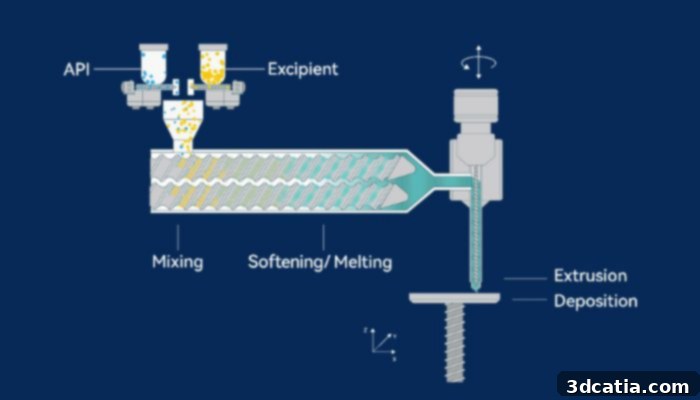
Triastek’s Melt Extrusion Deposition (MED®) 3D printing process (Image Credit: Triastek)
Rosatom, Russian Nuclear State Corporation, Establishes Additive Technologies Center in Belarus
The State Atomic Energy Corporation Rosatom (Rosatom), a titan in the global energy sector, has further cemented its commitment to industrial innovation by opening the first Centre for Additive Technologies (TsAT – Tsentr Additivvnikh Tekhnologii) in Belarus. Headquartered in Moscow, Rosatom’s core expertise lies in nuclear energy, but its vast portfolio also encompasses significant assets in power engineering, heavy machine engineering, and construction. Recognizing the transformative potential of additive manufacturing, Rosatom established its dedicated additive technologies division in 2017. Since then, the corporation has rapidly expanded its footprint, successfully launching seven TsATs across various regions in Russia, demonstrating a clear strategic vision for integrating 3D printing into its diverse operations.
The new Belarusian center represents a significant milestone: it is the first Rosatom TsAT to be established outside of Russia. This international expansion is a collaborative effort with H-Holding, a Belarusian company, underscoring a strategic partnership aimed at fostering technological advancement in the region. The decision to locate this facility in Belarus highlights Rosatom’s commitment to supporting the industrial development of its allies and leveraging additive manufacturing to build more resilient and localized supply chains. The center is equipped with cutting-edge machinery designed to handle a variety of industrial applications. Its arsenal includes two sophisticated Selective Laser Melting (SLM) machines: the medium-sized RusMelt 300M SLM printer and its larger, more robust counterpart, the RusMelt 600M. These printers are capable of producing high-quality metal parts with intricate geometries, crucial for demanding sectors such as nuclear, aerospace, and defense. In addition to these metal printers, the facility houses a Russian-made machine specifically designed for printing sand polymer molds, which are vital for complex casting processes. Completing its advanced toolkit is a 3D scanner, developed by one of Rosatom’s key technology partners, enabling precise measurement, quality control, and reverse engineering capabilities.
The opening ceremony of the Belarus TsAT was attended by high-ranking officials, including Viktor Karankevich, Belarus Deputy Prime Minister. In his address, Karankevich emphasized the profound impact this center is expected to have on Belarusian industry: “Belarusian enterprises are already switching to the use of additive technologies, and the appearance of such a facility in the country will give a new impetus to the development of new types of products and their application in medicine, energy, aircraft construction and other high-tech industries.” This statement underscores the strategic importance of the center, not just for Rosatom’s operations, but for the broader economic and technological development of Belarus. By providing access to advanced additive manufacturing capabilities, the TsAT is expected to accelerate innovation, enable the production of complex components locally, and reduce reliance on foreign imports. This initiative aligns with a broader trend of industrial self-sufficiency and technological modernization, positioning both Rosatom and Belarus at the forefront of the evolving global manufacturing landscape. The center will serve as a hub for expertise, training, and collaboration, driving the adoption of 3D printing across critical sectors and fostering a new era of industrial capabilities in the region.
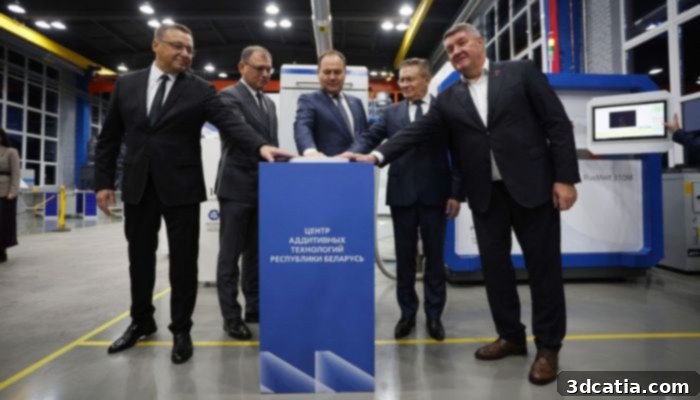
The opening ceremony of the Rosatom Centre for Additive Technologies in Belarus (Photo credit: Rosatom Additive Technologies LLC)
3D Systems Shifts Focus to 3D Sprint, Divesting from Oqton MOS and 3DXpert
3D Systems, a long-standing pioneer in the additive manufacturing industry, has announced a significant strategic shift designed to sharpen its focus and maximize its competitive edge. The company is set to advance its proprietary polymer solution, 3D Sprint, by heavily investing in its capabilities and leveraging cutting-edge technologies like artificial intelligence (AI) and machine learning (ML). This strategic redirection aims to dramatically improve part quality, accelerate design processes, optimize complex workflows, and simplify factory operations specifically within the realm of polymer additive manufacturing. By concentrating resources on 3D Sprint, 3D Systems intends to deliver unparalleled software solutions that drive efficiency and innovation for its polymer customers.
As a crucial part of this strategic pivot, 3D Systems will divest its broader industry-wide, printer-agnostic software platforms, including Oqton MOS and 3DXpert. These assets will be acquired by Hubb Global Holdings, following the signing of a definitive agreement. This divestment allows 3D Systems to streamline its product portfolio and concentrate its expertise where it sees the greatest future growth and differentiation. Under Hubb’s ownership, both Oqton MOS and 3DXpert are slated to continue operating as independent solutions. This ensures that these powerful platforms can support broader industry adoption of metal additive manufacturing, promoting standardization and enabling the efficient management of diverse fleets of 3D printers from various manufacturers. For many industrial users, the ability to manage mixed fleets through a unified software solution is critical for operational efficiency and scalability.
Despite the divestment, 3D Systems will maintain a strategic partnership with Hubb Global Holdings. This ongoing collaboration is vital, as it allows 3D Systems to continue incorporating 3DXpert into its comprehensive metal printing portfolio. This ensures continuity for existing customers and leverages the robust capabilities of 3DXpert for metal applications, even as 3D Systems prioritizes innovation and development within its polymer production systems. The transaction, expected to be finalized in the fourth quarter of 2025, marks a strategic evolution for 3D Systems. By focusing its internal development on 3D Sprint for polymers, and relying on a strategic partnership for metal software solutions, the company aims to optimize its R&D investments and deliver specialized, high-performance tools to its targeted customer segments. This move reflects a growing trend in the additive manufacturing software market towards specialized solutions that can deeply integrate with specific hardware and material processes, while still allowing for interoperability across the industry where necessary. It highlights the dynamic nature of the 3D printing ecosystem, where companies continually adapt their strategies to lead in an rapidly expanding market.
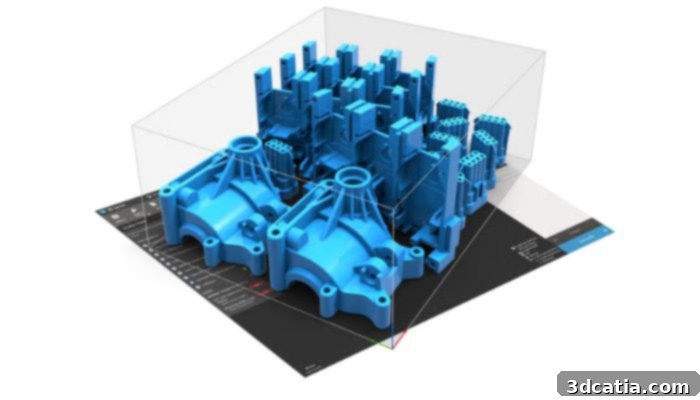
3D Sprint software (Credit: 3D Systems)
Groundbreaking Research on 3D Printed Bioactive Glass as a Bone Substitute
In a significant breakthrough for regenerative medicine, researchers in China have unveiled a novel bone substitute crafted from bioactive glass, precisely engineered using 3D printing technology. While the notion of using glass for bone replacement might initially sound counterintuitive, this innovative approach is rooted in a fundamental understanding of material science: certain types of glass, like bone, possess inherent structural properties that allow them to bear weight and provide mechanical support. Leveraging this surprising similarity, a dedicated team of researchers, spearheaded by Jianru Xiao, Tao Chen, and Huanan Wang, embarked on developing this revolutionary material. Their creation is a specialized glass gel, meticulously formulated from silica particles exhibiting opposite charges, which are then combined with critical elements such as calcium and phosphate. These specific components are not merely structural; they are chosen for their vital role in stimulating and promoting the formation of new bone cells, a process known as osteogenesis.
The manufacturing process for these advanced implants involves state-of-the-art 3D printing techniques, which allow for the creation of complex, porous internal structures that mimic natural bone architecture. This capability is crucial for promoting vascularization and cellular ingrowth, essential for successful integration with the host tissue. Following the 3D printing stage, the bioactive glass implants undergo a crucial post-treatment phase, where they are heated in a furnace at a precise temperature of 700 °C. This thermal processing step is vital for solidifying the material and enhancing its mechanical properties, ensuring it can withstand the biomechanical stresses within the body. To validate the efficacy of their new material, the research team conducted comprehensive tests on rabbits that had sustained cranial damage. The results were remarkably promising: the 3D printed bioactive glass implants consistently promoted more sustained and robust bone growth compared to conventional, non-bioactive glass. Furthermore, the performance of their novel substitute showed results that were comparable to those achieved with commercial bone substitutes currently available on the market, signifying its potential as a highly competitive and effective alternative.
The researchers enthusiastically highlight this development as a promising alternative for a wide range of medical and engineering applications. In medicine, this could revolutionize orthopedic surgery, reconstructive procedures for trauma patients, and the treatment of bone defects, offering patients more effective and personalized healing solutions. The ability to 3D print custom implants tailored to a patient’s unique anatomy, combined with the material’s inherent bioactivity, opens doors to unprecedented levels of personalization in bone regeneration. Beyond medical applications, the unique properties of 3D printed bioactive glass could also find utility in engineering, potentially in areas requiring robust, biocompatible materials with controlled degradation properties. While challenges remain, such as ensuring long-term mechanical stability in high-load bearing areas and fine-tuning degradation rates, this research represents a significant leap forward. It underscores the incredible potential of combining advanced materials science with additive manufacturing to address some of the most pressing challenges in healthcare and beyond, paving the way for future innovations in biomaterials and tissue engineering.
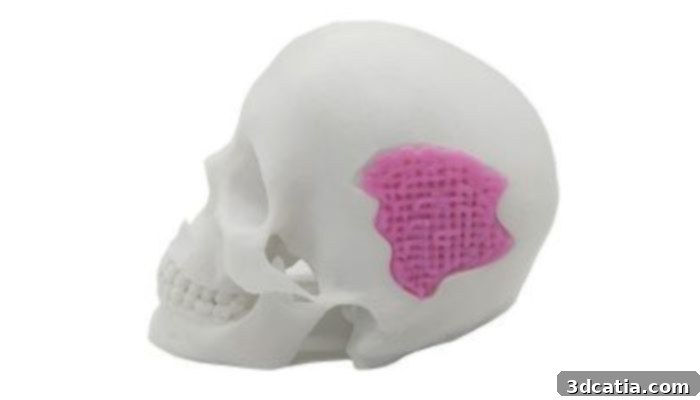
In pink, a 3D printed implant made from bioactive glass. (Photo credits: The American Chemical Society).
The recent advancements showcased by Triastek, Rosatom, 3D Systems, and cutting-edge biomaterials research collectively paint a vivid picture of a world increasingly shaped by 3D printing. From scaling up pharmaceutical production to pioneering industrial applications and developing revolutionary medical implants, additive manufacturing is no longer a niche technology but a pivotal force driving innovation across diverse sectors. These developments promise not only more efficient manufacturing processes but also highly customized, high-performance products that address complex challenges in healthcare, industry, and beyond. As the technology continues to evolve, we can anticipate even more transformative breakthroughs that will redefine our capabilities and possibilities.
What do you think of Triastek’s 3D printed drugs and these latest industry developments? Let us know in a comment below or on our LinkedIn or Facebook pages! Plus, don’t forget to sign up for our free weekly Newsletter to get the latest 3D printing news straight to your inbox. You can also find all our videos on our YouTube channel. Interested in more medical and dental 3D printing news? Visit our dedicated page HERE.
*Cover Photo Credit: Triastek