

3D Hubs 2018 Trends Report: Decoding the Evolution of Additive Manufacturing and Future Projections
3D Hubs, the world’s largest network of manufacturing services, has released its highly anticipated annual trends report, offering invaluable insights into the dynamic landscape of additive manufacturing. The 2018 report highlights a pivotal transformation: 3D printing is evolving beyond its traditional role as an almost exclusive prototyping technology to emerge as a robust and viable method for end-use part manufacturing. This significant shift is largely driven by the demanding requirements of industries such as automotive and aerospace, where engineers are increasingly exploring and integrating 3D technologies into their comprehensive manufacturing portfolios. While the technology’s capability for rapid iteration and concept validation ensures that prototyping remains its primary application, its expanding utility in production signals a new era for digital fabrication.
Echoing insights from other industry analyses, such as the Deloitte 2019 predictions, 3D Hubs firmly asserts that 3D printing is not a standalone panacea but rather an integral component within a broader manufacturing ecosystem. It is projected to revolutionize numerous sectors, yet it is not expected to completely supplant established traditional production methods like CNC machining or injection molding. Instead, the report emphasizes a synergistic relationship, where additive manufacturing collaborates alongside these conventional processes. This collaboration fosters a comprehensive “digital manufacturing ecosystem,” enabling greater flexibility, efficiency, and innovation across the production lifecycle. The report also delves into the burgeoning online demand for 3D printing services, noting that this activity is predominantly spearheaded by professional users. A geographical analysis of this online demand reveals a strong concentration in regions renowned for their vibrant tech industries and flourishing entrepreneurial environments, underscoring the technology’s appeal in innovation-driven hubs.

Source: 3D Hubs
The Global Additive Manufacturing Market: Key Milestones and Growth in 2018
The year 2018 proved to be a pivotal period for the global additive manufacturing (AM) market. Analysts estimated its annual revenue to be between $9.3 billion and $11.5 billion, reflecting a robust and expanding industry. This growth trajectory is not a recent phenomenon; between 2013 and 2017, the market experienced an impressive average annual growth rate of 24.7%. Looking ahead, expert projections for the next five years anticipate continued rapid expansion, with growth rates expected to range between 18.2% and 27.2%. This averages out to a formidable 23.5% annual growth, suggesting that the market size is set to double within the next three years. Despite this remarkable expansion, the report highlights a critical perspective: with a current valuation of $12.7 trillion, the global manufacturing market dwarfs the additive manufacturing sector. Even with its rapid growth, 3D printing currently represents only 0.1% of the total global manufacturing output. This statistic, while seemingly small, underscores the immense untapped potential and the significant room for further penetration and impact that additive manufacturing holds in the broader industrial landscape. It indicates that 3D printing is still in its nascent stages of widespread industrial adoption, poised for exponential growth as more industries recognize and harness its transformative capabilities.
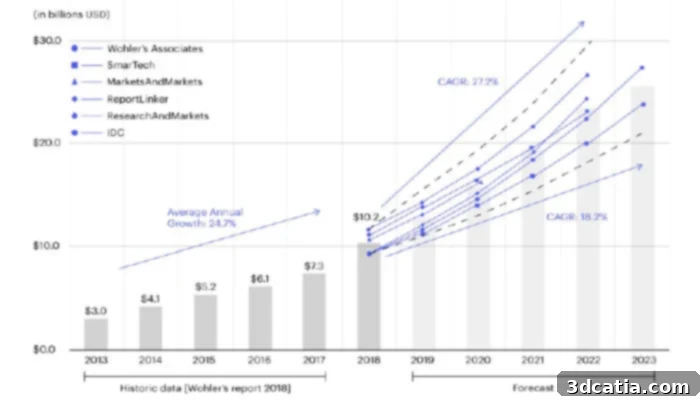
Source: 3D Hubs
As previously noted, 3D technologies were once almost exclusively confined to prototyping applications. However, the report vividly points towards a future where additive manufacturing achieves significantly broader adoption across various industries. This expansion is not without its challenges. The primary barriers to widespread adoption are largely attributed to “social factors,” encompassing the appropriate understanding and comprehensive education surrounding the technology. Many potential users and organizations lack sufficient knowledge regarding the capabilities, limitations, and best practices of 3D printing, which naturally hinders its integration. Overcoming these educational gaps through targeted training programs, accessible resources, and collaborative initiatives will be crucial for accelerating its industrial uptake. Finally, the report sheds light on the economic landscape of 3D printing services, revealing that approximately 37% of the total annual revenue generated by 3D printing can be attributed directly to 3D printing service providers. This segment plays a vital role in democratizing access to the technology, particularly for smaller enterprises or those unwilling to invest in in-house equipment. Geographically, the online demand for these services is predominantly driven by the robust economies of the US and Europe, though the Asia-Pacific region is rapidly emerging as a significant and growing market player, indicating a global shift towards localized digital manufacturing capabilities.
Key Findings and Predictions for 2019: Insights from 3D Hubs’ Online Demand Data
In its comprehensive report, 3D Hubs places a particular emphasis on statistical data derived from online 3D printing demand, offering a unique window into real-world application trends. By analyzing a representative sample of its own user demand from 2018, the report breaks down applications by industry. It reveals that a substantial 65% of the demand originates from engineers engaged in the development and production of industrial, electrical, or consumer goods. This high percentage suggests that these sectors heavily leverage external 3D printing services for rapid prototyping, functional part testing, and low-volume production. In contrast, engineers working within the automotive and aerospace industries account for a comparatively smaller 10% of this online demand. This discrepancy is largely attributed to the fact that major players in these highly specialized and capital-intensive industries often possess extensive in-house 3D printing capabilities. These dedicated facilities allow them to manage sensitive intellectual property, maintain stringent quality controls, and address their significant prototyping and production needs internally, reducing their reliance on external service providers for core operations.
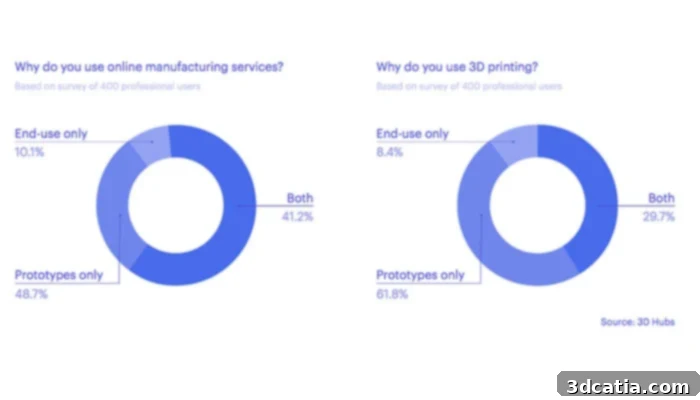
Source: 3D Hubs
Further delving into its customer base, the 3D Hubs report uncovers another crucial demographic insight: more than 75% of its users are affiliated with enterprises employing fewer than 100 individuals. This compelling statistic indicates that Small and Medium Enterprises (SMEs) are significant drivers of online 3D printing demand. This trend highlights the democratizing power of 3D printing services, providing SMEs with access to advanced manufacturing capabilities that might otherwise be cost-prohibitive to implement in-house. Even when it comes to the production of functional, end-use parts, engineers from these SMEs typically utilize 3D printing services for relatively small volumes, often limited to around 20 units. This pattern is characteristic of agile manufacturing strategies, custom product development, specialized tooling, or initial production runs before scaling up with traditional methods, demonstrating the flexibility and cost-effectiveness of on-demand additive manufacturing for smaller-scale applications.
Regarding the popularity of materials and processes, the online demand statistics for 2018 show a clear preference for plastics, with demand being 100 times higher than that for metals. Within the plastics category, Fused Deposition Modeling (FDM) emerged as the undisputed leader, accounting for nearly 80% of all plastic 3D printing orders. FDM’s widespread adoption can be attributed to its affordability, versatility with a broad range of thermoplastic materials, and relative ease of use, making it ideal for rapid prototyping and functional parts in many sectors. Stereolithography (SLA) and material jetting processes collectively secured the second position, capturing 12% of the demand, prized for their high resolution and smooth surface finishes suitable for detailed prototypes and functional parts. Meanwhile, Selective Laser Sintering (SLS) and Multi Jet Fusion (MJF) combined accounted for 8%, valued for their ability to produce strong, complex parts without support structures, making them excellent for intricate geometries and production-ready components. For metal 3D printing, the Direct Metal Laser Sintering (DMLS) / Selective Laser Melting (SLM) processes dominated, particularly when utilizing materials like aluminum and stainless steel, capturing over 90% of the metal demand. These processes are favored for their ability to create high-strength, complex metal parts suitable for demanding aerospace, medical, and automotive applications, underscoring the shift towards industrial-grade additive manufacturing.
Looking ahead to 2019 and beyond, the 3D Hubs report anticipates a continued acceleration in the adoption and accessibility of additive manufacturing. The technology is expected to find even more diverse applications and become increasingly integrated into mainstream manufacturing workflows. This optimism is echoed by industry leaders, including Jonah Myerberg, co-founder and CTO of Desktop Metal. Myerberg articulates this sentiment: “2019 is going to be an even more exciting year than 2018 and 2017. As more and more customers engage in design optimisation projects, they’ll say: “What can we do better? Can we do something like General Motors is doing? Can we do something like BMW is doing? Can we do something like Bugatti has done?” This quote encapsulates the growing ambition within the industry to push the boundaries of design and engineering through additive manufacturing, inspired by groundbreaking applications showcased by leading global manufacturers. The focus is shifting from simply “making” parts to “optimizing” them, leveraging the unique design freedoms that 3D printing offers to achieve superior performance, reduced weight, and consolidated assemblies.
In a concluding statement that encapsulates a critical challenge and a promising solution, Brian Garret, co-founder and CPO of 3D Hubs, emphasizes the paramount importance of consistency and quality in industrial 3D printing: “Engineers want to receive the same result every time they press print. Ensuring repeatable results has been the holy grail of industrial 3D printing for many years now. However, it takes time for international organisations like ASTM and ISO to publish their technical standards. So many early innovators, like BMW and 3D Hubs, are coming up with their in-house processes to ensure quality. This will expedite the wider industrial adoption of 3D printing.” Garret’s observation points to the industry’s collective effort to establish robust quality control and standardization. While international bodies work on formalizing standards, pioneering companies are proactively developing proprietary processes to guarantee consistency and reliability. This commitment to achieving repeatable, high-quality outcomes is essential for building trust and facilitating the broader industrial integration of additive manufacturing. The continuous pursuit of reliability and quality, whether through official standards or in-house innovations, will undoubtedly pave the way for 3D printing to move further into full-scale production, cementing its role as a foundational pillar of future manufacturing.
To gain a deeper understanding of these trends and access the full breadth of data, you can explore the complete report from 3D Hubs HERE.