
Revolutionizing Construction: An Exclusive Insight into Concrete 3D Printing with Austrian Innovator Concrete 3D
The landscape of modern construction is undergoing a significant transformation, with concrete 3D printing emerging as a key driver of innovation. Increasingly, we are witnessing a surge in projects that leverage this groundbreaking technology, fundamentally reshaping how structures are designed and built. From monumental concrete towers to innovative 3D-printed parking lots and even intricately designed bridges, the applications are continuously expanding. This additive manufacturing approach promises not only enhanced efficiency and material optimization but also unprecedented design freedom. Among the pioneers pushing the boundaries of this technology is the Austrian startup Concrete 3D. Established this year in the picturesque region of Vorarlberg, the company has rapidly positioned itself at the forefront of the concrete printing process. Concrete 3D empowers its clients to realize a diverse range of products, including bespoke facade elements, robust structural and civil engineering components, and even unique pieces of furniture tailored for personal spaces. Through these innovative offerings, Concrete 3D aims to accelerate the adoption of concrete 3D printing, unlocking its vast potential across new market segments. To gain a deeper understanding of this exciting field, we recently sat down with Michael Gabriel, Divisional Manager at Concrete 3D, to discuss the transformative power of concrete printing and the company’s inaugural projects.
Meet the Visionary: Michael Gabriel’s Journey into Concrete 3D Printing
3DN: Can you introduce yourself and elaborate on your connection to 3D printing?
My name is Michael Gabriel, and I serve as a Divisional Manager at Concrete 3D. My journey into the fascinating world of additive manufacturing began in November 2020. In my current role, I’ve had the unique opportunity to be involved in the entire process, from designing 3D models and defining print paths to personally overseeing the production. This hands-on experience has allowed me to quickly gain proficiency with both the printer and the sophisticated drawing software. More importantly, it has provided me with invaluable insights into the specific challenges inherent in 3D printing with concrete. Understanding these nuances from a practical perspective is crucial for developing robust and innovative solutions in this rapidly evolving industry.
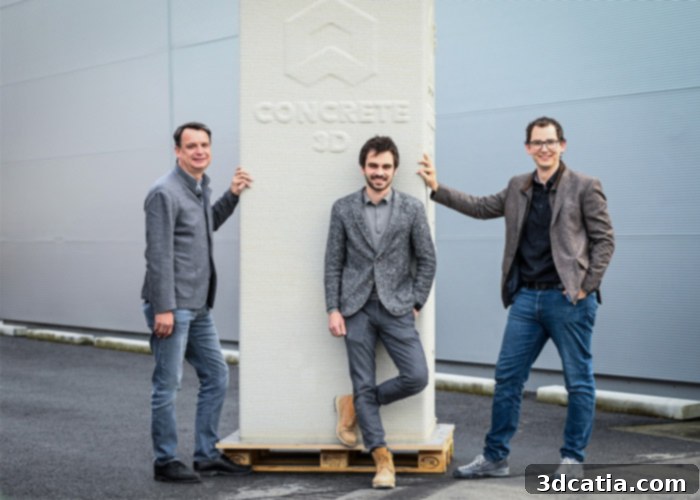
The two managing directors, Philipp Tomaselli (left) and Markus Loacker (right), as well as the division director, Michael Gabriel (center) — Photo Credit: Concrete 3D / Udo Mittelberger
Concrete 3D’s Vision: Pioneering Industry 4.0 in Construction
3DN: What does Concrete 3D do? With what mission was the company founded?
At its core, the most captivating aspect of 3D printing lies in its boundless possibilities. Recognizing this immense potential, we initially focused our efforts on four distinct but interconnected sub-areas. These include the creation of individual facade components that offer unparalleled aesthetic and functional flexibility, innovative C-shape recess systems designed to streamline construction, a wide array of furniture and accessories that challenge conventional perceptions of concrete, and finally, prefabricated or semi-finished parts that would demand extensive and costly formwork using traditional methods. Our overarching mission is clear: to finally usher the construction industry into the era of Industry 4.0. We are committed to a philosophy of material efficiency, ensuring that concrete is utilized precisely where it is needed. This approach leads to the production of leaner, more optimized components, which not only significantly reduces material weight but also conserves valuable resources and dramatically lowers CO2 emissions, contributing to a more sustainable future. Furthermore, in an age of increasing industrialization, we strive to offer our customers unparalleled individualization. Through the precision and flexibility of 3D printing, we can deliver bespoke solutions at an affordable price point, making custom designs accessible without compromising on quality or cost-effectiveness.
The Technology Behind the Innovation: Concrete 3D’s Printing System
3DN: Can you tell us a little more about the technology you are using?
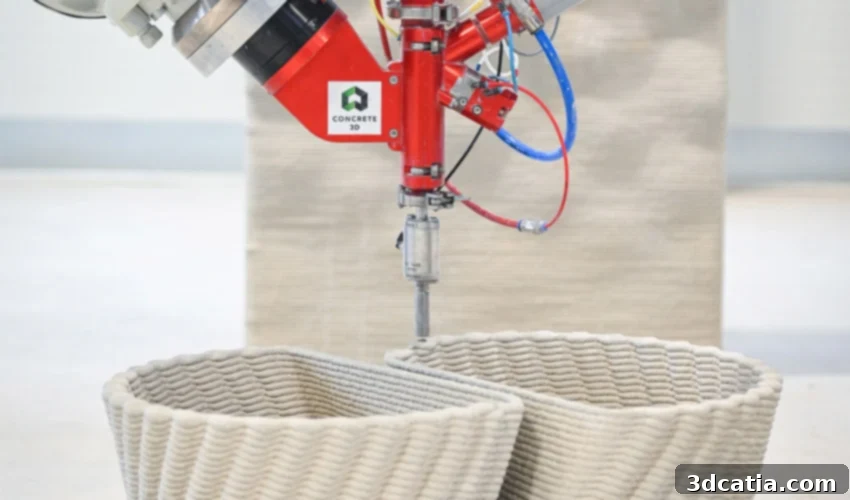
Our current operational setup relies on a sophisticated 6-axis robot arm, which is equipped with a specialized nozzle attachment. This advanced robotic system works in conjunction with a precise 2K material to meticulously create our components layer by layer. The choice of a 6-axis robot arm provides exceptional dexterity and allows for complex geometries to be produced with high accuracy, ensuring both structural integrity and aesthetic quality. However, our commitment to innovation means we do not intend to limit ourselves to this specific system indefinitely. We believe in continuous adaptation and improvement. As the technology evolves and new application demands arise, we remain open to integrating alternative systems or modifying our existing setup. We anticipate that ongoing developments will guide us in determining when and for which applications a system change becomes sensible or even unavoidable, always with the goal of optimizing our processes and expanding our capabilities in concrete 3D printing.
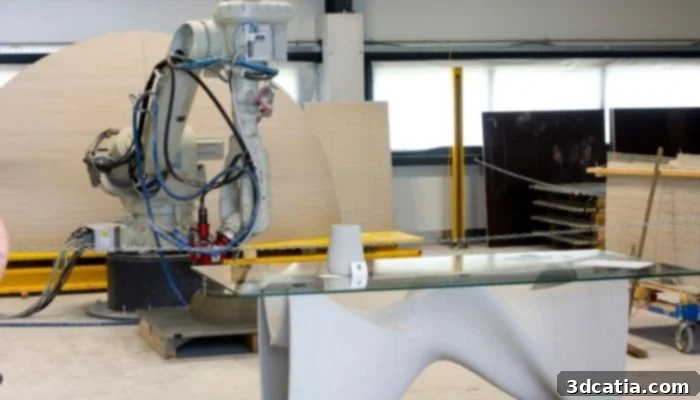
The 6-axis robotic arm allows the concrete object to be created layer by layer. (Photo Credit: Dietmar Mathis)
Diverse Applications: Concrete 3D Printing in Action
3DN: Which areas of application is concrete 3D printing used? Have you already completed your first projects?
The potential applications for concrete 3D printing are truly limitless. I often say, ‘The only thing that limits the possibilities is our own imagination to produce something with 3D concrete.’ This technology empowers us to translate virtually any design into a tangible concrete structure. Currently, a significant focus of our work is in facade construction, where we’ve already celebrated a major milestone. In July of this year, we proudly unveiled our reference project to the press in Nenzing, Vorarlberg. This impressive undertaking involved the production of 50 unique facade elements, each approximately 1.5 square meters. What made this project particularly exciting was the inherent variability in dimensions and the extensive design freedom we were afforded for 20 of these elements. We had the opportunity to integrate intricate portraits, detailed coats of arms, and various artistic samples directly into the concrete surfaces. This project served as a powerful demonstration to architects and builders, showcasing the aesthetic versatility and customizable potential that 3D printed concrete brings to architectural design, moving beyond purely functional requirements to create truly expressive building envelopes.
Another groundbreaking application lies in our innovative C-shape recess system. This system addresses two critical challenges in the construction industry: the persistent shortage of skilled labor and the significant waste generated from traditional wood formwork. We precision-produce custom cutouts and deliver them directly to construction sites across Vorarlberg and Tyrol, facilitated by our trusted sales partner, Schmidt’s Handelsgesellschaft mbH. We are actively seeking to expand this network and are looking for dynamic sales partners in Switzerland and southern Germany to bring this efficient solution to more regions. The installation process for our C-shape system is remarkably quick and straightforward. It eliminates the need for laborious formwork and stripping work, as the C-shape itself becomes an integral, permanent part of the structure. This not only saves time and labor but also reduces material consumption and waste. The system underwent rigorous testing with in-situ concrete at our shareholders JOLO Betonfertigteile – Josef Loacker GmbH in element ceilings, and at Tomaselli Gabriel Bau GmbH directly on construction sites. This collaborative development process, involving site managers, foremen, and skilled workers, allowed us to refine and improve the system, ensuring it meets the practical demands of modern construction.
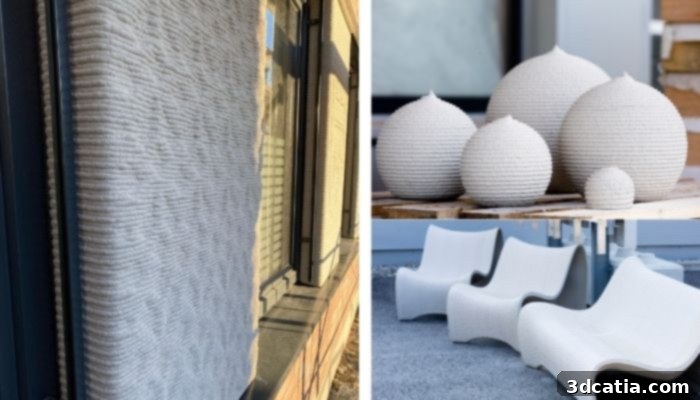
There are many possible uses for concrete 3D printing. (Photo Credit: Dietmar Mathis)
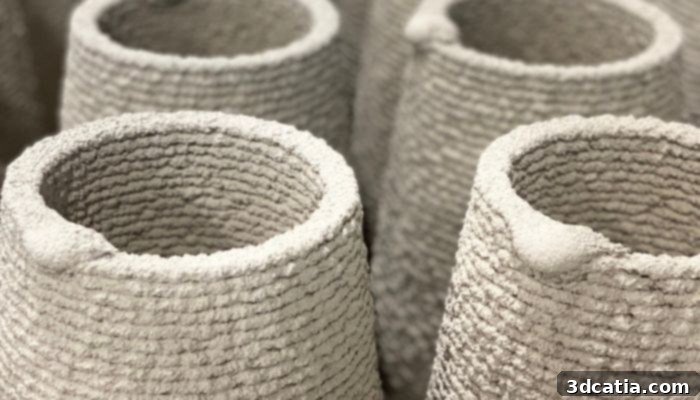
Furthermore, the realm of furniture and accessories represents a large and rapidly expanding area of application for us. Concrete is traditionally perceived as a very heavy and cumbersome building material, primarily suited for structural purposes. However, by cleverly utilizing geometrically favorable shapes and advanced design techniques, we can produce surprisingly light and elegant furniture pieces from unreinforced concrete. These designs would often be prohibitively expensive or even impossible to achieve using conventional manufacturing methods that rely on extensive molds or complex assembly. In this particular domain, concrete 3D printing allows us to present concrete as a construction material in an entirely new light to designers. It offers them unprecedented creative freedom and expanded options for bringing their innovative ideas to life, from sculptural tables to intricate seating. Last but certainly not least, it must be emphasized that with 3D printing, virtually anything is possible. Whether it’s intricately designed vases, specialized semi-finished industrial parts, or complex prefabricated components for larger structures, the technology adapts. The ability to create freeform geometries and offer highly individualized surface designs is a tremendous advantage, unlocking bespoke solutions across a multitude of sectors and truly democratizing custom concrete fabrication.
Navigating the Future: Challenges and Developments in Concrete 3D Printing
3DN: What are the challenges with concrete 3D printing? How do you see the further development of the process?
Undoubtedly, one of the most significant challenges we currently face in concrete 3D printing is working with unreinforced concrete. While it is certainly possible to integrate some form of reinforcement into the printed layers, we envision a future where the material itself can be made inherently more stable with minimal additional effort. This could involve advancements in material science, such as the development of advanced fiber-reinforced concrete mixtures or innovative admixtures that enhance tensile strength and durability. The goal is to reduce reliance on traditional rebar, which can complicate the printing process and limit design freedom. Furthermore, the material properties are highly dependent on the geometry of the printed object, which in turn influences the correct post-treatment procedures. What might be an optimal curing process or surface finish for one geometry is not necessarily applicable to another, requiring a deep understanding of material behavior under diverse conditions. This necessitates adaptive post-processing techniques and rigorous quality control for each unique component.
Adding to this complexity is the current landscape of concrete 3D printing, which features numerous different processes, each with its own set of advantages and disadvantages. From extrusion-based systems like ours to powder-bed techniques and binder jetting, the diversity of approaches reflects the nascent stage of the technology. It remains to be seen whether the industry will converge on a single, universally adopted procedure, or if, as I suspect, the future will involve a hybrid approach. This could entail a combination of existing methods, or the development of entirely new processes that cherry-pick the best aspects of current technologies. Such a synthesis could lead to a more versatile and efficient overall solution, capable of addressing an even broader spectrum of architectural and structural demands. Ultimately, the continuous research and development in material science, robotics, and computational design will be critical in overcoming these challenges and unlocking the full potential of concrete 3D printing for truly sustainable and customized construction.
The Transformative Impact of Concrete 3D Printing: A Final Word
3DN: Do you have any last words for our readers?
Concrete 3D printing represents a paradigm shift, offering immense added value for both architects and builders. Its unparalleled ability to create individuality and freeform geometries allows for the design of buildings that are not only structurally sound but also aesthetically distinctive and highly functional. Beyond large-scale construction, this technology also empowers every concrete enthusiast to realize their creative visions affordably and efficiently, without the burden of high formwork costs. Whether you dream of a unique vase, a custom-designed chair, or complex structural components, 3D printing makes these aspirations achievable. It democratizes access to bespoke concrete fabrication, moving it from specialized workshops to a broader audience of innovators and creators. We invite you to explore the possibilities and discover how Concrete 3D is leading this exciting revolution. You can find more comprehensive information about Concrete 3D and our projects HERE.
Were you already familiar with the innovative work of Concrete 3D? We’d love to hear your thoughts and insights! Please share your comments below or connect with us on our LinkedIn, Facebook, and Twitter pages! Don’t miss out on the latest advancements in additive manufacturing – remember to sign up for our free weekly Newsletter here, delivering the freshest 3D printing news directly to your inbox! You can also explore all our engaging videos and content on our dedicated YouTube channel for more in-depth insights into the world of 3D printing.