
Revolutionizing Running: MIT’s Predictive Model for Optimal 3D Printed Shoe Design
The pursuit of the “perfect” shoe has long been an ambitious quest within the footwear industry. For runners, in particular, the ideal shoe can significantly impact performance, comfort, and injury prevention. In this relentless endeavor, advanced technologies like 3D printing have emerged as a game-changer, offering unprecedented opportunities for fully customized footwear tailored precisely to an individual’s unique biomechanics. However, the ability to create bespoke shoes raises a crucial question: how can we scientifically validate their performance, and more importantly, how can we optimize their design based on specific running styles, distances, or personal preferences? A groundbreaking development from MIT engineers now provides a powerful answer, introducing a sophisticated model capable of predicting the optimal running shoe design for any given runner, including those incorporating innovative 3D printed components.
Running stands as one of the most widely practiced forms of exercise globally, captivating approximately 50 million Americans in 2021 alone, representing about 15% of the U.S. population, according to Statista. This widespread participation underscores the diverse range of runners and their varied needs. From seasoned marathoners logging hundreds of miles to casual joggers seeking weekend fitness, the demands placed on footwear differ dramatically. Consequently, the market is flooded with an extensive selection of shoes, each promising specific benefits. Yet, even with this vast array, true personalization often remains elusive.
This is where 3D printing truly shines, offering a transformative alternative by enabling the creation of shoes customized to the exact specifications of each runner. Leading brands and innovative startups alike are rapidly embracing this trend. Industry giants like Adidas, with its groundbreaking lattice midsoles, and avant-garde companies such as Zellerfeld, which has launched an entire platform for 3D printed footwear, are at the forefront of this revolution. These pioneers recognize that every runner is unique, and so too should be their shoes. The requirements of a career marathoner demand a different shoe profile than someone just embarking on their running journey. For manufacturers, the challenge lies not just in creating these custom designs but in possessing the scientific assurance that their personalized shoes will perform optimally, delivering the promised benefits of enhanced comfort, efficiency, and injury reduction.
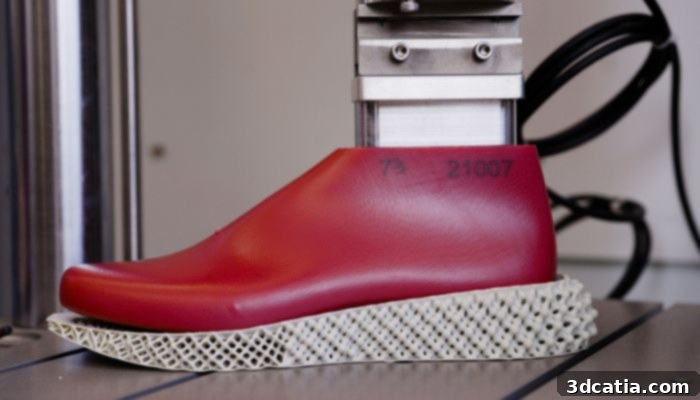
Researchers tested the stiffness of 3D printed midsole designs on an Instron machine in order to mimic footsteps.
Recognizing this critical need, forward-thinking shoe designers turned to the renowned minds at MIT to develop a robust methodology for optimizing shoe performance, especially within the context of 3D printed footwear. Anette “Peko” Hosoi, a distinguished professor of mechanical engineering at MIT and a co-author of the seminal paper detailing this research, eloquently explains the core dilemma faced by the industry: “With 3D printing, designers can tune everything about the material response locally. And they came to us and essentially said, ‘We can do all these things. What should we do?’” This profound question highlights the paradox of infinite design freedom – without a scientific framework, the sheer possibilities can be overwhelming. The predictive model developed by the MIT team is precisely the sophisticated response to this challenge, providing a data-driven compass for navigating the vast landscape of customized footwear design.
Predicting Performance: How MIT’s Model Optimizes 3D Printed Footwear
A New Model That Can Predict 3D Printed Shoe Performance
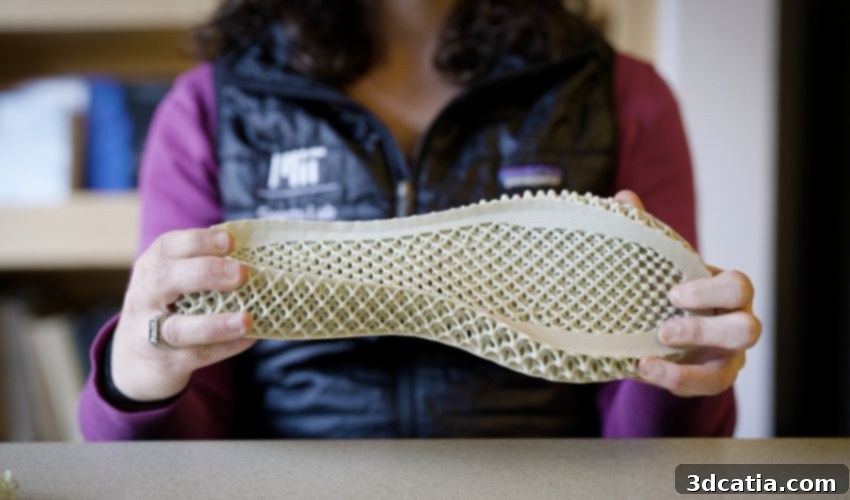
According to Sarah Fay, a postdoc in MIT’s Sports Lab and the Institute for Data, Systems, and Society (IDSS), this innovative model is poised to usher in a new era for footwear design, paving the way for the development of 3D printed shoes that are not only novel in their construction but also exceptionally high-performing. The tool’s potential to push the boundaries of sneaker design, particularly through its seamless integration with additive manufacturing principles, is immense. Its efficacy has already been rigorously tested on 3D printed midsoles featuring intricate scaffold designs. These scaffolds, impossible to achieve with traditional manufacturing methods, are engineered to deliver precise levels of bounce or stiffness in highly specific locations within the shoe, demonstrating the model’s ability to guide the creation of truly functional and optimized geometries.
The methodology behind this breakthrough is rooted in advanced computational mechanics and biomechanical principles. Researchers at MIT devised a system where the model accurately simulates changes in a runner’s gait by factoring in essential physiological parameters such as height, weight, and leg length. Critically, it also incorporates the detailed material properties of the shoe itself, focusing on elements like the stiffness profiles in both the front and back sections of the midsole. This comprehensive approach allows the model to predict how a shoe with specific characteristics will interact with an individual runner’s unique stride.
Central to the model’s predictive power is what Fay and Hosoi termed the “biological cost function.” This ingenious concept posits that runners instinctively strive to minimize certain physiological costs during their activity, even if they are not consciously aware of these efforts. Through extensive research and observation, the team identified two primary factors that runners tend to minimize: the impact forces generated when their feet strike the running surface (such as a treadmill) and the amount of energy expended by their legs to propel themselves forward. By combining the physiological inputs and shoe material properties with this crucial biological cost function, the MIT model achieved remarkable accuracy in predicting optimal gait patterns. This discovery means that shoe designs can now be meticulously optimized to significantly reduce impact and energy expenditure, leading to a more efficient, comfortable, and potentially injury-free running experience.
The Future of Personalized Running Shoes: Customization at Your Fingertips
The implications of this research extend far beyond mere performance enhancement. Sarah Fay envisions a future where personalized footwear becomes the norm rather than the exception. She concludes, “We’ve allowed for enough flexibility in the model that it can be used to design custom shoes and understand different individual behaviors. Way down the road, we imagine that if you send us a video of yourself running, we could 3D print the shoe that’s right for you.” This vision highlights a truly revolutionary approach to footwear. Imagine a world where, instead of choosing from off-the-shelf options, your unique running style, gait analysis, and physical attributes are directly translated into a perfectly engineered, 3D printed shoe designed specifically for you. Such a system could drastically reduce trial-and-error, improve athletic performance, and prevent common running-related injuries by providing unparalleled support and cushioning where it’s needed most.
This level of customization, powered by predictive modeling and advanced additive manufacturing, represents a significant leap forward in sports science and consumer product design. For shoe manufacturers, it opens doors to streamlined research and development, allowing them to rapidly prototype and test designs virtually before physical production. This reduces material waste and speeds up time-to-market for innovative products. For runners, it promises an era of truly personalized gear that adapts to their body, rather than forcing their body to adapt to the shoe. The integration of biomechanical data, computational models, and 3D printing signifies not just an improvement in footwear, but a complete rethinking of how running shoes are conceived, designed, and manufactured.
You can delve deeper into the intricacies of this groundbreaking model and its scientific underpinnings by reading the full paper HERE, or by watching the informative video below:
What are your thoughts on this revolutionary new model for predicting shoe performance, especially for 3D printed footwear? Do you believe it will fundamentally change how running shoes are designed and manufactured, shifting towards an era of true personalization? We’d love to hear your insights! Share your comments below or engage with us on our LinkedIn, Facebook, and Twitter pages! To stay updated with the very latest in 3D printing news and innovations, don’t forget to sign up for our free weekly newsletter here. You can also explore all our compelling videos and further content on our YouTube channel.
*All Photo Credits: Melanie Gonick, MIT