
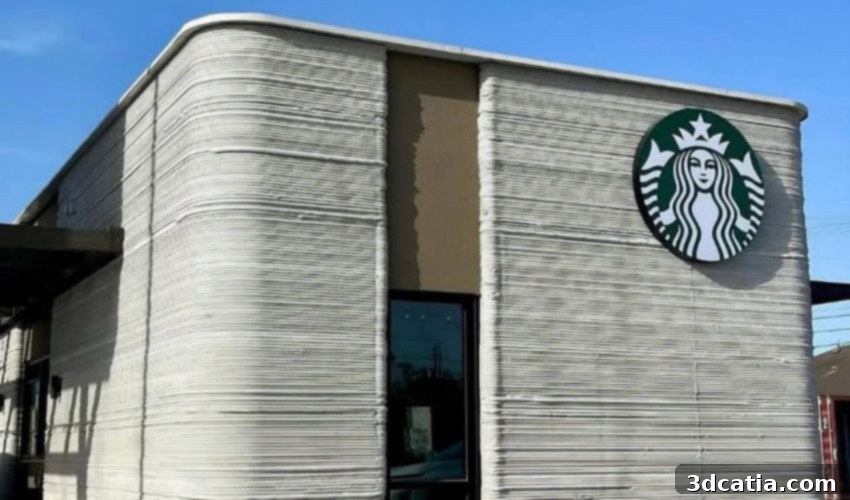
Starbucks Unveils First 3D Printed Store: A Glimpse into the Future of Retail Construction in Texas
Starbucks, an undeniable titan of global consumerism and a symbol of modern American culture, is once again pushing the boundaries of innovation. Following in the footsteps of its consistent evolution from a simple coffee shop to a ubiquitous lifestyle brand, the company has announced the grand opening of its first-ever 3D printed location. Set to open its doors on April 28th in Brownsville, Texas, this pioneering project marks a significant milestone not only for Starbucks but for the broader construction and retail industries, signaling a potential paradigm shift in how commercial spaces are conceived and built.
The venture into construction 3D printing is a bold statement, highlighting Starbucks’ commitment to exploring cutting-edge technologies. This isn’t just a novelty; it represents a serious exploration of efficiency, speed, and potentially sustainable building practices. The company behind this ambitious undertaking is Peri 3D, a recognized leader in the construction 3D printing sector. Utilizing COBOD’s advanced BOD2 3D construction printer and concrete, Peri 3D has a proven track record of delivering diverse and complex projects, ranging from single-family homes and multi-story apartment buildings to Europe’s largest 3D-printed structure in Heidelberg, Germany, and even an innovative apartment complex in France. The application of this mature technology in Brownsville, Texas, demonstrates the growing viability and scalability of 3D construction printing for commercial enterprises. Remarkably, the structural printing phase for this Starbucks location was estimated to have taken an astonishingly brief six hours, showcasing the immense time-saving potential of this method.
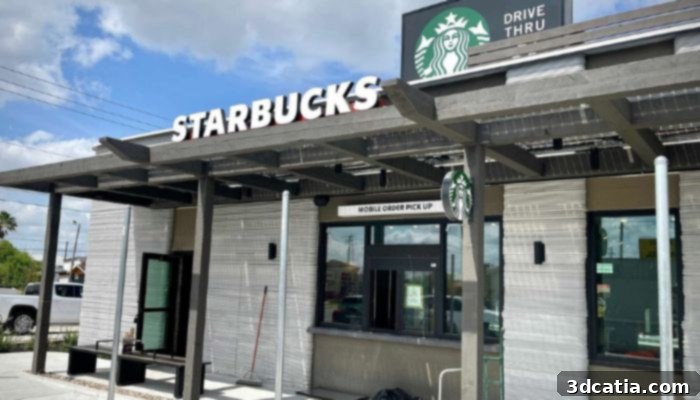
The 3D printed Starbucks location in Brownsville, featuring a pick-up area and drive-thru (photo credits: Dina Arévalo/MYSA)
Exploring the Specifics of the 3D Printed Starbucks in Brownsville
While details surrounding this groundbreaking Starbucks location are still emerging, initial information provides a clear picture of its design and operational focus. According to city permits, the structure is designed to be notably smaller than a traditional Starbucks outlet, encompassing approximately 1,400 square feet. This reduced footprint is a direct reflection of its strategic purpose: to serve as a streamlined mobile order pickup and drive-thru establishment. Unlike many conventional Starbucks stores, this location will not feature indoor seating or a full in-café service area, optimizing it for efficiency and speed in line with evolving consumer preferences for grab-and-go convenience.
The choice of Brownsville, Texas, for this pioneering project is particularly interesting. The state of Texas has emerged as a hotbed for construction 3D printing innovation, with several significant projects already underway or completed, leveraging the technology’s advantages in speed and scalability. This new Starbucks, situated at 2491 Boca Chica Boulevard, adds another prominent example to Texas’s burgeoning landscape of 3D printed structures. The construction, carried out using the state-of-the-art COBOD BOD2 3D printer and specialized concrete mixtures, represents a significant investment, with an estimated cost of $1,198,000. Images from local news outlets confirm that the building has been successfully completed, just in time for its eagerly anticipated grand opening. This rapid turnaround time underscores one of the most compelling benefits of construction 3D printing: the ability to dramatically accelerate project timelines compared to conventional building methods.
The Technology Behind the Build: COBOD BOD2 and Peri 3D’s Expertise
The foundation of this innovative Starbucks store lies in the robust capabilities of the COBOD BOD2 3D construction printer, operated by Peri 3D. COBOD, a Danish company, has established itself as a global leader in providing advanced 3D printing solutions for the construction industry. Their BOD2 printer is renowned for its gantry-based system, allowing for precise and rapid extrusion of concrete or other specialized building materials. This technology works by layer-by-layer deposition, building walls directly from digital designs, which minimizes material waste and labor requirements. The use of concrete as the primary building material ensures structural integrity and durability, aligning with the long-term operational demands of a commercial establishment like Starbucks.
Peri 3D, a subsidiary of the global construction giant Peri Group, brings extensive expertise in implementing these advanced technologies. Their portfolio demonstrates a wide range of successful applications, from affordable housing initiatives to large-scale commercial and residential buildings across Europe. This wealth of experience was crucial in translating Starbucks’ vision into a tangible structure, ensuring that the project adhered to strict quality standards and timelines. The collaboration between Starbucks, COBOD, and Peri 3D highlights a growing trend of major brands partnering with specialized 3D construction firms to explore new frontiers in building technology.
Addressing the Discourse: Simplicity vs. Complexity in 3D Printed Architecture
While the announcement of a 3D printed Starbucks has been met with widespread excitement and praise for its innovative spirit, it has also sparked a nuanced discussion within the 3D printing community. A point of contention for some has been the seemingly straightforward design of the building. 3D printing technology is celebrated for its unparalleled ability to create intricate, complex geometries and organic forms that would be prohibitively expensive or impossible to achieve with traditional construction methods. Previous 3D printed structures have often showcased these capabilities, featuring curved walls, unique patterns, and unconventional shapes that push architectural boundaries.
In contrast, the Brownsville Starbucks appears relatively simple and conventional in its aesthetic. This has led some to question why the full potential for design complexity offered by 3D printing was not leveraged in this instance. However, there are several practical reasons that might explain this choice. For a pilot project, especially for a global brand like Starbucks, simplicity often serves as a strategic advantage. Focusing on a basic, functional design allows for the testing and validation of the core construction process, material performance, and operational integration without the added variables and potential risks associated with highly complex architectural features. This approach prioritizes proving the fundamental viability and efficiency of 3D printing for commercial application, rather than immediately pushing artistic limits. Furthermore, maintaining brand consistency and ensuring rapid deployment might necessitate a more conservative design for initial implementations. The goal here might be efficiency and scalability first, with more ambitious designs to follow once the foundational technology is fully proven for their specific retail environment.
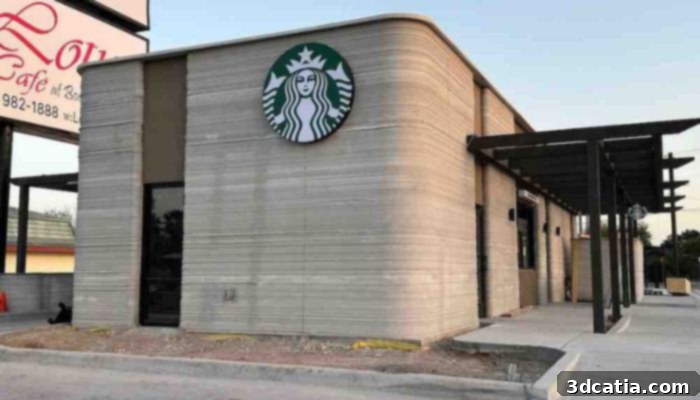
A side view of the new Starbucks location, showcasing its modern lines (photo credits: Brownsville Today via Instagram)
Broader Implications and the Future of 3D Printed Retail
Regardless of the design debate, the launch of the 3D printed Starbucks in Brownsville represents a monumental step forward for the additive manufacturing industry. Its significance extends beyond just a single coffee shop; it serves as a high-profile validation of construction 3D printing’s readiness for mainstream commercial deployment. This move by a globally recognized brand like Starbucks could catalyze wider adoption of the technology across the quick-service restaurant (QSR) sector and the broader retail landscape.
The potential implications are vast. Imagine rapid deployment of retail outlets in underserved areas, quick reconstruction after natural disasters, or the creation of highly customized pop-up stores with minimal lead times. The ability to construct structures in a fraction of the time, with potentially reduced labor costs and material waste, offers compelling economic and environmental advantages. This could fundamentally reshape supply chains for retail construction, making expansion faster, more agile, and more sustainable. Starbucks’ history is replete with innovations, from pioneering mobile ordering to its ambitious sustainability goals. This 3D printed store fits perfectly within that narrative, showcasing a commitment to exploring new methods to enhance efficiency and customer experience.
While the simplicity of the design and the relatively understated fanfare surrounding its opening suggest this might initially be a pilot program or a test case for Starbucks, the implications are profound. If successful, this venture could pave the way for a new standard in retail development. It signals a future where commercial buildings are not only constructed with unprecedented speed but also with greater material efficiency and design flexibility. The industry will be watching closely to see if Starbucks embraces construction 3D printing for more of its locations, potentially transforming how we perceive and interact with our everyday commercial spaces. We will continue to monitor developments and provide updates as more information becomes available on this exciting frontier.
What are your thoughts on this pioneering 3D printed Starbucks? Do you believe we will witness a broader adoption of construction 3D printing across other retail chains and industries? Share your insights in a comment below or connect with us on our LinkedIn, Facebook, and Twitter pages! Don’t miss out on the latest advancements in additive manufacturing—subscribe to our free weekly Newsletter here, delivered straight to your inbox! For more visual content, explore all our videos on our YouTube channel.
*Cover Photo Credits: Brownsville Today via Instagram