
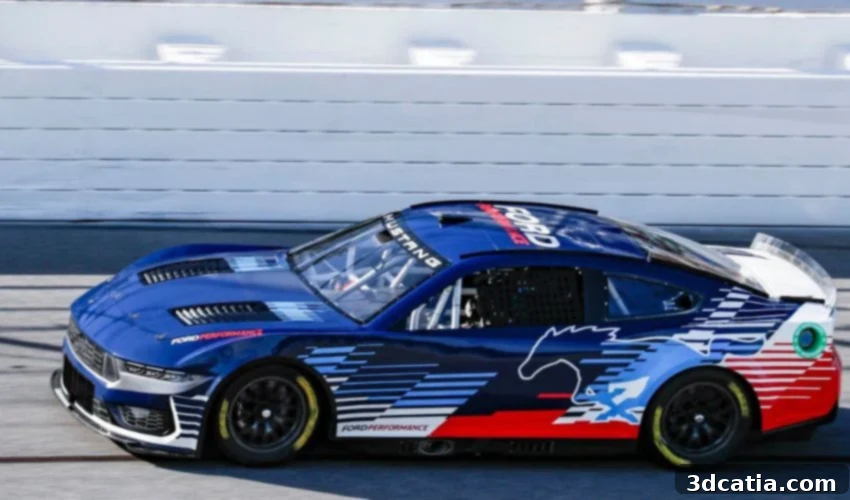
Revolutionizing NASCAR Aerodynamics: Stewart-Haas Racing and 3D Systems Drive Innovation with Additive Manufacturing
In the fiercely competitive world of NASCAR, the pursuit of marginal gains is relentless. Every fraction of a second, every ounce of downforce, and every subtle aerodynamic refinement can mean the difference between victory and defeat. For years, teams have invested heavily in cutting-edge technologies and methodologies to push the boundaries of vehicle performance. Among these pioneers, Stewart-Haas Racing (SHR) has consistently demonstrated a commitment to innovation, constantly seeking advanced solutions to enhance their racing machines. This drive for excellence has led them to embrace a burgeoning trend in motorsports: the integration of additive manufacturing. Stewart-Haas Racing recently announced a groundbreaking collaboration with 3D Systems, a global leader in additive manufacturing solutions, to significantly enhance the aerodynamic performance of their highly anticipated 2024 NASCAR Ford Mustang Dark Horse. This strategic partnership leverages advanced 3D printing technology, specifically Stereolithography (SLA), to streamline the development process through efficient and cost-effective testing of numerous body panel shapes, setting a new benchmark for rapid prototyping in the sport.
The Aerodynamic Imperative in NASCAR and the Challenge for SHR
Aerodynamics plays a paramount role in NASCAR racing, directly influencing a car’s speed, stability, handling, and fuel efficiency. Optimal aerodynamic design is crucial for achieving high top speeds on straightaways, maintaining grip through high-speed corners, and allowing drivers to effectively utilize drafting techniques. Small adjustments to a car’s body shape can yield significant performance advantages, making aerodynamic engineering one of the most critical aspects of car development. However, achieving peak aerodynamic efficiency is not a simple task; it must be balanced with NASCAR’s notoriously stringent technical regulations, which aim to ensure fair competition and driver safety. These rules dictate everything from body dimensions to specific component designs, leaving engineers with a complex puzzle: how to maximize performance within tight constraints.
The aerodynamic engineering team at Stewart-Haas Racing faced an formidable challenge when developing the 2024 Ford Mustang Dark Horse. Their objective was to identify the most aerodynamically efficient design from literally hundreds of potential body panel shapes, all while strictly adhering to NASCAR’s rigorous performance and design specifications. Traditionally, gaining NASCAR approval for new designs involves extensive and exhaustive full-scale wind tunnel testing. While indispensable for final validation, this conventional method is both incredibly time-consuming and prohibitively expensive. Each physical prototype and subsequent wind tunnel session incurs substantial costs and extends development timelines, severely limiting the number of design iterations that can be practically explored. The critical challenge for SHR was therefore to devise a method that would allow them to test a vast array of designs with unprecedented efficiency, overcoming these inherent constraints without compromising on accuracy or performance.
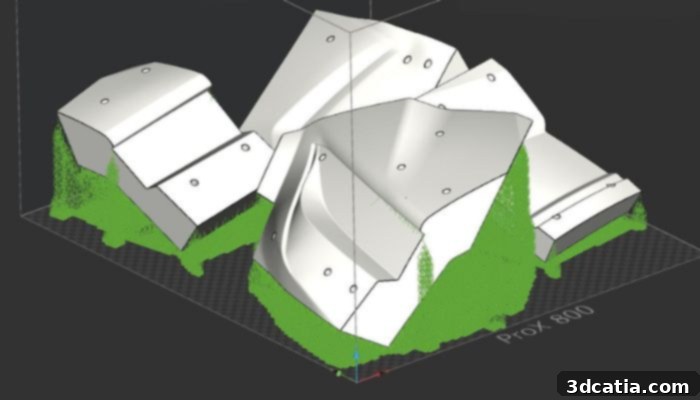
(Photo Credits: 3D Systems)
3D Systems: The Catalyst for Rapid Aerodynamic Prototyping
The solution to Stewart-Haas Racing’s complex prototyping dilemma emerged through their strategic collaboration with 3D Systems. This partnership introduced a transformative approach to aerodynamic development by harnessing the power of Stereolithography (SLA) 3D printers and the sophisticated 3D Sprint software from 3D Systems. This potent combination of hardware and software provided SHR with an innovative pathway to rapidly produce highly precise, full-scale body panels. Unlike traditional manufacturing methods that require custom tooling for each iteration, 3D printing allows for design changes to be implemented directly from CAD models, significantly reducing lead times and manufacturing costs associated with prototypes. These 3D printed panels could then be quickly and easily assembled onto the car’s chassis, creating a realistic, full-scale model ready for comprehensive wind tunnel testing. The efficiency gained from this rapid prototyping capability was a game-changer, enabling SHR to explore far more design variations than previously possible within their development schedule.
The Iterative Design and Additive Manufacturing Workflow
The development process for the 2024 Ford Mustang Dark Horse’s aerodynamics was meticulously structured, beginning with extensive digital development. Stewart-Haas Racing’s Computational Fluid Dynamics (CFD) team played a pivotal role in this initial phase. Utilizing advanced CAD (Computer-Aided Design) software, the engineers created highly detailed digital models of various body panel configurations. These designs were then subjected to rigorous virtual wind tunnel simulations, where sophisticated algorithms predicted how air would flow over and around the car. This virtual testing allowed the team to analyze aerodynamic forces, identify areas of high drag or insufficient downforce, and rapidly iterate on designs within a purely digital environment. After countless simulations and refinements, the most promising body panel designs—those that demonstrated the highest potential for aerodynamic efficiency and compliance with NASCAR regulations—were selected for physical prototyping.
The transition from virtual models to tangible prototypes was seamless, thanks to the precision of 3D Systems’ Stereolithography technology. The selected designs were prepared for additive manufacturing using the intuitive 3D Sprint software, which optimizes print parameters and ensures the highest quality output. These designs were then brought to life by the reliable ProX 800 SLA machine. Stereolithography is particularly well-suited for this application due to its ability to produce parts with exceptionally smooth surface finishes, high accuracy, and fine detail – all critical factors for aerodynamic testing where even microscopic imperfections can affect airflow. The ProX 800, known for its large build volume and consistent performance, allowed SHR to print full-scale body panels that accurately represented the digital designs. The result was a series of high-caliber, geometrically precise body panel prints, distinguished by their incredibly smooth surfaces, which are essential for minimizing turbulent airflow and optimizing overall aerodynamic performance.
Real-World Validation: Wind Tunnel Testing and Refinement
With the high-fidelity 3D printed panels in hand, the next crucial step was real-world validation. These advanced prototypes were meticulously fixed onto the car’s substructure, effectively transforming the chassis into a full-scale, realistic model of the 2024 Ford Mustang Dark Horse. This innovative approach significantly enhanced the wind tunnel testing process. Unlike traditional methods where fixed molds or costly bespoke parts limited design variations, the 3D printed panels allowed for the easy addition, removal, and modification of components. This flexibility empowered engineers to test a remarkably wide range of aerodynamic concepts in quick succession. Each test run in the wind tunnel provided invaluable empirical data on downforce, drag, and airflow characteristics. Armed with this data, engineers could rapidly adapt and refine their prototypes, making incremental yet significant adjustments to the car’s body shape. This iterative cycle of design, 3D printing, and wind tunnel testing was repeated over several months, a testament to the dedication of the SHR team and the efficiency of the additive manufacturing workflow. The ultimate goal throughout this rigorous process was to systematically move closer to achieving the optimal aerodynamic profile that not only maximized performance but also rigorously met NASCAR’s stringent approval standards. Once the final, approved design was locked in, it served as the definitive blueprint for manufacturing the actual carbon-fiber body panels that would grace the 2024 racing season.
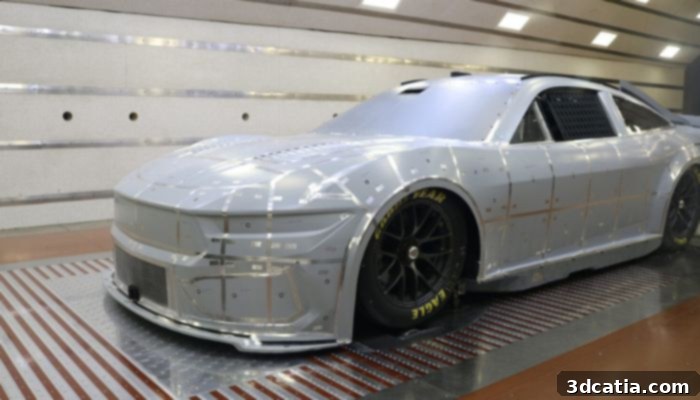
(Photo Credits: 3D Systems)
Setting a New Standard: Impact and Future of Additive Manufacturing in Motorsports
The culmination of this pioneering collaboration is a final race car body design that represents the perfect synergy of aesthetics and high performance. The sleek, aggressive lines of the Ford Mustang Dark Horse are seamlessly integrated with advanced aerodynamic features, meticulously engineered to provide Stewart-Haas Racing with a decisive competitive advantage on the track. This achievement is not merely a testament to a successful partnership but a demonstration of the transformative power of additive manufacturing in motorsports. The ability to rapidly prototype, test, and iterate on multiple design variations with such efficiency has undeniably set a significant new standard within the racing industry. This methodology drastically reduces the time and cost associated with traditional development cycles, accelerating innovation and allowing teams to explore design avenues that were once deemed impractical or impossible.
The success story of Stewart-Haas Racing and 3D Systems is poised to be a powerful catalyst, further propelling the widespread adoption of 3D printing across the entire motorsports landscape. As other racing teams witness the tangible benefits – from faster development cycles and reduced costs to superior performance outcomes – they will undoubtedly seek to replicate this competitive edge. Beyond NASCAR, the principles demonstrated here have far-reaching implications for Formula 1, endurance racing, and other high-performance automotive sectors. Additive manufacturing offers unparalleled design freedom, allowing for complex geometries and internal structures that optimize weight, strength, and functionality, all while speeding up the journey from concept to track. This collaboration highlights a pivotal moment where advanced manufacturing techniques are not just assisting traditional processes but actively leading the charge in defining the next generation of high-performance racing vehicles, ensuring that the relentless pursuit of speed and innovation continues unabated.
What do you think of this remarkable collaboration between Stewart-Haas Racing and 3D Systems? Do you believe 3D printing will become an indispensable tool for all top-tier racing teams? Share your thoughts and insights with us in a comment below or connect with us on our LinkedIn, Facebook, and Twitter pages! Don’t forget to sign up for our free weekly newsletter here to receive the latest 3D printing news, industry updates, and innovative applications directly to your inbox! You can also explore all our engaging videos and exclusive content on our YouTube channel.
*Cover Photo Credits: NASCAR