
3D Knitwear: The Future of Fashion – Sustainable, Personalized, and On-Demand Production Explained
In recent years, the world has witnessed the exponential growth and integration of 3D printing technology across a multitude of industries. From groundbreaking advancements in medicine and aerospace to innovative applications in design and construction, additive manufacturing consistently makes headlines with new breakthroughs and developments. However, one prominent industry has remained relatively quiet on the widespread adoption of 3D printing: the fashion sector. While initial experiments and notable advances in 3D printed clothing have indeed emerged, they have largely been confined to the realm of high-end fashion, gracing runways and red carpets rather than becoming accessible ready-to-wear for everyday consumers. The primary hurdle is straightforward: the materials typically used in conventional 3D printing, such as rigid plastics and metals, lack the inherent flexibility and comfort essential for wearable garments.
To address this fundamental challenge, a growing community of fashion visionaries and 3D technology enthusiasts has diligently sought viable alternatives. Their collective efforts have converged on a promising solution: 3D knitwear. But what exactly defines 3D knitwear? How does its production methodology diverge from traditional additive manufacturing and conventional textile production? And, most importantly, will 3D knitwear transition into a mainstream, ready-to-wear option for ordinary consumers in the foreseeable future? This comprehensive article delves into these critical questions, offering detailed insights and expert perspectives from leading industry figures to illuminate the transformative potential of this innovative technology.
To fully grasp the principles of 3D knitwear and its nuanced relationship with 3D printing, it is essential to first establish clear definitions. Gihan Amarasiriwardena, co-founder and CEO of the Ministry of Supply, concisely defines 3D printing as the process where “molded products (such as plastics) are produced by adding a layer of material (often plastic or synthetic) according to a given digital design.” Expanding on this, Rosanne van der Meer, designer and founder of New Industrial Order, offers a broader perspective: “3D printing is the production of a three-dimensional shape on the basis of a filament that is formed by a machine.” Fundamentally, traditional 3D printing involves computer-controlled machines meticulously creating three-dimensional objects by building them up layer by layer. The crucial question, then, is whether 3D knitwear adheres to this same precise principle of additive layering.
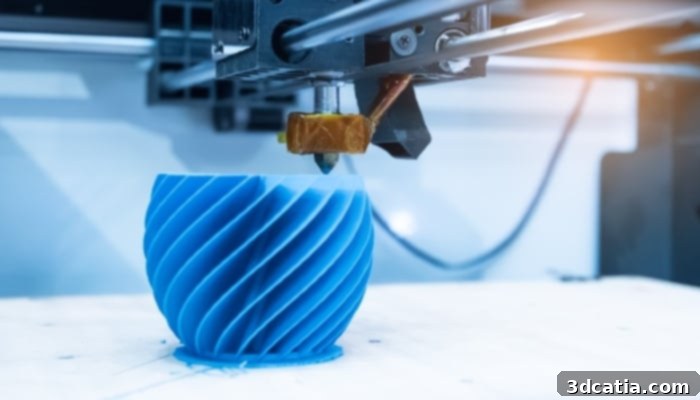
In 3D printing, the object is additively manufactured layer by layer.
The Distinctive Production Process of 3D Knitwear
The initial stages of manufacturing 3D knitted garments share a notable resemblance with the production of other 3D objects. Both processes commence in the digital realm: CAD software is employed to meticulously design the garment, subsequently translating this design into a specific programming language. These digital codes are then transmitted to a specialized machine, which initiates the physical manufacturing process. However, this is where 3D knitwear diverges significantly from conventional additive manufacturing. The fundamental difference lies in the machinery itself. Unlike a 3D printer that processes filament or powder through extruders to build layers, 3D knitwear utilizes an advanced knitting machine. This machine is capable of producing an entire three-dimensional garment in a single, continuous pass by uniting threads stitch by stitch. Therefore, while both methods are rooted in digital software and operate on an additive principle – building an object from scratch – the fundamental material and the specific manufacturing mechanism create a profound distinction between them.
Given these distinct differences, it comes as no surprise that industry experts largely agree that 3D knitted goods are not, strictly speaking, manufactured using 3D printing technology. Instead, 3D knitting is recognized as a unique technology in its own right. Gerard Rubio, co-founder and CEO of Kniterate, a company that specializes in selling 3D digital knitting machines, elaborates on this nuance regarding his company’s machines and the application of “3D” in their production method: “These machines are capable of 3D knitting. But these machines are not necessarily 3D knitting machines.” This distinction arises because even flat, single-layer items such as scarves can be produced with a Kniterate machine, which would negate the “additive manufacturing” aspect typically associated with building up a three-dimensional object layer by layer. Rosanne van der Meer further clarifies her deliberate use of the term ‘3D printed knitwear’ for her products, emphasizing its role in creating a clear differentiation between this innovative method and conventionally produced knitwear, thereby highlighting the advanced, digitally driven nature of her creations.
3D Knitwear vs. Conventional Textile Production: A Sustainable Solution?
Having delineated the critical differences and intriguing similarities between 3D knitwear and traditional 3D printing, the discussion naturally progresses to a more pressing question: should 3D knitwear be preferred over conventionally manufactured clothing, and if so, what compelling reasons justify this shift? To provide a comprehensive answer, it’s imperative to scrutinize the current landscape and inherent issues within conventional textile production.
The conventional fashion industry remains a contentious subject, largely due to a pervasive lack of transparency in its value chains and production methods. Beyond widely acknowledged and persistent problems such as child labor, depressingly low wages, and inadequate protective measures for workers in low-cost manufacturing countries, the industry’s environmental impact is astronomically negative. The lifecycle of a single garment often begins with the cultivation of raw materials like cotton, a process infamous for its heavy reliance on pesticides and an enormous consumption of water, leading to significant ecological damage. Once harvested, these materials embark on extensive transit routes, shipped across continents to be processed into yarn, and subsequently into fabric, often in entirely different countries. This initial phase alone represents a complex web of logistical and environmental challenges, ripe for improvement.
Following this, the woven fabric is typically sent to yet another facility for bleaching or dyeing. The harmful chemicals employed in these processes frequently end up as industrial wastewater, subsequently contaminating rivers and oceans, with devastating effects on aquatic ecosystems and human health. Finally, the garment is cut, sewn, or knitted, and finished, again, often in a different factory. This ‘cut-and-sew’ method is particularly wasteful, generating substantial amounts of material scrap—sometimes as much as 20-30% of the original fabric—which is often discarded. Once completed, the finished products are then distributed to various retail branches across the globe. These unbelievably long and complex transport routes significantly exacerbate CO2 emissions, culminating in a colossal carbon footprint that underscores the profound disadvantages of conventionally produced clothing. While smaller manufacturers committed to sustainable, fair, and regional production models do exist, they remain a minority; large-scale fashion producers relying on traditional production channels continue to dominate the global apparel market, perpetuating these systemic issues.
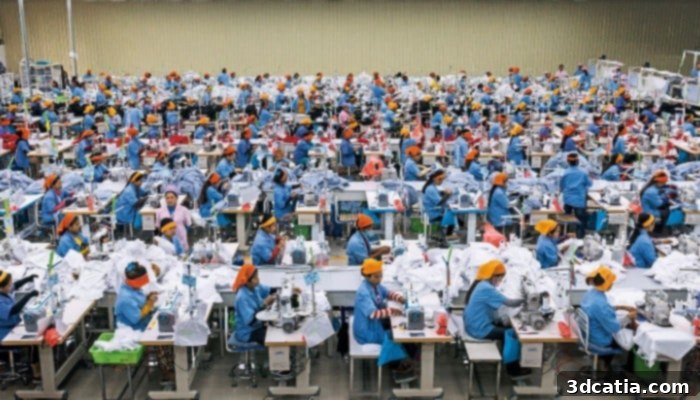
There are many problems with the conventional textile methods of large-scale fashion producers. These include the exploitation of workers in low-wage countries and the negative impact on the environment.
These pervasive social and environmental dilemmas are central concerns for industry leaders like Gerard Rubio, Gihan Amarasiriwardena, and Rosanne van der Meer. Their companies are built upon a steadfast commitment to sustainability, influencing every aspect from material sourcing to product manufacturing. This ethical approach begins with the conscious procurement of materials. In stark contrast to the conventional industry, where over half of all clothing is made from synthetic man-made fibers—predominantly polyester, but also nylon, elastane, and acrylic—all derived from environmentally detrimental fossil fuels, these innovative companies prioritize eco-friendly alternatives. New industrial methods often utilize sustainably sourced natural fibers such as merino wool. Merino wool, a renewable and biodegradable material, inherently boasts a significantly smaller ecological footprint compared to its synthetic counterparts, aligning with a more sustainable production philosophy.
Rosanne van der Meer further emphasizes her reliance on high-quality yarn, which is crucial not only for achieving superior product results but also for mitigating the risk of thread breakage during the intricate knitting process, which would otherwise necessitate a complete restart of production. A remarkable sustainability feature of 3D knitwear is its inherent recyclability: even if a thread were to break or a design needed to be altered, the semi-finished knitted piece could be separated and the material recovered. This means the utilized material can be entirely reclaimed and reused, embodying a key principle of the circular economy. Substantial material savings are a hallmark of 3D knitwear, as the advanced machines produce garments additively, using only the precise amount of thread required in a single pass. This eliminates numerous wasteful production steps, drastically saving both time and costs. Gihan Amarasiriwardena corroborates this efficiency, stating, “With 3D-printed knitwear, only the required fabric is used. This results in approximately 30% less material waste.” Sustainability is also a core tenet at Kniterate, where Gerard Rubio champions the use of plant-based yarns. These materials can be fully recycled, ensuring that garments, once they are no longer desired, can be responsibly disposed of and reprocessed, thereby preventing them from ending up in landfills.
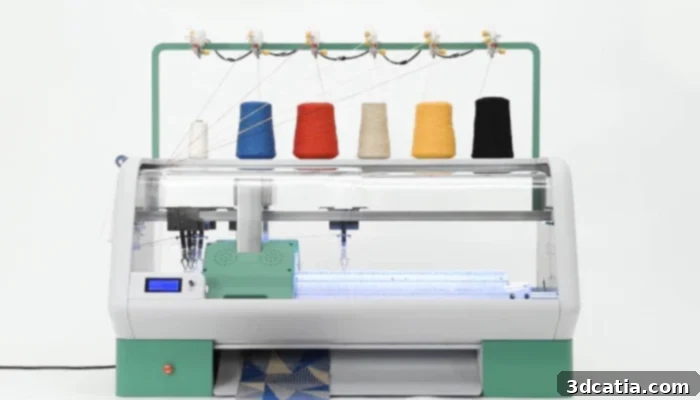
The material plays a huge role in the manufacture of 3D knitted fabrics. (Photo Credit: Kniterate)
Furthermore, the inherent on-demand production model of 3D knitwear presents a powerful solution to systemic industry problems such as overproduction and inventory waste. Large-scale fashion producers, hampered by extensive and rigid supply chains, often struggle to react flexibly and quickly to evolving market demands. This rigidity frequently leads to significant overproduction and excessive inventory, a fatal flaw in today’s fast-paced fashion industry where new collections and goods inundate stores almost weekly. The inevitable consequence is the disposal of “old”, unsold items, many of which are resource and energy-intensive manufactured textiles. These garments often end up in landfills or are incinerated, representing an immense waste of resources. On-demand production, particularly when executed on-site or in-house, offers a compelling alternative. Not only does it drastically reduce transport costs and associated emissions, but it also fundamentally produces significantly less waste, making it a truly sustainable manufacturing paradigm.
This ethos perfectly aligns with Rosanne van der Meer’s core philosophy: “The starting point for a better climate balance in the fashion industry is less consumption. If you have timeless clothing that fits you really well, you will also consume less.” Thanks to advanced 3D technologies, 3D knitwear also offers unparalleled opportunities for personalization. Since designs are created digitally, and each needle stitch can be meticulously controlled like a pixel, patterns can be effortlessly modified and adapted to individual customer requirements, granting immense creative freedom. The startup Shavatar, for instance, has developed a specialized program that assists New Industrial Order in enhancing the fit accuracy of their 3D knitwear without the need for a physical 3D scanner—a crucial advantage when purchasing clothing online. Similarly, with the open-source system and sophisticated knitting machines provided by Kniterate, users are empowered to unleash their creativity with endless possibilities for unique creations and personalized garments. Last but certainly not least, the localized, in-house, or regional production model of 3D knitwear also effectively eliminates typical problems associated with the exploitation of workers, fostering a more ethical and humane manufacturing environment.
Challenges of 3D Printed Clothing and Predictions for the Future of Fashion
Despite the numerous compelling advantages offered by 3D knitwear, a pertinent question arises: why is it not yet more widely available in mainstream retail? What are the current obstacles preventing its broader adoption, and what further improvements are necessary? More broadly, will 3D printed clothing, and particularly 3D knitwear, truly become the future of the fashion industry?
Indeed, the additive manufacturing of apparel faces a distinct set of challenges. As previously highlighted, material suitability remains perhaps the most significant hurdle—which is precisely why 3D knitwear has emerged as a targeted solution. When examining pioneering projects involving traditional 3D-printed clothing, such as those by acclaimed fashion designer Danit Peleg, it quickly becomes apparent that the material options compatible with standard 3D printers are limited. These are predominantly plastics like ABS, PLA, or the increasingly popular and flexible TPU. While TPU can produce stretchy and movable 3D objects, its tactile qualities are a far cry from the soft, comfortable texture inherent in conventional fabrics. Although one might argue that a significant portion of conventionally produced clothing also utilizes synthetic polymers (essentially plastic), the critical distinction lies in the form of the material. Fibers and threads possess a delicate, elastic, and flowing state, which is crucial for drape and comfort in garments. In contrast, 3D printing filament, by its nature, is comparatively thick, hard, and rigid, making it less suitable for direct contact with skin and limiting the wearer’s range of motion and overall comfort.
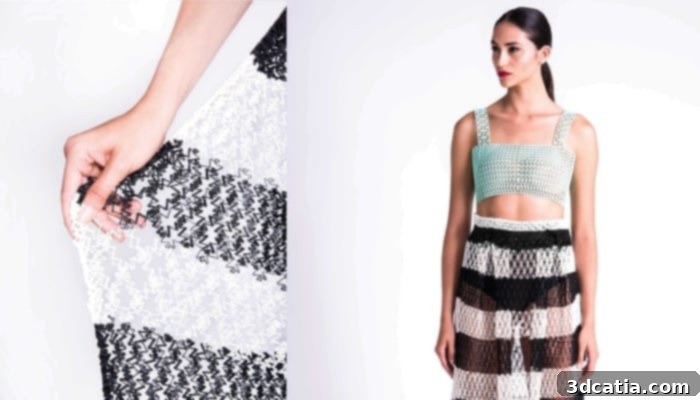
3D-printed clothing differs in texture from conventionally produced goods. (Photo credit: Danit Peleg)
Furthermore, most standard 3D printers struggle to produce details with sufficient fineness and intricacy for delicate garments. Unlike 3D knitting, where intricate moving threads are precisely manipulated by countless small needles to create complex patterns and textures, the extruders of a typical 3D printer simply cannot achieve a comparable level of detail or suppleness. The resulting structure and texture of traditionally 3D-printed clothing often feel heavy, pitted, and rigid, with a surface that is likely to be quite cold and unpleasant against the skin. Gerard Rubio concurs with this assessment, noting, “At this point, the materials are not developed enough. However, I strongly believe that 3D-printed clothing will be the future.”
While 3D knitwear addresses many of the material and texture challenges, it introduces its own set of unique problems. Rosanne van der Meer specifically highlights the considerable difficulty involved in creating the precise digital codes required to program the sophisticated knitting machines. This complexity necessitates extensive reliance on comprehensive databases, specialized non-fiction literature, and open-source systems to facilitate the design process. Indeed, it is a core ambition of New Industrial Order to develop a workflow that makes the complex codes for 3D knitwear more accessible to all interested parties, fostering broader adoption and innovation. Gerard Rubio echoes this sentiment, describing the development of the correct parameters for his machines as a major challenge. He recounts the long and arduous journey from initial prototypes to the highly complex, commercially viable Kniterate machine. Despite these current challenges, Rosanne van der Meer expresses optimism for the future, stating, “The technology is already established and ready to function, but the current system works completely differently.”
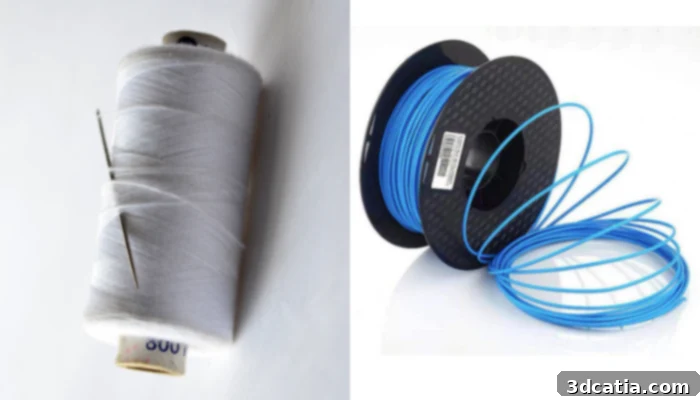
The biggest difference between 3D printed objects and 3D knitwear is the material. It is easy to see that much finer structures can be created with threads.
This fundamental shift in “system” refers to the stark contrast between the on-demand production model—the cornerstone of most current 3D knitwear manufacturers—and the prevailing market flow. The global fashion market is deeply entrenched in a paradigm of mass production and mass consumption. Attempting to overhaul such long-established systems and break deeply ingrained consumer habits proves exceptionally difficult. Consequently, more sustainable companies specializing in on-demand production and customization face a significant hurdle in penetrating and competing within the mass market. Furthermore, in terms of production costs, 3D knitwear, due to its currently limited market compatibility and scale, often struggles to compete with the incredibly low prices enabled by conventional mass manufacturing. As a result, the exquisite products from companies like New Industrial Order and Ministry of Supply currently reside in the luxury segment. Within this niche, customers are willing and able to invest significantly more for the unparalleled benefits of personalization, superior sustainability, and exceptional quality.
Despite these formidable challenges, the experts remain unequivocally confident that 3D printing will play an increasingly vital role in the fashion sector in the years to come, firmly believing that these novel technologies are poised to revolutionize the industry. Rosanne van der Meer succinctly summarizes this outlook: “Changes in the textile industry are slow. Yes: in the future we will find more additively manufactured clothing, but how far this progress is in the future cannot be said.” This highlights a realistic perspective: while the transformation will be gradual, the trajectory towards a more digitally driven, sustainable, and personalized fashion landscape through technologies like 3D knitwear is undeniable.
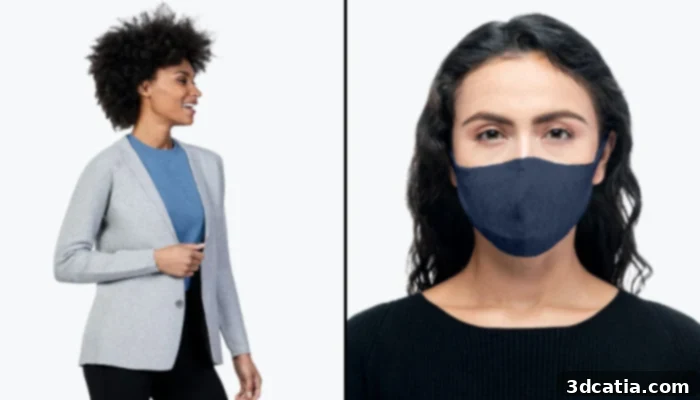
Ministry of Supply offers, among other things, 3D-printed blazers and masks. (Photo Credit: Ministry of Supply)
What are your thoughts on the transformative potential of 3D knitwear in the fashion industry? Share your opinions in a comment below or engage with us on our Facebook and Twitter pages. Don’t forget to sign up for our free weekly newsletter, delivering all the latest news and innovations in 3D printing directly to your inbox!
Photo Credit: New Industrial Order