
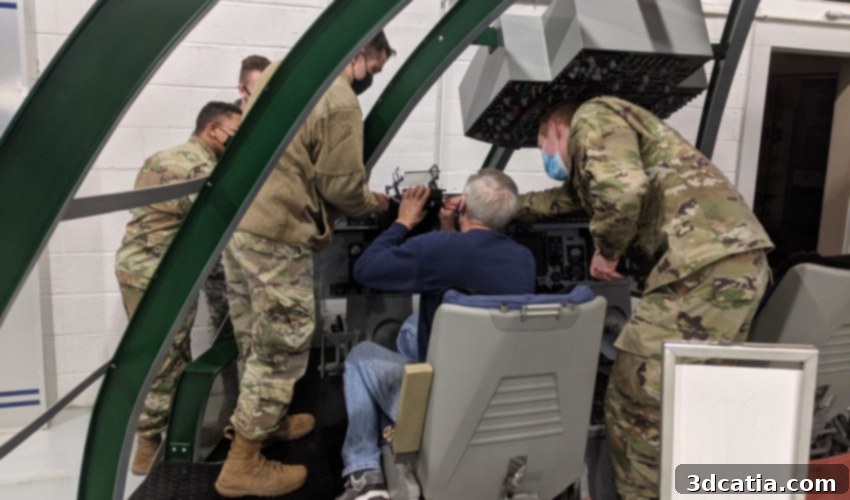
Revolutionizing Historic Aircraft Preservation: 3D Printing Extends the Legacy of Air Mobility at Dover AFB
Preserving the intricate legacy of aviation history presents unique challenges, especially when caring for seventy-year-old aircraft whose original parts are no longer in production. The Air Mobility Command Museum at Dover Air Force Base, Delaware, is a testament to this enduring challenge, housing an impressive collection of aircraft, some dating back as far as the First World War. After a century of service and display, time inevitably takes its toll on these invaluable historical relics. Worn, broken, or simply degraded components necessitate replacement, a task that Eric Czerwinski, the museum’s deputy director, describes as nearly impossible due to the scarcity of original spares. This critical need for innovative solutions led the museum to collaborate with Bedrock, Dover AFB’s dedicated innovation lab. Leveraging cutting-edge 3D printing technology, Bedrock has embarked on a groundbreaking initiative to fabricate a wide array of replacement parts, ensuring the meticulous restoration and maintenance of these historic aircraft while rigorously upholding the authentic and historical accuracy of their displays for future generations.
The application of additive manufacturing has already yielded tangible results. Bedrock’s skilled team has successfully fabricated crucial components for several iconic aircraft. For instance, they produced parts for a head-up display within a C-17 Globemaster III flight deck exhibit, a key interactive element for museum visitors. Additionally, intricate throttle handle pieces for a KB-50J Superfortress have been precisely replicated. The challenges faced by the Air Mobility Command Museum often extend beyond mere mechanical wear. Aesthetic degradation, such as the throttle handles on the KB-50J literally falling apart due to prolonged exposure to summer heat, posed a significant problem. Czerwinski articulates the constant battle against time and the elements: “Several of the aircraft we house here are many decades old and need to be consistently maintained to preserve them for future generations. We can’t always protect the aircraft from aging. There’s just too many things to consider like the natural elements, light sensitivity and time. […] When the C-17 first came out, this was one of the demonstrators they would bring around to different air shows to show off its capabilities. Over the years, the head-up display on these things, people would reach in, grab [the instruments], and would easily break [them].” This highlights the dual challenge of age-related deterioration and the wear and tear from enthusiastic public interaction.
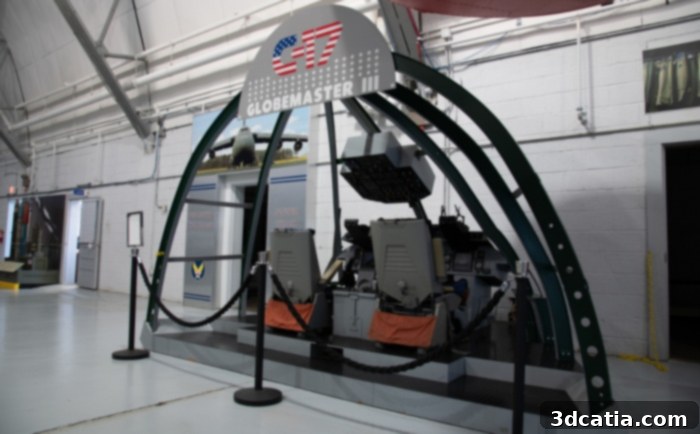
The C-17 Globemaster III flight deck display at the Air Mobility Command Museum offers visitors an inside look at the C-17 cockpit, featuring components restored with 3D printing. The Air Mobility Command Museum at Dover Air Force Base, Delaware, is home to many aircraft dating back to World War I. (U.S. Air Force photo by Senior Airman Marco A. Gomez)
Bedrock was specifically established to leverage technology and intuitive solutions to tackle complex challenges faced by the military, fostering innovation and bridging the gap between Dover AFB’s Airmen and Guardians and industry experts. This collaborative environment has proven invaluable for the museum’s restoration efforts. “I think that’s the great thing about a program like Bedrock,” Czerwinski remarked, emphasizing the lab’s pivotal role. “It gives us a better avenue to reproduce replica parts quickly so we can restore these aircraft as close as possible to their original state.” This direct access to advanced manufacturing capabilities has transformed the museum’s approach to maintenance. The traditional methods of scouring for increasingly rare original parts or commissioning expensive, specialized fabrication for one-off components are often time-consuming and prohibitively costly. With Bedrock’s support, the museum has found a significantly faster and more cost-effective option for maintaining the structural and aesthetic integrity of these priceless aircraft, ensuring their longevity and authenticity for countless visitors to come. This strategic partnership underscores a forward-thinking approach to heritage preservation, recognizing that modern solutions are essential for safeguarding historical artifacts.
The profound importance of preserving these aircraft extends far beyond their material form. Czerwinski eloquently explains, “Because it gives people the context in which history is given. It wasn’t [only] written in books, it was actually fought in the skies of Germany or flown over France. It’s one thing to look at something in an old black and white photo, but it’s another thing to actually stand in front of it and see it in person. It gives you a real appreciation, not only for the technology, but also for the men and women who actually flew this aircraft.” These aircraft are tangible links to pivotal moments in global history, embodying the courage, ingenuity, and sacrifices of past generations. A visit to the Air Mobility Command Museum allows individuals to connect with history on a deeply personal level, fostering a profound sense of respect for the technological advancements of their time and the human stories behind them. The ability to touch, see, and even interact with components of these machines, made possible by precise 3D-printed replicas, elevates the educational experience significantly, making history come alive in a way that static images or written accounts simply cannot achieve.
The precise nature of 3D printing, or additive manufacturing, makes it an ideal solution for historical restoration. Unlike traditional subtractive manufacturing methods, which involve cutting material away from a larger block, 3D printing builds objects layer by layer from a digital design. This allows for the creation of incredibly complex geometries and highly accurate replicas, even for parts that are no longer documented with detailed blueprints. Engineers at Bedrock can reverse-engineer a damaged or worn part by 3D scanning it, creating a precise digital model. This model can then be refined and printed using a variety of materials that closely match the properties and appearance of the original, whether it’s a specific plastic for a control knob or a robust polymer for a display component. This process ensures that the historical integrity and aesthetic accuracy of the aircraft are maintained, allowing the exhibits to remain as true to their original state as possible. The capability to produce these parts on-demand also drastically reduces the lead times that would typically be associated with sourcing or manufacturing bespoke components, making the restoration process far more efficient and sustainable for a non-profit museum operation.
Considering the C-17 Globemaster III, a modern military transport aircraft, its head-up display (HUD) is a crucial component for depicting realistic cockpit environments. Public interaction, while beneficial for engagement, often results in damage to delicate instruments. 3D printing allows Bedrock to create durable, accurate replacements for these HUD parts, ensuring that the C-17 flight deck remains an interactive and educational exhibit without compromising its authenticity. Similarly, for the KB-50J Superfortress, an aircraft that played a vital role in aerial refueling during the Cold War era, the restoration of its throttle handles is critical. The original material, likely a type of plastic or resin, degraded over decades due to temperature fluctuations and environmental exposure. By leveraging advanced polymers and 3D printing, Bedrock can recreate these throttle handles with improved durability, ensuring they withstand the test of time and continued visitor interaction without sacrificing their historical appearance. This bespoke manufacturing capability ensures that specific challenges, whether material degradation or visitor-induced wear, can be addressed with tailored, high-quality solutions.
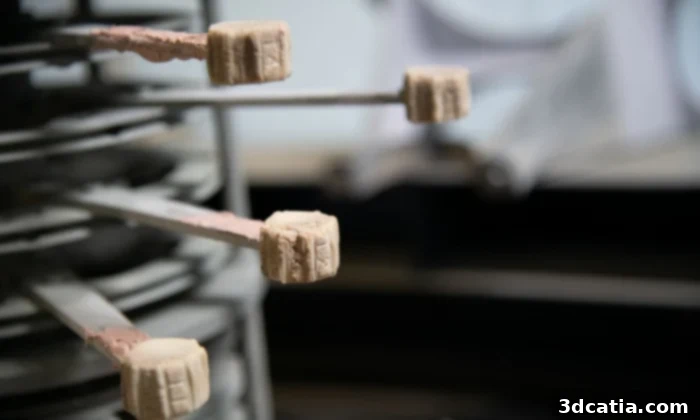
The throttle handle knobs belonging to a KB-50J Superfortress are being replaced by 3D-printed knobs made by the Bedrock team at Dover Air Force Base, Delaware. The original knobs started cracking and falling apart over time due to heat during the summer months, demonstrating the vital role of additive manufacturing in preserving aerospace heritage. (U.S. Air Force photo by Senior Airman Marco A. Gomez)
The collaboration between the Air Mobility Command Museum and Bedrock at Dover Air Force Base serves as a powerful model for heritage preservation across various sectors. The ability of 3D printing to provide customized, cost-effective, and rapid solutions for obsolete parts is invaluable for museums, historical societies, and private collectors worldwide. This approach not only preserves the physical artifacts but also maintains the integrity of the stories they tell. As technology continues to advance, the potential applications for 3D printing in cultural preservation will undoubtedly expand, offering new ways to safeguard our shared history and make it accessible to future generations. The innovative spirit demonstrated by Bedrock and the Air Mobility Command Museum ensures that the magnificent machines of the past will continue to inspire and educate for decades to come, demonstrating how cutting-edge technology can seamlessly integrate with the profound duty of historical stewardship.
For those interested in delving deeper into this pioneering initiative, the full press release provides comprehensive details and can be accessed HERE. We invite you to share your thoughts on the innovative use of 3D printing technologies for the preservation of historical aircraft. What are your perspectives on blending modern manufacturing with heritage conservation? Let us know in a comment below or join the conversation on our Facebook, Twitter, and LinkedIn pages! For the latest updates and breaking news in the additive manufacturing world, sign up for our free weekly Newsletter here, delivered straight to your inbox.
*Cover photo by U.S. Air Force Senior Airman Marco A. Gomez