
Unlocking Innovation: A Deep Dive into Key Micro-Trends in Additive Manufacturing Materials
The landscape of additive manufacturing (AM), commonly known as 3D printing, is constantly evolving, with material innovation at its core. A recent and highly anticipated report published by the prominent research firm IDTechX meticulously examines the micro-trends shaping additive manufacturing materials for 2022 and beyond. This comprehensive study arrives at a crucial juncture for the AM market, which, despite the global challenges posed by the recent pandemic, has demonstrated remarkable resilience and continued its impressive growth trajectory. The IDTechX analysis delves into four fundamental families of materials crucial to the industry’s advancement: polymers, metals, ceramics, and composites. For each of these categories, IDTechX offers insightful predictions, highlighting critical shifts such as the escalating importance of sustainability within the polymer segment and the growing prominence of extrusion processes in metal 3D printing. One undeniable conclusion from the report is that relentless innovation in materials will serve as the primary catalyst for the additive manufacturing sector’s ascension, continually delivering surprising advancements and opening new possibilities across countless applications.
While the additive manufacturing market, much like nearly every sector of the global economy, experienced significant disruption and weakening due to the COVID-19 crisis, it remarkably managed to not only persevere but also to thrive and underscore its inherent strengths. The pandemic, unexpectedly, provided an impetus for certain industry players to dedicate resources to longer-term substantive developments and to fundamentally re-evaluate their operational strategies. For instance, the widespread halting of offshore production compelled numerous companies to pivot towards the utilization of local resources, fostering shorter, more resilient supply chains, and prioritizing solutions that are inherently more respectful of the environment. This profound emphasis on sustainability is particularly pronounced and gaining immense traction within the polymer market segment, signaling a paradigm shift in how materials are conceived, produced, and utilized in 3D printing. This focus is driven by increasing consumer awareness, stricter regulatory frameworks, and a collective industry commitment to reducing environmental impact.
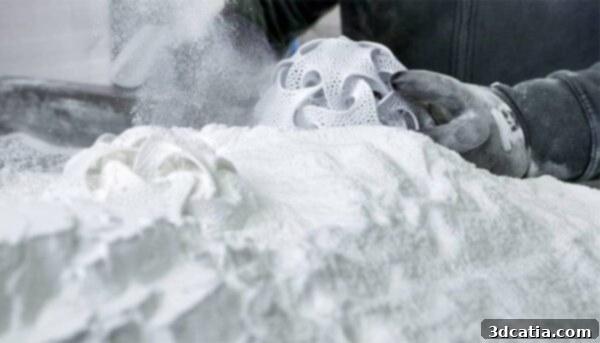
Bluesint PA12 powder, an innovative example of a 100% recyclable material designed for additive manufacturing. (Photo Credit: Materialise)
Polymers and Metals: Driving Towards Sustainability & Accessibility
Today’s leading material manufacturers are intensifying their efforts to produce high-performance filaments, resins, and powders derived from natural and renewable resources, moving away from traditional petroleum-based alternatives. This shift is fueled by a burgeoning demand for manufacturing parts that can be readily recycled or, at the very least, efficiently reused, thereby significantly reducing their overall carbon footprint. The topic of sustainability in additive manufacturing has gained considerable momentum, a point we extensively highlighted following Formnext 2021, where it became clear that 3D printing companies are not only mobilizing but also committing to swift action on this crucial subject. IDTechX’s report strongly corroborates this trend, underscoring its particular reinforcement within the polymers segment. The new generation of plastics entering the market are, according to the report, increasingly ecological, often based on natural feedstocks or incorporating a substantial proportion of recycled materials. Illustrative examples include the innovative partnership between UBQ Materials and Plastics App, which has successfully developed a filament engineered from industrial technical waste, or Fillamentum’s pioneering NonOilen material, which boasts 100% biodegradability and compostability. These developments signify a decisive step towards a more environmentally conscious and circular additive manufacturing ecosystem.
The polymer market’s pursuit of sustainability extends far beyond just filaments, encompassing a wide array of initiatives within the powders segment as well. Manufacturers are relentlessly striving to enhance the ‘refresh rate’ of their powders – the proportion of new powder required in each build – to minimize waste, optimize material utilization, and significantly reduce operational costs. Concurrently, there is a dedicated push to develop new plastics that are inherently recyclable and can be effectively re-integrated into the production cycle without compromising material integrity. A significant, albeit often overlooked, challenge in achieving widespread material circularity is the establishment of robust, dedicated recycling channels within each country, a complex logistical and infrastructural undertaking that requires industry-wide collaboration. Notable advancements in this area include Bluesint PA12, a groundbreaking 100% recyclable powder meticulously engineered by Materialise, setting a new standard for sustainable powder bed fusion. Another significant innovation is PP 3D High Reusability, an advanced polypropylene developed through a strategic partnership between chemical giant BASF and HP, emphasizing the importance of collaborative efforts in sustainable material development. This urgent imperative to discover and implement more sustainable solutions is unequivocally clear and is projected to intensify significantly over the coming years. We are not discussing distant future aspirations but rather concrete developments anticipated within the next five years. The industry’s awareness is palpable, and more than ever, additive manufacturing players are actively mobilizing resources and demonstrating a strong desire to enact tangible, positive change.
Shifting our focus to the realm of metals, the IDTechX study illuminates the impressive ascent of Fused Filament Fabrication (FFF) technology, a process conceptually inspired by the well-established metal injection molding (MIM) technique. This innovative approach enables the creation of complex metal parts through a streamlined, multi-stage process involving three key steps: initial printing of a “green” part composed of metal powder bound by a polymer, followed by a debinding step to remove the polymer binder, and finally, sintering in a high-temperature furnace to fuse the metal particles into a dense, solid component. The paramount advantage of metal FFF technology lies in its significantly lower initial capital cost relative to more expensive and capital-intensive powder bed laser fusion solutions, which typically employ one or more high-power lasers, or even electron beam melting (EBM) systems. This cost-effectiveness and simpler operational workflow make metal FFF an increasingly attractive option for a broader range of manufacturers, especially those looking to adopt metal 3D printing without the substantial initial investment traditionally associated with it, thereby significantly improving accessibility. Consequently, the number of manufacturers actively positioning themselves within this burgeoning market segment is rapidly expanding. Prominent players include industry pioneers like Desktop Metal and Markforged, alongside more recent entrants such as 3DGence with its innovative Element range of metal FFF 3D printers, BCN3D with its specialized metal printing pack, and the ambitious startup FuseLab. Furthermore, an exciting area of development involves certain companies striving to further simplify this process by completely eliminating the debinding step, which would represent a significant leap forward in reducing complexity, processing time, and overall cost. This particular development is certainly one to monitor very closely as it could redefine accessibility and efficiency in metal additive manufacturing.
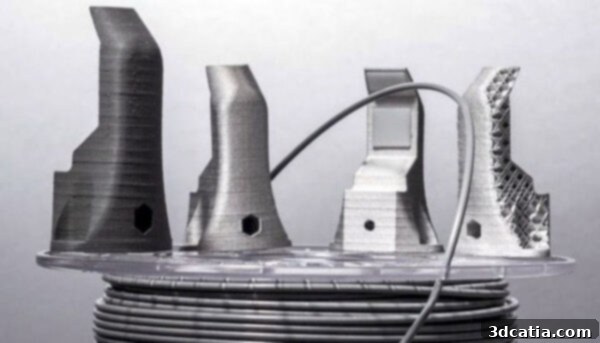
A growing variety of metal filaments are becoming available on the market, broadening material options and applications. (Credit Photo: BASF)
The Expanding Frontiers: Growth of Ceramics and Composites
The IDTechX report also provides illuminating insights into the substantial expansion of ceramics within additive manufacturing, a topic the firm has previously explored in other comprehensive studies. The report confidently projects that the ceramic additive manufacturing market is poised to reach an impressive value of $400 million by 2032, representing an astonishing seven-fold increase from its current valuation. This remarkable growth trajectory is primarily attributable to the rapid development of innovative new materials, driven by the synergistic efforts of three distinct types of industry players. Firstly, the report highlights the increasing number of conventional manufacturing companies entering this specialized niche for the first time, recognizing the unique advantages 3D printed ceramics offer in various applications, from aerospace components requiring high heat resistance to custom medical implants demanding biocompatibility. Secondly, chemical companies, traditionally focused on broader material markets, are demonstrating a heightened interest in ceramics, actively developing and offering dedicated solutions tailored for additive manufacturing processes, such as advanced slurries, binders, and photo-curable resins optimized for specific ceramic properties. Finally, the formation of strategic partnerships across the industry is significantly broadening the spectrum of possibilities, enabling collaborative research and development that leads to the conception of novel materials specifically designed for ceramic additive manufacturing. These partnerships accelerate innovation, pooling expertise and resources to overcome technical hurdles and expand the application potential of these high-performance materials. Much like the advancements in metal FFF, the evolution of ceramic 3D printing is an area that warrants close observation, promising to unlock new functionalities and applications previously unattainable with traditional manufacturing methods.
Turning our attention to the composites sector, the findings presented in the IDTechX report reveal a remarkably similar trend: significant growth is largely catalyzed by the collaborative efforts and convergence of multiple key players within the industry. This collaborative paradigm is exemplified by the strategic partnership between Solvay and 9T Labs, who have joined forces to create a specialized portfolio of high-performance materials meticulously adapted for 9T Labs’ advanced printing solutions. This portfolio notably includes materials such as PEEK (Polyether Ether Ketone), polyamide, and PPS (Polyphenylene Sulfide), all expertly reinforced with carbon fibers. These high-performance composites offer unparalleled strength-to-weight ratios, exceptional thermal resistance, and superior stiffness, making them ideal for demanding applications in aerospace, automotive, and defense industries where performance is critical. Despite these exciting developments, composite additive manufacturing is still largely considered to be in its nascent stages. However, this early phase is brimming with immense potential, and the future undoubtedly holds a wealth of groundbreaking projects and applications for all users of this transformative technology. As material science advances and printing processes become more refined, we can expect composites to play an increasingly critical role in areas requiring lightweight, durable, and highly customized parts, from advanced robotics and infrastructure to sports equipment and consumer electronics, fundamentally reshaping product design and performance. For those seeking further detailed information, the official press release from IDTechX is available HERE.
In conclusion, the IDTechX report provides a compelling overview of the dynamic and rapidly evolving landscape of additive manufacturing materials. The pervasive themes of sustainability and enhanced accessibility are clearly driving innovation across polymers, metals, ceramics, and composites. These micro-trends are not merely incremental changes but represent fundamental shifts that will collectively propel the entire 3D printing industry forward, expanding its capabilities, market reach, and overall impact on global manufacturing. As the industry continues to mature, the development of advanced materials that are both high-performing and environmentally responsible will be paramount to unlocking the full potential of additive manufacturing. The insights from IDTechX underscore a future where material science is central to redefining what is possible with 3D printing, enabling new applications, improving efficiency, and contributing to a more sustainable industrial future.
What are your thoughts on these pivotal material trends shaping the additive manufacturing industry? We invite you to share your insights in a comment below or join the conversation on our Linkedin, Facebook, and Twitter pages! Don’t forget to sign up for our free weekly Newsletter here to receive the latest 3D printing news straight to your inbox! You can also find all our videos on our YouTube channel.
*Cover Photo Credit: Marina_Skoropadskaya