
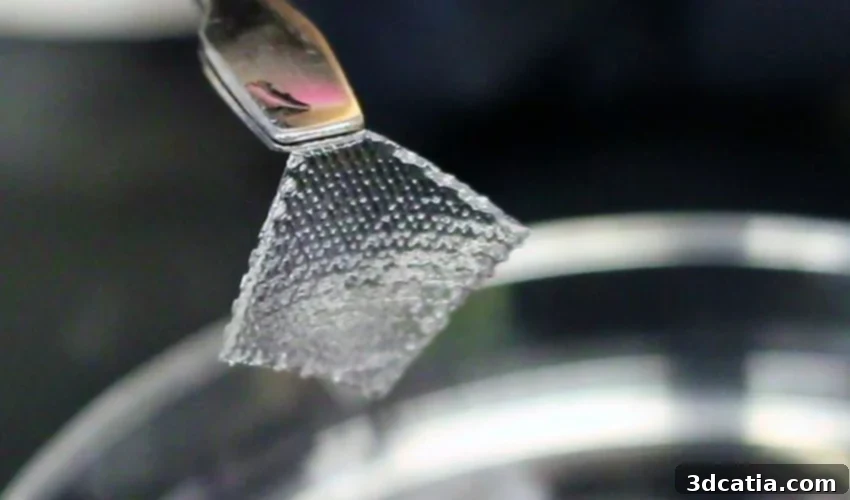
3D Printed Smart Hydrogel Dressings: Revolutionizing Personalized Wound Care for Burn and Cancer Patients
The medical industry is undergoing a profound transformation thanks to the advancements in additive manufacturing. This innovative technology is not merely streamlining the production of prostheses, implants, and facilitating more precise surgical planning; it’s actively paving the way for groundbreaking patient care solutions. Among the most exciting developments is the application of 3D printing in creating advanced wound dressings. Researchers at the University of Waterloo have achieved a remarkable breakthrough, utilizing sophisticated 3D printing technology to develop smart hydrogel wound dressings specifically designed to meet the critical needs of burn and cancer patients.
Traditional wound care, particularly for burn victims, has long presented significant challenges. The process of changing conventional dressings can inflict considerable pain and discomfort, leading to distress for patients and complicating treatment for healthcare professionals. This painful reality often hinders the healing process, increases the risk of infection, and prolongs recovery times. However, the introduction of these novel 3D printed wound dressings, crafted from intelligent hydrogel materials, promises a paradigm shift. Their unique polymer structure is engineered to accelerate the healing process while dramatically minimizing pain during dressing changes. This innovative and compassionate approach heralds a future of more comfortable, efficient, and ultimately, more effective wound care, significantly enhancing the quality of life for vulnerable patients.
The key to the success of these advanced dressings lies in their unparalleled customization and material properties, made possible through 3D printing. As Dr. Boxin Zhao, a distinguished professor in the University of Waterloo’s Department of Chemical Engineering, eloquently explains, “We can customize the shape with a 3D printer, and the material has a fine-tuned surface adhesion, which is a key element.” This capability to tailor the dressing’s geometry precisely to the wound’s contours is revolutionary, allowing for an optimal fit even on notoriously difficult-to-dress body parts such as the nose and fingers. Beyond precise shaping, the meticulously engineered surface of these hydrogel dressings ensures an excellent yet gentle adhesion to the skin. This delicate balance is critical: strong enough to remain securely in place, yet gentle enough to prevent trauma to sensitive healing tissue upon removal. The material’s inherent properties also facilitate effortless detachment, ensuring truly pain-free dressing changes, a feature that addresses one of the most significant burdens in wound management.
The profound advantage of utilizing 3D printing in the development of these wound dressings is personalization. Conventional wound care often relies on standardized dressings that may not perfectly conform to individual patient needs, leading to suboptimal contact, potential slippage, and decreased effectiveness. By contrast, 3D printing empowers healthcare providers to create dressings tailored to each patient’s unique wound morphology, size, and location. This bespoke approach goes beyond simple shape matching; it allows for varying thickness, porosity, and even localized drug delivery zones within a single dressing. Such precise personalization enhances the comfort of the application, maximizes contact with the wound bed for optimal healing, and significantly improves overall treatment outcomes. This level of individualized care represents a major leap forward in the field of modern wound management, moving away from a one-size-fits-all approach to truly patient-centric solutions.
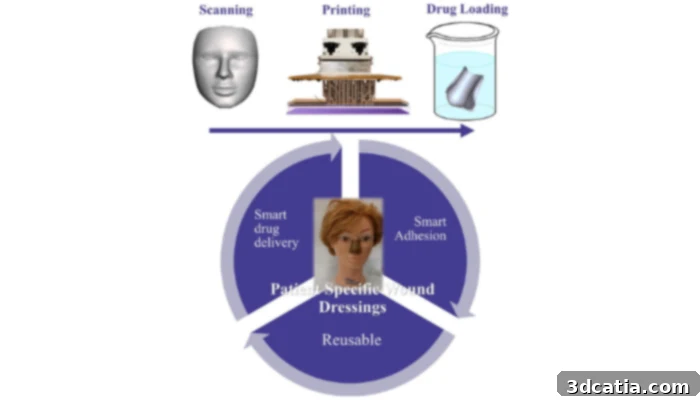
3D printed wound dressings demonstrate significant potential for supporting accelerated wound healing. (photo credits: ©University of Waterloo)
Advanced Treatment for Cancer Patients and Localized Drug Delivery
The benefits of these innovative wound dressings extend far beyond burn victims, holding immense promise for cancer patients as well. Many cancer treatments, particularly those involving skin lesions or localized tumors, traditionally necessitate lengthy and frequent hospital visits, which can be physically and emotionally draining for patients. These new 3D printed dressings offer a more comfortable and convenient treatment alternative by providing a continuous and highly controlled release of medication directly onto the affected skin. This targeted drug delivery minimizes systemic side effects often associated with oral or intravenous medications, improving patient tolerance and overall quality of life during treatment. The ability to manage treatment at home or with fewer clinic visits also significantly reduces the burden on both patients and healthcare systems.
The sophisticated composition of these dressings is key to their advanced functionality. They are carefully formulated from a unique blend of components: a biopolymer derived from seaweed, a thermally reactive polymer, and cellulose nanocrystals. The seaweed-derived biopolymer offers excellent biocompatibility and biodegradability, making it a safe and natural choice for prolonged skin contact. The thermally reactive polymer is crucial for the “smart” aspect of the dressing; it allows the material to respond to temperature changes. When stored in a refrigerator, the dressing remains cool. Upon application to the skin, it gradually warms to body temperature, creating a soothing and gentle experience that can provide immediate comfort and potentially reduce localized inflammation. Cellulose nanocrystals contribute to the structural integrity of the dressing, ensuring it maintains its shape and controlled release properties while also enhancing its mechanical strength and durability. This intricate combination of materials allows for precise control over drug release kinetics, ensuring a steady therapeutic effect over an extended period.
Beyond Medical Applications: A Vision for Broader Impact and Commercialization
The innovative potential of these hydrogel dressings is not confined solely to the medical industry. Dr. Zhao envisions a future where these personalized 3D printed solutions could revolutionize other sectors, notably the beauty and cosmetics industry. Imagine cosmetologists utilizing advanced 3D scanning technology to meticulously analyze a client’s unique facial features and skin topography. With this precise data, they could then 3D print customized hydrogel masks, each specifically enriched with a bespoke combination of active facial and skin care products. This would allow for targeted delivery of anti-aging compounds, hydration boosters, acne treatments, or soothing agents precisely where they are most needed, offering an unprecedented level of personalized skincare that transcends generic off-the-shelf products. Furthermore, this innovative approach also presents significant benefits for plastic surgeons, who could use similar personalized hydrogel applications for post-operative care, scar management, or to deliver specialized agents that promote faster and more aesthetically pleasing healing after procedures.
The versatility and adaptability of this 3D printing technology, particularly with smart hydrogels, underscore its immense potential across various domains. While the immediate focus remains on optimizing these medical dressings for critical patient needs, the long-term vision encompasses a much wider array of applications. From enhancing cosmetic treatments to potentially improving athletic performance through custom injury wraps or even advanced food packaging, the possibilities are vast. However, before widespread commercial adoption, the researchers’ immediate next steps involve further optimizing their development to achieve maximum efficacy, scalability, and cost-effectiveness. This critical phase includes rigorous clinical trials, refinement of printing processes, and navigating the complex regulatory pathways to ensure safety and compliance. The goal is to transition this groundbreaking laboratory innovation into a readily available, impactful product that can improve lives on a global scale. This journey from conceptual breakthrough to commercial feasibility is well underway, promising an exciting future for personalized material science and additive manufacturing. More detailed information regarding this pioneering research can be found in the Journal of Colloid and Interface Science study HERE.
This development truly highlights the transformative power of additive manufacturing in healthcare, offering not just new tools, but entirely new paradigms for patient care. The ability to create personalized, smart materials tailored to individual needs promises a future where treatments are more effective, less painful, and significantly improve patient comfort and recovery. We invite you to share your thoughts on this remarkable treatment for burn and cancer patients. Let us know what you think in a comment below or engage with us on our LinkedIn, Facebook, and Twitter pages! Don’t forget to sign up for our free weekly Newsletter here to receive the latest 3D printing news straight to your inbox! You can also find all our compelling videos on our YouTube channel, exploring the cutting edge of additive manufacturing.
*Cover photo credits: ©University of Waterloo