
Pioneering Space Manufacturing: Advancing 3D Printing for Off-World Construction and Repair in Microgravity
Humanity’s enduring fascination with space has driven ambitions towards colonizing celestial bodies like Mars and the Moon. Achieving this monumental goal necessitates a paradigm shift in logistics and manufacturing: the ability to process and utilize local resources directly in the harsh conditions of space. Traditional supply chains, which rely on launching every single component from Earth, are prohibitively expensive, time-consuming, and logistically complex. This is where 3D printing, or additive manufacturing, emerges as a transformative technology. Its impressive potential lies in its capacity for on-demand production, custom part creation, and critical repairs with minimal material usage, thereby circumventing the need for costly and bulky spare parts to be ferried from Earth. This capability is not just about convenience; it’s about enabling sustainable long-duration missions and the eventual establishment of self-sufficient off-world outposts.
Across the globe, numerous projects and research endeavors are vigorously exploring the application of 3D printing in space exploration, specifically focusing on its functionality in microgravity environments. These initiatives are continuously pushing the boundaries of what’s possible, advancing our understanding of additive manufacturing’s role in orbit, on planetary surfaces, and during transit. Adding a significant contribution to this exciting field, two prominent German universities have recently unveiled a groundbreaking, flexible method for laser additive manufacturing, specifically engineered to operate effectively under microgravity conditions. This development represents a crucial step forward in making off-world manufacturing a tangible reality.
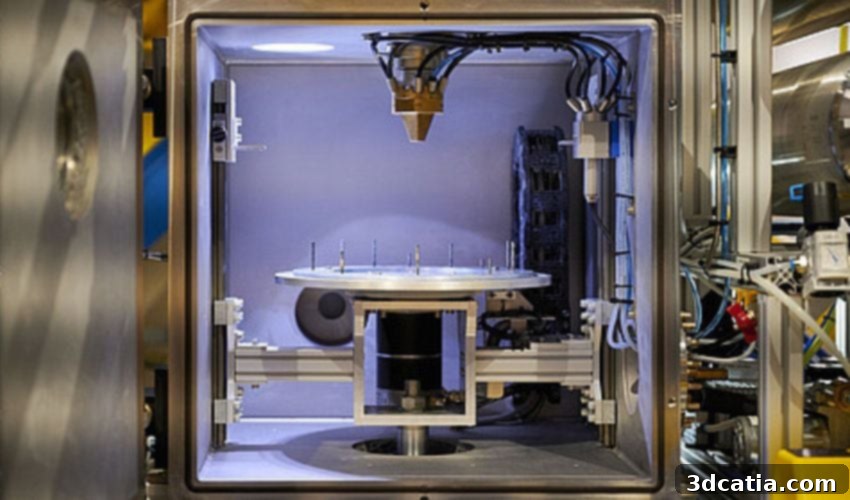
An interdisciplinary research team, comprising experts from Leibniz University Hannover (LUH) and Otto von Guericke University Magdeburg, spearheaded a pivotal project titled “Additive Manufacturing in Microgravity Using Laser Metal Deposition”. Generously funded by the German Research Foundation, this collaborative effort aimed to overcome some of the most formidable challenges associated with space manufacturing. As a direct outcome of this extensive project, the researchers successfully developed a highly flexible 3D printing method. This innovative technique is designed for both the production of new metal components and the efficient repair of existing ones, all while operating under the unique and challenging conditions of microgravity. The core of this process leverages laser metal deposition (LMD), a robust additive manufacturing technology. In LMD, a powerful laser beam is precisely directed to selectively melt metal powder, which is simultaneously fed into the melt pool. This molten material then solidifies, building up the desired component layer by excruciating layer with exceptional precision. A key advantage of this method is its adaptability for repair: it can directly print onto damaged areas of existing parts, effectively restoring their structural integrity and functionality without the need to replace the entire component. This capability is invaluable for long-duration space missions, where bringing replacement parts from Earth is often impractical or impossible.
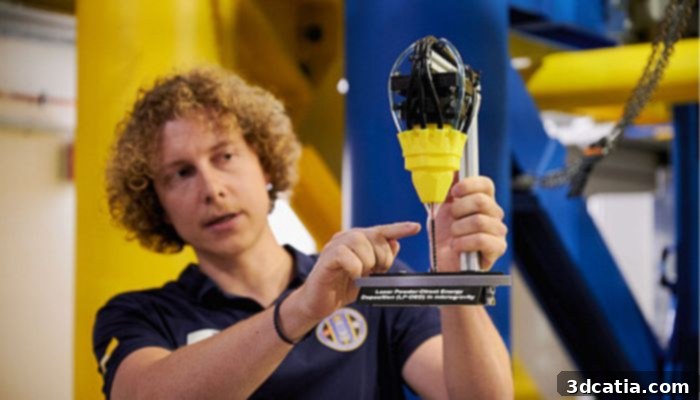
Marvin Raupert, project engineer, pictured with a model demonstrating the 3D printing process.
The most significant technical hurdle faced by the research team revolved around the intricate process of handling metal powder and ensuring its controlled delivery and processing in a microgravity environment. Unlike Earth, where gravity helps settle and direct powder, space presents a scenario where powder particles can float freely, potentially contaminating equipment or hindering precise deposition. To rigorously simulate these challenging conditions and validate their innovative method, the team utilized the state-of-the-art Einstein Elevator, a large-scale research facility located at the Hannover Institute of Technology. This unique apparatus allowed the researchers to subject their printing process to a spectrum of gravitational conditions, ranging from near-perfect weightlessness – crucial for orbital manufacturing simulations – to the intense and dynamic forces experienced during a rocket launch. Such comprehensive testing is vital to ensure the robustness and reliability of the system under all phases of a space mission.
Within the Einstein Elevator, the custom-engineered powder delivery system and the laser system were meticulously installed inside a specialized gondola. This setup was carefully adapted to replicate the microgravity environment of space, accounting for factors such as vibration, thermal management, and power constraints. The researchers conducted extensive tests using laser metal deposition with a variety of materials renowned for their properties in aerospace applications. These included titanium and nickel alloys. Titanium is highly valued for its exceptional strength-to-weight ratio and corrosion resistance, making it ideal for structural components in spacecraft. Nickel alloys, on the other hand, offer excellent high-temperature strength and creep resistance, essential for parts exposed to extreme thermal cycles or propulsion systems. The successful printing and repair demonstrations with these materials in simulated microgravity mark a significant validation of the German universities’ flexible LMD approach, proving its potential for practical application in future space missions.
Building on the groundbreaking success of this research, the team has ambitious plans for further development and exploration. In a strategic collaboration with the esteemed Laser Zentrum Hannover (LZH), future efforts will focus on an even more audacious goal: developing methods to process lunar regolith for 3D printing applications. Lunar regolith, the loose, unconsolidated dust and rocky material covering the Moon’s surface, represents an abundant, readily available resource. However, its fine, abrasive nature and specific chemical composition pose unique challenges for additive manufacturing. The overarching objective of this next phase is to harness the Moon’s indigenous regolith for direct, on-site production of essential infrastructure and vital components. This includes everything from constructing habitats and landing pads to fabricating tools and spare parts directly on the lunar surface, dramatically reducing reliance on Earth-launched supplies. This vision extends beyond the Moon, with similar regolith utilization strategies being developed for Mars, paving the way for truly self-sufficient and sustainable off-world human settlements.
The implications of this research are profound. By demonstrating the feasibility of precise laser metal deposition in microgravity, and by laying the groundwork for regolith processing, these German universities are significantly accelerating the timeline for human expansion into space. The ability to manufacture and repair crucial components in orbit or on distant planetary surfaces will not only make missions safer and more robust but also vastly more economical. This flexibility in manufacturing will be critical for establishing permanent bases, conducting long-term scientific research, and eventually, facilitating resource extraction from celestial bodies. The advancement of in-situ resource utilization (ISRU) through additive manufacturing is a cornerstone for the next era of space exploration, enabling humanity to truly live and thrive beyond Earth.
For those keen to delve deeper into the specifics of this pioneering research, more comprehensive information is available HERE. We encourage you to share your thoughts on this innovative 3D printing method in microgravity. What potential applications do you envision? How do you believe it will impact the future of space exploration? Let us know your insights in a comment below or join the conversation on our LinkedIn or Facebook pages! Furthermore, don’t miss out on the latest advancements in additive manufacturing; remember to sign up for our free weekly Newsletter to receive top 3D printing news directly in your inbox. You can also explore all our engaging videos and exclusive content on our YouTube channel for more detailed visual insights into the world of 3D printing.
*All Photo Credits: Sören Pinsdorf, LUH