
Adidas 4D Fusio: Pioneering the Future of Footwear with Advanced 3D Printing Technology
The landscape of athletic footwear is constantly evolving, driven by technological advancements that push the boundaries of design, performance, and sustainability. Among these innovations, 3D printed shoes have emerged as a significant game-changer, moving from concept to mainstream market availability at an impressive pace. Leading this revolution is Adidas, a brand synonymous with sports innovation, which has consistently leveraged additive manufacturing to redefine what’s possible in shoe construction. Models like the Futurecraft 4D, the ALPHAEDGE 4D, and the groundbreaking FUTURECRAFT.STRUNG, all integrated advanced 3D printed midsoles, showcasing Adidas’s commitment to cutting-edge technology. Now, Adidas is set to release another remarkable model, the 4D Fusio, which will soon be available on their official website. This continuous rollout of 3D printed sneakers raises an important question: why does the company continue to invest so heavily in additive manufacturing for its footwear lines? The answer lies in the unparalleled opportunities for customization, performance enhancement, and a more sustainable production process that 3D printing offers.
The Rise of 3D Printing in the Footwear Industry
Adidas is certainly not alone in recognizing the transformative potential of 3D printing for shoe manufacturing. Other sports giants, such as Nike, and innovative startups like Scientifeet and Wiivv, are also enthusiastically embracing additive manufacturing. The reasons for this widespread adoption are compelling and multifaceted, primarily centered around the revolutionary possibilities for personalization and product optimization. Traditional shoe manufacturing often involves a ‘one-size-fits-all’ approach, or at best, mass production based on standardized sizing. However, 3D technologies allow for a paradigm shift.
Unlocking Unprecedented Personalization and Performance
Imagine a shoe perfectly tailored to the unique contours of your foot. With 3D printing, this is not just a dream but a tangible reality. Consumers’ feet can be meticulously scanned, capturing precise morphological data. This data is then used to develop a personalized 3D model, which can be printed in a remarkably short timeframe. The result is a shoe that is truly customized to an individual’s specific morphology, addressing their unique needs for comfort, support, and performance, while also reflecting their personal style. This level of customization offers significant advantages, particularly for athletes who require optimal footwear to prevent injuries and enhance their performance. By creating bespoke cushioning and support zones, 3D printed shoes can drastically improve comfort and reduce stress on pressure points, leading to a superior running or training experience.
Beyond personalization, 3D printing also grants unparalleled design freedom. Manufacturers can create intricate lattice structures and complex geometries that would be impossible or prohibitively expensive to produce with conventional methods. These advanced structures can be engineered to precisely control cushioning, energy return, and flexibility, optimizing every aspect of the shoe’s performance. For instance, midsoles can be designed with varying densities across different zones to provide targeted support where it’s needed most, or to absorb impact more effectively. This ability to fine-tune material properties and structural design opens up new avenues for innovation, allowing for lighter, stronger, and more responsive footwear. The agility of additive manufacturing also facilitates rapid prototyping and iteration, allowing designers to test and refine new concepts much faster than before, accelerating the product development cycle.
Given these substantial benefits, it’s no surprise that the additive manufacturing market within the footwear industry is experiencing robust growth. A report by SmarTech Analysis estimates that this sector is expanding at an impressive 19% annually, signaling a strong future for 3D printed shoes. This growth is not merely a trend; it represents a fundamental shift in how footwear is conceived, designed, and manufactured globally, with an increasing emphasis on precision, efficiency, and individualized user experience.
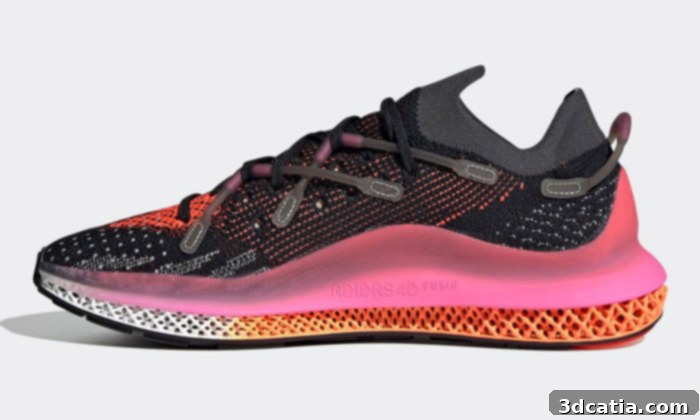
Adidas’ latest model, 4D Fusio, showcasing vibrant design and 3D printed midsole.
Adidas’s Vision: A Legacy of Innovation with Carbon DLS Technology
Adidas’s journey into 3D printed footwear is deeply rooted in its strategic partnership with American 3D printer manufacturer, Carbon. This collaboration, established in 2017, has been instrumental in bringing Adidas’s visionary 4D line to life. Carbon’s proprietary technology, Digital Light Synthesis™ (DLS), stands at the heart of Adidas’s 3D printed midsoles, distinguishing their offerings in a competitive market. Digital Light Synthesis is an advanced additive manufacturing process that utilizes a combination of resins, light, and oxygen to precisely create high-quality parts from polymers. Unlike traditional 3D printing methods that build layers sequentially, DLS grows parts continuously from a pool of resin, resulting in exceptionally intricate lattice structures with superior mechanical properties and a smoother finish – perfect for the demanding requirements of athletic footwear.
Evolution of Adidas Futurecraft and Carbon Partnership
The collaboration began with the pioneering Futurecraft 4D, which was among the first mass-produced 3D printed shoes, showcasing the potential of DLS technology for producing complex, responsive midsoles. This initial success paved the way for further innovation, including models like the ALPHAEDGE 4D. A particularly significant milestone was the development of the FUTURECRAFT.STRUNG. While the Futurecraft 4D primarily focused on leveraging Carbon’s DLS technology to manufacture the intricate 4D sole, the STRUNG pushed the boundaries further by integrating a unique multi-faceted process. This involved combining invaluable athlete input, advanced additive manufacturing for the midsole, and sophisticated robotics for the upper construction. The goal was to create an ultra-lightweight shoe that offered unparalleled support and flexibility.
For the FUTURECRAFT.STRUNG, the upper part of the shoe was meticulously manufactured with a robotic arm, which precisely placed each thread according to data-driven insights from athletes. This innovative process allowed for the creation of a seamless, sock-like upper that was not only incredibly lightweight but also designed to allow natural foot movement and provide targeted support exactly where needed. This fusion of computational design, robotic manufacturing, and 3D printed components exemplified Adidas’s holistic approach to footwear innovation, demonstrating how different advanced technologies can converge to create a product that delivers superior athletic performance and comfort.
Introducing the Adidas 4D Fusio: Where Style Meets Performance
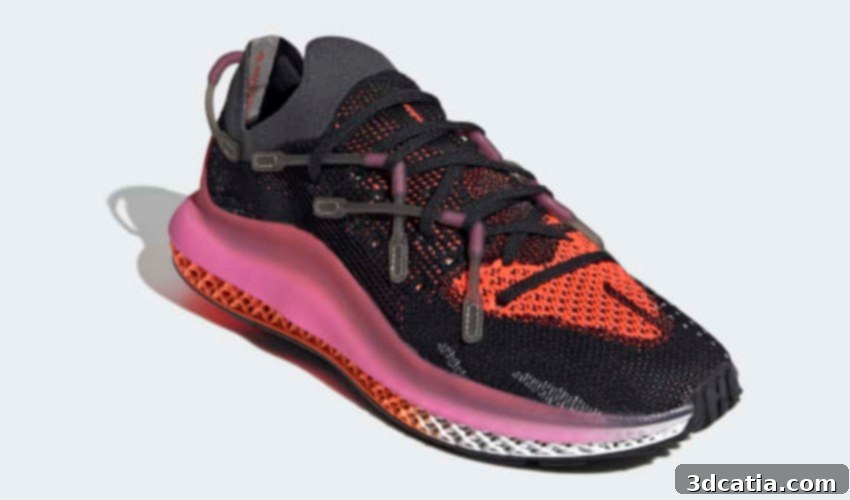
Building on the legacy of its 4D predecessors, Adidas’s latest model, the 4D Fusio, also prominently features the signature 4D midsole, but it introduces a vibrant aesthetic that sets it apart. The 4D Fusio is designed not just for performance but also to make a bold style statement, shining in several bright and eye-catching colorways. This model embodies a fusion of advanced technology and striking visual appeal, aiming to capture the attention of both athletes and fashion-conscious consumers.
Design Elements and Performance Benefits of the 4D Fusio
The upper of the 4D Fusio is crafted from Adidas’s renowned Primeknit material. This innovative knitted textile features a dynamic construction where black, pink, and orange threads interweave to form varying thicknesses. This strategic knitting creates both thinner, more flexible sections and thicker, more supportive areas, all while maintaining a lightweight profile. Primeknit is celebrated for its exceptional breathability, allowing for optimal air circulation around the foot, which is crucial for comfort during extended wear or intense physical activity. Its adaptive nature also ensures a snug, sock-like fit that molds to the foot, offering unparalleled comfort and support without bulk.
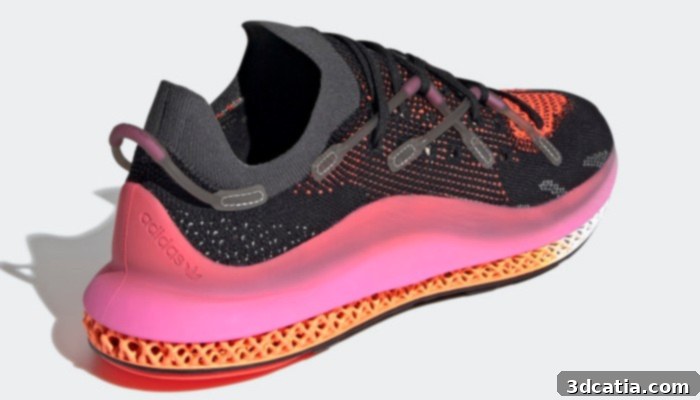
Further enhancing the wearer’s experience, the 4D Fusio incorporates a distinctive lacing system that is both functional and aesthetically integrated into the shoe’s overall design. Complementing this is a pull loop located in the heel, ingeniously crafted from TPU (thermoplastic polyurethane). This durable yet flexible material makes it remarkably easy to put on and take off the sneaker, adding a layer of convenience to its high-performance features. The combination of the lightweight Primeknit upper, the responsive 3D printed 4D midsole, and these thoughtful design elements results in a modern running shoe that offers a harmonious blend of lightweight construction, contemporary style, and advanced functional benefits. It’s engineered to provide a comfortable, supportive, and visually appealing experience, whether on the track or as part of a casual everyday ensemble.
For those eager to delve deeper into the specific features, technology, and availability of this exciting new model, more information can typically be found directly on the official Adidas website, which you can explore HERE.
The Future is Now: What’s Next for 3D Printed Footwear?
The release of the Adidas 4D Fusio is more than just another sneaker launch; it represents a continuing stride into the future of footwear manufacturing. With the continuous advancements in material science and 3D printing technologies, the potential for further innovation is immense. We can anticipate even greater levels of customization, moving towards fully bespoke shoes that are not just printed to foot scans but also optimized for individual running gaits, biomechanics, and specific athletic demands. Imagine shoes that adapt their cushioning properties based on real-time performance data, or those made from increasingly sustainable, recyclable, and even biodegradable materials, significantly reducing the environmental footprint of shoe production.
Localized, on-demand manufacturing could also become more prevalent, allowing shoes to be produced closer to the consumer, minimizing transportation costs and carbon emissions. This shift could enable a more agile supply chain, reacting quickly to market demands and reducing waste from overproduction. Adidas, through its ongoing partnership with Carbon and its commitment to the 4D line, is clearly at the forefront of this exciting evolution. The company’s relentless pursuit of innovation not only delivers cutting-edge products like the 4D Fusio but also sets a benchmark for the entire industry, inspiring others to explore the vast possibilities that additive manufacturing offers for creating truly personalized, high-performance, and sustainable footwear solutions for the modern world.
Join the Conversation on 3D Printing Innovation
What are your thoughts on Adidas’s latest 3D printed sneaker, the 4D Fusio, and the broader impact of additive manufacturing on the footwear industry? We’d love to hear your perspective! Share your comments below or engage with us on our social media channels. You can find us on Facebook and Twitter to join the discussion. Don’t miss out on the latest advancements and news in the world of 3D printing. Sign up for our free weekly Newsletter here, and get the most important 3D printing insights delivered straight to your inbox!