
Revolutionizing Robotics: UC San Diego Engineers Unveil Affordable 3D Printed Insect-Inspired Soft Robots
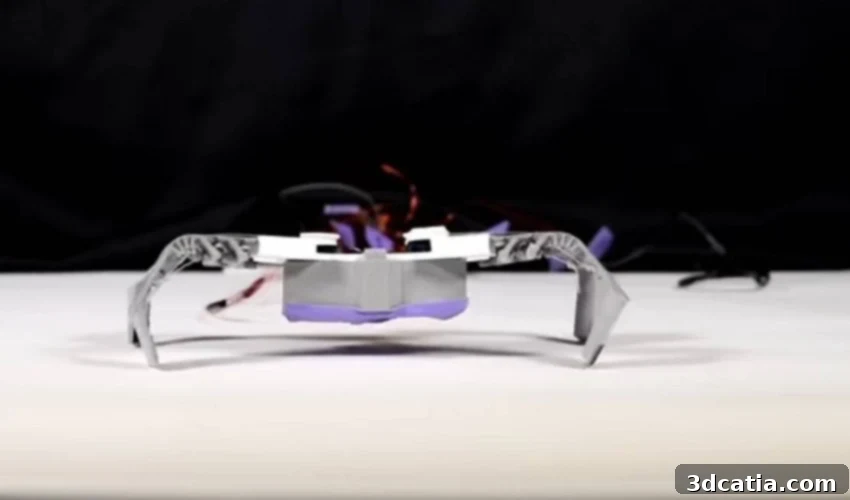
The convergence of additive manufacturing and robotics has long been a source of groundbreaking innovation, and it’s no secret why. 3D printing empowers designers with unparalleled freedom to integrate complex functionalities and intricate geometries into their creations, pushing the boundaries of what’s possible in automation and mechanical design. We’ve previously delved into exciting developments in this space, such as the ingenious 3D printed sweating robot muscle developed by researchers at Cornell University, showcasing the diverse applications of AM. This time, the spotlight turns to UC San Diego, where a team of visionary engineers has successfully designed and rigorously tested 3D printed insect-like soft robots, marking a significant leap forward in the field. Soft robotics, a fascinating subfield of robotics, focuses on constructing robots from highly compliant materials, mimicking the inherent flexibility and adaptability found in living organisms. By leveraging accessible FDM 3D printers and common filament materials like ABS, these researchers have engineered insect-inspired robots that are not only remarkably cheaper but also significantly more accessible for widespread adoption and research.
A Paradigm Shift in Soft Robot Design: The Flexoskeleton Approach
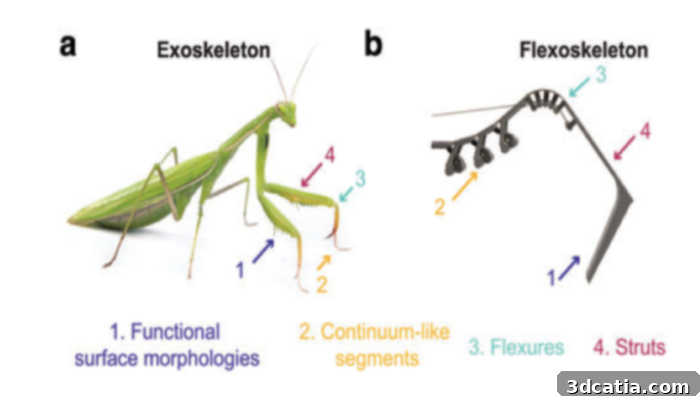
The ingenuity behind this innovation by engineers at the Jacobs School of Engineering at UC San Diego stems from a fundamental rethinking of how soft robots are conceptualized and built. Traditionally, the challenge in soft robotics often involved figuring out how to seamlessly integrate soft, flexible components into a predominantly rigid robot body to achieve compliance. However, the UC San Diego team inverted this approach. Instead of starting with a rigid framework, they began with a soft, pliable body and strategically incorporated rigid features into crucial components. This novel design philosophy, which they termed “flexoskeleton,” draws direct inspiration from the intricate and highly functional insect exoskeleton. Insect exoskeletons are marvels of natural engineering, characterized by areas of remarkable rigidity that provide structural support and protection, juxtaposed with sections that are perfectly flexible, allowing for intricate movement and articulation. By emulating this biological blueprint, the researchers have created robots that possess both the resilience of hard-bodied machines and the inherent adaptability and safety of soft robotic systems. This ‘soft-first’ approach allows for a design that is intrinsically compliant, reducing the need for complex joints or actuators often found in rigid robotics, and paving the way for more robust and forgiving robotic interactions.
Credits: Soft Robotics
Additive Manufacturing the Agile Flexoskeletons
The manufacturing process for these insect-like robots hinges on the widespread and cost-effective technique of Fused Deposition Modeling (FDM) 3D printing. In a typical FDM setup, a plastic filament, commonly ABS or PLA, is heated to its melting point and then precisely extruded through a nozzle onto a build plate, layer by layer, to form a three-dimensional object. The innovative flexoskeleton process, however, introduces a crucial enhancement to this standard method. Utilizing readily available FDM 3D printers, specifically mentioning models like the Prusa i3 MK3S and the LulzBot Taz 6, the researchers refined the deposition technique. Instead of printing on a cold bed, they deposit the filament directly onto a pre-heated thermoplastic base layer. This specialized approach is critical as it facilitates an exceptionally high bond strength between the newly deposited material and the flexible underlying base. This robust adhesion is paramount for the integrity and functionality of the flexoskeleton, ensuring that the rigid elements remain firmly attached to the soft body throughout the robot’s movement and operation, thereby yielding improved resistance to wear and tear and enhanced structural durability. The use of standard, off-the-shelf FDM printers and filaments underscores the accessibility and cost-effectiveness of this manufacturing technique, making it highly replicable for other research institutions and hobbyists alike.
Unprecedented Efficiency: Cost-Effectiveness and Rapid Prototyping
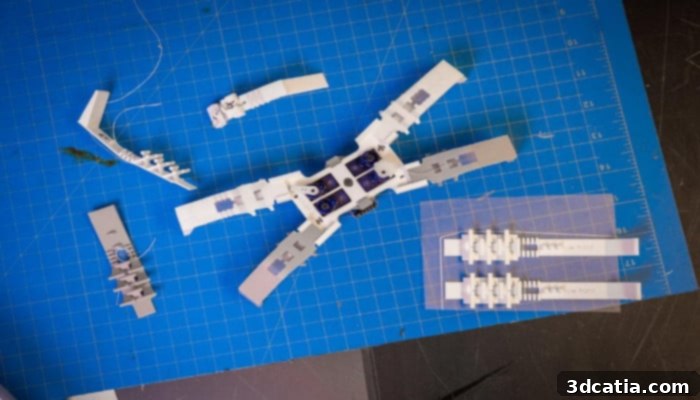
One of the most compelling aspects of this research is the astounding efficiency and affordability of the manufacturing process. According to the UC San Diego researchers, producing a single Flexoskeleton takes approximately 10 minutes from start to finish. This rapid turnaround time is almost unheard of in advanced robotics and significantly accelerates the design-test-iterate cycle. Furthermore, the material cost for each flexoskeleton component is incredibly low, requiring less than $1 in materials. This economic advantage is profound, as it drastically reduces the barriers to entry for experimentation and development in soft robotics. The entire process, from fabricating the individual flexoskeleton components to the final assembly of a fully functioning robot, takes less than three hours. This impressively fast and cheap methodology opens up exciting possibilities, particularly for creating rather large groups or “swarms” of flexoskeleton robots with minimal manual assembly. The ability to rapidly produce numerous units is vital for swarm robotics applications, where collective intelligence and redundancy are key. Imagine deploying a hundred of these robots, each performing a simple task, to achieve a complex objective far beyond the capabilities of a single, more expensive robot.
Beyond speed and cost, the modularity of these robots is another game-changer. The design allows for the assembly of a whole library of “Lego-like” parts, enabling easy interchangeability of components. This means that if a robot part is damaged or simply wears out, it can be quickly swapped out, minimizing downtime and extending the operational lifespan of the robots. This modularity also facilitates rapid customization, allowing researchers to quickly adapt robots for different tasks or environments by simply exchanging specific parts. During initial testing, the completed robot demonstrated impressive agility, reaching a speed of nearly 5 centimeters per second. This speed, while seemingly modest, is significant for small, soft-bodied robots and indicates their potential for navigating various terrains and performing mobility-centric tasks. Nick Gravish, a mechanical engineering professor at the Jacobs School of Engineering at UC San Diego and the overseer of this groundbreaking project, articulated the ambitious long-term vision: “The ultimate goal is to create an assembly line that prints whole flexoskeleton robots without any need for hand assembly. A swarm of these small robots could do as much work as one massive robot on its own-or more.” This vision highlights the transformative potential of automated, mass-producible soft robots for complex, large-scale operations.
Transformative Applications and the Future of Soft Robotics
The implications of this innovation extend far beyond the immediate research lab, promising significant advancements across multiple industries and applications. This budget-minded additive manufacturing technique is set to profoundly impact the landscape of soft robotics by not only dramatically lowering the cost of entry for development and deployment but also by unlocking entirely new applications for the technology in environments previously deemed too dangerous or inaccessible for human operators or traditional rigid robots. Consider the potential for deployment in hazardous conditions: these robust, adaptable, and cost-effective soft robots could be invaluable for navigating disaster zones, performing intricate search and rescue missions in collapsed structures, or exploring volatile war zones without risking human lives. Their compliant nature makes them inherently safer for interaction with fragile environments or even humans, contrasting sharply with the potential hazards posed by rigid robots.
Beyond emergency response, the applications are vast and varied. In scientific exploration, swarms of these insect-like robots could be deployed for environmental monitoring in ecologically sensitive areas, exploring subterranean caves, or even assisting in extraterrestrial missions where rugged, self-repairing, and adaptable systems are crucial. Their ability to conform to irregular surfaces and navigate tight spaces makes them ideal for industrial inspection tasks, reaching areas inaccessible to larger machinery. The medical field could also benefit immensely, with prospects for minimally invasive surgical tools that can gently manipulate tissues or rehabilitation devices that offer compliant support. Furthermore, the low cost makes this technology particularly appealing for educational purposes, allowing students and hobbyists to engage with advanced robotics without significant financial investment, fostering the next generation of innovators. As materials science continues to evolve, the integration of even more advanced flexible and smart materials with this flexoskeleton printing method promises to unlock even greater functionalities, leading to robots with enhanced sensing capabilities, more sophisticated locomotion, and even rudimentary forms of self-healing. The UC San Diego team’s work represents a pivotal step towards a future where intelligent, adaptable, and affordable soft robots become an integral part of our technological landscape, addressing complex challenges in unprecedented ways.
What are your thoughts on these groundbreaking insect-like soft robots and their potential impact? We’d love to hear from you! Share your insights in a comment below or join the conversation on our Facebook and Twitter pages! Don’t miss out on the latest advancements in 3D printing; sign up for our free weekly Newsletter to get all the news delivered straight to your inbox!