
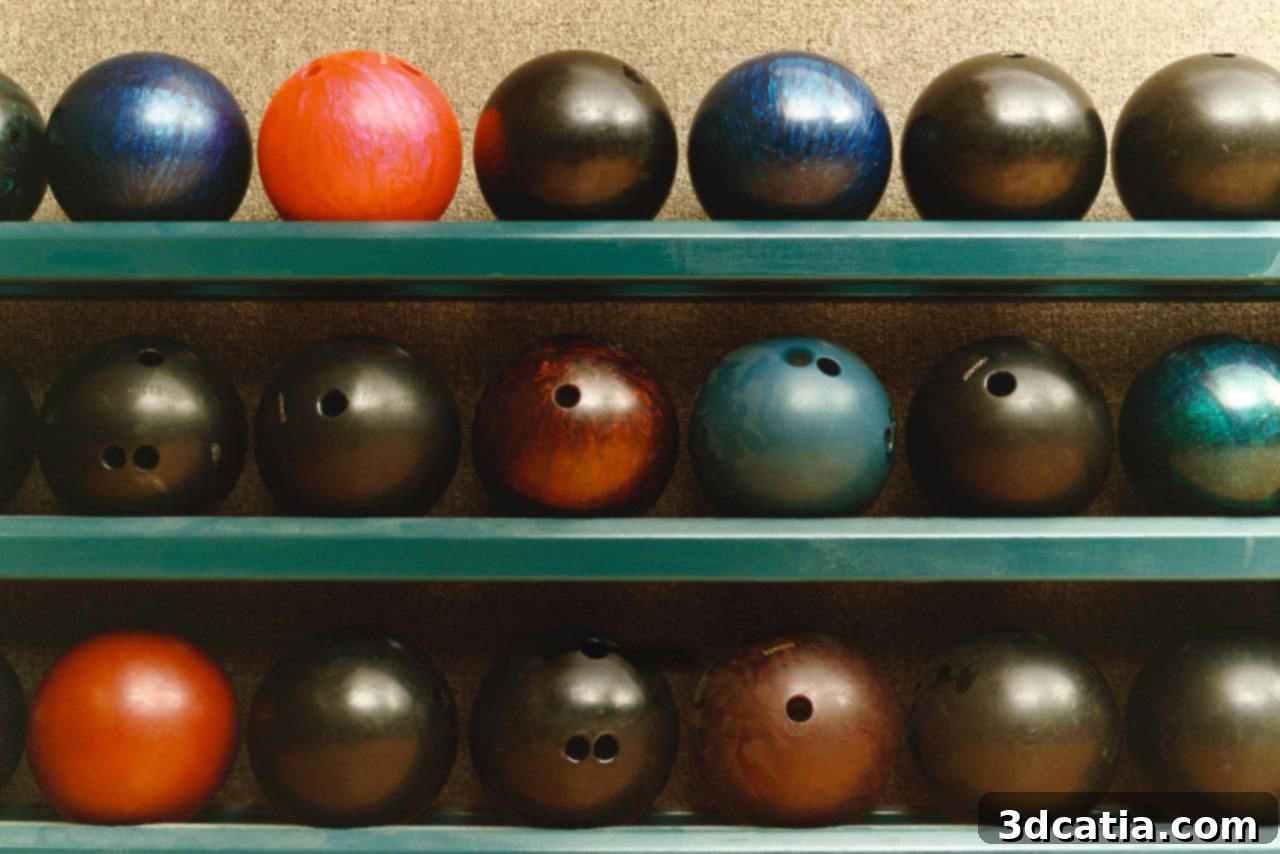
Freshmade 3D Revolutionizes Industrial Manufacturing with AMClad: The Power Behind 3D-Printed Bowling Balls
In a significant leap forward for additive manufacturing, Ohio-based startup Freshmade 3D has proudly announced the development of AMClad, a groundbreaking material with unprecedented strength, capable of producing functional 3D-printed bowling balls. This innovative substance, an “isotropic Engineered Sand Composite (ESC),” is poised to transform industrial manufacturing by enabling the creation of large, robust, and highly functional objects through 3D printing, challenging traditional production methods and expanding the horizons of material science.
Introducing AMClad: A New Era for Functional 3D Printing Materials
The advent of AMClad marks a pivotal moment in the evolution of 3D printing. While additive manufacturing has long been celebrated for its prototyping capabilities and ability to produce intricate designs, the industry has consistently sought materials strong enough to withstand real-world stress and demanding industrial applications. Freshmade 3D’s AMClad directly addresses this need. Described as an “isotropic Engineered Sand Composite,” this material offers uniform strength in all directions, a critical property for parts that will undergo varying loads and stresses in their operational environment. This characteristic sets AMClad apart from many other 3D printing materials, which often exhibit anisotropic properties, meaning their strength varies depending on the print orientation.
The isotropic nature of AMClad ensures that objects printed with it possess consistent mechanical properties regardless of their geometry or the direction of applied force. This is particularly vital for large, functional parts where structural integrity is paramount. Freshmade 3D asserts that AMClad is “ideal for 3D printing large, functional, and strong objects,” signaling its potential to move 3D printing beyond mere prototyping into the realm of end-use industrial components and tooling, where durability and reliability are non-negotiable.
The Unlikely Test: Proving Strength with 3D-Printed Bowling Balls
The choice of bowling balls as a demonstration of AMClad’s strength might seem unconventional, yet it’s brilliantly effective. For many, bowling balls are synonymous with durability and a flawless, high-gloss finish. Recreational players often cherish their bowling balls, which become prized possessions due to their weight, perfect spherical shape, and the smooth, hard surface that allows them to glide effortlessly down the lane. The idea of 3D printing such an object immediately raises questions about feasibility and performance.
When initially contemplating 3D-printed bowling balls, several challenges come to mind. First, achieving the level of surface finish that is characteristic of traditional bowling balls—a smooth, shiny, and perfectly spherical exterior—with additive manufacturing techniques seemed incredibly difficult. Furthermore, the inherent weight and density requirements for a bowling ball, coupled with the need for precise balance, present significant hurdles. Most importantly, bowling balls must withstand considerable force; they are repeatedly slammed against pins and rolled down a lane, enduring high-impact collisions and abrasive friction. The material needs to be exceptionally resilient, capable of absorbing impact without cracking or deforming, even when subjected to less-than-perfect throws.
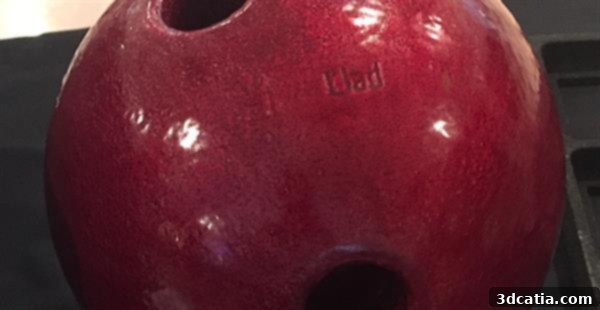
Bowling ball made from AMClad material, showcasing its robustness.
Freshmade 3D, however, asserts that AMClad has successfully met these demanding requirements. They specifically utilized bowling balls as a tangible example to underscore the extraordinary strength and resilience of their new Engineered Sand Composite. Rich Wetzel, a key figure at Freshmade 3D, highlighted AMClad’s impressive mechanical properties, stating, “compared to nylon, which is a commonly used 3D printing material which is common in the tooling industry, it’s right up there with that. It can withstand high tensile strengths and it has a good compression strength.” This comparison is significant, as nylon is already a well-regarded and widely adopted material in various industrial applications for its balance of strength and flexibility.
AMClad’s Mechanical Prowess: Tensile and Compression Strength Explained
The terms “tensile strength” and “compression strength” are crucial indicators of a material’s durability. Tensile strength refers to the maximum stress a material can withstand while being stretched or pulled before breaking. High tensile strength is vital for objects that need to resist being pulled apart, like structural components or parts under tension. Compression strength, on the other hand, measures a material’s ability to withstand forces that try to squeeze or crush it. For a bowling ball, high compression strength is essential to endure the repeated impacts with pins and the surface of the lane without deforming or cracking. Wetzel’s statement confirms that AMClad excels in both these critical areas, positioning it as a highly reliable material for applications requiring extreme durability.
The ability to 3D print a bowling ball that not only performs functionally but also replicates the smooth finish and structural integrity of its traditionally manufactured counterparts is a testament to AMClad’s advanced formulation. It showcases that Freshmade 3D has engineered a material that can endure significant dynamic loads and stresses, making it suitable for a broad spectrum of high-performance applications beyond just recreational sports equipment. This demonstration serves as a powerful proof of concept for the material’s viability in rigorous industrial environments.
Beyond Recreation: AMClad’s Transformative Potential in Manufacturing
While the 3D-printed bowling ball serves as an impressive and memorable promotional tool, highlighting the material’s unparalleled strength, it is crucial to understand that Freshmade 3D’s primary vision for AMClad extends far beyond novelty items. The true impetus behind its development lies in addressing critical needs within the manufacturing sector. Freshmade 3D envisions AMClad playing an extensive role in industrial applications, particularly in the creation of robust and precise tooling and manufacturing aids. This is where the material is expected to make its most significant impact, offering a versatile and cost-effective solution for numerous production challenges.

AMClad material, demonstrating its capability for detailed and robust creations beyond industrial tools.
Brett Conner, another influential voice from Freshmade 3D, elaborated on this industrial potential, outlining a range of applications that AMClad is perfectly suited for. These include complex tools for processes like “vacuum forming, blow molding…and even composite layout tools and more simple applications like fixtures, jigs, and various manufacturing aids.” Each of these applications represents a significant area where traditional manufacturing methods can be slow, expensive, and restrictive.
Key Industrial Applications of AMClad:
- Vacuum Forming Tools: These tools are essential for shaping heated plastic sheets into desired forms. AMClad’s high strength, temperature resistance (as indicated by its Peak Tg), and dimensional accuracy make it an ideal material for producing durable molds that can withstand the heat and pressure of vacuum forming cycles, leading to faster prototyping and production of custom parts.
- Blow Molding Tools: Similar to vacuum forming, blow molding involves shaping plastic, typically for hollow objects like bottles or containers. The pressures involved require extremely robust and precise molds. AMClad’s high compression strength ensures these tools maintain their integrity and accuracy over repeated cycles, reducing wear and tear and extending tool life.
- Composite Layout Tools: In industries such as aerospace and automotive, where lightweight yet strong composite materials are crucial, precise layout tools are indispensable. AMClad can create highly accurate tools for positioning and shaping composite plies, contributing to the fabrication of complex components with tight tolerances. This is particularly valuable for accelerating development cycles and reducing costs associated with traditional tooling.
- Fixtures and Jigs: These are fundamental components in assembly and manufacturing processes, used to hold workpieces securely and guide tools for consistent and accurate operations. The ability to 3D print custom fixtures and jigs with AMClad means manufacturers can rapidly produce bespoke tools tailored to specific production lines or product designs. This agility can significantly improve efficiency, reduce setup times, and enhance product quality, especially for low-volume or highly customized production runs.
- Various Manufacturing Aids: Beyond these specific examples, AMClad’s versatility suggests a multitude of other uses, from custom prototypes for large-scale components to specialized ergonomic tools that enhance worker efficiency and safety. Its ability to create strong, large, and intricate objects on demand opens doors for innovation across countless manufacturing workflows.
Technical Specifications and the Path to Commercialization
The impressive capabilities of AMClad are underpinned by its robust technical specifications. Freshmade 3D has provided precise metrics that highlight the material’s engineering prowess: a tensile strength of 5,071 psi, compression of 19,500 psi, flexural strength of 9,260 psi, a peak glass transition temperature (Tg) of 103°C, and an accuracy of +/- 0.1mm. These numbers are not merely theoretical; they translate directly into practical benefits for industrial applications.
- Tensile Strength (5,071 psi): This indicates the material’s resistance to being pulled apart. For comparison, many commonly used plastics have tensile strengths in the range of 3,000-7,000 psi, placing AMClad squarely in the robust category, suitable for components that endure stretching forces.
- Compression Strength (19,500 psi): This exceptionally high value signifies AMClad’s remarkable ability to withstand crushing forces. This is paramount for tooling that faces immense pressure during operations, ensuring longevity and consistent performance under stress.
- Flexural Strength (9,260 psi): Measuring resistance to bending before fracturing, a high flexural strength is crucial for tools and parts that may experience bending loads, maintaining their shape and structural integrity even under significant deformation attempts.
- Peak Tg (103°C): The glass transition temperature indicates the point at which a polymer transitions from a hard, glassy material to a softer, rubbery state. A Tg of 103°C means AMClad maintains its structural integrity and mechanical properties at temperatures well above typical room temperature, making it suitable for applications that involve moderate heat, such as those encountered in some molding processes.
- Accuracy (+/- 0.1mm): This level of precision is critical for manufacturing aids and tooling, where tight tolerances are often required to ensure the quality and fit of final products. It underscores AMClad’s suitability for demanding industrial environments where dimensional consistency is non-negotiable.
Freshmade 3D is currently awaiting confirmation on the patent for AMClad, a crucial step that will secure their intellectual property and allow them to fully commercialize and profit from their innovation. While the material is not yet available for sale to the public, and no guide price has been released, the company’s progress and the detailed specifications suggest that AMClad is well on its way to becoming a significant player in the advanced materials market. Interested parties can find more in-depth details and updates directly on Freshmade 3D’s official website.
The Broader Impact of Advanced 3D Printing Materials Like AMClad
The emergence of materials like AMClad represents a broader trend in additive manufacturing: the shift from rapid prototyping to the direct production of functional, end-use components and industrial tooling. For years, the primary limitation of 3D printing in many industrial contexts was the lack of materials that could match the strength, durability, and performance of traditionally manufactured metals or robust plastics. AMClad, with its isotropic properties and impressive mechanical strengths, is helping to bridge this gap.
This evolution in material science is set to have profound implications for global manufacturing. It facilitates faster innovation cycles, as designers and engineers can quickly iterate and test functional prototypes made from production-grade materials. It also enables the creation of highly customized tools and parts on demand, reducing lead times and potentially optimizing supply chains. Industries from aerospace and automotive to consumer goods and medical devices stand to benefit immensely from the increased availability of high-performance 3D printable materials. The ability to produce strong, reliable, and precise components without the need for extensive traditional tooling opens new avenues for design freedom, material optimization, and cost efficiency, fostering a more agile and responsive manufacturing ecosystem.
Conclusion: Freshmade 3D and the Future of Industrial Additive Manufacturing
Freshmade 3D’s AMClad material is more than just a novelty that can create 3D-printed bowling balls; it is a testament to the ongoing innovation within the additive manufacturing industry. By developing an isotropic Engineered Sand Composite with superior tensile, compression, and flexural strengths, Freshmade 3D is pushing the boundaries of what is possible with 3D printing. The material’s potential to revolutionize the manufacturing sector by offering durable, precise, and customizable solutions for tooling, fixtures, and other industrial aids is immense.
As Freshmade 3D moves closer to patent confirmation and commercial availability, AMClad promises to be a game-changer for businesses seeking to enhance efficiency, reduce costs, and unlock new design possibilities in their production processes. The era of high-performance, functional 3D-printed parts is rapidly expanding, and AMClad is poised to lead the charge. What are your thoughts on these revolutionary 3D-printed materials and their potential applications? We invite you to share your insights in a comment below or join the discussion on our Facebook and Twitter pages! Don’t forget to sign up for our free weekly Newsletter to receive all the latest news and advancements in 3D printing delivered straight to your inbox!